

NCERT Solutions for Class 8 Social Science Part 1 Chapter 6 The Parliamentary System: Legislature and Executive are provided here with simple and easy-to-understand explanations. Based on the NCERT textbook Exploring Society: India and Beyond Part 1, this chapter introduces the roles of Parliament and the executive and the relationship between law-making and government. These NCERT Solutions for Class 8 help students understand important concepts, complete textbook activities, and revise the chapter for school examinations.
The Parliamentary System: Legislature and Executive Class 8 Questions and Answers
The Big Questions (Page No. 139)
1: What is India’s parliamentary system, and how is it structured?
Answer: India follows a parliamentary system of government where the people elect their representatives, and these representatives run the government on behalf of the people. The Indian Parliament has a bicameral structure, which means it has two houses. One is Lok Sabha another one is Rajya Sabha. In Lok Sabha members are directly elected by the people whereas in Rajya Sabha members are elected indirectly by the states.
So, India’s parliamentary system is a bicameral, representative, democratic system where Prime Minister and Council of Ministers is responsible to the Lok Sabha, and the Parliament represents the will of the people.
2: What are the key functions of the Parliament?
Answer: The Parliament performs several important functions:
- It elects the President and the Vice President.
- It can amend the Constitution whenever necessary.
- It protects core values like democracy, federalism, fundamental rights, and separation of powers.
- It makes laws for the entire country.
- It keeps a check on the Executive (the government) through questions and discussions.
- It examines the annual Budget and controls taxation and government spending.
- It also approves and monitors how the government uses public money.
3: What are the roles of the legislature and the executive in India’s Parliamentary democracy?
Answer: Role of the Legislature (Parliament)
- It makes laws for the country.
- It checks and questions the Executive through tools like Question Hour.
- It approves the Budget and controls government spending.
- It represents the people and debates important national issues.
Role of the Executive (Prime Minister and Council of Ministers)
- It implements and enforces laws made by the Legislature.
- It runs the day-to-day administration of the country.
- It takes policy decisions for governance.
- It is answerable to the Lok Sabha, which means it must explain and justify its actions.
4: How are the legislature and the executive organised at the union and state levels?
Answer: India has a federal system, where both the Union and the States have their own legislature and executive.
At the Union level, the legislature is bicameral, consisting of the Lok Sabha and the Rajya Sabha, along with the President. The Executive includes the President as the Head of State, and the Prime Minister with the Council of Ministers who run the government.
At the State level, the Legislature may be unicameral (Vidhan Sabha) or bicameral (Vidhan Sabha and Vidhan Parishad). The Executive includes the Governor, Chief Minister, and the Council of Ministers.
Let’s Explore (Page No. 151)
Question: Why do you think that Parliament keeps an eye on government expenditure?
Answer: Parliament keeps an eye on government expenditure because the money spent by the government is public money. Since this money comes from citizens through taxes, Parliament must ensure it is used properly, honestly, and for the benefit of the people. By checking expenditure, Parliament prevents waste, misuse, and corruption.
Don’t Miss Out (page no 151)
Question: Part V of the Indian Constitution begins with Chapter I – The Executive. It looks at the roles and responsibilities of the President, Vice President, and Council of Ministers, among others. It is in Chapter II that the role and functions of Parliament are listed. Why might this be so?
Answer: The Constitution begins with the Executive because the Executive is responsible for running the country and implementing laws. While Parliament makes the laws, the President, Prime Minister, and Council of Ministers ensure these laws are carried out. This order shows that both law-making and law-implementation are important, and the government works properly only when the Executive and Parliament function together.
Let’s Explore (Page No. 152)
Q: If the Executive is part of the Legislature, how do we say that there is separation of power?
Answer: Even though the Executive (Prime Minister and Council of Ministers) comes from the Legislature, there is still separation of power. The Legislature makes laws and checks the Executive, while the Executive implements those laws and runs the government. The Legislature can question the Executive through Question Hour, debates, and committees. It ensures that the Executive cannot misuse its power. This system of checks and balances maintains separation of power and prevents any branch from becoming too strong.
Let’s Explore (Page No. 154-155)
Q: What might happen if one of the organs Legislature, Executive, Judiciary had all the power?
Answer: If any one organ—Legislature, Executive, or Judiciary—had all the power, it would lead to misuse of authority. This could result in loss of citizens’ rights, dictatorship, and an undemocratic government.
Q. How could it affect the rights of people?
Answer: If one organ had all the power, people’s rights could be easily violated. Unfair laws could be made, government actions could go unchecked, and there would be no independent court to protect citizens. This could lead to loss of freedom, discrimination, and misuse of authority, harming the basic rights guaranteed by the Constitution.
Q. Discuss with your classmates how each organ checks the others. For example, how does the Legislature question the actions of the Executive?
Answer: In a democracy, the Legislature, Executive, and Judiciary keep a check on each other so that no organ becomes too powerful.
- The Legislature checks the Executive through Question Hour, debates, and committees.
- The Executive checks the Legislature by implementing only those laws that follow the Constitution.
- The Judiciary checks both the Legislature and the Executive by reviewing laws and government actions.
Q. How does the Judiciary make sure that laws and government actions respect the Constitution?
Answer: The Judiciary makes sure that laws and government actions respect the Constitution through judicial review. If anything violates Fundamental Rights or goes against Constitutional principles, the Judiciary can cancel that law or stop that action.
Q. Do you think there might be ways in which the actions of the Judiciary itself are reviewed?
Answer: Yes, the actions of the Judiciary can also be reviewed. Although the Judiciary is independent, it is not above the Constitution. Its actions are checked in the following ways:
- Higher courts review lower courts’ decisions through appeals.
- The Supreme Court can review its own judgment if there is a mistake.
- Judges must follow the Constitution, and if they violate judicial ethics, they can be removed through impeachment by Parliament.
Q. Can you find examples where the Judiciary has asked lawmakers to review a law?
Answer: The Judiciary often points out issues with laws and suggests changes. Some examples include:
- Motor Vehicles Act, 1988: In 2024, the Supreme Court clarified the rules on licenses for Light Motor Vehicles and asked the Government to amend the law to remove confusion.
- Uniform Civil Code (UCC): The Supreme Court suggested a common set of civil laws for all religions would support equality and reduce discrimination.
- Aadhaar Act (privacy issues): The Supreme Court asked the government to review parts of the Aadhaar law that affected people’s privacy and limited its use only to essential welfare schemes.
- Farm Laws (2020): The Supreme Court suspended the farm laws and suggested that the government reconsider them after hearing farmers’ concerns.
Q. Can you find any instances when the implementation of a law has been questioned by the Judiciary?
Answer: Yes, the Judiciary has questioned the government many times for not properly implementing laws. Some examples are:
- RTI Act (2013): The Supreme Court asked the government to ensure proper implementation because many departments were delaying information.
- MNREGA (2016): The Court told the government to make sure rural workers received their wages on time.
- Environmental Laws (2005): The Court ordered strict action to reduce pollution in the Ganga and Yamuna by enforcing existing environmental laws.
- Forest Conservation Act (1997): The Supreme Court stopped deforestation and directed proper enforcement of forest protection laws.
Let’s Explore (Page No. 158)
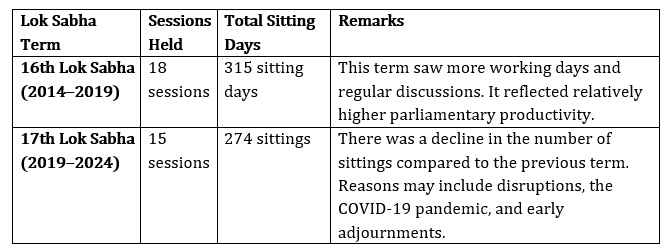
Q: Study the data given in the following table. What conclusions can you draw about the functioning of Parliament over time? Compile data for more recent years.
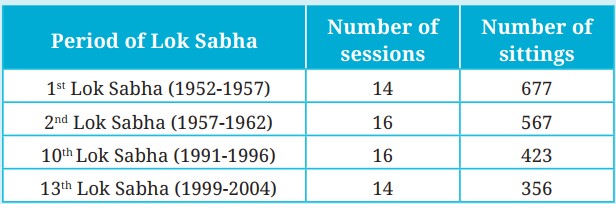
Answer: The data shows a steady decline in the number of Lok Sabha sittings over time. While the number of sessions has remained fairly consistent, the 1st Lok Sabha had 677 sittings, which dropped to 567 in the 2nd, 423 in the 10th, and just 356 in the 13th. This suggests that Parliament now spends less time on debates and discussions than in earlier years, which may affect the quality of legislative work.
Read the following statement of the former chairman of the Rajya Sabha, M. Venkaiah Naidu given in 2021: “…the productivity of Rajya Sabha during 200414 has been about 78% and it declined to about 65% since then. Of the 11 sessions [that he presided over], four of them clocked low productivity of 6.80%, 27.30%, 28.90% and 29.55%; during the year 2018, the Rajya Sabha recorded the lowest ever productivity of35.75% under the impact of disruptions.” (Page 158)
Question: What conclusions can you draw from this statement?
Answer: The statement by M. Venkaiah Naidu shows that the productivity of the Rajya Sabha has significantly declined over time. While it worked efficiently between 2004–2014 with about 78% productivity, it later dropped to around 65%, and some sessions even fell below 30%. In 2018, productivity reached its lowest point at 35.75% because of frequent disruptions. This decline shows that the Rajya Sabha is often unable to discuss and pass laws properly, which reduces its effectiveness and weakens public trust in Parliament.
Question: What implications does this have for the role that the Rajya Sabha is expected to play?
Answer: Low productivity means the Rajya Sabha cannot perform its key duties effectively. When sessions are disrupted, the House gets less time to debate bills, review government actions, and represent the states’ interests. This weakens its role as a body meant to carefully examine and improve laws passed by the Lok Sabha. Overall, poor productivity reduces the effectiveness of Parliament and affects the quality of decision-making in the country.
Don’t Miss Out (Page No. 160)
Atal Bihari Vajpayee, a former Prime Minister of India, said during a speech in the Lok Sabha, “Sarkaarein aayengi, jaayengi. Paartiyaan banengi, bigadengi. Lekin yeh desh rehna chaahiye, is desh ka loktantra amar rehna chaahiye.”
(Governments will come and go, parties will rise and fall. But the nation must endure, and its democracy must live on.)
Q. What message do you think this gives about the role of Parliament and leaders in a democracy?
Answer: This message highlights that democracy is more important than any government or political party. Governments may change and parties may rise or fall, but the country and its democratic values must always remain strong.
It shows that responsible leadership, healthy debate, and respect for democracy are more important than party politics. Protecting democracy should always come before personal or party interests.
Q. Why is it important to protect democratic values even when political power changes?
Answer: It is important to protect democratic values even when political power changes because democracy belongs to the people, not to any one party or leader. Governments may change, but rights like freedom, equality, justice, and rule of law must always remain safe.
If democratic values are protected, the country remains stable, fair, and accountable, no matter who is in power. This ensures that leaders respect the Constitution and work for the welfare of the people.
Questions and Activities – Exercises (Page No. 161)
1: Find out how many representatives from your state are in each House of the Parliament.
Answer: Do it yourself according to your home state.
2: What makes the Indian Parliament the “voice of the people”? How does it ensure that different opinions are heard?
Answer: The Indian Parliament is called the “voice of the people” because its members are directly or indirectly elected by the people. They represent citizens from every state, region, language, and community of India.
Parliament ensures different opinions are heard by allowing debates, discussions, Question Hour, and participation from members of different political parties. Both the Lok Sabha and Rajya Sabha include people from various regions, backgrounds, and ideologies, which helps in presenting diverse viewpoints.
3: Why do you think the Constitution made the Executive responsible to the Legislature?
Answer: The Constitution made the Executive (Prime Minister, ministers, and officials) responsible to the Legislature (Parliament) so that the government remains accountable to the people. This system prevents the misuse of power and ensures that leaders work within their limits. Since the Legislature represents the people, the Executive must answer to it, explain its actions, and justify its decisions. This ensures that the government works transparently, follows the law, and serve the people’s interest.
4: Why do you think we have chosen the system of bicameral legislature at the Union level?
Answer: India chose a bicameral legislature at the Union level to ensure better representation and careful law-making. The Lok Sabha represents the people directly, while the Rajya Sabha represents the states and protects their interests. Having two houses allows more detailed discussion, prevents hasty laws, and maintains the federal balance between the Centre and the states. Thus, a bicameral system strengthens democracy and improves the quality of laws.
5: Try to track the journey of a recent bill passed by the Parliament. Identify in which House it was introduced. Were there any major debates or disagreements? How long did it take for the bill to become a law? Use newspaper archives, government websites, and Lok Sabha debates, or ask your teacher for help.
Answer: The Women’s Reservation Bill, which reserves 33% seats for women in the Lok Sabha and State Assemblies, had a very long journey. It was first introduced in 1996, but it faced many delays for several years. The Bill was finally reintroduced in the Lok Sabha on 19 September 2023 and passed on 21 September 2023 with 454 votes in favour. The Rajya Sabha also passed it on the same day. The Bill then received the President’s assent on 28 September 2023, and became the Constitution (106th Amendment) Act, 2023. It took 27 years for this Bill to become a law, showing the long struggle and determination required to ensure greater political representation for women in India.
6: Choose a recent law passed by the Parliament. Divide into teams to role-play different parts of the process — MPs debating in Lok Sabha and Rajya Sabha, ministers answering questions, and the President giving assent. Present a short skit showing how a bill becomes a law; enact a ‘model Parliament’.
Answer: Do it yourself.
7: The Women’s Reservation Bill, 2023, was passed with wide support. Why might it have taken over 25 years for this bill to be passed, despite being discussed for so long?
Answer: The Women’s Reservation Bill took more than 25 years to be passed because there was no full agreement among political parties on how the reservation should be given. Some demanded sub-reservation for women from OBCs (Other Backward Classes) within the 33% quota, while others opposed this.There were also political changes, lack of consensus, and repeated disruptions in Parliament, which delayed the Bill several times. Even though the idea had strong support, these differences and political issues made it difficult to pass the Bill quickly.
8: Sometimes the Parliament is disrupted and does not function for the number of days it is supposed to. What impact do you think this has on the quality of laws and the trust people place in their representatives?
Answer: When Parliament is disrupted and cannot function properly, important debates and discussions get reduced. Many bills may be passed without enough examination, which can lower the quality of laws. Disruptions also make people feel that their representatives are not doing their duty, which reduces public trust. This weakens the role of Parliament and slows down the country’s progress.
9: Can you create ‘interest’ groups among students and list questions related to any policy that you may want to ask your MP and/or your MLA? How would these questions be different if it were the MP instead of the MLA, and vice versa?
Answer: Do it yourself.
10: What is the role that the Judiciary plays in Indian democracy? What could happen if we didn’t have an independent judiciary?
Answer: The Judiciary interprets the laws, settles disputes, and makes sure that both the Legislature and the Executive follow the Constitution. It protects Fundamental Rights and acts as the custodian of the Constitution.
If the Judiciary were not independent, the government might misuse its power, and people’s rights could be violated. There would be no fair body to check wrong laws or actions. This could lead to injustice, loss of freedoms, and a threat to democracy.
Class 8 Social Science Exploring Society Chapter 6 Questions and Answers
The chapter The Parliamentary System: Legislature and Executive introduces the institutions through which representative government functions. Students learn about the legislature’s role in making laws and the executive’s responsibility for implementing decisions and administering public affairs.
Students also explore how the government is accountable to elected representatives. The chapter connects parliamentary discussions, questions, and decision-making with the broader principles of democratic participation and responsible governance.