

NCERT Solutions for Class 8 English Poorvi Chapter 13 Feathered Friend are provided here with simple and easy-to-understand explanations. This science-fiction story is a part of Unit 5: Science and Curiosity in the NCERT textbook Poorvi. It explores a canary aboard a space station and the unexpected value of careful observation. These NCERT Solutions for Class 8 help students understand the main ideas, complete textbook activities, improve their language skills, and prepare for school examinations.
Feathered Friend Class 8 English Questions and Answers
Let us do these activities before we read (Page no. 205)
I. Work in pairs and discuss the questions given below. Share your answers with your classmates and teacher.
1. Who can a ‘feathered’ friend be?
Answer: A ‘feathered’ friend refers to a bird.
2. Which ‘feathered’ friend do you like? Why?
Answer: I like the peacock because it is colourful and beautiful
3. If you have a choice between a ‘feathered’ and a ‘furry’ friend, who would you choose? Why?
Answer: I would choose a furry friend, such as a dog, because dogs are loyal, friendly, and emotionally attached to humans.
4. Do you think a ‘feathered’ or a ‘furry’ friend can accompany astronauts to space? If yes, why? If no, why not?
Answer: Yes, a feathered friend can accompany astronauts to space because birds like canaries adapt well to zero gravity, need little food, and can act as early warning signs of air problems.
But I think a furry friend cannot accompany astronauts to space. Furry animals generally need more food, space, and constant care.
II. Complete the words given below by inserting vowels. Refer to their meanings given alongside. Share your answers with your classmates and teacher.
1. official rule that controls how something is done: R_G_L_T N
2. to not allow something: F _ R B _ D
3. join or blend to form a single entity: F _ S _
4. suddenly: _BR_PTLY
5. admit one’s mistake: C _ N F _ S S
6. a person who advises what to eat to keep healthy: D T _ T N
Answer:
1. REGULATION
2. FORBID
3. FUSE
4. ABRUPTLY
5. CONFESS
6. DIETITIAN
Let us discuss (Page no. 209)
I. Answer the following questions briefly.
1. Why did the narrator think Sven had sneaked a bird aboard? What was Sven’s scientific reason?
Answer: The narrator realized a bird was aboard when he heard a melodic whistle in his office that wasn’t an official announcement. Later, Sven admitted that he had smuggled the canary Claribel out of scientific curiosity. He wanted to observe how a bird would behave and fly in zero gravity.
2. How did Claribel adjust to the new surroundings?
Answer: Claribel adjusted very well to the new surroundings of the space station. She quickly learned how to float in zero gravity without flapping her wings. She moved smoothly, performed loops in the air, and avoided unnecessary effort. She grew fat because she wasn’t making effort to fly anymore.
3. What made the narrator mistake the musical whistle for a sound from the intercom?
Answer: The narrator was working in his office when he heard a musical whistle. In a space station, such sounds usually come from communication systems. Since he never expected a bird onboard, he naturally assumed the sound was from the station intercom.
4. Do you think the presence of the canary would lead the spacers into trouble? If yes, why? If no, why not?
Answer: No, the presence of the canary did not lead the spacers into trouble. In fact, the canary became a lifesaver. When the air purifier failed and alarms did not work, the canary fainted first, alerting the crew to danger. Her presence helped the spacers detect the problem in time and saved their lives.
Let us discuss (Page No. 211-213)
I. Identify whether the following statements from parts I and II are true or false. Share your answers with your classmates and teacher.
1. The alarm at the space station failed to work properly because they were not connected.
Answer: True.
2. Claribel was brought to the space station for an official experiment on animal behaviour in space.
Answer: False.
3. The canary’s suffering helped the crew discover a problem with the air purifier.
Answer: True.
4. The air purifier froze because there was a rare eclipse.
Answer: True.
5. Claribel could fly gracefully in the space station, performing loops in the air.
Answer: True.
6. The space station crew was uninterested in Claribel and hardly noticed her presence after she was discovered.
Answer: False.
7. Claribel had fainted and had to be revived with oxygen supply.
Answer: True.
Let us think and reflect (Page no. 212-213)
I. Read the given extracts and answer the questions that follow.
1. Sven was one of our best construction men, and excelled at the tricky and specialised work of collecting assorted girders as they floated around in free fall, making them do the slow-motion, three-dimensional ballet that would get them into their right positions, and fusing the pieces together when they were precisely dovetailed into the intended pattern: it was a skilled and difficult job, for a space suit is not the most convenient of garbs in which to work.
(i) What can be inferred about Sven’s abilities from his job description?
A. He is good at following instructions but lacks creativity.
B. He possesses a strong understanding of working in space.
C. He struggles with the complexities of construction in space.
D. He prefers working on simpler tasks rather than complex jobs.
Answer: B. He possesses a strong understanding of working in space.
(ii) How can we conclude that Sven was working in zero gravity?
Answer: We can conclude that Sven was working in zero gravity because the heavy metal girders were floating around in free fall instead of resting on the ground. The absence of gravity is also clear when the narrator mentions that Sven and his team could step back and admire their work without gravity separating them from it.
(iii) Select the option that is correct for both (Assertion) A and (Reason) R.
(A): Sven’s job required him to make girders perform a ‘three-dimensional ballet’ in space.
(R): Working in zero gravity allows objects to float, making precise positioning more challenging.
A. Both (A) and (R) are true, and (R) is the correct explanation of (A).
B. Both (A) and (R) are true, but (R) is not the correct explanation of (A).
C. (A) is true, but (R) is false.
D. (A) is false, but (R) is true.
Answer: A. Both (A) and (R) are true, and (R) is the correct explanation of (A).
Explanation: Both the Assertion and Reason are true. In zero gravity, girders float freely, so Sven had to guide them carefully like a three-dimensional ballet, making precise positioning difficult. Hence, R correctly explains A.
(iv) Replace the underlined word with a word similar in meaning from the extract.
During the festival, people wore colourful outfits that represented their culture.
Answer: During the festival, people wore colourful garbs that represented their culture.
2. “Jim!” There’s something wrong with the air! That’s why Claribel’s passed out. I’ve just remembered that miners used to carry canaries down to warn them of gas.”
“Nonsense!” said Jim. “The alarms would have gone off. We’ve got duplicate circuits, operating independently.”
“Er—the second alarm circuit isn’t connected up yet,” his assistant reminded him. That shook Jim; he left without a word, while we stood arguing and passing the oxygen bottle around like a pipe of peace.
(i) Fill in the blank by selecting the correct option from those given in the brackets.
The narrator references canaries and miners in order to __________.
(highlight the historical use of canaries as warning systems/explain the reason that caused Claribel to faint suddenly)
Answer: The narrator references canaries and miners in order to explain highlight the historical use of canaries as warning systems.
(ii) Complete the following sentence with a suitable reason.
Jim initially dismisses the warning about the air because __________.
Answer: Jim initially dismisses the warning about the air because he believes that the alarms would have warned them if anything was wrong.
(iii) What does the phrase ‘shook Jim’ mean in the context of the information in the extract?
Jim was _________.
A. physically pushed by someone
B. startled by unexpected information
C. cold and needed to warm up
D. trying to shake off sleepiness
Answer: B. startled by unexpected information
(iv) What does the crew’s action of passing the oxygen bottle around ‘like a pipe of peace’ suggest about their response to the situation?
Answer: The phrase suggests that the crew remained peaceful and united during a scary situation. Instead of panicking, they shared the oxygen peacefully while waiting for Jim to check the air supply.
II. Answer the following questions. (Page 213)
1. What was the purpose of the alarm? What had caused its failure?
Answer: The alarm was meant to warn the crew about air contamination. It failed because one circuit was not connected and the other failed when the air purifier froze during a rare eclipse.
2. How does the crew’s reaction to Claribel change over the course of the story?
Answer: When the crew first discovered Claribel, they were surprised but did not care for the small bird. They were relieved that the bird did not cause serious trouble but found her annoying when she peeped and whistled during VIP visits. However, when Claribel suddenly fainted, the crew became anxious and deeply concerned. Later, they realised that she had sensed the polluted air before the machines did and had actually saved their lives. This changed their attitude completely, and they became caring, respectful, and accepting of Claribel as an important member of the space station.
3. What does the last part of the story tell us about the significance of unusual ways of problem solving?
Answer: The last part of the story shows that unusual and simple methods of problem solving can be extremely important, especially in critical situations. Although the space station was equipped with advanced technology and alarm systems, they failed at a crucial moment. Claribel, a small canary, acted as a natural warning system by fainting when the air became unsafe. This unexpected and unconventional solution helped the crew detect danger in time and saved their lives.
4. Justify the appropriateness of the title of the story.
Answer: The title ‘Feathered Friend’ is appropriate because the story revolves around Claribel, a small canary who becomes a companion and protector of the space station crew. Though she is small and initially kept as a pet, she becomes a true friend by warning the spacers of polluted air. Claribel is not just a pet but a life-saving friend who saved the crew.
5. ‘Without Claribel, we should soon have been slightly dead.’ What does this line suggest about uncertainty of life in space?
Answer: This quote highlights the crucial role of Claribel in alerting the space station crew to a potentially deadly situation. Life in space are fragile and uncertain. The crew depended completely on machines for survival, and when technology failed, death was near. When the air purifier malfunctioned it was Claribel who sensed the polluted air and warned the crew by fainting.
6. Explain how has the writer presented science fiction with a touch of humour.
Answer: The writer presents science fiction with a touch of humour through light-hearted narration and amusing situations. The idea of secretly keeping a canary in a space station itself is humorous. Claribel floating effortlessly, singing at odd times, and being hidden from VIPs adds comedy make serious situations entertaining. Even serious moments, like the air crisis, are described with gentle humour, such as passing the oxygen bottle “like a pipe of peace.” The humorous tone keeps the story light while still conveying an important scientific message.
7. How would Sven reflect on his experience of almost losing Claribel and for saving the lives of the entire crew?
Answer: Sven would reflect with mixed emotions. He would feel sad and guilty for risking Claribel’s life. At the same time, he would feel proud that his decision to bring her to space saved the lives of the entire crew.
Let us learn (Page No. 214 -221)
I. Choose the appropriate adjectives from the box given below to match with the words 1–8 that follow.

1. ________________ path
2. ________________ worry
3. ________________ plan
4. ________________ look
5. ________________ reason
6. ________________ traffic
7. ________________ voices
8. _______________ expression
Now, underline the sentences that use these adjectives in the text.
Answer: 1. narrow path
2. nagging worry
3. vague plan
4. delighted look
5. inexplicable reason
6. sluggish traffic
7. hushed voices
8. sheepish expression
The sentences that use these adjectives in the text are:
1. There were a couple of narrow escapes – but then who would dream of looking for a canary in a space station?
2. I had a nagging headache, and vague memories of fitful, disturbed dreams.
3. To our delighted surprise, she revived at once.
4. So now, if you visit any space station, don’t be surprised if you hear an inexplicable snatch of birdsong.
5. My mind seemed to be very sluggish that morning, as if I was still unable to cast off the burden of sleep.
6. We all waited in hushed silence while he held Claribel against his ear in an attempt to detect any heartbeat.
7. He came back ten minutes later with a sheepish expression.
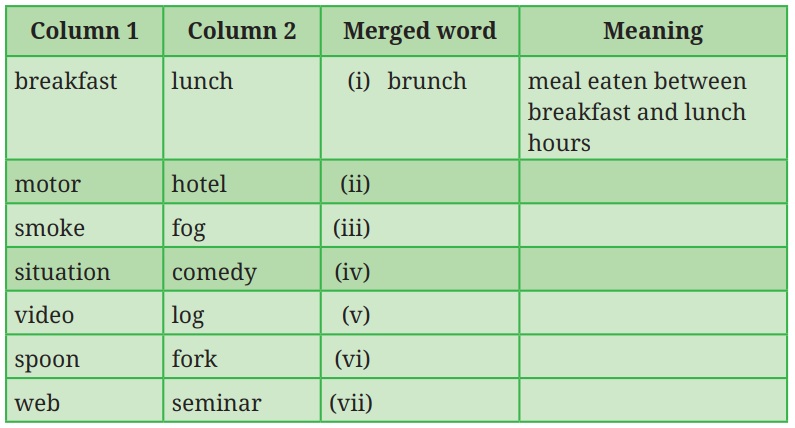
II. The word ‘intercom’ is used in the text. It is called a merged word as it is made by combining the parts of two words—‘internal’ and ‘communication’. Merged words are made by combining two words.
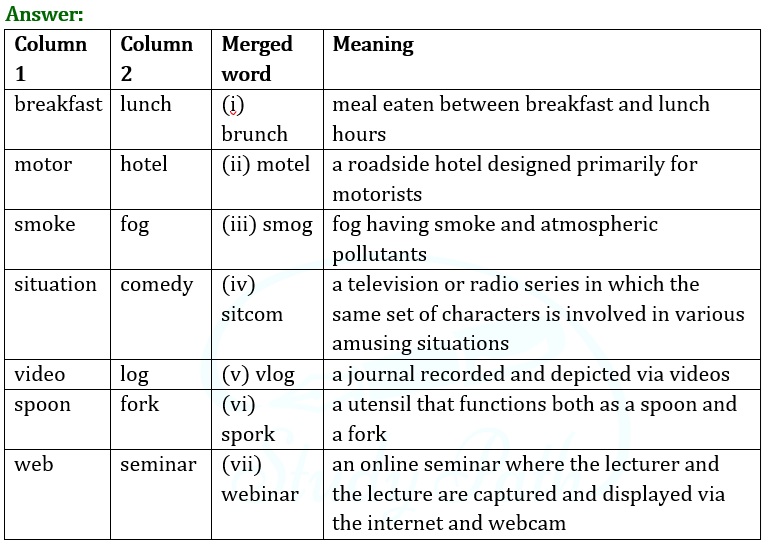
Combine the words in Column 1 with the words in Column 2 to make merged words. Write the merged word and its meaning.
One example has been done for you.
Answer:
III. Read the following sentence from the text and fill in the blank.
It will mean that you’re being doubly safeguarded.
In the given sentence, ‘will’ denotes __________ (past/present/future) time.
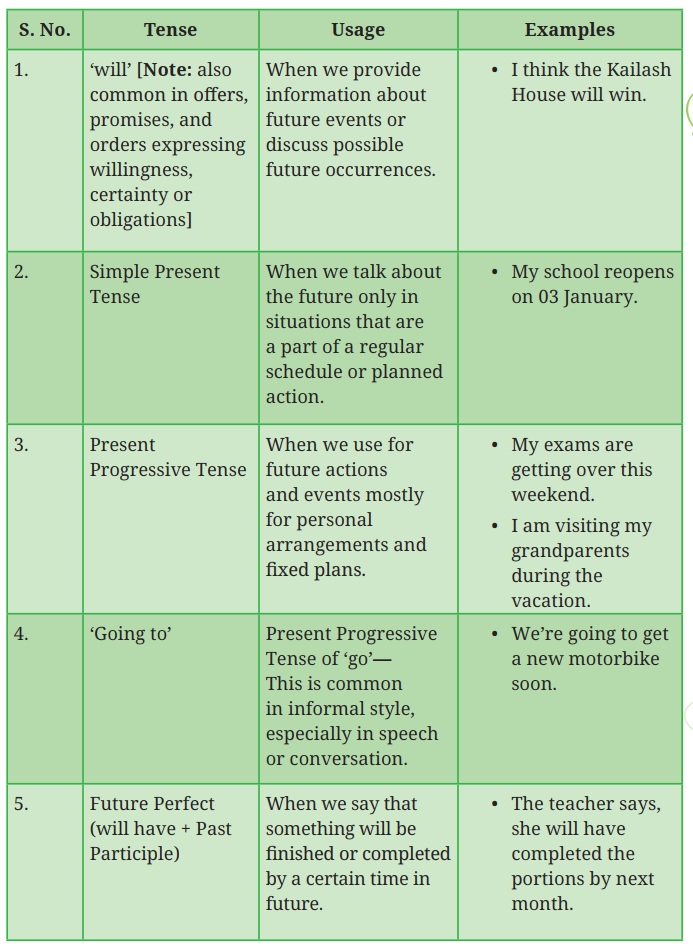
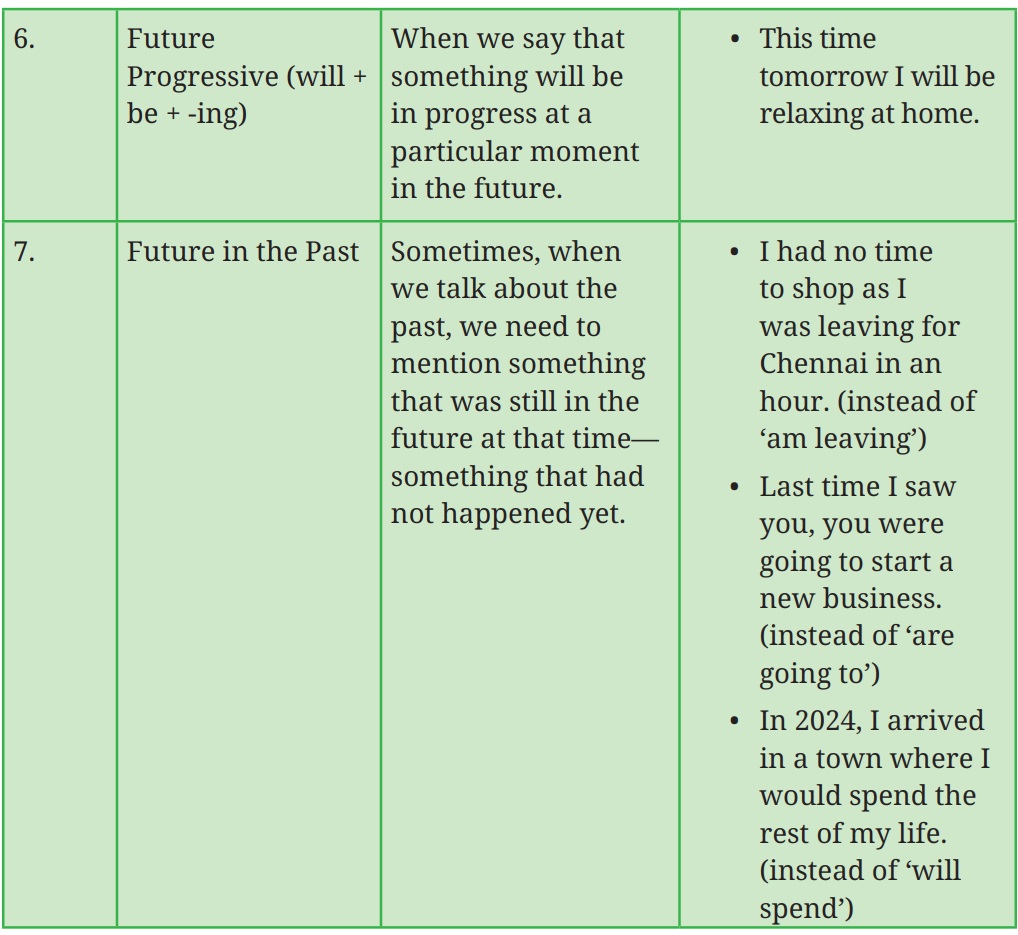
There are several ways to use verbs to talk about the future in English.
The following table lists some of the usages of future time references.
IV. Fill in the blanks with the correct form (Simple Present, Present Progressive, ‘will’, or ‘going to’) to indicate future time.
1. Our flight __________ (leave) at 10.00 a.m. tomorrow.
2. They __________ (finish) the project by the end of this week.
3. The weather forecast says it __________ (rain) later today.
4. We __________ (move) into our new house next month.
5. I __________ (start) my new hobby class next Monday.
6. She __________ (go) to the mall this afternoon.
7. The team __________ (have) a meeting at 3.00 p.m. tomorrow.
8. I __________ (help) you with your homework after dinner.
Answer:
1. Our flight leaves at 10.00 a.m. tomorrow.
2. They will finish the project by the end of this week.
3. The weather forecast says it is going to rain later today.
4. We are moving into our new house next month.
5. I am starting my new hobby class next Monday.
6. She is going to go to the mall this afternoon.
7. The team is having a meeting at 3.00 p.m. tomorrow.
8. I will help you with your homework after dinner.
V. Fill in the blanks with the suitable forms of verbs given in brackets to express future time reference.
By 2040, artificial intelligence 1. ________ (revolutionise) medical treatments. Researchers 2.________ (develop) AI-powered diagnostic tools that 3. ________ (transform) healthcare by the end of this decade. Next week, the International Science Congress 4. _______ (open) to showcase advancements in AI and robotics. In the coming years, robots 5. _______ (assist) surgeons in performing complex operations. Years ago, experts had predicted that AI would reshape our world, and now, as we approach the future, this 6. _______ (be) our new reality.
Answer: By 2040, artificial intelligence 1. will have revolutionised medical treatments. Researchers 2. are developing AI-powered diagnostic tools that 3. will transform healthcare by the end of this decade. Next week, the International Science Congress 4. opens to showcase advancements in AI and robotics. In the coming years, robots 5. will assist surgeons in performing complex operations. Years ago, experts had predicted that AI would reshape our world, and now, as we approach the future, this 6. will be our new reality.
Let us listen (Page no. 217-218)
I. You will listen to a conversation between Monika and Toby. Toby is a Martian and is stranded on Earth. He has become Monika’s friend. As you listen, put a tick mark (✓) against the correct statements and a cross against the wrong ones. (Transcript for teacher on page 249)
Answer:
1. Toby misses his school. (×)
2. Monika accepts Toby as her friend. (✓)
3. Monika asks Toby about one of his facial features. (✓)
4. Toby tells Monika that she had a banana for breakfast. (×)
5. Toby shares that he can see much clearer with a closed eye. (✓)
II. Listen to the conversation again and fill in the blanks with the exact words you hear.
1. Toby: I miss my _________________ and home.
2. Toby: Well, we _________________ don’t need to eat anything. We get our _________________ from the Sun.
3. Monika: Oh! Don’t you ever feel like having ice-creams and _________________!
4. Monika: Okay, tell me one thing. How are you able to see only with _________________ eye?
5. Toby: I can see beyond mountains and _________________, woods and even ____________.
Answer: 1. Toby: I miss my people and home.
2. Toby: Well, we Martians don’t need to eat anything. We get our energy from the Sun.
3. Monika: Oh! Don’t you ever feel like having ice-creams and chocolates!
4. Monika: Okay, tell me one thing. How are you able to see only with one eye?
5. Toby: I can see beyond mountains and clouds, woods and even metals.
Let us write (Page no. 217-218)
I. Complete the social media web given below with the uses of the internet.

Now, write an article titled ‘The Importance of Internet’ with the help of the social media web.
Points to remember:
Heading/Title
Name of the writer
Paragraph 1: Give a general introduction to the topic.
Paragraph 2: Explain the uses of the internet and why it is important.
Give examples to support your view.
Paragraph 3: End with a comment and leave the reader with a thoughtful idea or quote.
Answer:
The Importance of Internet
By: Suman
The internet has become an essential part of modern life. It connects people across the world and provides instant access to information. From students to professionals, almost everyone depends on the internet for daily activities, making life faster, easier, and more convenient.
The internet is important because it supports communication, education, and services. Students use it for online classes, research, and projects. People communicate through emails, video calls, and social media. Online banking, shopping, and ticket booking save time and effort. The internet also keeps us informed through news websites and helps in entertainment through music, movies, and games.
In today’s digital age, the internet is a powerful tool that must be used wisely. When used responsibly, it opens doors to knowledge and opportunities. As the saying goes, “The internet is the world’s largest library—use it to learn, not to waste time.”
About the Chapter: Feathered Friend
The science-fiction story Feathered Friend follows the crew of a space station where Sven Olsen has secretly brought a canary named Claribel. The bird becomes a familiar companion, and an unexpected change in her condition alerts the crew to a dangerous problem with their air.
Students also explore the relationship between technology, living things, and human judgement. The chapter combines humour and suspense while helping students follow cause and effect, understand scientific ideas in a story, and explain how a small creature can make a vital difference.