

NCERT Solutions for Class 8 English Poorvi Chapter 8 The Magic Brush of Dreams are provided here with simple and easy-to-understand explanations. This poem is a part of Unit 3: Mystery and Magic in the NCERT textbook Poorvi. It explores a magical paintbrush, generosity, and the conflict between kindness and greed. These NCERT Solutions for Class 8 help students understand the main ideas, complete textbook activities, improve their language skills, and prepare for school examinations.
The Magic Brush of Dreams Class 8 Questions and Answers
Let us discuss (Page no. 127)
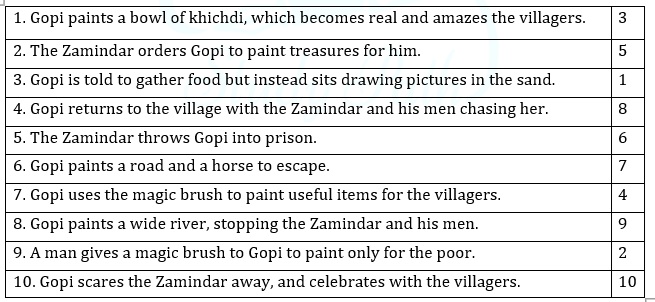
I. Arrange the events in order of occurrence in the poem. The last one has been marked for you. Share your answers with your classmates and teacher.
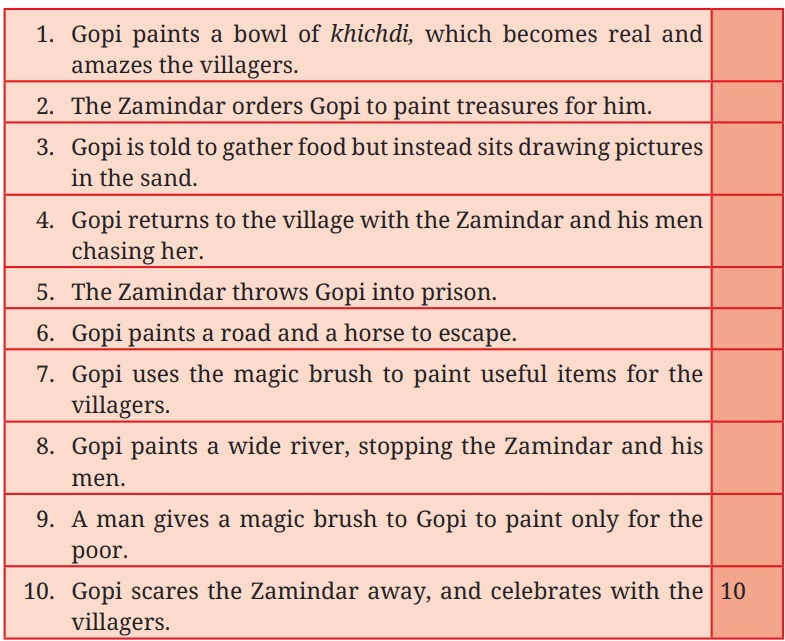
Answer:
II. Fill in the blanks by choosing the correct answer from the box given below.

The tone of the poem shifts throughout, reflecting the different moods of the story. Initially, the tone is 1. _________________ as Gopi uses her imagination to draw in the sand, and later when the Zamindar enters the story, the tone shifts to one of 2. _________________. In the final part of the poem, the tone becomes 3. _________________ as Gopi escapes, the Zamindar is defeated, and the villagers rejoice.
Answer: The tone of the poem shifts throughout, reflecting the different moods of the story. Initially, the tone is playful and innocent as Gopi uses her imagination to draw in the sand, and later when the Zamindar enters the story, the tone shifts to one of tension and suspense. In the final part of the poem, the tone becomes triumphant and celebratory asGopi escapes, the Zamindar is defeated, and the villagers rejoice.
III. Fill in the blanks by choosing the correct option from within the brackets.
1. The poem mostly follows a simple rhyme scheme, _________________, which adds a rhythmic flow. (ABCB, ABBA, ABAB)
2. This poem belongs to the _________________ poetry genre, which tells a story through verse. (descriptive, narrative or ballad, free style)
Answer:
1. ABCB
2. narrative or ballad
IV. Give examples from the poem for the following explanations.
1. The poem is rich in imagery, creating clear pictures in the reader’s mind. For example, ___________________.
2. What is the effect of repetition in the line—‘On you, and you and you!’?
Answer:
1. The poem is rich in imagery, creating clear pictures in the reader’s mind. For example: “She paints a mighty river wide, Its currents fast and deep”
2. The repetition in the line “On you, and you and you!” increases the sense of threat and fear. By repeating the word “you,” Gopi directs her warning at each individual in the Zamindar’s group. It emphasises that the magical beast would attack every single man, making the threat more powerful and frightening.
V. Match the phrases from the poem in Column 1 with what they symbolise in Column 2.
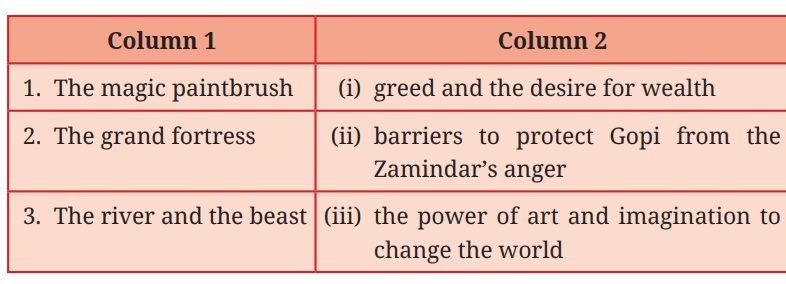
Answer:
| Column 1 | Column 2 |
| 1. The magic paintbrush | (iii) the power of art and imagination to change the world |
| 2. The grand fortress | (i) greed and the desire for wealth |
| 3. The river and the beast | (ii) barriers to protect Gopi from the Zamindar’s anger |
VI. Identify whether the following statement is true or false.
While Gopi uses the magic brush to help others, the Zamindar wants to use it for personal gain. This contrast drives the moral of the story.
Answer: True.
Let us think and reflect (Page no. 128)
I. Read the given extracts and answer the questions that follow.
1. But on a stone there sits a man,
A brush is in his hand.
He looks around. He calls to Gopi.
“Come here!” he whispers. “Hush!
We mustn’t let the village know
About this magic brush.”
He slips the brush into her hand
And tells her to be sure,
“Paint not for the wealthy ones,
But only for the poor.”
(i) Fill in the blank by selecting the correct option from those given in the brackets.
The man is whispering and telling Gopi to keep the brush a secret reflects his _______________________ (careful and secretive/magical and delightful) nature.
Answer: careful and secretive
(ii) What is the significance of the man slipping the brush into Gopi’s hand?
Answer: The act of the man slipping the brush into Gopi’s hand is significant because it symbolises trust and responsibility. He secretly gives her the magical power, believing she is kind and selfless.
(iii) Complete the following sentence with a suitable reason.
The most likely reason the man instructs Gopi to ‘Paint not for wealthy ones but only for the poor’ is because he _______________________.
Answer: wants the magic brush to be used for kindness and to help the needy, not for selfish or greedy purposes.
(iv) Select the most appropriate title for the extract from the two given below.
A. The Magic Brush’s Secret
B. Gopi’s Special Gift
Answer: B. Gopi’s Special Gift
2. And soon the news spreads far and wide,
Through forests, fields, and plains,
Until the Zamindar himself
Hears of these magic gains.
“I order you to paint for me,
A fortress tall and grand.
Paint treasures, jewels, and riches rare,
Enough to rule this land.”
(i) Complete the following sentence with the correct reason.
The news of Gopi’s magic brush spreads ‘through forests, fields, and plains’ because of its _______________________.
Answer: helpfulness and magical power
(ii) Why does the poet refer to things painted by Gopi’s paintbrush as ‘magic gains’?
Answer: The poet calls them ‘magic gains’ because whatever Gopi paints becomes real and brings happiness and benefit to people.
(iii) Which of the following statements given below is false? Rectify the false statement.
A. Gopi’s magic brush draws the attention of the powerful Zamindar.
B. The Zamindar requests Gopi to paint a grand fortress and jewels.
Answer: B is false.
Reason: The Zamindar does not politely request Gopi. Instead, he ordered her to paint a grand fortress and precious jewels for him.
(iv) What does the Zamindar’s demand for a grand fortress and jewels reveal about his character?
Answer: The Zamindar’s demand for a grand fortress and jewels revealed that he was greedy, selfish and materialistic.
II. Answer the following questions.
1. Explain why Gopi made the right decision by refusing to paint for the Zamindar.
Answer: Gopi made the right decision by refusing to paint for the Zamindar because the magic brush was given to her to help the poor and needy. The Zamindar was greedy and wanted wealth and power. By refusing the greedy Zamindar, she protected the magic brush from being used for personal gain and selfish wealth.
2. Gopi threatens to draw a beast to scare away the Zamindar. Justify her action. How would you have dealt with the situation differently?
Answer: Gopi’s action was justified because the Zamindar was cruel, greedy, and had used force to seize her and the magic brush. Threatening to draw a beast was a clever, non-violent use of her power to protect herself and the village from his greed.
If I were Gopi, I might have instead drawn an endless maze to trap the soldiers or a protective shield to keep the village safe without needing to threaten them.
3. What is the significance of Gopi celebrating with the villagers at the end of the poem?
Answer: Gopi’s celebration with the villagers at the end of the poem signifies the victory of good over greed. It shows that the magic brush is used for the welfare of the people, not for selfish gain. The celebration also reflects unity, happiness, and the peaceful life restored after the Zamindar is defeated.
4. Compare Gopi’s use of the magic brush to how the Zamindar would have used it.
Answer: Gopi used the magic brush for the benefit of her community rather than herself. She used the magic brush for painting essential items like khichdi, fans, clothes, ploughs, shawls, and other useful items.
On the other hand, the Zamindar was selfish and greedy. He would have used the magic brush to get richer and more powerful. He would have painted fortresses, riches and treasures, all for himself.
5. What can be inferred about Gopi’s character based on her refusal to follow the Zamindar’s orders?
Answer: Gopi’s refusal to follow the Zamindar’s orders shows her strong moral values and courage. Despite being threatened and imprisoned, she does not misuse the magic brush for greed. She remains loyal to her promise to help the poor, showing that she is brave, kind, and honest.
6. Justify the appropriateness of the title of the poem.
Answer: The title “The Magic Brush of Dreams” is appropriate because the brush has magical powers that bring Gopi’s drawings to life. The magic brush can be used to paint and create anything that the user wishes to have. In the poem, Gopi uses the brush to bring hope and happiness to people, making the title meaningful.
7. If you had the magic brush, how would you use it in today’s world?
Answer: If I had the magic brush, I would use it to solve major problems in today’s world. I would paint food for the hungry, homes for the homeless, and schools and hospitals for the needy. Like Gopi, I would use the magic brush selflessly to make the world a better place.
Let us learn (Pages 130-132)
I. The verb ‘draw’ has different meanings in different contexts. Match the sentences in Column 1 with their appropriate meanings in Column 2.
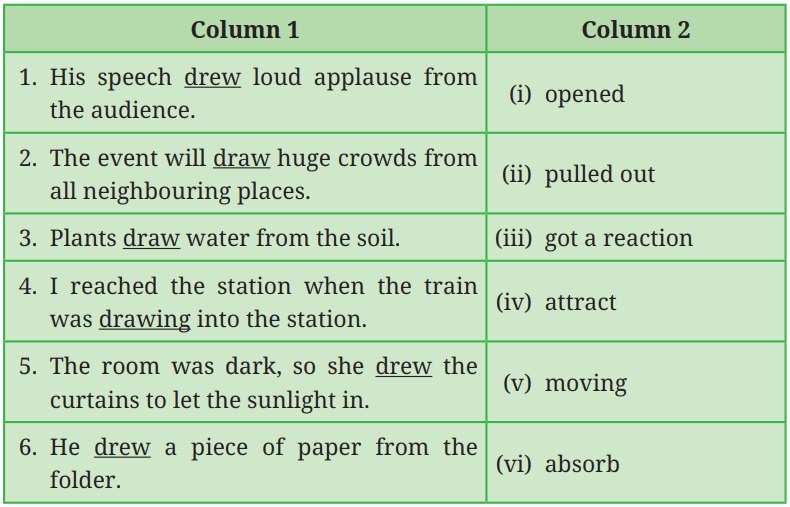
Answer:
| Column 1 | Column 2 |
| 1. His speech drew loud applause from the audience. | (iii) got a reaction |
| 2. The event will draw huge crowds from all neighbouring places. | (iv) attract |
| 3. Plants draw water from the soil. | (vi) absorb |
| 4. I reached the station when the train was drawing into the station. | (v) moving |
| 5. The room was dark, so she drew the curtains to let the sunlight in. | (i) opened |
| 6. He drew a piece of paper from the folder. | (ii) pulled out |
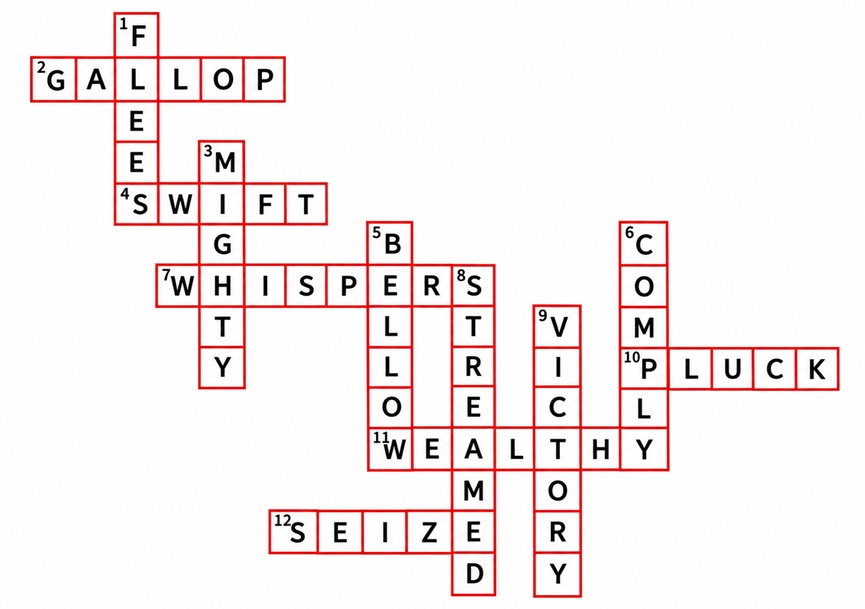
II. Fill in the crossword. Clues have been given below. You will find the words in the poem.
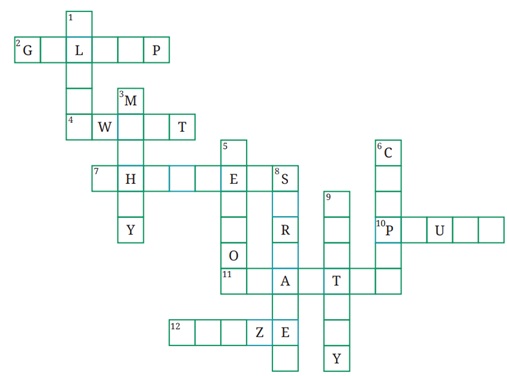
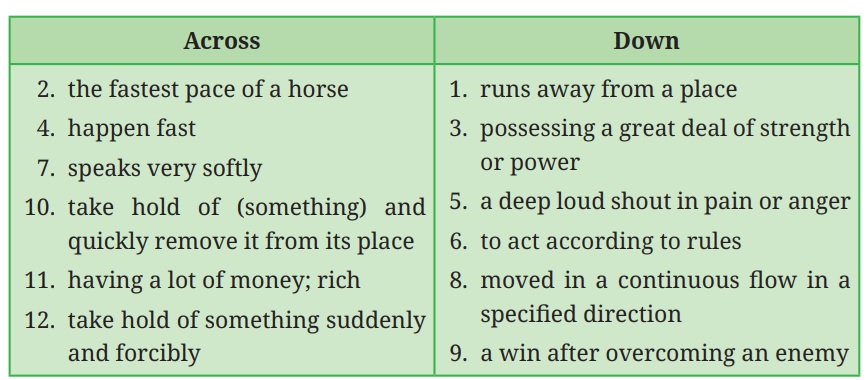
Answer:
| Across | Down |
| 2. gallop | 1. flees |
| 4. swift | 3. mighty |
| 7. whispers | 5. bellow |
| 10. pluck | 6. comply |
| 11. wealthy | 8. streamed |
| 12. seize | 9. victory |
III. There are certain expressions that convey a sudden feeling or reaction.
They can be used to express a variety of emotions and thoughts.
Example: … he whispers. “Hush!”
(‘Hush’ denotes the act of silencing someone)
Now, match the expressions in Column 1 with what emotions or reactions they convey, in Column 2.
| Column 1 | Column 2 |
| 1. Phew! | (i) surprise |
| 2. Eek! | (ii) pain |
| 3. Ouch! | (iii) mistake |
| 4. Yippee! | (iv) attract attention |
| 5. Whoa! | (v) relief |
| 6. Oops! | (vi) delight |
| 7. Hey! | (vii) alarm |
Now, create sentences using any five expressions from Column 1.
Answer:
| Column 1 | Column 2 |
| 1. Phew! | (v) relief |
| 2. Eek! | (vii) alarm |
| 3. Ouch! | (ii) pain |
| 4. Yippee! | (vi) delight |
| 5. Whoa! | (i) surprise |
| 6. Oops! | (iii) mistake |
| 7. Hey! | (iv) attract attention |
Let us listen (Page 132)
I. You will listen to five speakers speak about a magical power they wish for. As you listen, match statements 1–7 with speakers (i)–(v). There are two statements you do not need. (Transcript for teacher on page 152 )
Answer:
| Statements | Speaker No. |
| 1. Power of healing ailments | (iv) |
| 2. Ability to end poverty in the world | X |
| 3. Power to control the weather as per need | (v) |
| 4. Ability to make wise business decisions | X |
| 5. Power to predict one’s own future clearly | (i) |
| 6. Ability to remember information quickly | (ii) |
| 7. Power to move around without using vehicles | (iii) |
Let us write (Pages 134 & 135)
III. Write an imaginative essay on any one of the following.
1. Imagine you were a scarf that flew away from a clothesline. Describe the places you travelled to and how you came back. Also write about what you thought was the most valuable experience.
2. Imagine you stumbled upon a magical book in the library. The book transported you to a different time period. Describe your experience and an important learning.
Answer:
1. A Scarf’s Journey on the Wind
One windy afternoon, I was hanging peacefully on a clothesline when a strong gust of wind lifted me into the air. I flew over rooftops, trees, and busy roads. I wrapped myself around a smiling child’s neck for a while and then floated into a park where birds rested on me.
Later, I travelled to a bus stand and warmed an old man who was shivering in the cold. Finally, the wind carried me back to my own street, where my owner happily found me stuck on a fence.
The most valuable experience of my journey was learning how small things like me can bring comfort and happiness to others. I realised that even ordinary objects have a purpose when they help someone in need.
2. A Journey Through a Magical Book
One quiet afternoon in the library, I found an old, dusty book glowing softly. As soon as I opened it, I was pulled into its pages and transported to ancient India. I saw students studying under trees at Nalanda University and teachers sharing knowledge freely.
I learned how education was respected and how people lived simple yet meaningful lives. Before I knew it, I was back in the library holding the same book.
The important learning from this experience was that true knowledge does not depend on technology or luxury. Curiosity, discipline, and respect for learning are what truly make education powerful.
About the Poem: The Magic Brush of Dreams
The poem The Magic Brush of Dreams tells of Gopi, a girl whose magical brush can bring her paintings to life. She uses this extraordinary gift to help people in need, but a greedy landowner wants to exploit it for himself. Imagination and courage shape the events that follow.
Students also explore the responsible use of power and the contrast between generosity and selfishness. The activities develop understanding of the narrative, poetic images, and central message while encouraging creative responses to the poem’s magical world.