

NCERT Solutions for Class 8 English Poorvi Chapter 6 Verghese Kurien – I Too Had a Dream are provided here with simple and easy-to-understand explanations. This lesson is a part of Unit 2: Values and Dispositions in the NCERT textbook Poorvi. It explores Verghese Kurien’s work, his commitment to farmers, and the power of a shared vision. These NCERT Solutions for Class 8 help students understand the main ideas, complete textbook activities, improve their language skills, and prepare for school examinations.
Verghese Kurien – I Too Had a Dream Class 8 Questions and Answers
Let us do these activities before we read. (Page no. 82)
1. Arrange the worldwide means of communication given below in the timeline provided. Share your answers with your classmates and teacher.
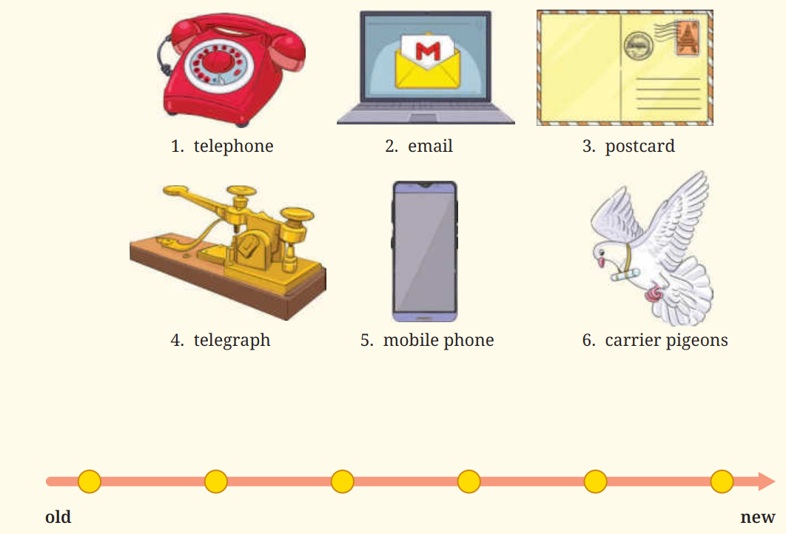
Answer: Carrier pigeons → Telegraph → Postcard → Telephone → Email → Mobile phone
II. Work in pairs and discuss the following things. Share your answers with your classmates and teacher.
1. The reasons for change in the means of communication over the years.
Answer: The means of communication have changed due to technological advancement. People prefer faster, easier, and more convenient ways to share information over long distances in less time. The growth of the internet, mobile phones, and digital platforms has made communication faster, cheaper, and more accessible.
2. The means of communication that you prefer to use and the reason for your choice.
Answer: I prefer using mobile phones and messaging apps such as WhatsApp or email because they allow quick and easy communication. Not just text messages, but I can video call in real time with these apps. They help me stay connected with friends, teachers, and family members instantly.
3. Communication through social media: its benefits and precautions that one should take against its misuse.
Answer: Social media has many benefits such as connecting people globally, sharing photos, spreading awareness, and encouraging creativity. However, it can be misused if not handled carefully. Users should avoid sharing personal information, be cautious of fake news, and limit screen time. Responsible use is important to avoid cyberbullying, addiction, and misinformation.
Let us discuss (Page no. 85)
A fact is something that can be proven true or false. A fact is not based on people’s beliefs. An opinion on the other hand is a belief, feeling or judgement, and can vary from one person to another. An opinion cannot be proven.
I. Identify which of the following statements are facts and which are opinions. Share your answers with your classmates and teacher.
1. But speaking on the telephone only gives us an immediate but fleeting joy.
2. I started my working life soon after our country became independent.
3. To be quite honest, service to our nation’s farmers was not the career I had envisioned for myself.
4. I knew I could make a more meaningful contribution by working here in Anand, Gujarat.
5. … values that I saw in my mentor and supporter here in Anand— Tribhuvandas Patel.
6. Life is a privilege, and to waste it would be wrong.
7. I hope that you, too, will discover, as I did, that failure is not about not succeeding.
8. … the magnificent ceremony in which the President awarded me the Padma Vibhushan in 1999?
Answer:
1. Opinion
2. Fact
3. Fact
4. Opinion
5. Fact
6. Opinion
7. Opinion
8. Fact
Let us think and reflect (Page no. 86-88)
I. Read the given extracts and answer the questions that follow.
1. In today’s fast-paced world we have become so addicted to instant communication that we prefer to use a telephone. But speaking on the telephone only gives us an immediate but fleeting joy. Writing is different. Writing—even if it is a letter—not only conveys our present concerns and views of the events taking place around us but it becomes a possession that can be treasured and re-read over the years, with great, abiding pleasure.
(i) Fill in the blank given below by selecting the correct option from the brackets.
When the writer refers to a ‘fast-paced world’, he is speaking of a world where _________________. (communication happens quickly but lacks depth/people have more time to write and reflect)
Answer: communication happens quickly but lacks depth
(ii) Select the option that applies correctly to both Assertion (A) and Reason (R).
(A): Writing letters can be treasured and re-read over the years.
(R): Speaking on the telephone provides long lasting joy.
A. Both (A) and (R) are true, and (R) is the correct explanation of (A).
B. Both (A) and (R) are true, but (R) is not the correct explanation of (A).
C. (A) is true, but (R) is false.
D. Both (A) and (R) are false.
Answer: C. (A) is true, but (R) is false.
(iii) Identify whether the statement given below is true or false.
The writer feels that letter-writing is a class apart from other kinds of writing.
Answer: False
(iv) Which of the following is the most appropriate title for the given extract?
A. The Rise of Instant Communication
B. The Fleeting Delight of Phone Calls
C. The Lasting Joy of Written Words
D. Living in a Fast-paced World
Answer: C. The Lasting Joy of Written Words
2. Your grandmother too made an important choice. She knew, in those early days, life in Anand could not offer even the simple comforts that we take for granted today. However, she ardently supported my choice to live and work in Anand. That choice of your grandmother to stand by me has given me an everlasting strength, always ensuring that I shouldered my responsibilities with poise.
(i) How can we say that the grandmother shared her husband’s dedication to a greater cause?
Answer: The grandmother shared her husband’s dedication to a greater cause by supporting him and working for the greater cause as well.
(ii) Complete the following with the correct option from the two given in brackets.
The fact that the writer (grandfather) praises his wife tells us that he _____________________ (truly values/quietly accepts) her role in his life.
Answer: truly values
(iii) Complete the following sentence with the correct option from those given below.
Based on the information in the extract, we can infer that the grandmother had all of the following traits EXCEPT ____________.
A. encouraging
B. understanding
C. comforting
D. thoughtful
Answer: C. comforting
(iv) Select the phrase that conveys— ‘showed grace under pressure and carried out my duties with dignity and confidence’.
Answer: The word ‘poise’ means ‘showed grace under pressure and carried out my duties with dignity and confidence.’
II. Answer the following questions. (Page 88)
1. What event does Dr. Kurien refer to when he mentions receiving the Padma Vibhushan?
Answer: Dr. Kurien refers to the Padma Vibhushan award ceremony held in Delhi in 1999. During the ceremony, his grandson Siddharth proudly slipped the medal around his neck and innocently asked if he could keep it. Dr. Kurien and his wife agreed but gently explained that Siddharth should not be satisfied with someone else’s achievements and must work hard to earn his own rewards.
2. How did Dr. Kurien’s decision to join the cooperative in Anand affect his life?
Answer: Dr. Kurien’s decision to join the small dairy cooperative in Anand completely transformed his life. Although he had other attractive career options, a series of events led him to this choice. Working with farmers gave him a deep sense of purpose and responsibility. This decision shaped his lifelong service to India’s farmers and later led to the success of the White Revolution.
3. Dr. Kurien’s decision to work in Anand reveals his values and sense of duty. Explain.
Answer: Dr. Kurien’s decision to work in Anand reveals his strong values of integrity, humility, and national service. Even though he could have chosen a successful career abroad or in the army, he chose to serve Indian farmers. He believed in contributing to the common good and accepted responsibility for improving people’s lives. This shows his deep sense of duty towards the nation.
4. Why did Dr. Kurien write the letter to his grandson?
Answer: Dr. Kurien wrote the letter to his grandson to share his memories, experiences, and life lessons. He wanted to explain the choices he made and the values he followed. Through the letter, he hoped to inspire his grandson and younger generations to live responsibly and work sincerely for humanity.
5. According to Dr. Kurien “life is a privilege and it is wrong to waste it”. What is your opinion on this?
Answer: I strongly agree with Dr. Kurien’s view that life is a privilege and should not be wasted. Every person has abilities and opportunities that must be used wisely. By working hard, helping others, and contributing to the common good, we can make our lives meaningful. Wasting life without effort or responsibility would be a loss not only to oneself but also to society.
6. What message does Dr. Kurien want to convey about selfless service and its long-term impact on the society?
Answer: The message Dr. Kurien wanted to convey is that selfless service has a powerful and lasting impact on society. He believes that true rewards come from contributing to the common good rather than personal gain. When individuals serve others with honesty and dedication, their efforts strengthen communities and inspire future generations.
Let us learn (Page no. 88 – 89)
1. Replace the underlined words in each sentence with the correct synonym from the box. You may refer to a dictionary.
| essential | swift | lifelong |
| momentary | useful | splendid |
1. He received the award in a magnificent ceremony.
2. I felt a fleeting joy when I received the appreciation for my song.
3. With today’s instant communication, we can share information across the world in seconds.
4. Our school focuses on the core values—collaboration, innovation, and unity.
5. My teacher’s advice on time management is a valuable reminder of the importance of planning.
6. Reading books and listening to music can give abiding pleasure that will last forever.
Answer:
1. Magnificent → Splendid
2. Fleeting → Momentary
3. Instant → Swift
4. Core → Essential
5. Valuable → Useful
6. Abiding → Lifelong
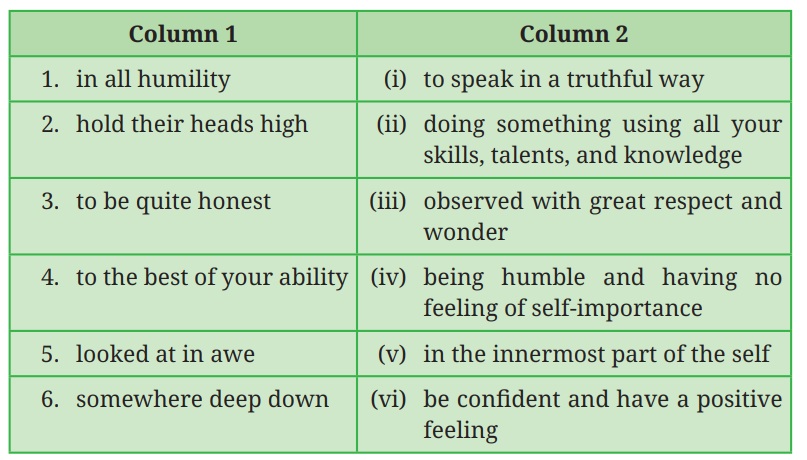
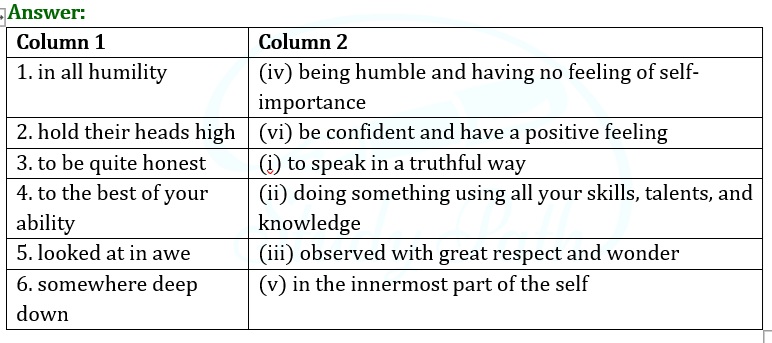
II. Match the expressions from the text in Column 1 with their meanings in Column 2.
III. Make as many words as you can out of the following words. One example has been done for you.
1. community — city, toy, tune, unity, mutiny, cot
2. important
3. magnificent
4. satisfied
5. generation
6. achievement
Answer:
1. community — city, toy, tune, unity, mutiny, cot
2. important— import, port, torn, tap, tint, tan, rot, rant, rat, tart
3. magnificent— cent, mint, mat, cat, face, gent, gem, nine, ten, tin
4. satisfied— sad, die, dies, fit, fits, sea, deaf, diet, fist, fast
5. generation— gent, ration, rat, nation, rot, not, rag
6. achievement— achieve, eve, ache, men, ten, have, hive, machete, vent, meant, cheat, eat, tea
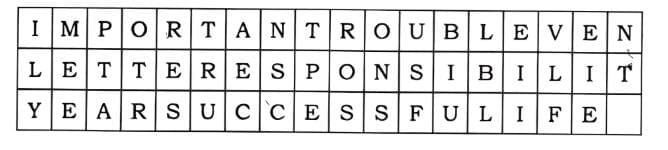
IV. Let us play a word game – antakshari.
1. Write the synonym of the word according to the clues given below.
2. For example, the synonym of the first word, ‘IMPORTANT’ ends with the letter ‘T’. The synonym of the second word begins with ‘T’, ‘TROUBLE’. Then write the synonym of the third word starting with the letter ‘E’.
3. Now, continue with the word game

(i) major (synonym)
(ii) problem (synonym)
(iii) uneven (antonym)
(iv) related to post office
(v) our moral duty
(vi) related to time
(vii) prosperous (synonym)
(viii) related to being alive
Answer:
(i) major (synonym) — important
(ii) problem (synonym) — trouble
(iii) uneven (antonym) — even
(iv) related to post office — lender
(v) our moral duty — responsibility
(vi) related to time — years
(vii) prosperous (synonym) — successful
(viii) related to being alive — living
V. Study the highlighted punctuation marks in the following sentences from the text.
1. … but that you should not be satisfied in merely keeping my awards— the challenge before you was to earn your own rewards for the work that you did in your lifetime.
2. Writing—even if it is a letter—not only conveys our present concerns and views of the events taking place around us, but it becomes a possession.
The highlighted punctuation is a long dash that can be used to link words or numbers or to create a pause in a sentence. There are two main types: the shorter en dash (–) and the longer em dash (—).
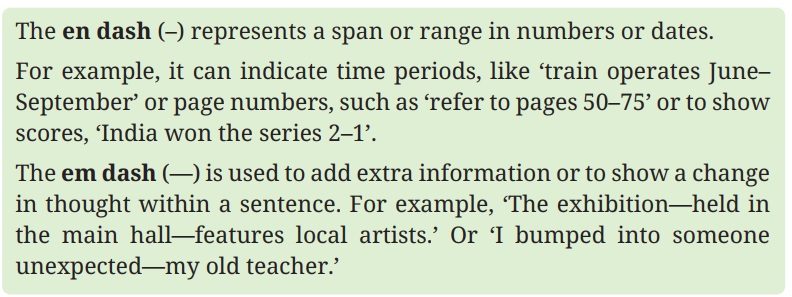
Note: Do not add spaces around the dash and avoid overusing them.
Read the sentences below and insert either an em dash (—) or an en dash (–) suitably.
(i) The conference will be held from March 15 March 20.
(ii) I have lived in Kanpur Raipur for five years now.
(iii) The artist known for her vibrant paintings will be showcasing her work in Guwahati.
(iv) The scores for the final match were 2 3.
(v) My favourite snacks samosas, pakoras, and jalebis are all from India.
(vi) The train journey from Belagavi Bengaluru takes less than ten hours.
(vii) I just finished reading the book it was absolutely amazing!
(viii) The event will take place on September 1 September 5.
Answer:
(i) The conference will be held from March 15 – March 20.
(ii) I have lived in Kanpur—Raipur for five years now.
(iii) The artist—known for her vibrant paintings will be showcasing her work in Guwahati.
(iv) The scores for the final match were 2-3.
(v) My favourite snacks—samosas, pakoras, and jalebis are all from India.
(vi) The train journey from Belagavi—Bengaluru takes less than ten hours.
(vii) I just finished reading the book—it was absolutely amazing!
(viii) The event will take place on September 1- September 5.
VI. Study the highlighted words in the following sentences from the text.
1. We told you that of course, this medal was yours as much as it was mine…
2. …who were trying to gain control over their lives.
3. I have always emphasised that it’s a recognition of the achievements of many people…
In the given sentences, ‘yours’ and ‘theirs’ indicate possession— something belonging to you and them, respectively. But, ‘it’s’ does not indicate possession rather is the contracted form of ‘it is’.
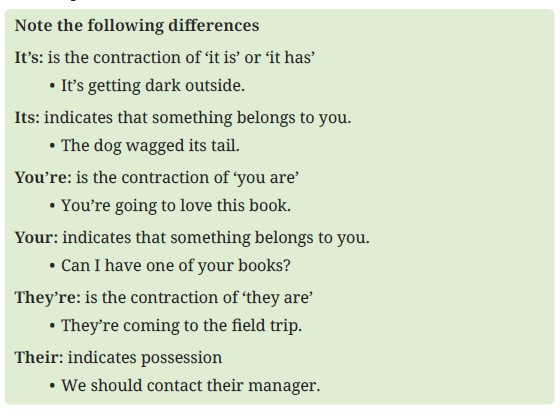
Fill in the blanks by choosing the correct word from the options given in the brackets.
(i) Please remember to bring ___________ (your/you’re) assignment book.
(ii) The team celebrated ___________ (their/they’re) victory after the match.
(iii) ___________ (its/it’s) important to stay hydrated during the hot summer days.
(iv) I can’t believe ___________ (your/you’re) going to the mango festival today.
(v) The students said ___________ (they’re/their) excited for the field trip tomorrow.
(vi) The tree lost ___________ (its/it’s) leaves in the winter.
Answer: (i) Please remember to bring your assignment book.
(ii) The team celebrated their victory after the match.
(iii) It’s important to stay hydrated during the hot summer days.
(iv) I can’t believe you’re going to the mango festival today.
(v) The students said they’re excited for the field trip tomorrow.
(vi) The tree lost its leaves in the winter.
VII. Read the following phrases from the text.
1. In today’s fast-paced world
2. On the telephone
3. With great, abiding pleasure
4. In the chapters that follow
5. At a certain time
6. With equal respect and love
The given phrases are Prepositional Phrases.
| Prepositional phrases are groups of words that begin with a preposition and include a noun or pronoun as the object of the preposition. These phrases provide additional information about time, place, manner, cause, direction, or relationship. |
Now, complete the following sentences with suitable prepositional phrases.
(i) The children played happily in ___________________________________.
(ii) Nisha placed the vase on ___________________________________.
(iii) We discussed the project in ___________________________________.
(iv) Preethi found the lost book under ___________________________________.
(v) The cat slept on ___________________________________.
Answer:
(i) the lunch break
(ii) the cabinet
(iii) the empty classroom
(iv) the yellow bench
(v) the red leather couch
VIII. Rearrange the following jumbled words and phrases into meaningful sentences.
1. barked/at the strangers/the dog/loudly/the house/walking by
2. wrote/my classmate/during the/a story/summer vacations
3. enjoyed/under the trees/they/by the lake/a picnic
4. in his/grandfather’s room/hung/he/the painting
5. studied/with great determination/for/students/the/exam
Answer:
1. The dog barked loudly at the strangers walking by the house.
2. My classmates wrote a story during the summer vacations.
3. They enjoyed a picnic by the lake under the trees.
4. He hung the painting in his grandfather’s room.
5. Students studied for the exam with great determination.
Let us listen (Page no. 93)
I. You will listen to the passage about Evelyn Glennie’s journey in overcoming her hearing loss through music and turning a physical disability into a success story. (Transcript for teacher on page 100)
After listening, match the words given in Column 1 with their meanings given in Column 2.
| Column 1 | Column 2 |
| 1. percussionist | (i) a person who plays drums and similar instruments |
| 2. impaired | (ii) the ability to keep going despite difficulties |
| 3. vibrations | (iii) slow and steady over time |
| 4. determination | (iv) physical sensations caused by sound damaged or weakened |
| 5. gradual | (v) damaged or weakend |
Answer:
| Column 1 | Column 2 |
| 1. percussionist | (i) a person who plays drums and similar instruments |
| 2. impaired | (v) damaged or weakened |
| 3. vibrations | (iv) physical sensations caused by sound-damaged or weakened |
| 4. determination | (ii) the ability to keep going despite difficulties |
| 5. gradual | (iii) slow and steady over time |
1. Listen to the passage once again and state whether the statements given below are true or false.
1. Evelyn Glennie became deaf suddenly.
2. Her headmistress ignored the signs of her hearing loss.
3. Ron Forbes was a percussionist who helped Evelyn.
4. Evelyn used her skin and bones to sense music.
5. She gave up on music after her diagnosis.
Answer:
1. False.
Reason: Her hearing loss was gradual.
2. False
Reason: Teachers typically notice such signs.
3. True
4. True
5. False.
Reason: She continued her music career.
III. Answer the following questions in one or two words.
1. How did Evelyn turn her disability into strength?
2. What role did Ron Forbes play in her life?
3. What lessons can we learn from Evelyn’s story about how to treat others who have different abilities or challenges?
Answer:
1. By sensing vibrations.
2. Mentor or Percussionist
3. Empathy, support
Let us write (Page no. 95)
I. Write a letter to your grandparents thanking them for the valuable lessons they have taught you. Include how their wisdom has shaped your values and behaviour in life.
1. Thank them for teaching you important lessons, sharing stories, or helping others in the neighbourhood.
2. Share how their actions inspire you to contribute to the betterment of the society.
Answer:
House No. 24, Lake Road
Kolkata – 700029
Date: 15 December 2025
Dear grandpa and grandma,
I hope both of you are healthy and happy. I am writing this letter to thank you for the valuable lessons you have taught me throughout my life. Your stories about honesty, hard work, and kindness have always guided me. I especially admire how you help neighbours in need and treat everyone with respect.
Your actions have inspired me to be responsible, caring, and helpful towards others. Because of your guidance, I try to contribute positively to society by helping classmates, respecting elders, and being honest in my actions. You have shaped my values and behaviour in a meaningful way.
Thank you for your love, wisdom, and constant support. I feel proud and blessed to have grandparents like you.
With lots of love,
Your loving grandchild Anup
About the Chapter: Verghese Kurien – I Too Had a Dream
The lesson Verghese Kurien — I Too Had a Dream introduces the ideas and experiences of a leader closely associated with India’s dairy cooperative movement. Students learn how professional knowledge, determination, and cooperation can support farmers and bring meaningful change to society.
Students also explore the values of service, integrity, and working towards a larger purpose. The chapter helps them understand a real-life account and reflect on how individual choices and collective effort can turn an ambitious dream into lasting progress.