

NCERT Solutions for Class 8 English Poorvi Chapter 2 A Concrete Example are provided here with simple and easy-to-understand explanations. This poem is a part of Unit 1: Wit and Wisdom in the NCERT textbook Poorvi. It explores the humour of an unusual garden and the importance of noticing small things. These NCERT Solutions for Class 8 help students understand the main ideas, complete textbook activities, improve their language skills, and prepare for school examinations.
A Concrete Example Class 8 English Questions and Answers
Let us do these activities before we read (Page No. 17)
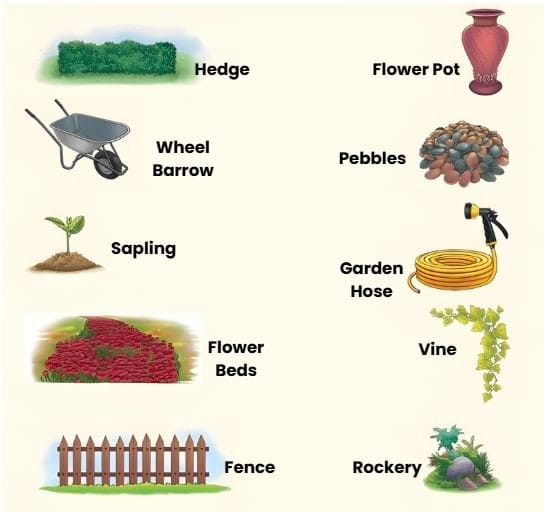
I. Read the names of items you usually find in a garden and write their names against each picture given below.
garden hose, sapling, hedge, flower beds, flower pot, pebbles, rockery, fence, vine, wheelbarrow
Answer:
II. Work in groups of four. What kind of garden would you like to have? Mention the features that you can include and the reasons for your choice. Share your answers with your classmates and teacher.
Answer: I would like to have a green and eco-friendly garden with flowering plants, medicinal herbs, shade-giving trees, and a small water feature. It is because such a garden would attract birds, provide fresh air, and create a peaceful environment.
III. Read the title of the poem. What comes to your mind when you read the word ‘concrete’? Does it have more than one meaning? Share your answers with your classmates and teacher.
Answer: When I read the word concrete, I think of something solid like cement or stones. At the same time, it also means clear, real, or definite. So, the word has more than one meaning.
Let us discuss (Page No. 19)
Complete the following summary with exact words from the poem. One example has been done for you. Share your answers with your classmates and teacher.
The poem describes Mrs. Jones, the speaker’s next-door neighbour, who has a unique garden filled with 1 ______. Her garden includes a peculiar 2 ______, a pond, and, a rockery, along with an unusual 3 ______ that she finds charming. Mrs. Jones plants tiny, 4 _____, plants between the stones, which the speaker thinks must be so small that they are planted with a 5 ______. One day, Mrs. Jones invites the speaker to see her garden, and they discuss a 6 ______ that Mrs. Jones treasures. When the speaker asks where the 7______ flower is, Mrs. Jones says that the speaker has been 8 ______ on it all along.
Answer: The poem describes Mrs. Jones, the speaker’s next-door neighbour, who has a unique garden filled with 1. stones. Her garden includes a peculiar 2. crazy path, a pond, and a rockery, along with an unusual 3. sundial that she finds charming. Mrs. Jones plants tiny 4. delicate plants between the stones, which the speaker thinks must be so small that they are planted with a 5. pin. One day, Mrs. Jones invites the speaker to see her garden, and they discuss a 6. flower that Mrs. Jones treasures. When the speaker asks where the 7. lovely flower is, Mrs. Jones says that the speaker has been 8. standing on it all along.
II. Select the correct option to fill in the blanks for the following sentences.
The tone of the poem is
(i) mocking
(ii) humorous
(iii) mournful
(iv) amusing
(v) light-hearted
A. (i), (ii), and (iii)
B. (i), (ii), and (v)
C. (ii), (iii), and (iv)
D. (ii), (iv), and (v)
Answer: D. (ii), (iv), and (v)
2. The speaker in the poem is
(i) Mrs. Jones
(ii) the poet
(iii) a gardener
(iv) a child
Answer: (ii) the poet
The speaker is the poet, Reginald Arkell, who uses the first-person “I” to narrate their visit to Mrs. Jones’s garden and their humorous interaction.
3. The rhyme scheme of the poem is
(i) AABBCC
(ii) ABAВСС
(iii) AABСАС
(iv) ABBАСС
Answer: (i) AABBCC
The poem’s rhyme scheme is AABBCC, with each stanza having six lines where the first two rhyme (e.g., “Jones/stones”), the next two rhyme (e.g., “pond/beyond”), and the last two rhyme (e.g., “device/nice”). The options are identical, so any choice (e.g., i) is correct.
III. Complete the following sentences by choosing the correct answer given in the brackets.
1. The poet uses the word ‘stones’ in all stanzas in order to emphasise her ______ (obsession with a stony garden/ pride in gardening skills.)
Answer: The poet uses the word ‘stones’ in all stanzas in order to emphasise her obsession with a stony garden.
2. The poet uses imagery to describe the features of the garden that help readers______. (understand Mrs. Jones love for plants/visualise the garden’s peculiar nature)
Answer: The poet uses imagery to describe the features of the garden that the readersunderstand the garden’s peculiar nature.
IV. Pick examples of alliteration from the poem.
Answer: Alliteration means repetition of the same starting sound in nearby words.
For example:
- “My next-door neighbour” – the ‘n’ sound is repeated.
- “Strange device” – the ‘s’ sound is repeated.
These are the examples of alliteration in the poem.
V. A refrain is a repeated line or phrase that appears in each stanza. Identify the refrain from the poem.
Answer: The refrain of the poem is the repeated phrase “My next-door neighbour, Mrs. Jones,” which is used at the start of every stanza.
VI. Irony is a literary device that emphasises the difference between what is expected and what actually happens. It often involves a situation where the outcome is the opposite of what is expected, creating a surprising or a humorous effect. For example, Mrs. Jones’ excitement about her garden contrasts with the speaker’s disappointment on how ordinary it is.
Identify the line(s) from the poem that display(s) situational irony.
Answer: Lines from the poem that display situational irony are:
- “Where is this lovely thing?” I cried.
- “You’re standing on it,” she replied.
These lines are ironic because the speaker expects to see a beautiful flower, but the “lovely thing” turns out to be a tiny plant and he is actually standing on it.
VII. Complete the following sentences appropriately.
1. The word ‘concrete’ can refer to _______ in Mrs. Jones’ garden.
Answer: The word ‘concrete’ can refer to the stones in Mrs. Jones’ garden.
2. The title also has a symbolic meaning, as the poem provides a clear or ‘concrete’ example of Mrs. Jones’ ________ gardening habits.
Answer: The title symbolically gives a clear or ‘concrete’ example of Mrs. Jones’ unusual gardening habits.
Let us think and reflect (Page No. 20)
I. Read the given extract and answer the questions that follow.
My next-door neighbour, Mrs. Jones,
has got a garden full of stones:
A crazy path, a lily pond,
a rockery and, just beyond
A sundial with a strange device,
which Mrs. Jones thinks rather nice.
1. What can be inferred about Mrs. Jones’s taste in gardening from the description of her garden being ‘full of stones’?
Answer: It shows that Mrs. Jones prefers an unusual style of gardening. She values stones, rockeries, and decorative features more than colourful flowers and traditional greenery.
2. Identify whether the following statement is true or false: The garden serves as a means to reveal more about Mrs. Jones herself.
Answer: True.
3. What does the poet mean by ‘crazy path’?
Answer: The poet uses the term ‘crazy path’ to describe an irregular, winding path made of stones in Mrs. Jones’s garden. It shows that Mrs. Jones prefers an unusual and unconventional garden design.
4. What does the sundial with a ‘strange device’ suggest about Mrs. Jones’ personality?
A. She has a fascination with unusual items.
B. She prefers traditional garden decorations.
C. She is uninterested in her garden’s appearance.
D. She likes modern and expensive items.
Answer: A. She has a fascination with unusual items.
II. Answer the following questions. (Page 21)
1. How does Mrs. Jones feel about her garden? Support your answer with evidence from the poem.
Answer: Mrs. Jones feels proud and happy about her garden. She enjoys every part of it, including the stones and the strange sundial, which she finds “rather nice.” She also invites the speaker to admire her garden and lovingly talks about a flower. It shows her deep attachment to it.
2. Why do you think the speaker describes the plants as being so small that they could be planted with a ‘pin’?
Answer: The speaker says the plants are so tiny they could be planted with a pin to exaggerate their tiny size. This humorous description shows how small and delicate the plants are when compared to the stones.
3. What do we get to know about Mrs. Jones based on her gardening style and her interaction with the speaker?
Answer: Mrs. Jones is enthusiastic and proud of her unique garden. Her stone-filled garden and tiny plants show her unusual taste. Her friendly interaction with the speaker shows that she is proud of her garden and enjoys showing them to others.
4. The poem portrays Mrs. Jones in a positive light. Support this statement.
Answer: The poem shows Mrs. Jones positively by highlighting her enthusiasm, creativity, and pride in her garden. She cares for tiny plants with love and happily shares her garden with others. Her polite reply to the speaker shows her calm, patient, and confident personality.
5. What does the poem tell us about the way people think differently about the world around them?
Answer: The poem highlights that people have different perspectives about beauty and value. While the speaker finds the garden ordinary, Mrs. Jones sees beauty and meaning in stones and tiny plants. It shows what seems plain or unimportant to one person may be special to another.
Let us learn (Page No 21-22)
1. Select the appropriate word from the brackets that correctly replaces the underlined word in the sentences from the text.
1. A sundial with a strange device. (unusual, peculiar, new, rare, external)
Answer: peculiar
2. … which Mrs. Jones thinks rather nice. (pleasant, superior, agreeable, gentle, charming)
Answer: pleasant
3. They are so delicate. (delicious, fragile, dainty, graceful, weak)
Answer: dainty
4. ‘Where is this lovely thing?’ I cried. (exclaimed, wept, shouted, announced, whispered)
Answer: exclaimed
II. The ‘sundial’ is referred to as a ‘device’ in the poem. Work in pairs to infer the meaning of ‘device’. Share your thoughts with your classmates and teacher.
Answer: In the poem, a “device” refers to a tool or object designed for a specific purpose, here the sundial, which uses the sun’s shadow to tell time.
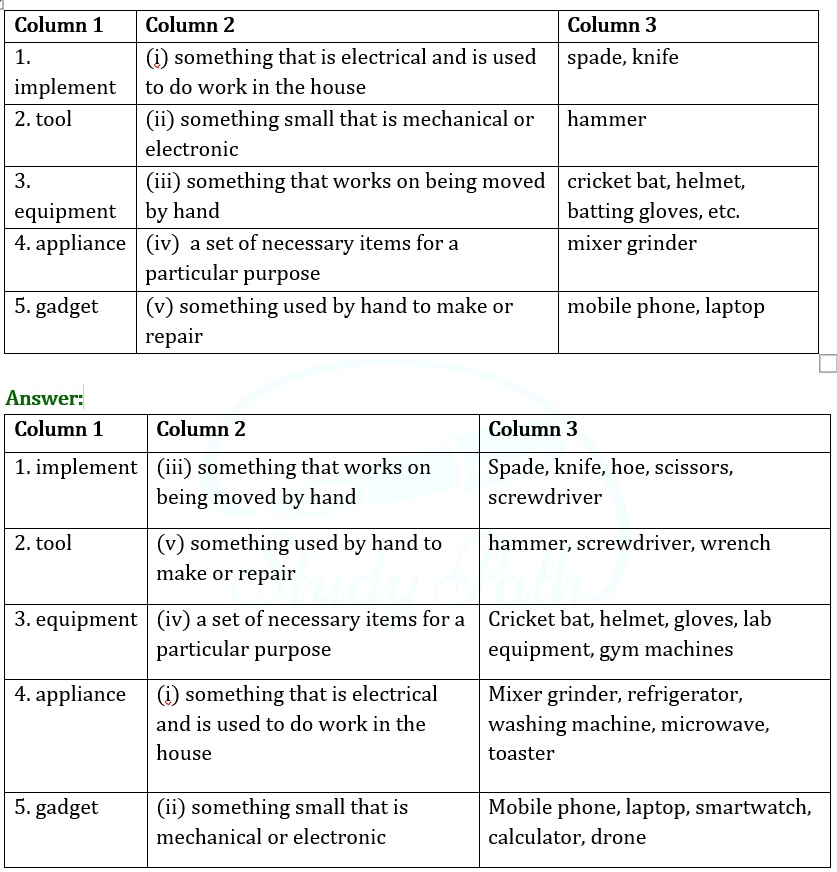
Now, match the type of instruments in Column 1 with their definitions in Column 2. Column 3 shows one example of each type of instrument. Add more examples in Column 3.
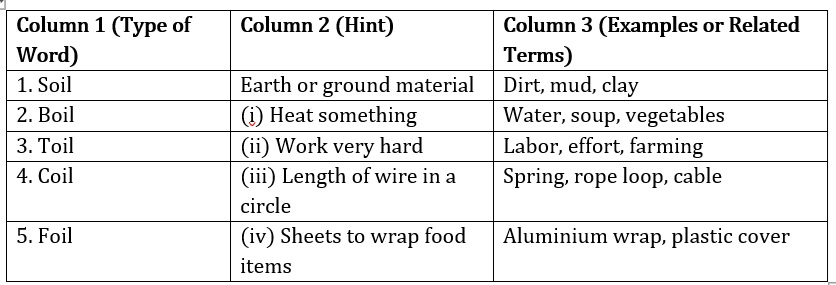
III. Complete the table by making new words in Column 1 using the hints given new in Column 2. Replace the first letter of the given word to create words. One example has been done for you.
1.
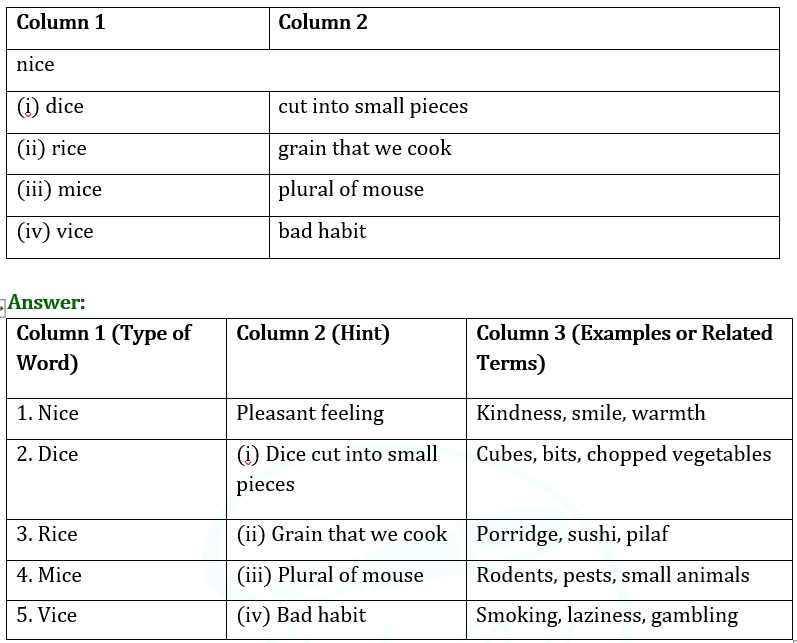
2.
| Column 1 | Column 2 |
| soil | |
| (i) boil | heat something |
| (ii) toil | work very hard |
| (iii) coil | length of wire in a circle |
| (iv) foil | sheets to wrap food items |
Answer:
Let us listen (Page No. 23)
I. You will listen to a presentation about the wonderful Rock Garden of Chandigarh. As you listen, answer the following questions using one to three exact words from the presentation. (Transcript for teacher on page 47)
1. Where was Nek Chand’s Rock Garden featured?
Answer: Nek Chand’s Rock Garden was featured on an Indian postage stamp in 1983.
2. What kind of sculptures does the Rock Garden have?
Answer: The Rock Garden has colorful sculptures made from waste materials.
3. How is the Rock Garden divided?
Answer: The Rock Garden is divided into three distinct phases. Each phase has a distinct showcase of artistry made from materials like terracotta pots, light fixtures, and broken toilet pots.
4. Name any one thing that has been transformed into a piece of art in the Rock Garden.
Answer: Broken toilets have been transformed into pieces of art in the Rock Garden.
5. Approximately, how many statues border the Rock Garden?
Answer: Approximately, 5,000 statues border the Rock Garden.
Let us speak (Page No. 23)
The speaker of the poem might have felt sorry for stepping on Mrs. Jones’ flower. When we make a mistake, we must express regret and apologise for our actions.
1. When we apologise to a friend or a family member, we use informal language. Take turns to apologise for the following situations and respond to the apology.
(i) You have eaten your brother’s share of sweets.
(ii) You have broken your sister’s flower craft.
(iii) You accidentally spilled ink on your mother’s important documents.
(iv) You forgot to bring your friend’s notebook to the school after borrowing it.
You may use the following phrases given below.
| Phrases for Apology | Phrases to Respond to Apology |
| • I’m sorry about… | • That’s alright. |
| • I’m really sorry… | • It’s no big deal. |
| • Please forgive me for… | • No problem |
| • Sorry, I didn’t mean to… | • These things happen. |
Answer:
| Phrases for Apology | Phrases to Respond to Apology |
| I’m really sorry, I ate your share of sweets. | That’s alright. |
| I’m really sorry about forgetting to bring your notebook today. | It’s no big deal. |
| Please forgive me for breaking your flower craft. | No problem |
| Sorry, I didn’t mean to spill ink on your documents. | These things happen. |
2. When we apologise to someone in authority like a Principal or a teacher in a formal setting, we use formal language. Work in pairs and take turns to apologise for the following situations and respond to the apology.
(i) You did not bring an assignment that was due for submission.
(ii) You the Principal were late to school for the past three days and had to meet
(iii) You did not submit your project work and were asked to explain. You may use the phrases given below.
You may use the phrases given below.
| Phrases for Apology | Phrases to Respond to Apology |
| • I’m extremely sorry for… I promise it won’t happen again. | • I accept your apology. Please ensure you… |
| • I owe you an apology for… I’ll do my best not to repeat it. | • I appreciate you saying this, but… |
| • I really regret…I assure you that this will never happen again. | • I’m glad you realised your mistake… |
Answer:
| Phrases for Apology | Phrases to Respond to Apology |
| I’m extremely sorry for not bringing my assignment. I promise it won’t happen again. | I accept your apology. Please ensure you submit it by tomorrow. |
| I owe you an apology for being late to school for the past three days. I’ll do my best not to repeat it. | I appreciate you saying this, but you must be more punctual from now on. |
| I really regret not submitting my project work. I assure you that this will never happen again. | I’m glad you realised your mistake. Make sure you complete it as soon as possible. |
Let us write (Page no. 25)
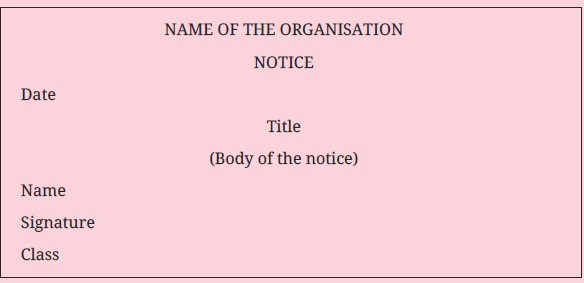
You are a member of the Nature Club of your school. Draft a notice informing the students of Grades 6-8 about the inauguration of the Herb Garden.
Points to remember:
- Mention the purpose of writing, date, time, venue, and any other relevant information-whom to contact, when, and where.
- Use formal language in the third person form.
- Write the notice in a box.
Answer:
GREEN VALLEY SCHOOL
NATURE CLUB
NOTICE
Date: 10 July 2025 Nature Club
Inauguration of the Herb Garden
This is to inform all students of Grades 6–8 that the Nature Club is organising the inauguration of the school Herb Garden on 15 July 2025 at 10:30 a.m. in the school garden area.
The programme will include a brief talk on medicinal plants and a guided tour of the garden. All interested students are requested to attend and be part of this eco-friendly initiative.
For further details, students may contact the Nature Club in-charge.
Rohit Sharma
Secretary
Nature Club
Grade 8
About the Poem: A Concrete Example
The poem A Concrete Example describes Mrs. Jones’s distinctive garden, with its stones, decorations, and tiny plants. The speaker’s visit ends in a surprising discovery about a flower that has been discussed at length. This humorous turn makes the poem both entertaining and gently thought-provoking.
Students also explore the speaker’s viewpoint, the poem’s playful tone, and the contrast between admiration and carelessness. The activities help them appreciate poetic language and explain how the ending changes their understanding of the garden visit.