

NCERT Solutions for Class 8 Science Chapter 12 How Nature Works in Harmony are provided here with simple and easy-to-understand explanations. Based on the NCERT textbook Curiosity, this chapter introduces ecosystems, relationships among organisms, and the connections between living things and their surroundings. These NCERT Solutions for Class 8 Science help students understand important concepts, complete textbook activities, and revise the chapter for school examinations.
How Nature Works in Harmony Class 8 Questions and Answers
Probe and Ponder Questions and Answers (Page no. 190)
Question: How might the loss of forest cover and changes in rainfall patterns lead elephants to enter human farms and villages?
Answer: Elephants depend on plenty of vegetation and water for survival. When forests are cleared for roads, farming, or buildings, their food and shelter disappear. At the same time, changes in rainfall patterns can dry up waterholes and reduce plant growth in their habitats. As a result, elephants leave forests in search of food and water. Farms with crops like sugarcane and bananas attract them, leading to elephants entering human villages and causing conflicts.
Question: Imagine you are a tree in a dense forest. What kind of relationships would you have with water, sunlight, other animals, and other components of the forest?
Answer: If I were a tree in a dense forest, I would absorb water and nutrients from the soil and use sunlight for photosynthesis. Animals and birds would rely on me for food and shelter, while insects would help in pollination and seed dispersal.
Question: Do you think the Earth can thrive without humans? Can humans survive without the Earth?
Answer: Yes, the Earth can thrive without humans. Earth’s ecosystems functioned in balance through interactions among plants, animals, microbes, and natural cycles even before human appeared.
On the other hand, humans cannot survive without Earth. We depend on it for air, water, food, shelter, and all natural resources. Earth provides the right atmosphere and conditions for life. Without Earth’s ecosystems and resources, human survival would be impossible.
Question: If two kinds of birds compete for the same fruit, how might their way of living change over time?
Answer: If two kinds of birds compete for the same fruit, they will experience constant struggle for food. To avoid this, they may adapt by changing their feeding habits, timing, or even diet. For example, one bird might adapt by eating different fruits or at different times to avoid fights. Such adaptations reduce competition and allow both species to coexist in the same habitat.
Question: Can human actions cause natural disasters?
Answer: Yes, human actions can contribute to natural disasters. For example, deforestation increases the risk of floods and landslides. Burning fossil fuels leads to global warming, which intensifies cyclones, droughts, and heatwaves. Overuse of pesticides can disrupt ecosystems, indirectly contributing to environmental imbalances.
Keep the Curiosity Alive Exercise Questions (Pages 207-208)
1: Refer to the given diagram (Fig.) and select the wrong statement.
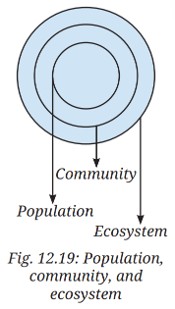
(i) A community is larger than a population.
(ii) A community is smaller than an ecosystem.
(iii) An ecosystem is part of a community.
Answer: (iii) An ecosystem is part of a community.
Explanation: According to the diagram, the population is a part of a community, and the community is a part of an ecosystem. So, the ecosystem is the largest unit, and the ecosystem is not a part of the community. Hence, option (iii) is wrong.
2. A population is part of a community. If all decomposers suddenly disappeared from a forest ecosystem, what changes do you think would occur? Explain why decomposers are essential.
Answer: If decomposers suddenly disappeared from a forest ecosystem, dead plants, animals, and waste materials would accumulate without being broken down. Nutrients like nitrogen and phosphorus would not return to the soil, making it infertile. Without fertile soil, plants would struggle to grow, reducing food availability.
Decomposers are essential because they recycle nutrients back into the soil by breaking down dead matter. They ensure that plants get the minerals they need, maintain soil fertility, and keep the ecosystem balanced.
3. Selvam from Cuddalore district, Tamil Nadu, shared that his milage was less affected by the 2004 Tsunami compared to nearby milages due to the presence of mangrove forests. This surprised Sarita, Shabnam, and Shijo. They wondered if mangroves were protecting the village. Can you help them understand this?
Answer: Yes, mangrove forests acted as natural protectors for Selvam’s village during the 2004 Tsunami. Mangrove trees grow densely along coastlines with thick roots. When tsunami waves hit, these roots and tree trunks slowed down the force of the water.
4. Look at this food chain:
Grass → Grasshopper → Frog → Snake
If frogs disappear from this ecosystem, what will happen to the population of grasshoppers and snakes? Why?
Answer: In this food chain, frogs eat grasshopper to survive. So, if frogs disappear the number of grasshoppers will rise sharply. Snakes depend on frog for their survival. So, if frogs disappear the snake population will decline. Thus, the disappearance of frogs will create an imbalance in the ecosystem by increasing grasshopper numbers and reducing snake numbers.
5. In a school garden, students noticed fewer butterflies the previous season. What could be the possible reasons? What steps can students take to have more butterflies on campus?
Answer: The possible reasons for fewer butterflies in this season could be:
- Lack of nectar-rich flowering plants.
- Excessive use of chemical pesticides harming butterflies or caterpillars.
- Absence of host plants for laying eggs.
- Unfavourable weather conditions (too much rain or heat).
Steps which students can take to have more butterflies on campus are:
- Plant more nectar-rich flowers like marigold, sunflower.
- Grow host plants like milkweed, lemon, or curry leaf for caterpillars.
- Avoid chemical pesticides and use organic methods instead.
- Create a butterfly-friendly zone with water, shade, and shelter.
6. Why is it not possible to have an ecosystem with only producers and no consumers or decomposers?
Answer: If there are no consumers, producers like plants will keep growing without control. Soon they will become overcrowded and start dying due to competition. Without decomposers, dead plants will pile up, and essential nutrients will not return to the soil. Slowly, the soil will lose its fertility, and even plants will stop growing. Thus, it is not possible to have an ecosystem with only producers and no consumers or decomposers.
7. Observe two different places near your home or school (e.g., a park and a roadside). List the living and non-living components you see. How are the two ecosystems different?
Answer: A park has many living things like trees, grass, birds, and insects, along with non-living things like soil, water, air, and sunlight.
On the roadside, living components include a few weeds, stray dogs, crows, and some insects, while non-living components are concrete, vehicles, dust, smoke, and sunlight.
Differences between park and roadside:
- The park has more plants and animals in comparison to the roadside.
- The roadside has more pollution, whereas the park has less pollution and fresh air.
8. ‘Human-made ecosystems like agricultural fields are necessary, but they must be made sustainable.’ Comment on the statement.
Answer: Human-made ecosystems such as agricultural fields are necessary because they provide us with food, raw materials and employment. But unsustainable practices like overuse of fertilisers, pesticides, and growing only one type of crop reduce soil fertility, pollute water, and disturb biodiversity. To make these ecosystems sustainable methods such as organic farming, crop rotation, and natural pest control are needed.
9. If the Indian hare population (Fig.) drops because of a disease, how would it affect the number of other organisms?
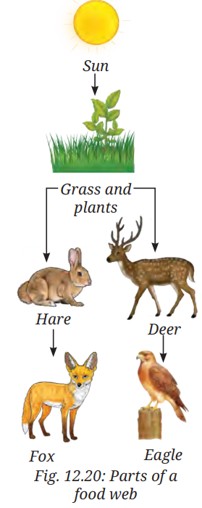
Answer: If the Indian hare population drops due to disease, their predators like foxes, eagles, and snakes will suffer food shortage so their populations may decline. At the same time, grasses and plants eaten by hares will increase due to less grazing. This shows that a fall in one population disturbs the balance of the entire ecosystem.
Class 8 Science Curiosity Chapter 12 Questions and Answers
The chapter How Nature Works in Harmony explores how plants, animals, microorganisms, and non-living components interact in an ecosystem. Students learn about the roles of producers, consumers, and decomposers and the movement of energy through food relationships.
Students also study how changes in one part of an ecosystem can affect other parts. The chapter highlights biodiversity, interdependence, and the importance of conserving habitats so that natural processes can continue to support life.