

NCERT Solutions for Class 8 Science Chapter 9 The Amazing World of Solutes, Solvents, and Solutions are provided here with simple and easy-to-understand explanations. Based on the NCERT textbook Curiosity, this chapter introduces dissolving, the roles of solutes and solvents, and the factors that affect the formation of solutions. These NCERT Solutions for Class 8 help students understand important concepts, complete textbook activities, and revise the chapter for school examinations.
The Amazing World of Solutes, Solvents, and Solutions Class 8 Questions and Answers
Probe and Ponder Questions and Answers (Page no. 134)
Question: What happens when you add too much sugar to your tea and it stops dissolving? How can you solve this problem?
Answer: When too much sugar is added to tea, it stops dissolving because the solution becomes saturated, and excess sugar settles at the bottom. The problem can be solved either by heating the tea to increase solubility or by adding more tea/water so that the extra sugar can dissolve.
Question: Why do sugar and salt dissolve in water but not in oil? Why is water considered a good solvent?
Answer: Sugar and salt dissolve in water because both are polar and interact with water’s polar molecules. Oil is non-polar, so sugar and salt do not dissolve in it. Water is considered a good solvent, often called the universal solvent, as it dissolves many substances needed for biological and everyday processes.
OR
Sugar and salt are polar substances. Water is also a polar solvent, meaning its molecules have partial positive and negative charges. These charges attract and pull apart the sugar and salt particles, allowing them to dissolve evenly.
Oil, on the other hand, is non-polar. Since “like dissolves like,” polar substances such as sugar and salt cannot dissolve in non-polar solvents like oil. That’s why they remain undissolved in oil.
Water is called a good solvent because it can dissolve a wide variety of substances, especially polar and ionic ones.
Question: Why are water bottles usually tall and cylindrical in shape instead of spherical?
Answer: Water bottles are tall and cylindrical instead of spherical because cylinders are easier to hold, store, and transport. They save space, stand upright, and do not roll like spheres. Cylindrical shapes also withstand pressure better, making them more practical and durable for everyday use.
Question: We know air is a mixture. Would a mixture of gases also be considered a solution? (Page no. 135)
Answer: Yes, a mixture of gases can be a solution if the gases mix uniformly. Air is a gaseous solution where nitrogen is the solvent and other gases like oxygen, argon, and carbon dioxide are solutes. It is a homogeneous mixture, as the gases are evenly distributed.
Question: What will happen if we keep adding more salt to a given amount of water? (Page no. 136)
Answer: If more salt is added to water, it dissolves only up to a certain limit. Once the solution becomes saturated, the excess salt will not dissolve and will settle at the bottom. The solubility of salt depends on temperature. More salt dissolves in hot water than in cold water.
Question: Do gases also dissolve in water? (Page no. 139)
Answer: Yes, gases do dissolve in water. For example, oxygen dissolves in small amounts and is essential for aquatic life. Gas solubility decreases with rising temperature, so cold water holds more oxygen than warm water.
Question: Why are measuring cylinders always designed narrow and tall instead of wider and shorter like a beaker? (Page no.144)
Answer: Measuring cylinders are tall and narrow to give accurate volume readings.
Keep the Curiosity Alive Exercise Questions and Answers (Pages no. 149-151)
Question 1. State whether the statements given below are True [T] or False [F]. Correct the false statements.
(i) Oxygen gas is more soluble in hot water than in cold water.
(ii) A mixture of sand and water is a solution.
(iii) The amount of space occupied by any object is called its mass.
(iv) An unsaturated solution has more solute dissolved than a saturated solution.
(v) The mixture of different gases in the atmosphere is also a solution.
Answer:
(i) False:
Reason: Oxygen is more soluble in cold water.
(ii) False:
Reason: Sand and water form a non-uniform mixture not a solution, because sand does not dissolve.
(iii) False:
Reason: The space occupied by an object is called its volume. Mass is the amount of matter in the object.
(iv) False:
Reason: A saturated solution has the maximum solute dissolved. An unsaturated solution can still dissolve more solute.
(v) True.
Question 2. Fill in the blanks:
(i) The volume of a solid can be measured by the method of displacement, where the solid is ____________ in water and the ____________ in water level is measured.
(ii) The maximum amount of ____________ dissolved in ____________ at a particular temperature is called solubility at that temperature.
(iii) Generally, the density ____________ with increase in temperature.
(iv) The solution in which glucose has completely dissolved in water, and no more glucose can dissolve at a given temperature, is called a ____________ solution of glucose.
Answer:
(i) The volume of a solid can be measured by the method of displacement, where the solid is immersed in water and the rise in water level is measured.
(ii) The maximum amount of solute dissolved in solvent at a particular temperature is called solubility at that temperature.
(iii) Generally, the density decreases with increase in temperature.
(iv) The solution in which glucose has completely dissolved in water, and no more glucose can dissolve at a given temperature, is called a saturated solution of glucose.
Question 3. You pour oil into a glass containing some water. The oil floats on top. What does this tell you?
(i) Oil is denser than water.
(ii) Water is denser than oil.
(iii) Oil and water have the same density.
(iv) Oil dissolves in water.
Answer: (ii) Water is denser than oil.
Question 4. A stone sculpture weighs 225 g and has a volume of 90 cm³. Calculate its density and predict whether it will float or sink in water.
Answer: Given,
Mass = 225 g, Volume = 90 cm³
∴Density of stone = 225/90
=2.5 g/cm³
Since the water has a density of 1 g/cm³, therefore, the sculpture is denser than water.
Hence, the stone sculpture will sink in water.
Question 5. Which one of the following is the most appropriate statement, and why are the other statements not appropriate?
(i) A saturated solution can still dissolve more solute at a given temperature.
(ii) An unsaturated solution has dissolved the maximum amount of solute possible at a given temperature.
(iii) No more solute can be dissolved into the saturated solution at that temperature.
(iv) A saturated solution forms only at high temperatures.
Answer: Statement (iii) is most appropriate.
Reason:
(i) It is not appropriate as a saturated solution cannot dissolve more solute at a given temperature.
(ii) An unsaturated solution can have more solute dissolved at a given temperature.
(iv) A Saturated solution can be formed at all temperatures, not only at high temperatures.
Question 6. You have a bottle with a volume of 2 litres. You pour 500 mL of water into it. How much more water can the bottle hold?
Answer: The bottle can hold 2 L = 2000 mL.
The amount of water poured = 500 mL
Therefore, the remaining volume is = 2000 – 500
= 1500 mL
So, the bottle can still hold 1500 mL (or 1.5 L) of more water.
Question 7. An object has a mass of 400 g and a volume of 40 cm³. What is its density?
Answer: Given,
Mass = 400 g, Volume = 40 cm³
We know that,
Density = Mass/Volume
= (400 g)/(40 cm3)
= 10 g/cm³
Therefore, the density of this object is 10 g/cm³, which means the object has 10 grams of mass in every cubic centimeter of space.
Question 8. Analyse Figures (a) and (b). Why does the unpeeled orange float, while the peeled one sinks? Explain.
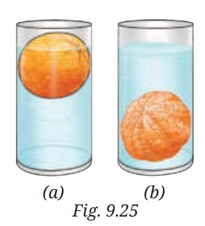
Answer: We know that the objects with low density float in medium of higher density. On the other hand, objects with higher density sink in mediums of lower density.
The unpeeled orange floats because its peel has many tiny air pockets. These pockets make overall density of the orange less than water.
When the orange is peeled, the air-filled spongy layer is removed. It increases the density of the peeled orange. Density of an orange without its peel is higher than the density of water. That’s why peeled orange sinks in water.
Question 9. Object A has a mass of 200 g and a volume of 40 cm³. Object B has a mass of 240 g and a volume of 60 cm³. Which object is denser?
Answer: As we know, Density = Mass ÷ Volume
Therefore, for object A, density = 200 g ÷ 40 cm³ = 5 g/cm³
And for object B, density = 240 g ÷ 60 cm³ = 4 g/cm³
Hence, object A is denser, having more density than B.
Question 10. Reema has a piece of modeling clay that weighs 120 g. She first moulds it into a compact cube that has a volume of 60 cm³. Later, she flattens it into a thin sheet. Predict what will happen to its density.
Answer: We know that, Density = Mass ÷ Volume
Mass is always constant for an object. When the cube is flattened out the Volume does not change only the shape changes. So, the density of the clay will not change upon changing its shape.
Question 11. A block of iron has a mass of 600 g and a density of 7.9 g/cm³. What is its volume?
Answer: We know that
Volume = Mass ÷ Density
= 600 g ÷ 7.9 g/cm³
= 75.949 cm³
So, the volume of the iron block is about 75.949 cm³.
Question 12. You are provided with an experimental setup as shown in Figures (a) and (b). On keeping the test tube (Figure b) in a beaker containing hot water (~ 70°C), the water level in the glass tube rises. How does it affect the density?

Answer: When the test tube is placed in hot water, the water inside the glass tube gets heated and expands. This causes the water level to rise. The mass remains the same, but the volume increases.
We know, density = mass/volume.
So, as the volume increases, the density will decrease. This shows that heating reduces density, which is why hot air or water rises.
Hence, the density of water in setup (b) will decrease.
Class 8 Science Curiosity Chapter 9 Questions and Answers
The chapter The Amazing World of Solutes, Solvents, and Solutions explains what happens when a substance dissolves in a solvent. Students identify solutes, solvents, and solutions in familiar examples and explore how the amount of dissolved material can vary.
Students also investigate solubility and the influence of conditions such as temperature on dissolving. Activities encourage them to observe carefully, compare mixtures, and connect the properties of solutions with everyday uses in homes and the wider world.