

NCERT Solutions for Class 8 Science Chapter 11 Keeping Time with the Skies are provided here with simple and easy-to-understand explanations. Based on the NCERT textbook Curiosity, this chapter introduces patterns in the Sun, Moon, and Earth and their use in measuring time and developing calendars. These NCERT Solutions for Class 8 Science help students understand important concepts, complete textbook activities, and revise the chapter for school examinations.
Keeping Time with the Skies Class 8 Science Questions and Answers
Probe and Ponder Questions and Answers (Page no. 170)
Question: Have you ever seen the Moon during the day? Why do you think it is sometimes possible when the Sun is up?
Answer: Yes, the Moon can often be seen during the day. The Moon does not produce its own light but reflects sunlight. It can be seen in different parts of the sky depending on its phase. A waxing Moon is easiest to spot at sunset and a waning Moon at sunrise.
Question: Imagine you lived on the Moon instead of Earth. What would you mean by a day, a month, or a year?
Answer: If we lived on the Moon, the meaning of “day,” “month,” and “year” would be very different from Earth.
- A day on the Moon i.e., from one sunrise to the next would be about 27.3 Earth days.
- A month might be defined by one complete orbit around Earth which is also about 27.3 Earth days.
- The Moon, along with Earth, revolves around the Sun. So one lunar year would be the same as one Earth year, about 365¼ days.
Question: What would happen if Earth had two moons instead of one? How would that change the night sky?
Answer: If Earth had two moons, our nights would look much brighter. Sometimes both moons would shine together, while at other times they would appear in different parts of the sky. Each would show its own phase, so the sky would always be changing. Their pull on the oceans would make tides stronger and irregular. Eclipses would happen more often, giving us a night sky full of surprises.
Question: If we didn’t have clocks or calendars, how else could we measure time?
Answer: Without clocks or calendars, time could be measured by:
- Daily motion of the Sun (sunrise, noon, sunset).
- Observing the phases of the Moon to count months.
- Tracking stars and constellations that change with the seasons.
- Observing different seasons like summer, monsoon, winter.
Question: Why does the illuminated portion of the Moon seen from the Earth decrease when it appears closer to the Sun? (Page no. 174)
Answer: The Sun always lights up one half of the Moon, but from Earth we can only see the portion of that lit-up side that faces us. As the Moon moves closer to the Sun in the sky, the angle between the Earth, Moon, and Sun becomes smaller. Because of this less of the illuminated side is visible to us. That’s why the Moon’s glowing shape appears to shrink from a big round disc into a thin crescent.
Question: Why do most Indian festivals fall on different dates every year? (Page no. 183)
Answer: Most Indian festivals are linked to the phases of the Moon. Many communities follow lunar or luni-solar calendars instead of the purely solar Gregorian calendar. A lunar month is about 29.5 days, so a lunar year has about 354 days, which is shorter than the solar year of 365 days. This mismatch shifts festival dates each year in the Gregorian calendar.
Question: When I look at the night sky in early evening, I see some moving stars. What are they? Is their motion also periodic? (Page no. 185)
Answer: The moving stars are artificial satellites, not real stars. They appear as bright points crossing the sky rapidly. Satellites orbit Earth in about 100 minutes, so their motion is periodic and predictable. This is why they can be spotted regularly at certain times after sunset or before sunrise.
Keep the Curiosity Alive Exercise Questions (Pages 187-189)
1. State whether the following statements are True or False.
(i) We can only see that part of the Moon which reflects sunlight towards us.
(ii) The shadow of Earth blocks sunlight from reaching the Moon, causing phases.
(iii) Calendars are based on various astronomical cycles which repeat predictably.
(iv) The Moon can only be seen at night.
Answer:
(i) True
(ii) False
Reason: Earth’s shadow causes a lunar eclipse, not phases.
(iii) True
(iv) False
Reason: The Moon can also be seen during the daytime, depending on its phase and position in the sky.
2. Amol was born on the 6th of May on a full Moon day. Does his birthday fall on the full Moon day every year? Explain your answer.
Answer: No, Amol’s birthday will not fall on the full moon day every year. This is because lunar cycle does not match our calendar months. A full Moon occurs every 29.5 days, while a year is about 365 days. Since these cycles do not match, the date of the full Moon changes each year in the Gregorian calendar.
3. Name two things that are incorrect in the Figure.
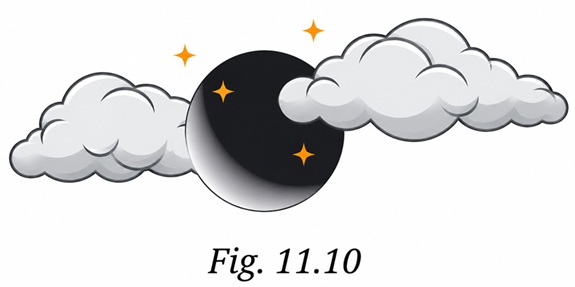
Answer: The two things that are incorrect in the figure are:
- Stars are shown near the Moon during the daytime, which is incorrect because stars are only visible at night.
- The Moon’s dark part is shaded incorrectly to show a phase.
4. Look at the pictures of the Moon in the figure, and answer the following questions.
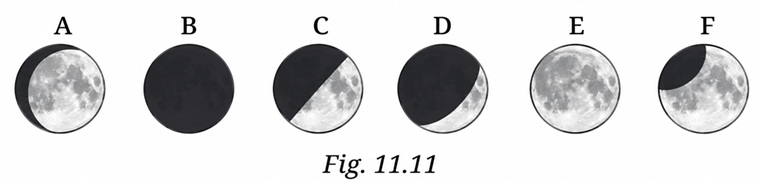
(i) Write the correct panel number corresponding to the phases of the Moon shown in the pictures above.
| Picture label (e.g., A, B, C, etc.) | Phase of Moon |
| Three days after New Moon | |
| Full Moon | |
| Three days after the Full Moon | |
| A week after the Full Moon | |
| Day of New Moon |
(ii) List the picture labels of the phases of the Moon that are never seen from Earth.
Answer:
(i)
| Picture Label | Phase of Moon |
| C | Three days after New Moon |
| E | Full Moon |
| F | Three days after the Full Moon |
| A | A week after the Full Moon |
| B | Day of New Moon |
(ii) Picture B (New Moon phase) is never seen from Earth because the illuminated side of the Moon is facing away from us.
5. Malini saw the Moon overhead in the sky at sunset.
(i) Draw the phase of the Moon that Malini saw.
(ii) Is the Moon in the waxing or the waning phase?
Answer:
(i) At sunset, the Moon is overhead only during the first quarter (a week after New Moon), when the right half is illuminated. So, we need to draw half Moon.

(ii) The moon is in the waxing phase because it occurs after New Moon, and the bright part is increasing.
6. Ravi said, “I saw a crescent Moon, and it was rising in the East when the Sun was setting.” Kaushalya said, “Once I saw the gibbous Moon during the afternoon in the East.” Who out of the two is telling the truth?
Answer: Kaushalya is telling the truth because Ravi said he saw a crescent moon rising in the east at sunset. But this is not possible because Crescent Moons do not rise in the East at sunset. Crescent rises just before sunrise, not at sunset.
On the other hand, Kaushalya said she saw a gibbous moon during the afternoon in the east. This is possible because a waxing gibbous Moon rises in the afternoon and is often visible before sunset.
7. Scientific studies show that the Moon is getting farther away from the Earth and slower in its revolution. Will luni-solar calendars need an intercalary month more often or less often?
Answer: The Moon is slowly drifting away from Earth and taking longer to complete one revolution. This means the lunar month will become slightly longer over time. So, a lunar year becomes even shorter compared to the solar year. Therefore, in the future, luni-solar calendars will need the intercalary month less often than they do now.
8. A total of 37 full Moons happen during 3 years in a solar calendar. Show that at least two of the 37 full moons must happen during the same month of the solar calendar.
Answer: In 3 years, the solar calendar has 36 months. If every month had only one full Moon, there would be at most 36 full Moons. But since 37 full Moons occur, so, at least one month must contain two full Moons.
9. On a particular night, Vaishali saw the Moon in the sky from sunset to sunrise. What phase of the Moon would she have noticed?
Answer: As Vaishali saw the moon in the sky from sunset to sunrise, then it is the full moon phase. It is because the full moon rises at sunset, then remains visible all night, and sets as sunrise.
10. If we stopped having leap years, in approximately how many years would the Indian Independence Day happen in winter?
Answer: One leap year adds ~1 day every 4 years.
Without leap years, the calendar shifts by 1 day every 4 years.
There are roughly 183 days between 15 August (monsoon) and winter (mid-February).
183 × 4 = 732 years
∴ In approximately 730-732 years, 15 August would occur in winter.
11. What is the purpose of launching artificial satellites?
Answer: Artificial satellites are launched for communication, navigation, weather forecasting, disaster management, and space research. They help in mapping, studying celestial objects, and supporting scientific missions.
12. On which periodic phenomenon are the following measures of time based:
(i) day
(ii) month
(iii) year?
Answer:
(i) Day → Earth’s rotation on its axis.
(ii) Month → Moon’s revolution around Earth.
(iii) Year → Earth’s revolution around the Sun.
Class 8 Science Curiosity Chapter 11 Questions and Answers
The chapter Keeping Time with the Skies explores how regular changes in the sky help people keep track of time. Students learn about the movements of Earth and the Moon and connect these with days, months, years, and the changing appearance of the Moon.
Students also examine how observations of celestial patterns contributed to the development of calendars. The chapter encourages them to relate scientific explanations to familiar timekeeping traditions and to recognise the importance of careful, repeated observations.