

NCERT Solutions for Class 8 Science Chapter 10 Light: Mirrors and Lenses are provided here with simple and easy-to-understand explanations. Based on the NCERT textbook Curiosity, this chapter introduces reflection, different types of mirrors and lenses, and the formation of images. These NCERT Solutions for Class 8 Science help students understand important concepts, complete textbook activities, and revise the chapter for school examinations.
Light: Mirrors and Lenses Class 8 Science Questions and Answers
Probe and Ponder Questions and Answers (Page no. 152)
Question: Can we make mirrors that can give enlarged or diminished images?
Answer: Yes. Spherical mirrors can give enlarged or diminished images. A concave mirror forms enlarged images when objects are close and diminished or inverted images when objects are far. A convex mirror always produces erect and diminished images. Hence, concave mirrors are used in dentist’s tools, while convex mirrors are used in vehicle side-view mirrors.
Question: On the side-view mirrors of vehicles, there is a warning that says “Objects in mirror are closer than they appear”. Why is this warning written there?
Answer: Side-view mirrors of vehicles are convex mirrors. Convex mirrors always form erect, diminished images, which means the vehicles behind appear smaller than their actual size. To prevent drivers from misjudging the distance and causing accidents, the warning “Objects in mirror are closer than they appear” is written on such mirrors.
Question: Why is there a curved line on some reading glasses?
Answer: Some reading glasses have a curved line because they are made using lenses with two different powers. The upper portion of the lens is usually meant for distant vision, while the lower portion is for near vision. The dividing line between these two powers is seen as a curved line on the glass. Such glasses are called bifocal lenses. They help people with presbyopia.
Question: How can we distinguish between concave and convex mirrors? (Page no. 155)
Answer: Concave and convex mirrors can be distinguished by the way their reflecting surface curves and by the images they form. If the reflecting surface curves inwards, it is a concave mirror. If the reflecting surface curves outwards it is a convex mirror. A concave mirror can form enlarged, diminished, or same-sized images. A convex mirror always forms an erect and diminished image, regardless of distance.
Question: We have observed images formed by three types of mirrors – plane, concave, and convex. But are there any laws that govern the image formation? (Page no. 157)
Answer: Yes, there are definite laws of reflection that govern image formation in all types of mirrors – plane, concave, and convex.
- First law of reflection states that the angle of incidence is always equal to the angle of reflection.
- Second law of reflection states that the incident ray, the reflected ray, and the normal all lie in the same plane.
Question: Are the laws of reflection applicable to spherical mirrors also? (Page no. 160)
Answer: Yes, the laws of reflection apply to spherical mirrors like concave and convex mirrors.
Question: What changes can be seen in the objects when viewed through lenses? (Page no. 163)
Answer: When objects are viewed through lenses, the changes depend on whether the lens is convex or concave. If the object is placed close to the convex lens, the image appears erect and enlarged. As the object moves farther away, the image becomes diminished and inverted. A concave lens always produces an image that is erect and diminished in size.
Question: Do lenses also converge or diverge the light beam? (Page no. 163)
Answer: Yes, lenses can both converge and diverge light beams. Convex lenses converge light, while concave lenses diverge light.
Question: Since a convex lens converges a light beam, can it also burn a paper? (Page no. 164)
Answer: Yes, a convex lens can burn paper. A convex lens bends sunlight and brings it together at one point called the focus. If we keep a piece of paper there, the heat is strong enough to make the paper burn.
Question: Where are all the lenses used? (Page no. 165)
Answer: Lenses are used in a variety of applications, both in everyday life and in scientific instruments. These include eyeglasses, cameras, microscopes, telescopes, and projectors, as well as simple magnifying glasses and spyholes indoors.
Keep the Curiosity Alive Exercise Questions (Pages 166-169)
1. A light ray is incident on a mirror and gets reflected by it (Figure). The angle made by the incident ray with the normal to the mirror is 40°. What is the angle made by the reflected ray with the mirror?
(i) 40°
(ii) 50°
(iii) 45°
(iv) 60°
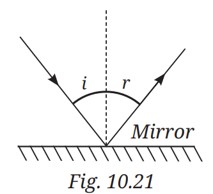
Answer: (ii) 50°
Reason: If the incident ray makes a 40° angle with the normal, then:
Angle of incidence (i) = 40°
According to the law of reflection,
Angle of reflection (r) = Angle of incidence (i) = 40°
Now,
Angle between reflected ray and mirror = 90° – angle of reflection
= 90° – 40°
= 50°
2. The figure shows three different situations where a light ray falls on a mirror:
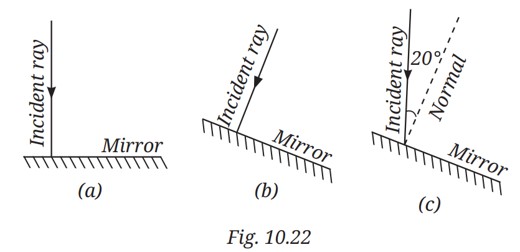
(i) The light ray falls along the normal.
(ii) The mirror is tilted, but the light ray still falls along the normal to the tilted surface.
(iii) The mirror is tilted, and the light ray falls at an angle of 20° from the normal.
Draw the reflected ray in each case (Use a ruler and protractor for accurate drawing). What is the angle of reflection in each case?
Answer: (i) When the light ray falls exactly along the normal (perpendicular to the surface)
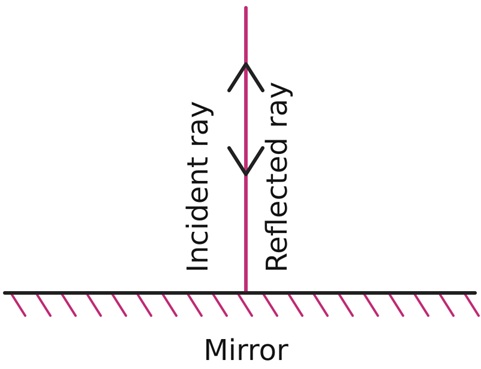
Angle of incidence = 0°
Angle of reflection = 0°
The reflected ray goes straight back along the same path.
(ii) The mirror is tilted, but the light ray still falls along the normal to the tilted surface
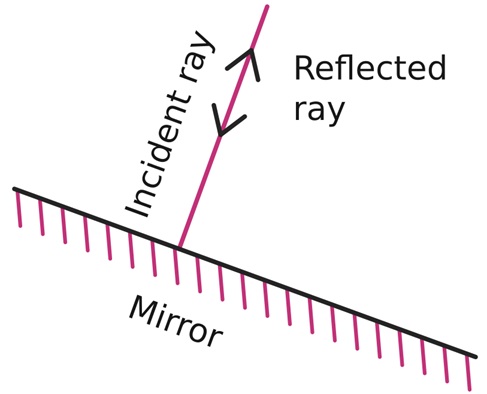
Even though the mirror is tilted, the ray is still perpendicular to the surface.
∴ Angle of incidence = 0°
Angle of reflection = 0°
The reflected ray goes straight back on itself.
(iii) The mirror is tilted, and the light ray falls at 20° from the normal
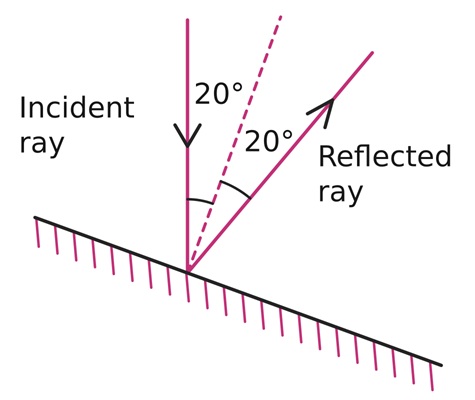
Angle of incidence = 20°
By the law of reflection:
Angle of reflection = 20°
The reflected ray will make a 20° angle with the normal, on the opposite side.
3. In the Figure, the cap of a sketch pen is placed in front of three types of mirrors.
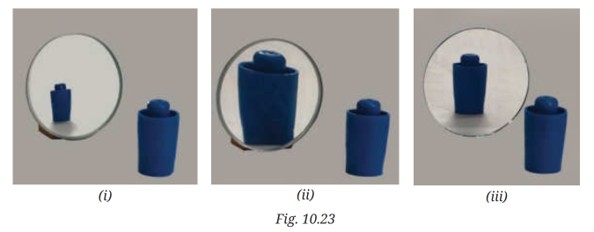
Match each image with the correct mirror.
| Image | Mirror |
| (i) | Plane mirror |
| (ii) | Convex mirror |
| (iii) | Concave mirror |
Answer:
| Image | Mirror |
| Image (i) | Convex mirror |
| Image (ii) | Concave mirror |
| Image (iii) | Plane mirror |
Image (i): Smaller, erect, and covers a wide area → Convex mirror.
Image (ii): Enlarged, depending on distance → Concave mirror.
Image (iii): Same size, erect → Plane mirror.
4. In the Figure, the cap of a sketch pen is placed behind a convex lens, a concave lens, and a flat transparent glass piece – all at the same distance.
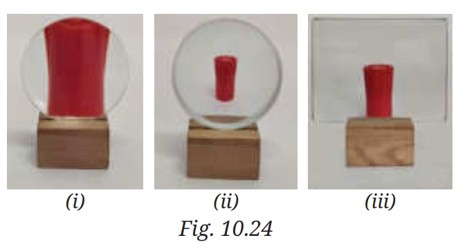
Match each image with the correct type of lens or glass.
| Image | Lens/Glass type |
| (i) | Flat transparent glass piece |
| (ii) | Convex lens |
| (iii) | Concave lens |
Answer:
| Image | Lens/Glass Type |
| Image (i) | Convex lens |
| Image (ii) | Concave lens |
| Image (iii) | Flat transparent glass piece |
Image (i): Larger than object (enlarged) → Convex lens.
Image (ii): Smaller than object (diminished) → Concave lens.
Image (iii): Same size as object → Flat transparent glass piece.
5. When the light is incident along the normal on the mirror, which of the following statements is true:
(i) Angle of incidence is 90°
(ii) Angle of incidence is 0°
(iii) Angle of reflection is 90°
(iv) No reflection of light takes place in this case
Answer: (ii) Angle of incidence is 0°
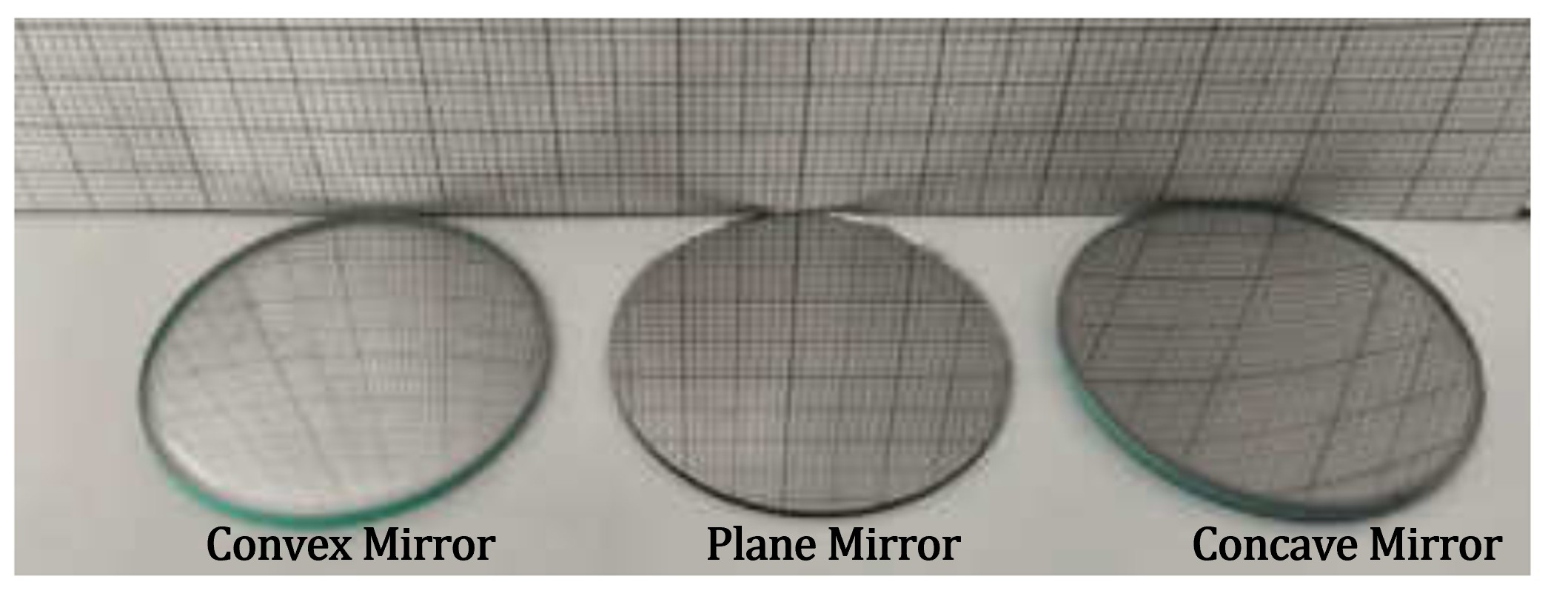
6. Three mirrors-plane, concave, and convex, are placed in the Figure. Based on the images of the graph sheet formed in the mirrors, identify the mirrors and write their names above the mirrors.
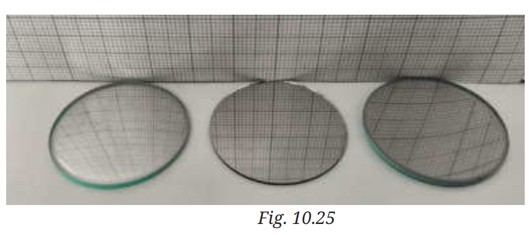
Answer:
7. In a museum, a woman walks towards a large convex mirror (Figure). She will see that:
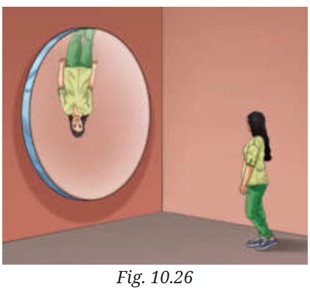
(i) Her erect image keeps decreasing in size.
(ii) her inverted image keeps decreasing in size.
(iii) her inverted image keeps increasing in size, and eventually it becomes erect and magnified.
(iv) Her erect image keeps increasing in size.
Answer: (i) Her erect image keeps decreasing in size.
Reason: Convex mirrors always show a small, erect image, and as we go closer the image gets even smaller.
8. Hold a magnifying glass over the text and identify the distance at which you can see the text bigger than they are written. Now move it away from the text. What do you notice? Which type of lens is a magnifying glass?
Answer: When we hold a magnifying glass close to the text, at the right distance, the letters look bigger. This is because the glass bends light rays to form an enlarged, erect image. If we move the magnifying glass farther away from the text, the image can become inverted or smaller.
A magnifying glass is made of a convex lens.
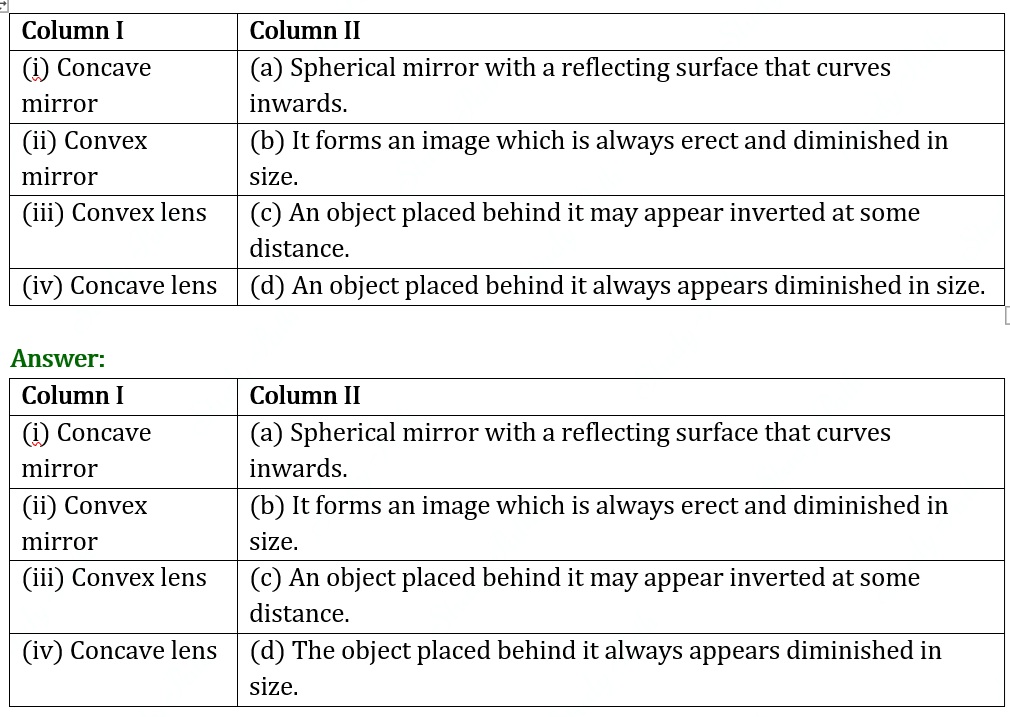
9. Match the entries in Column I with those in Column II.
10. The following question is based on Assertion/Reason.
Assertion: Convex mirrors are preferred for observing the traffic behind us.
Reason: Convex mirrors provide a significantly larger view area than plane mirrors.
Choose the correct option:
(i) Both Assertion and Reason are correct, and Reason is the correct explanation for Assertion.
(ii) Both Assertion and Reason are correct, but Reason is not the correct explanation for Assertion.
(iii) Assertion is correct, but Reason is incorrect.
(iv) Both Assertion and Reason are incorrect.
Answer: (i) Both Assertion and Reason are correct, and Reason is the correct explanation for Assertion.
Reason: Convex mirrors show a wider field of view, so they are used as rear-view mirrors.
11. In the Figure, note that O stands for object, M for mirror, and I for image.
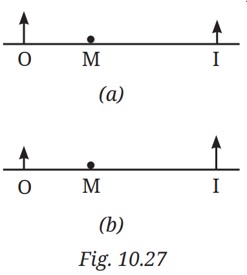
Which of the following statements is true?
(i) Figure (a) indicates a plane mirror, and Figure (b) indicates a concave mirror.
(ii) Figure (a) indicates a convex mirror and Figure (b) indicates a concave mirror.
(iii) Figure (a) indicates a concave mirror and Figure (b) indicates a convex mirror.
(iv) Figure (a) indicates a plane mirror, and Figure (b) indicates a convex mirror.
Answer: (ii) Figure (a) indicates a convex mirror and Figure (b) indicates a concave mirror.
Reason: In a convex mirror, the image formed is always erect and diminished. In a concave mirror, the erect and enlarged image is formed behind the mirror.
Question 12. Place a pencil behind a transparent glass tumbler (Figure a). Now fill the tumbler halfway with water (Figure b). How does the pencil appear when mewed through the water? Explain why its shape appears changed.
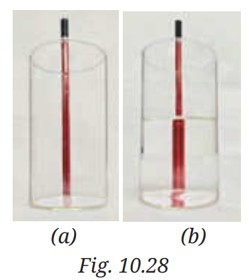
Answer: When the tumbler is filled with water, the pencil looks bent or broken at the surface. This happens due to refraction. Light bends when it moves from water to air because they have different densities. Because of this bending of light, the pencil appears shifted and its shape looks changed, though the pencil itself is straight.
Class 8 Science Curiosity Chapter 10 Questions and Answers
The chapter Light: Mirrors and Lenses explores how light interacts with reflecting surfaces and transparent curved materials. Students learn to recognise plane, concave, and convex mirrors and compare the images they produce.
Students also investigate convex and concave lenses and their effects on light. Simple observations and activities connect image formation with familiar uses of mirrors and lenses, helping students understand their importance in optical devices and everyday life.