

NCERT Solutions for Class 8 Science Chapter 5 Exploring Forces are provided here with simple and easy-to-understand explanations. Based on the NCERT textbook Curiosity, this chapter introduces pushes and pulls, contact and non-contact forces, and the effects of forces on objects. These NCERT Solutions for Class 8 Science Curiosity Chapter 5 help students understand important concepts, complete textbook activities, and revise the chapter for school examinations.
Exploring Forces Class 8 Science Questions and Answers
Probe and ponder Question Answer (Page no. 62)
Question 1. Why does it feel harder to pedal a bicycle when going uphill than on flat ground?
Answer: It feels harder to pedal a bicycle going uphill because, besides friction and air resistance, the rider must also work against gravity, which pulls the bicycle downward on a slope. This extra opposing force makes it harder to pedal. So much more energy is required when riding uphill than on flat ground.
Question 2. Why is it easier to slip on a wet surface?
Answer: We slip more easily on a wet surface because water reduces friction between our feet and the ground. As a result, our feet cannot hold firmly and we lose balance more easily.
Question 3. Why do we feel ‘light’ or like we are ‘floating’ just after our swing reaches its highest point and begins to come down?
Answer: When a swing reaches its highest point, it stops for a moment before coming down. At that instant, the only force acting on us is the downward pull of gravity. Our body and the swing are both in free fall for a very short time as the swing begins to descend. Because of this, the supporting force of the swing decreases, so we feel less pressure on our body. This reduced normal force makes us feel “light” or floating for a short moment.
Question: Is it essential for an object applying force on another object to always be in contact with it? (Page no. 69)
Answer: No, it is not essential for an object applying force on another object to always be in contact with it. Forces can act with or without contact. Contact forces, like friction or muscular force, need physical touch. But non-contact forces, such as gravity, act from a distance without contact. For example, the Earth pulls objects down by gravity even without touching them.
Question: Why do all the objects fall towards the Earth? (Page no. 72)
Answer: Objects fall towards the Earth due to gravity, a force of attraction between any two objects with mass. Earth’s gravity pulls everything towards its center, so any object released from a height moves downward.
Question: Does the Earth pull every object with equal force? (Page no. 72)
Answer: No, the Earth does not pull every object with equal force. The force of gravity depends on the mass of the object. Heavier objects experience a stronger pull, while lighter objects experience a weaker pull.
Question: What is the difference between weight and mass? (Page no. 75)
Answer: Mass is the amount of matter present in an object. It is a constant quantity and does not change with place. Its SI unit is kilogram (kg) or gram (g).
Weight, on the other hand, is the force with which the Earth pulls an object towards itself due to gravity. Since weight is a force, its SI unit is newton (N). Weight can vary from place to place due to changes in gravity.
Question: If we place some objects on water, some of them float, while others fall to the bottom. The gravitational force of the Earth is acting on all objects, so why don’t all objects fall to the bottom? (Page no. 76)
Answer: Although gravity pulls all objects downward, a liquid also exerts an upward force on objects placed in it. This force is called upthrust or buoyant force. If the weight of the object is greater than the buoyant force, the object sinks. Whether an object floats or sinks also depends on its density compared to water. Objects less dense than water (like wood or pumice) float, while denser objects (like stone or iron) sink.
OR
Although gravity pulls all objects downward, a liquid also applies an upward force on them known as upthrust or buoyant force. According to Archimedes’ Principle, when an object is fully or partially immersed in a liquid, the buoyant force exerted on the object is equal to the weight of the liquid displaced by it. If the displaced liquid’s weight is equal to the object’s weight the object floats. If the displaced liquid’s weight is less than the object’s weight the object sinks.
Keep the Curiosity Alive – Exercise Questions (Pages 77-79)
Question 1. Match items in Column A with the items in Column B.
| Column A (Type of Force) | Column B (Example) |
| (i) Muscular force | (a) A cricket ball stopping on its own just before touching the boundary line |
| (ii) Magnetic force | (b) A child lifting a school bag |
| (iii) Frictional force | (c) A fruit falling from a tree |
| (iv) Gravitational force | (d) A balloon rubbed on a woollen cloth attracts hair strands |
| (v) Electrostatic force | (e) A compass needle pointing North |
Answer:
| Column A (Type of Force) | Column B (Example) |
| (i) Muscular force | (b) A child lifting a school bag |
| (ii) Magnetic force | (e) A compass needle pointing North |
| (iii) Frictional force | (a) A cricket ball stopping on its own just before touching the boundary line |
| (iv) Gravitational force | (c) A fruit falling from a tree |
| (v) Electrostatic force | (d) Balloon rubbed on woollen cloth, attracting hair strands |
Question 2. State whether the following statements are True or False.
(i) A force is always required to change the speed of motion of an object.
(ii) Due to friction, the speed of the ball rolling on a flat ground increases.
(iii) There is no force between two charged objects placed at a small distance apart.
Answer:
(i) True
Reason: A force is indeed always required to change the speed of motion of an object. If there is no force acting on an object, it will maintain its current speed and direction.
(ii) False
Reason: Friction opposes motion, so it will decrease the speed of a rolling ball.
(iii) False
Reason: Two charged objects exert an electrostatic force on each other. This force can be attractive or repulsive depending on the charges. But it is always present when charges are close to each other.
Question 3. Two balloons rubbed with a woollen cloth are brought near each other. What would happen and why?
Answer: When two balloons are rubbed with a woollen cloth and brought near each other, they will repel each other. This happens because both balloons will acquire a negative charge when rubbed with wool. Since like charges repel each other, the two balloons will push away from each other when brought close.
Question 4. When you drop a coin in a glass of water, it sinks, but when you place a bigger wooden block in water, it floats. Explain.
Answer: The coin sinks because its density is higher than water, so the gravitational force pulling it down is stronger than the buoyant force from water pushing it up.
The wooden block floats because its density is lower than water, making the buoyant force equal to or greater than gravity, keeping it on the surface.
Question 5. If a ball is thrown upwards, it slows down, stops momentarily, and then falls back to the ground. Name the forces acting on the ball and specify their directions.
(i) During its upward motion
(ii) During its downward motion
(iii) At its topmost position
Answer: When a ball is thrown upwards, the only force acting on it throughout its entire motion is gravity, which pulls it downwards. However, depending on the motion of the ball, the direction of this force relative to the ball’s velocity changes.
(i) During its upward motion: The force of gravity is downwards, opposing the upward motion of the ball, causing it to slow down.
(ii) During its downward motion: The force of gravity is still downwards, but now it aligns with the ball’s direction of motion, accelerating it downwards.
(iii) At its topmost position: The ball has zero velocity, meaning it’s momentarily stationary. At this point, the force of gravity is still downwards, but since the ball is not moving upwards or downwards, it has no net effect on the ball’s motion.
Question 6. A ball is released from the point P and moves along an inclined plane and then along a horizontal surface as shown in the figure. It comes to a stop at point A on the horizontal surface. Think of a way so that when the ball is released from the same point P, it stops (i) before the point A, (ii) after crossing the point A.
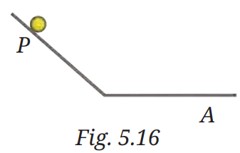
Answer: The ball’s motion is governed by the forces of gravity and friction. On the inclined plane, gravity provides the acceleration for the motion. On the horizontal surface, only friction acts on the ball.
(i) To stop before point A, make the surface rougher to increase frictional force, which slows the ball down faster.
(ii) To stop after crossing point A, make the surface smoother to reduce frictional force, allowing the ball to roll farther.
Question 7. Why do we sometimes slip on smooth surfaces like ice or polished floors? Explain.
Answer: We slip on smooth surfaces because there is very little friction between our feet and the surface. Rough surfaces have irregularities that provide friction and prevent slipping. On smooth or icy surfaces, these irregularities are minimal, so friction is very low. As a result, our feet cannot hold firmly and we lose balance, leading to slipping.
Question 8. Is any force being applied to an object in a non-uniform motion?
Answer: Yes, for an object to be in non-uniform motion, a force must be acting upon it. In non-uniform motion there is a change in speed or direction, which requires a force.
Question 9. The weight of an object on the Moon becomes one-sixth of its weight on Earth. What causes this change? Does the mass of the object also become one-sixth of its mass on the Earth?
Answer: The weight of an object depends on the gravitational pull of the celestial body it is on. The Moon’s gravity is one-sixth of Earth’s, so an object’s weight there is reduced to one-sixth.
Mass is the amount of matter in an object and it remains unchanged
Question 10. Three objects, 1, 2, and 3 of the same size and shape but made of different materials, are placed in the water. They dip to different depths as shown in the figure.
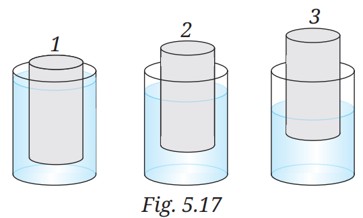
If the weights of the three objects 1, 2, and 3 are w1, w2, and w3, respectively, then
(i) w1 = w2 = w3
(ii) w1 > w2 > w3
(iii) w2 > w3 > w1
(iv) w3 > w1 > w2
Answer: (ii) w1 > w2 > w3
Explanation: Object 1 is the deepest meaning it displaces the most water.
Object 2 is less deep than object 1 but deeper than object 3.
Object 3 is the least deep, meaning it displaces the least amount of water.
Since the objects have the same size and shape, a greater depth indicates a greater weight (assuming they are made of the same material). Therefore, the heaviest object will sink the deepest, while the lightest object will remain closest to the surface.
Class 8 Science Curiosity Chapter 5 Questions and Answers
The chapter Exploring Forces explains how interactions between objects can produce forces. Students learn that a force may change an object’s speed, direction of motion, or shape. Familiar examples help them identify how the effects of a force depend on its strength and direction.
Students also explore muscular force, friction, magnetic force, electrostatic force, and gravity. Through observations and activities, they compare forces that require contact with those that act at a distance and connect these ideas with everyday situations.