

NCERT Solutions for Class 8 Science Chapter 8 Nature of Matter: Elements, Compounds, and Mixtures are provided here with simple and easy-to-understand explanations. Based on the NCERT textbook Curiosity, this chapter introduces the classification of matter into elements, compounds, and mixtures and the features that distinguish them. These NCERT Solutions for Class 8 help students understand important concepts, complete textbook activities, and revise the chapter for school examinations.
Nature of Matter: Elements, Compounds, and Mixtures Class 8 Science Questions and Answers
Probe and Ponder Questions and Answers (Page no. 116)
Question: How can elements be combined to form a compound?
Answer: Compounds are formed when different elements combine chemically in fixed ratios. For example, hydrogen and oxygen combine in a 2:1 ratio to form water. Once a compound is formed, its constituent elements cannot be separated by physical methods.
Question: How could the discovery of a compound that absorbs carbon dioxide from the air contribute to solving environmental challenges?
Answer: Carbon dioxide is a greenhouse gas that causes global warming. If a compound is discovered that can effectively absorb CO₂ from the air, it would help in lowering its concentration in the atmosphere. This would reduce the greenhouse effect, slow down climate change, and improve air quality.
Keep the Curiosity Alive Exercise Questions and Answers (Pages 131-132)
Question 1. Consider the following reaction where two substances, A and B, combine to form a product C:
A + B → C
Assume that A and B cannot be broken down into simpler substances by chemical reactions. Based on this information, which of the following statements is correct?
(i) A, B, and C are all compounds, and only C has a fixed composition.
(ii) C is a compound, and A and B have a fixed composition.
(iii) A and B are compounds, and C has a fixed composition.
(iv) A and B are elements, C is a compound, and has a fixed composition.
Answer: (iv) A and B are elements, C is a compound, and has a fixed composition.
Reason: A and B cannot be broken into simpler substances this means they are elements. Elements are pure substances made of only one kind of atom and cannot be broken down chemically. C is a compound because it is made by chemically combining two elements (A and B) in a fixed ratio.
Question 2. Assertion: Air is a mixture.
Reason: A mixture is formed when two or more substances are mixed, without undergoing any chemical change.
(i) Both Assertion and Reason are true and Reason is the correct explanation for Assertion.
(ii) Both Assertion and Reason are true, but Reason is not the correct explanation for Assertion.
(iii) Assertion is true, but Reason is false.
(iv) Assertion is false, but Reason is true.
Answer: (i) Both Assertion and Reason are true and Reason is the correct explanation for assertion.
Justification: Air is indeed a mixture because it is consists of various gases like nitrogen, oxygen, argon, carbon dioxide, and water vapour, mixed without any chemical reaction between them. The properties of these individual gases are retained within the air.
Question 3. Water, a compound, has different properties compared to those of the elements oxygen and hydrogen from which it is formed. Justify this statement.
Answer: Hydrogen is a highly flammable gas, and oxygen supports combustion. Water (H₂O) is a compound formed when hydrogen and oxygen chemically combine in a fixed ratio of 2:1. Water is a liquid that extinguishes fire instead of fueling it. This shows that a compound has properties distinct from the elements that make it.
Question 4. In which of the following cases are all the examples correctly matched? Give reasons in support of your answers.
(i) Elements – water, nitrogen, iron, air.
(ii) Uniform mixtures – minerals, seawater, bronze, air.
(iii) Pure substances – carbon dioxide, iron, oxygen, sugar.
(iv) Non-uniform mixtures – air, sand, brass, muddy water.
Answer: (iii) Pure substances – Carbon dioxide, iron, oxygen, sugar.
Reason:
(i) Elements – water, nitrogen, iron, air
Incorrect. Only nitrogen and iron are elements. Water is a compound (H₂O), and air is a mixture of gases.
(ii) Uniform mixtures – minerals, seawater, bronze, air
Incorrect. Minerals are usually compounds, not mixtures. The other three seawater, bronze, and air are correct examples of uniform mixtures.
(iii) Pure substances – carbon dioxide, iron, oxygen, sugar
Correct. All four are pure substances. A pure substance has identical particles throughout. Iron and oxygen are elements, while carbon dioxide and sugar are compounds, but all are pure.
(iv) Non-uniform mixtures – air, sand, brass, muddy water
Incorrect. Air and brass are uniform mixtures (homogeneous). Only sand (when mixed with something) and muddy water are non-uniform mixtures.
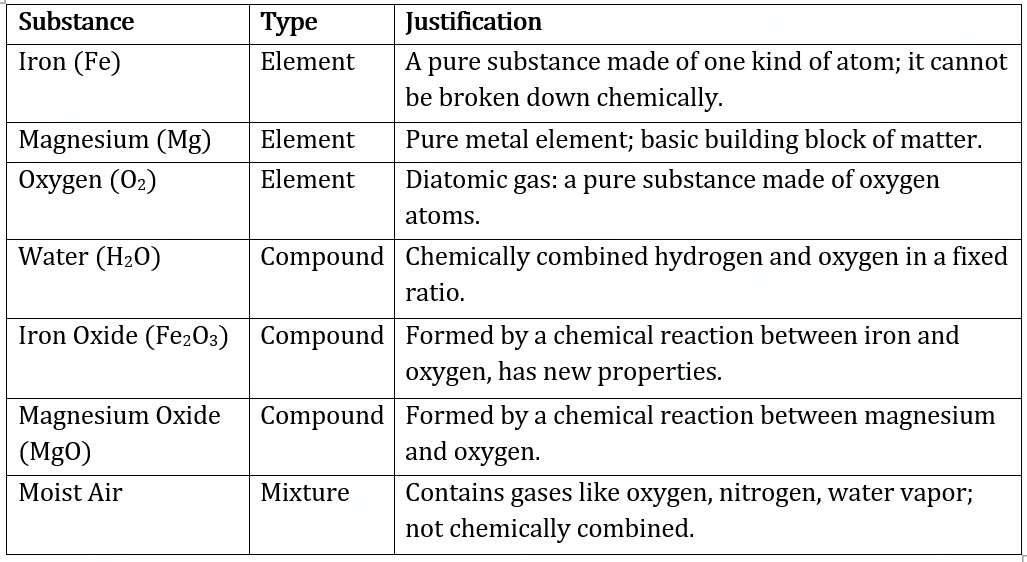
Question 5. Iron reacts with moist air to form iron oxide, and magnesium burns in oxygen to form magnesium oxide. Classify all the substances involved in the above reactions as elements, compounds, or mixtures, with justification.
Answer: Iron reacts with moist air to form iron oxide
Iron (Fe) + Oxygen (O2) + Water (H2O) → Iron Oxide (Fe2O3)
Magnesium burns in oxygen to form magnesium oxide
Magnesium (Mg) + Oxygen (O2) → Magnesium Oxide (MgO)
Classification of Substances
Question 6. Classify the following as elements, compounds, or mixtures in the Table.
Carbon dioxide, sand, seawater, magnesium oxide, muddy water, aluminum, gold, oxygen, rust, iron sulfide, glucose, air, water, fruit juice, nitrogen, sodium chloride, sulfur, hydrogen, and baking soda.
| Elements | Compounds | Mixtures |
Identify pure substances amongst these and list them below.
| Pure substances |
Answer:
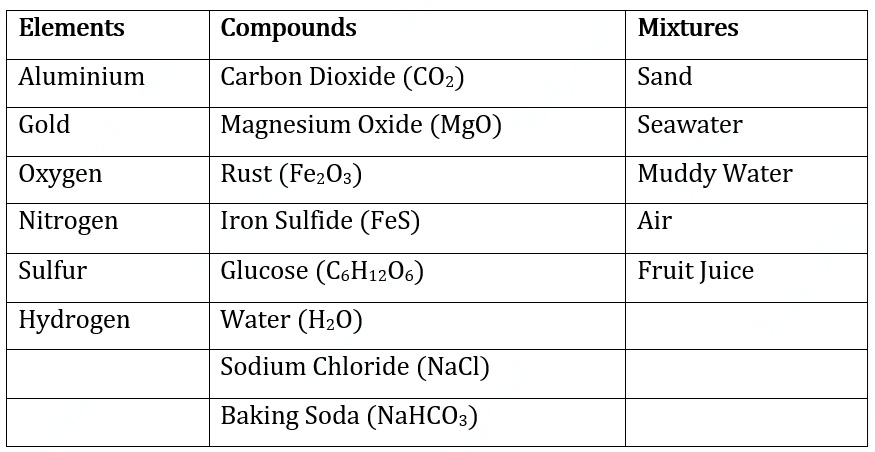
Pure Substances: Aluminium, gold, oxygen, nitrogen, sulfur, hydrogen, carbon dioxide, magnesium oxide, iron sulfide, glucose, water, sodium chloride, baking soda.
Question 7. What new substance is formed when a mixture of iron filings and sulfur powder is heated, and how is it different from the original mixture? Also, write the word equation for the reaction.
Answer: Original Mixture: When iron filings and sulfur powder are physically mixed, they retain their individual properties. This mixture can be separated by physical means like using a magnet to attract the iron.
When iron filings and sulfur powder are heated, they react to form a new substance called ferrous sulfide (FeS), also known as iron sulfide. Unlike the original mixture, its components cannot be separated and it is not attracted by a magnet.
The word equation for the reaction is: Iron + Sulfur → Iron Sulfide.
Question 8. Is it possible for a substance to be classified as both an element and a compound? Explain why or why not.
Answer: No, it is not possible for a substance to be classified as both an element and a compound. An element is the simplest pure substance made of only one type of atom, such as hydrogen, oxygen, or iron. It cannot be broken down into simpler substances by chemical reactions.
A compound, on the other hand, is a pure substance formed when two or more different elements chemically combine in a fixed ratio, such as water (H₂O) or sodium chloride (NaCl). Therefore, a substance cannot be both a single type of atom and a combination of different types of atoms simultaneously.
Question 9. How would our daily lives be changed if water were not a compound but a mixture of hydrogen and oxygen?
Answer: If water were only a mixture of hydrogen and oxygen instead of a compound, its properties would be very different from the water we know today. Hydrogen is a flammable gas and oxygen support combustion, so their mixture could easily catch fire and would not be safe to use. It would not exist as a stable liquid, making it unfit for drinking or sustaining life. Without water, the survival of humans, animals, and plants would not be possible.
Question 10. Analyse the figure. Identify Gas A. Also, write the word equation of the chemical reaction.
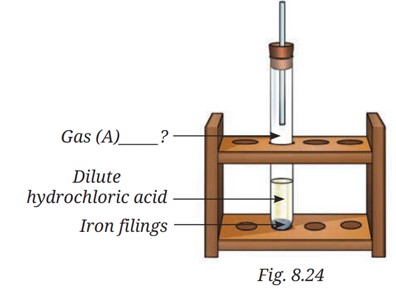
Answer: By analysing the figure, we can say that when dilute hydrochloric acid (HCl) reacts with iron filings, a chemical reaction takes place inside the test tube. The reaction produces iron chloride (FeCl2) and releases a colourless gas (A), which is hydrogen. This gas can be identified because it burns with a characteristic ‘pop’ sound when a burning splinter is brought near it.
Word equation: Iron + Dilute Hydrochloric acid → Iron chloride + Hydrogen
Question 11. Write the names of any two compounds made only from non-metals, and also mention two uses of each of them.
Answer:
1. Carbon Dioxide (CO2) – made from the non-metals carbon and oxygen.
Uses:
- Used in fire extinguishers to put out flames.
- Used by plants during photosynthesis to make food.
2. Ammonia (NH₃) – made from the non-metals nitrogen and hydrogen.
Made of: Sulfur and Oxygen (both non-metals)
Uses:
- Used in the production of fertilizers to increase crop yield.
- Used as a refrigerant in cooling systems.
Question 12. How can gold be classified as both a mineral and a metal?
Answer: A mineral is a naturally occurring substance found in rocks. Gold occurs in nature in its pure form as a native mineral, meaning it is found directly in rocks without combining with other elements. At the same time, gold is also a metal because it shows metallic properties such as lustre, malleability, ductility, and conductivity. Thus, gold is classified as both a mineral (by occurrence) and a metal (by properties).
Class 8 Science Curiosity Chapter 8 Questions and Answers
The chapter Nature of Matter: Elements, Compounds, and Mixtures explores the composition of materials around us. Students learn how elements differ from compounds and how substances combine to form materials with different properties.
Students also compare pure substances with mixtures and learn why the components of a mixture retain their individual characteristics. Activities and familiar examples help them classify materials and distinguish physical mixing from the formation of a new substance.