

NCERT Solutions for Class 8 Science Chapter 7 Particulate Nature of Matter are provided here with simple and easy-to-understand explanations. Based on the NCERT textbook Curiosity, this chapter introduces the tiny particles that make up matter and how their arrangement and movement explain its properties. These NCERT Solutions for Class 8 help students understand important concepts, complete textbook activities, and revise the chapter for school examinations.
Particulate Nature of Matter Class 8 Science Questions and Answers
Probe and Ponder Questions and Answers (Page No. 98)
Question: Why is it possible to pile up stones or sand, but not a liquid like water?
Answer: Stones and sand are solids. Their particles are closely packed with strong intermolecular forces, giving them a definite shape and volume. So, they can be piled up. Water however is a liquid. Its particles are loosely packed with weaker intermolecular forces. So, it does not retain shape and spreads out instead of piling up.
Question: Why does water take the shape of folded hands but lose that shape when released?
Answer: Water is a liquid. Liquids do not have a fixed shape but have a definite volume. When held in folded hands, the water adapts to that space. But once released, it flows and spreads because its weak weaker intermolecular forces,
Question: We cannot see air, so how does it add weight to an inflated balloon?
Answer: All matter has mass. We cannot see air, but it is matter and has mass. When we blow air into a balloon, the balloon gets filled with gas particles like oxygen and nitrogen. These particles add mass to the balloon, and more mass means more weight. That is why an inflated balloon is heavier than an empty one.
Question: Is the air we breathe today the same that existed thousands of years ago?
Answer: Yes, the air we breathe today is essentially the same as it was thousands of years ago. It is because the atmosphere is a continuous mixture of gases like nitrogen, oxygen, carbon dioxide, and others. These gases keep cycling through natural processes such as respiration, photosynthesis, evaporation, and the carbon cycle. Due to this circulation, the overall composition of air has remained nearly constant over very long periods.
Intext Questions and Answers
Question: Is every speck of this fine chalk powder still composed of the same substance, or has it changed into something else on breaking or grinding? (Page no. 99)
Answer: Yes, every speck of chalk powder is still composed of the same substance. Breaking or grinding only makes the chalk into smaller pieces, but it does not change its composition. This is a physical change, not a chemical change. So, the powder remains made of the same substance as the original chalk stick.
Question: Do gases also have a fixed volume? (Page no. 105)
Answer: No, gases do not have a fixed volume. A gas spreads out and completely fills the container in which it is kept. Unlike solids and liquids, the particles of a gas are far apart and can move freely. So, a gas changes its volume according to the space available.
Question: Sugar and sand are both solids. Why does sugar dissolve in water, but sand does not? (Page no. 108)
Answer: Yes, sugar dissolves in water because its tiny particles can mix with water molecules and spread evenly, forming a solution. Sand does not dissolve in water because its particles are much larger and do not interact with water molecules in the same way. Instead, sand just settles at the bottom.
Keep the Curiosity Alive Exercise Questions (Pages 113-114)
Question 1. Choose the correct option.
The primary difference between solids and liquids is that the constituent particles are:
(i) closely packed in solids, while they are stationary in liquids.
(ii) far apart in solids and have fixed positions in liquids.
(iii) always moving in solids and have a fixed position in liquids.
(iv) closely packed in solids and move past each other in liquids.
Answer: (iv) Closely packed in solids and move past each other in liquids.
Reason: In solids, the particles are tightly packed and can only vibrate in fixed positions. In liquids, the particles are still close but can slide past one another. It allows liquids to flow.
Question 2. Which of the following statements are true? Correct the false statements.
(i) Melting ice into water is an example of the transformation of a solid into a liquid.
(ii) The melting process involves a decrease in interparticle attractions during the transformation.
(iii) Solids have a fixed shape and a fixed volume.
(iv) The interparticle interactions in solids are very strong, and the interparticle spaces are very small.
(v) When we heat camphor in one corner of a room, the fragrance reaches all corners of the room.
(vi) On heating, we are adding energy to the camphor, and the energy is released as a smell.
Answer:
(i) True
(ii) True
(iii) True
(iv) True
(v) True
(vi) False
Reason: On heating, we are adding energy to the camphor, and the camphor changes directly into vapour (sublimation). The smell is not “released energy” but rather camphor vapour particles mixing with air, which we sense as fragrance.
Question 3. Choose the correct answer with justification. If we could remove all the constituent particles from a chair, what would happen?
(i) Nothing will change.
(ii) The chair will weigh less due to lost particles.
(iii) Nothing of the chair will remain.
Answer: (iii) Nothing of the chair will remain.
Justification: A chair, like all matter, is made up of constituent particles (atoms and molecules). If every particle were removed there would be no matter left to form the chair. Therefore, without particles the chair simply would not exist.
Question 4. Why do gases mix easily, while solids do not?
Answer: Gases mix easily because their particles are very far apart and move freely in all directions with negligible interparticle forces. In solids, particles are closely packed and strongly held by intermolecular forces, so they cannot move freely. Hence, gases mix easily, but solids do not.
Question 5. When spilled on the table, milk in a glass tumbler flows and spreads out, but the glass tumbler stays in the same shape. Justify this statement.
Answer: Milk flows and spreads out when spilled because it is a liquid. In liquids, the particles are close to each other but can slide past one another. So, liquids do not have a fixed shape and take the shape of the surface or container. The glass tumbler is a solid. Solids have a definite shape and volume because their particles are tightly packed with strong intermolecular forces. Thus, the tumbler retains its shape while milk does not.
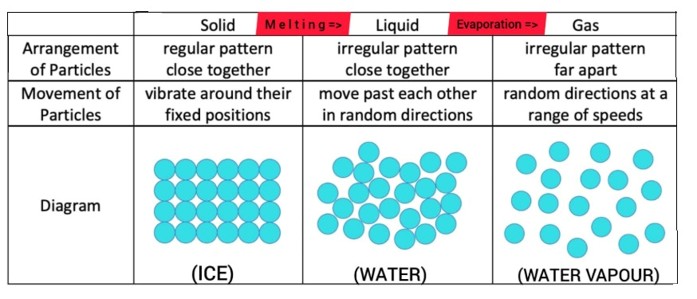
Question 6. Represent diagrammatically the changes in the arrangement of particles as ice melts and transforms into water vapour.
Answer: The changes in the arrangement of particles as ice melts and transforms into water vapour:
Question 7. Draw a picture representing particles present in the following:
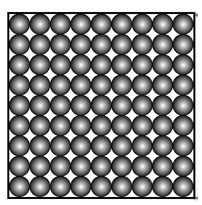
(i) Aluminium foil
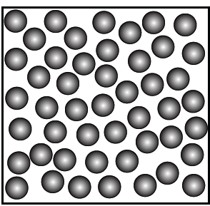
(ii) Glycerin
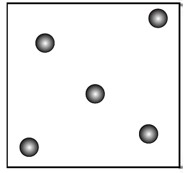
(iii) Methane gas
Answer: (i) Aluminium foil: Aluminium is a solid material. The molecules are closely packed in it. The intermolecular attraction is very high. Every molecule has its fixed place.
(ii) Glycerin: Glycerin is a liquid and the intermolecular attraction of liquids is less than the solids. So, the molecules do not have fixed place. The molecules are loosely packed.
(iii) Methane gas: Gases have very low intermolecular attraction. This increases the intermolecular distance. Gases have great intermolecular distance compared to solids and liquids.
Question 8. Observe figure (A), which shows the image of a candle that was just extinguished after burning for some time. Identify the different states of wax in the figure and match them with figure B, showing the arrangement of particles.
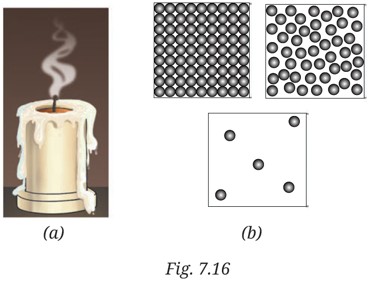
Answer: Different states of wax
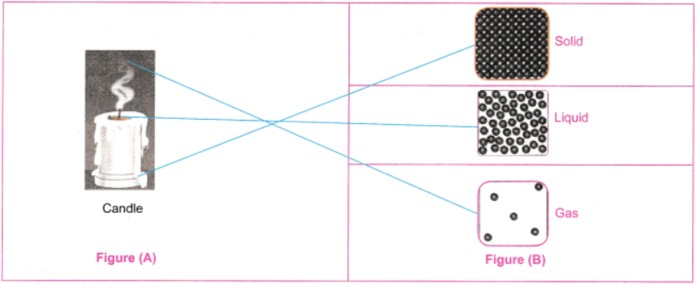
Three states of wax
The solid cylindrical part of the candle is solid wax. The molecular distribution of the wax is shown in the figure 2(a). As we can see in the image the particles are closely packed in solid wax.
At the top of the candle, we can see molten wax puddle where wax is in liquid form. The molecular arrangement of liquid wax is shown in the figure 2(b). The particles in liquid wax are loosely placed as we can see in the image.
The smoke rising up from the extinguished is vaporized gaseous form of wax. The particle arrangement of the gaseous wax is shown in figure 2(c). In the gaseous form of wax the inter particle distance is great as shown in the image.
Question 9. Why does the water in the ocean taste salty, even though the salt is not visible? Explain.
Answer: Ocean water tastes salty because it contains dissolved salts like sodium chloride. When salt dissolves in water, it breaks into tiny constituent particles (ions) that occupy the spaces between water molecules. These particles are too small to be seen with the naked eye. Therefore, ocean water tastes salty even though the salt itself is not visible.
Question 10. Grains of rice and rice flour take the shape of the container when placed in different jars. Are they solids or liquids? Explain.
Answer: Both rice grains and rice flour are solids, not liquids. Each grain or particle of rice and flour has a definite shape and volume of its own. When grains of rice and rice flour poured into a container the shapes of singles grains do not change shape or size. All the grains as a whole take the shape of the container.
Class 8 Science Curiosity Chapter 7 Questions and Answers
The chapter Particulate Nature of Matter introduces the idea that matter is made up of very small particles. Students use activities and observations to explore spaces between particles, their movement, and the attraction between them.
Students also learn how particle behaviour helps explain differences between solids, liquids, and gases. Everyday examples involving diffusion and changes of state connect visible changes in materials with what happens at the particle level.