

NCERT Solutions for Class 6 Social Science Chapter 14 Economic Activities Around Us help you understand how people earn a living and contribute to the economy through different occupations and activities. This chapter explores the production, distribution and consumption of goods and services. Here, we have provided answers to the textbook questions and activities from Exploring Society: India and Beyond in simple, student-friendly language.
Class 6 SST Exploring Society Chapter 14 Economic Activities Around Us NCERT Solutions
The Big Questions (Page no. 195)
1. How are economic activities classified?
Answer: Economic activities are classified into three main sectors based on the type of work and how people are involved in producing goods or services:
Primary Sector
- Activities where people directly use natural resources.
- Examples: farming, fishing, mining, forestry, and raising livestock.
Secondary Sector
- Activities where people use raw materials from the primary sector to make new products.
- Examples: making flour from wheat, furniture from wood, or cars from steel.
Tertiary Sector
- Activities that provide services and support the primary and secondary sectors.
- Examples: banking, transportation, communication, teaching, and healthcare.
2. What differentiates these activities to be grouped into sectors?
Answer: Economic activities are classified into three main sectors based on the type of work involved:
Primary Sector: Economic activities which rely directly on natural resources to generate goods. For example, cultivation of grains, extraction of coal from mines, fish from fisheries, wood from forests.
Secondary Sector: Involves manufacturing and processing, where raw materials from the primary sector are converted into finished goods. For example: the processing of wheat grains to make flour in mills, processing wood from forests into paper and furniture, cotton into textiles etc.
Tertiary Sector: Economic activities that support the primary and secondary sectors. For example, a truck driver transporting grains and vegetables from farms to factories or markets, banking services, education, retail, healthcare and communication.
3. How are the three sectors interconnected?
Answer: The three sectors of economic activities—primary, secondary, and tertiary—are closely connected and depend on each other. The Primary Sector provides raw materials (like wheat from farming or minerals from mining). The secondary sector takes those raw materials and turns them into finished goods, such as food products or clothing. The tertiary sector helps by offering services like transport, sales, and communication, making sure the goods reach the people. Without the support of one, the others cannot function smoothly. Their link ensures the flow of goods and services in the economy.
THINK ABOUT IT (Page no. 199)
Question: Can you think of any primary activities that you may have seen in the past? What are the natural resources used in these activities? Name two of them and discuss your experiences with your classmates.
Answer: Two interesting primary activities that I have observed are:
1. Agriculture (Farming)
- Natural Resources Used: Soil, water, seeds, and sunlight.
- Experience: I’ve seen farmers preparing fields, planting seeds, and harvesting crops like wheat and rice. The process relies on natural resources like fertile soil and water. It’s amazing to witness how a bare field transforms into a productive farm, and the farmer’s efforts directly influence the outcome, which changes with the seasons.
2. Fishing
- Natural Resources Used: Water bodies (rivers, lakes, seas), fish, and aquatic plants.
- Experience: I’ve watched fishermen casting nets in rivers, using skill and patience to catch fish. Their success depends on the health of the water and ecosystem. It’s fascinating to see how they use traditional methods to find fish-rich spots and how their livelihood is connected to the environment.
These examples show how closely primary activities depend on natural resources and the environment.
LET’S EXPLORE (Page no. 200)
Question: Now that we have seen some examples of secondary sector activities, can you name two more economic activities in the secondary sector?
Answer: Two more economic activities in the secondary sector are:
- Making bricks in a kiln: Here clay (a natural resource) is processed and baked into bricks used for construction.
- Baking bread in a bakery: In bakery raw materials like flour and sugar are turned into finished food products.
Both involve processing or manufacturing raw materials into usable goods, which is the main feature of secondary sector activities.
DON’T MISS OUT (Page no. 205)
Question: Just like AMUL, there are many other milk cooperatives under brands such as Nandini from Karnataka, Mother Dairy from Delhi-NCR, Aavin from Tamil Nadu, Vijaya from Andhra Pradesh, Kevi from Nagaland, Sudha from Bihar, Verka from Punjab, etc. Can you name one cooperative around you that has helped groups like farmers, persons with disabilities, and women, to come together and has brought prosperity to their lives?
Answer: One cooperative in Delhi that helps groups like farmers, people with disabilities, and women is SEWA (Self-Employed Women’s Association).
- For Women: SEWA is run by women to help other women who are self-employed. It gives them training, money, and helps them sell their products. SEWA helps women start small businesses, earn fair wages, and become independent.
- For People with Disabilities: SEWA also helps women with disabilities by training them in making handicrafts, sewing and embroidery and helping them get jobs so they can earn money and support themselves.
- For Farmers: SEWA supports women farmers by giving them better seeds, loans, and teaching them good farming methods to help them grow more food and earn more money.
SEWA works to make sure everyone can have a better life by helping them work and support themselves.
LET’S EXPLORE (Page no. 207)
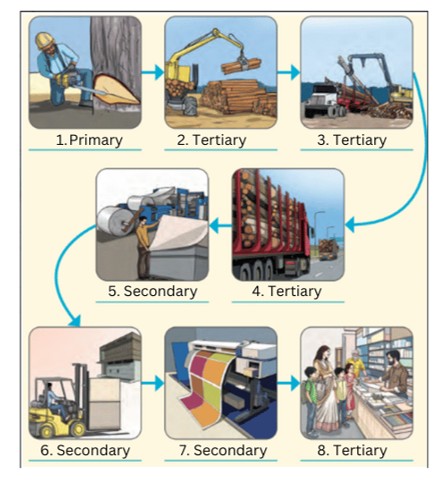
Label the pictures in the illustration shown in Fig. 14.1 on page 206 as:
1. Primary sector
2. Secondary sector
3. Tertiary sector
Answer:
LET’S EXPLORE (Page no. 208)
Question: List the economic activities in your neighbourhood and label them appropriately as primary, secondary or tertiary. Draw arrows to show how they are connected to each other. In what ways are they dependent on each other? What would happen if one of the activities ceased to exist?
Answer: Economic Activities in a neighbourhood:
1. Primary Sector
- Agriculture: Growing fruits and vegetables on local farms.
- Fishing: Catching fish from a nearby lake.
2. Secondary Sector
- Food Processing: A small factory turning local produce into canned goods.
- Textile Manufacturing: A workshop making clothes from raw cotton.
3. Tertiary Sector
- Retail Stores: Shops selling fresh produce, canned goods, and clothes.
- Transportation Services: Trucks moving goods from farms and factories to stores.
- Banking: A local bank providing financial services like loans.
- Healthcare: A clinic offering medical help to residents.
Connections and Dependencies
- Agriculture (Primary) → Food Processing (Secondary) → Retail Stores (Tertiary): Farms supply food to the factory, which then sends processed goods to shops.
- Fishing (Primary) → Retail Stores (Tertiary): Fish from the lake are sold in local stores.
- Textile Manufacturing (Secondary) → Retail Stores (Tertiary): Clothes made in the workshop are sold in stores.
- Transportation Services (Tertiary): Trucks move products between farms, factories, and shops.
- Banking (Tertiary): Banks support businesses in all sectors by providing loans and financial services.
- Healthcare (Tertiary): The clinic ensures workers across all sectors stay healthy.
Interdependence:
- The Primary Sector (farming, fishing) supplies the raw materials for the Secondary Sector (factories).
- The Secondary Sector processes these materials into products sold by the Tertiary Sector (shops).
- Transportation Services are essential for moving goods between farms, factories, and stores.
- Banking helps keep businesses running by offering financial support.
- Healthcare maintains a healthy workforce, allowing all sectors to function well.
What Happens if One Activity Stops?
- If agriculture stops, food processing factories won’t have raw materials, and stores will run out of food.
- If transportation stops, goods won’t move from farms and factories to shops, causing a disruption.
- If banking services stop, businesses may struggle to get funds, slowing down the economy.
- Without healthcare, workers will become less healthy, reducing productivity in all sectors.
This shows how every sector is important and connected to keep the neighbourhood’s economy running smoothly.
Questions, activities and projects (Page no. 208)
1. What is the primary sector? How is it different from the secondary sector? Give two examples.
Answer: The primary sector includes economic activities where people directly use natural resources to produce goods. Examples are farming, fishing, forestry, and mining.
It is different from the secondary sector, where people take the raw materials from the primary sector and process or manufacture them into finished products. Examples of secondary activities include making furniture from wood and producing tea from tea leaves.
Examples: Primary Sector: Farming (growing crops), mining (extracting coal), fishing (catching fish from rivers and seas)
Secondary Sector: producing steel from iron ore, food processing which turns raw agricultural products (like milk, vegetables, or grains) into packaged goods such as cheese, canned foods, or bread.
2. How does the secondary sector depend on the tertiary sector? Illustrate with a few examples.
Answer: The secondary sector depends on the tertiary sector for services that help in the production and distribution of goods. While the secondary sector focuses on manufacturing and construction, the tertiary sector provides support services like transport, communication, banking, and retail.
Examples:
- Transportation: Factories need vehicles and roads to transport raw materials to the factory and deliver finished goods to the market.
- Banking: Industries depend on banks for loans, transactions, and financial services to run their operations.
- Retail outlets: The secondary sector needs retail outlets to display and sell their products.
- Communication: Factories use phones, internet, and other tools to manage orders, contact suppliers, and coordinate with workers.
3. Give an example of interdependence between primary, secondary and tertiary sectors. Show it using a flow diagram.
Answer: An example of the interdependence between primary, secondary and tertiary sectors is the production of bread.
Primary Sector: Farmers grow wheat.
Secondary Sector: Wheat is processed in factories to produce flour, and then bread is baked.
Tertiary Sector: Transportation services deliver bread to grocery stores, and shops sell it to consumers.
Flow Diagram:
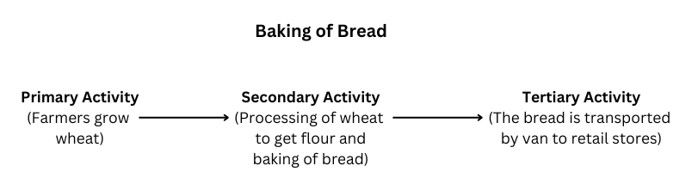
In this example, all three sectors are interdependent: the primary sector provides raw materials (wheat), the secondary sector transforms them into products (bread), and the tertiary sector helps distribute and sell them. If one sector stops functioning, it affects the entire chain.
NCERT Solutions for Class 6 Social Science Chapter 14 Economic Activities Around Us
Chapter 14, Economic Activities Around Us, explores the different activities through which people produce goods, provide services and earn income. Students learn about the three main sectors of economic activities: primary, secondary and tertiary. The chapter explains how farming, manufacturing, trading, transport and other services are connected. It also introduces the concepts of producers, consumers, markets and the exchange of goods and services, helping students understand how economic activities support everyday life.
The important concepts covered in this chapter are:
- Meaning of Economic Activities: Understand how people engage in activities to produce goods, provide services and earn income.
- Production of Goods: Learn how people use resources, materials and skills to create products that satisfy human needs.
- Services: Understand how activities such as teaching, healthcare, transport and banking help individuals and society.
- Primary Sector: Explore activities that depend directly on natural resources, such as farming, fishing, forestry and mining.
- Secondary Sector: Learn how raw materials are processed and converted into finished goods through manufacturing and construction.
- Tertiary Sector: Understand how service-based activities support production and help goods reach consumers.
- Producers and Consumers: Learn about the roles of producers who make goods or provide services and consumers who use them.
- Markets and Exchange: Understand how buyers and sellers interact to exchange goods and services through markets.
- Interdependence of Economic Activities: Recognise how different occupations and economic sectors depend on one another to keep the economy functioning.
We hope these NCERT Solutions for Class 6 Social Science help students understand the textbook activities, revise important concepts and prepare confidently for their examinations.