

NCERT Solutions for Class 7 Science Chapter 10 Life Processes in Plants are provided here in simple and easy-to-understand language. These NCERT Solutions for Class 7 are based on the new NCERT Science textbook Curiosity. In this chapter, students learn about the different life processes that help plants grow and survive. The chapter explains how plants prepare their own food through photosynthesis, absorb water and minerals from the soil, and transport substances to different parts. Students also learn about respiration in plants and the importance of sunlight, water, and air for plant growth.
Life Processes in Plants NCERT Class 7 Science Chapter 10 Questions & Answers
Intext Questions
Question: How does sunlight contribute in the production of starch in plants? (Page no. 141)
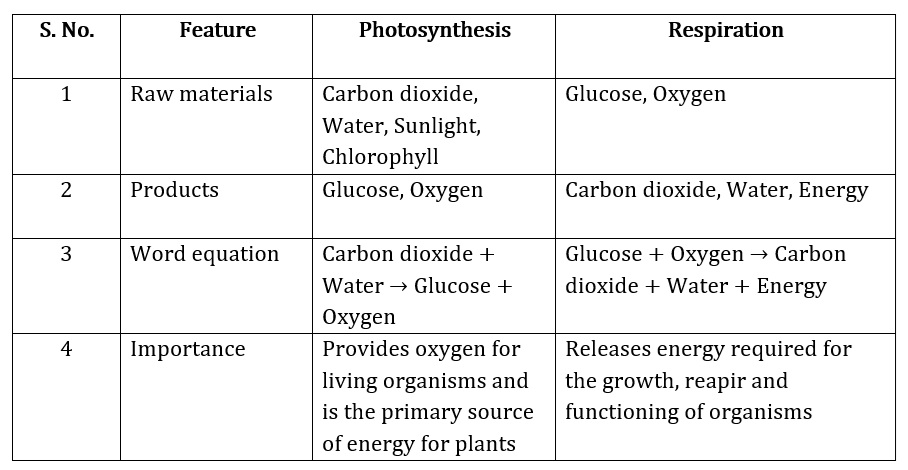
Answer: Sunlight provides the energy needed for photosynthesis, the process by which plants make food. The chlorophyll present in the leaves captures sunlight and uses it to convert carbon dioxide and water into glucose. This glucose is then stored as starch in the leaves.
Question: Which gas from the air is essential in the process of food preparation in plants? (Page no. 143)
Answer: Carbon dioxide is essential for the process of food preparation in plants.
Let Us Enhance Our Learning (Exercise)
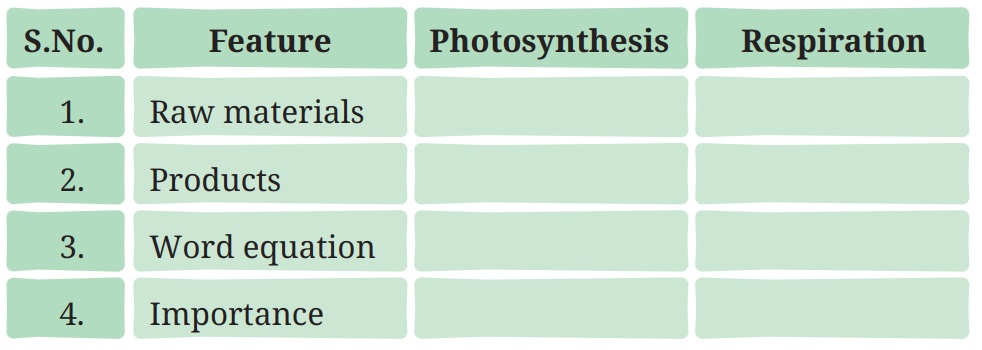
1. Complete the following table
Answer:
2. Imagine a situation where all the organisms that carry out photosynthesis on the earth have disappeared. What would be the impact of this on living organisms?
Answer: If all organisms that carry out photosynthesis disappeared, there would be no production of oxygen and food for other living organisms. This would disrupt the food chain, as plants provide food for herbivores and oxygen for respiration. Without plants, life on Earth won’t sustain.
3. A potato slice shows the presence of starch with iodine solution. Where does the starch in potatoes come from? Where is the food synthesised in the plant, and how does it reach the potato?
Answer: The starch in potatoes comes from the glucose produced in the leaves during photosynthesis. Photosynthesis occurs in the leaves, where food is synthesised in the form of glucose. This glucose is then transported through the plant to the potato, where it is stored in the form of starch.
4. Does the broad and flat structure of leaves make plants more efficient for photosynthesis? Justify your answer.
Answer: Yes, the broad and flat structure of leaves makes plants more efficient for photosynthesis. This shape provides a larger surface area, allowing more sunlight to be captured by the chlorophyll present in the leaves. It also helps in the exchange of gases through the stomata, thus enhancing the rate of photosynthesis.
5. X is broken down using Y to release carbon dioxide, Z, and energy.
X + Y → Carbon dioxide + Z + Energy.
X, Y, and Z are three different components of the process. What do X, Y, and Z stand for?
Answer: X stands for Glucose.
Y stands for Oxygen.
Z stands for Water.
This represents respiration, where glucose and oxygen produce carbon dioxide, water, and energy.
Glucose + Oxygen → Carbon dioxide + Water + Energy
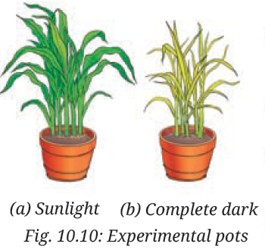
6. Krishna set-up an experiment with two potted plants of same size and placed one of them in sunlight and the other in a dark room, as shown in Fig. 10.10. Answer the following questions:
(i) What idea might she be testing through this experiment?
Answer: Krishna is testing the effect of sunlight on plant growth and starch production in plants.
(ii) What are the visible differences in plants in both the conditions?
Answer: The plant in sunlight will grow better, with greener leaves and more height.
(iii) According to you, leaves of which plants confirm the iodine test for the presence of starch?
Answer: The leaves of the plant kept in sunlight will show a positive iodine test, turning blue-black due to the presence of starch. Since sunlight is essential for photosynthesis, the plant in sunlight will produce starch, whereas the plant kept in the dark will not produce starch and thus will not show a colour change with iodine.
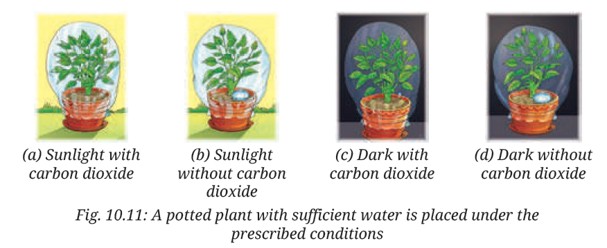
7. Vani believes that ‘carbon dioxide is essential for photosynthesis’. She puts an experimental set-up, as shown in Fig. 10.11, to collect evidence to support or reject her idea. Answer the following questions:
(i) In which plant(s) in the above set-up(s) will starch be formed?
Answer: Starch will be formed in plant (a) (sunlight with carbon dioxide), as it has all requirements for photosynthesis (sunlight, water, carbon dioxide, and chlorophyll).
(ii) In which plant(s) in the above set-up(s) will starch not be formed?
Answer: Starch will not be formed in:
Plant (b) (sunlight without carbon dioxide), due to lack of carbon dioxide.
Plant (c) (dark with carbon dioxide), due to lack of sunlight.
Plant (d) (dark without carbon dioxide), due to lack of both sunlight and carbon dioxide.
(iii) In which plant(s) in the above set-up(s) will oxygen be generated?
Answer: Oxygen will be generated in plant (a) (sunlight with carbon dioxide), as photosynthesis occurs, producing oxygen.
(iv) In which plant(s) in the above set-up(s) will oxygen not be generated?
Answer: Oxygen will not be generated in:
- Plant (b) (sunlight without carbon dioxide), as photosynthesis cannot occur without carbon dioxide.
- Plant (c) (dark with carbon dioxide), as photosynthesis requires sunlight.
- Plant (d) (dark without carbon dioxide), as photosynthesis does not occur.
8. Ananya took four test tubes and filled three-fourth of each test tube with water. She labelled them A, B, C, and D (Fig. 10.12). In test tube A, she kept a snail; in test tube B, she kept a water plant; in test tube C, she kept both a snail and a plant. In test tube D, she kept only water. Ananya added a carbon dioxide indicator to all the test tubes. She recorded the initial colour of water and observed if there are any colour changes in the test tubes after 2-3 hours. What do you think she wants to find out? How will she know if she is correct?
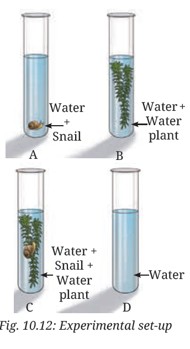
Answer: Ananya is likely conducting an experiment to investigate the role of carbon dioxide (CO₂) in the process of respiration and photosynthesis in aquatic organisms. She is testing whether the presence of a snail (which respires) and/or a water plant (which carries out photosynthesis) affects the level of carbon dioxide in the water over time.
Activity Explanation:
- Test tube A (with a snail): The snail respires and releases carbon dioxide (CO₂). If the carbon dioxide indicator turns a different color (e.g., from yellow to green), it will indicate an increase in CO₂ levels in the water due to respiration.
- Test tube B (with a water plant): The water plant carries out photosynthesis, using carbon dioxide and releasing oxygen. If the indicator shows a decrease in CO₂ (e.g., from yellow to blue), it will indicate that the plant is taking in carbon dioxide during photosynthesis.
- Test tube C (with both a snail and a water plant): In this setup, the plant will use the CO₂ produced by the snail during photosynthesis, so the indicator may show little or no change.
- Test tube D (only water): This is the control test. Since there’s no plant or snail to produce or consume CO₂, any change in the indicator’s color would be due to external factors or the experiment’s set-up.
If the colour changes match these expectations, she will know her idea is correct.
9. Design an experiment to observe if water transportation in plants is quicker in warm or cold conditions.
Answer: Aim: To observe if the rate of water transportation (transpiration and absorption) in plants is quicker in warm conditions compared to cold conditions.
Materials needed: Two similar plant twigs (e.g., balsam), two glass tumblers, water, red food colouring, thermometer, warm water (around 30°C), cold water (around 5°C), magnifying glass.
Procedure:
- Fill two tumblers with water. Add a few drops of red food colouring to both.
- Label one tumbler “Warm” and heat its water to about 30°C. Label the other “Cold” and cool its water to about 5°C (use a thermometer to check).
- Cut the stems of two similar plant twigs obliquely under water to prevent air bubbles.
- Place one twig in the “Warm” tumbler and the other in the “Cold” tumbler.
- Keep both setups in the same room with similar light conditions.
- After 2-3 hours, observe the stems, leaves, and flowers for red colour using a magnifying glass.
- Cut the stems and check how far the red colour has travelled in the xylem.
Observation: If the red colour travels farther in the “Warm” tumbler’s plant, water transportation is quicker in warm conditions. If farther in the “Cold” tumbler, it’s quicker in cold conditions.
Conclusion: Warm conditions likely speed up water transport due to increased molecular activity and lower water viscosity.
10. Photosynthesis and respiration are essential to maintain balance in nature. Discuss.
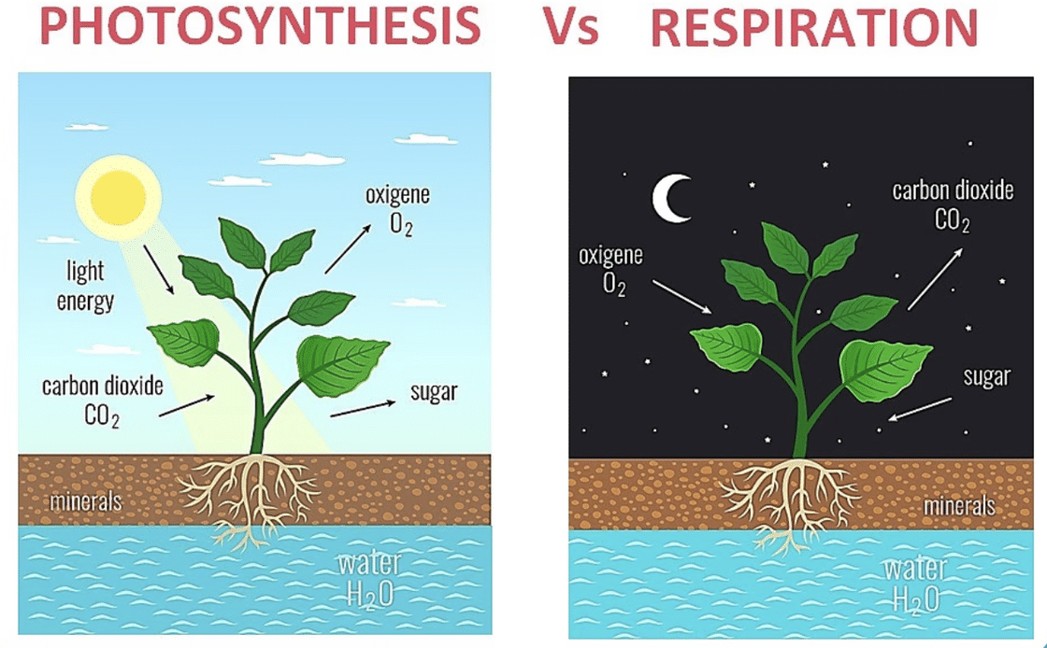
Answer: Photosynthesis and respiration are interconnected processes that help maintain balance in nature. During photosynthesis, green plants use sunlight, carbon dioxide, and water to produce glucose and release oxygen into the atmosphere. This oxygen is used by animals and other organisms during respiration to break down glucose and release energy, producing carbon dioxide and water in the process. The carbon dioxide released during respiration is again used by plants in photosynthesis. This continuous cycle ensures a steady supply of oxygen and carbon dioxide, maintaining the balance of gases in the atmosphere and supporting life on Earth.
Class 7 Science Curiosity Chapter 10 NCERT Solutions
The chapter Life Processes in Plants introduces students to the essential processes carried out by plants to stay alive and grow. It explains how green plants use sunlight, carbon dioxide, and water to prepare food through photosynthesis.
Students learn about the role of roots, stems, and leaves in absorbing and transporting water, minerals, and food. The chapter also explains how plants respire to release energy and how different environmental factors affect their growth and development.