

NCERT Solutions for Class 7 Science Chapter 12 Earth, Moon, and the Sun are provided here in simple and easy-to-understand language. These NCERT Solutions for Class 7 are based on the new NCERT Science textbook Curiosity. In this chapter, students learn about the Earth, Moon, and Sun and their movements in space. The chapter explains how the rotation and revolution of the Earth cause day and night and changes in seasons. Students also learn about the phases of the Moon, solar and lunar eclipses, and the relationship between the Earth, Moon, and Sun.
Earth, Moon, and the Sun NCERT Class 7 Science Chapter 12 Questions & Answers
Intext Questions
Question: How day and night occur on the Earth due to its rotation? (Page no. 172)
Answer: Day and night occur because the Earth rotates on its axis from west to east. At any time, half of the Earth gets sunlight and this part experiences day while the other half is in darkness and experiences night.
Question: Since the Earth is rotating, shouldn’t the stars also appear to move in the sky like the Sun? (Page no. 174)
Answer: Yes, since the Earth rotates from west to east, the stars appear to move across the sky from east to west, just like the Sun. But, the Earth’s axis of rotation points very close to the Pole Star in the Northern Hemisphere. Therefore, the Pole Star appears nearly stationary in the sky from the Earth. All the stars appear to move around it.
Question: Why do different stars appear in the night sky over the course of a year? (Page no. 175)
Answer: Different stars appear in the night sky over the year because, while the Earth rotates on its axis daily, it also revolves around the Sun once a year. As the Earth changes its position in orbit, the part of the sky we can see at night also changes, bringing new stars and constellations into view in different months.
Question: We go through a cycle of seasons every year. Is it related to the revolution of the Earth around the Sun in some way? (Page no. 177)
Answer: Yes, the cycle of seasons is related to the Earth’s revolution around the Sun. The Earth’s axis is tilted and as it revolves around the Sun, its tilted axis causes different parts of the Earth to receive different amounts of sunlight at different times of the year. This change in sunlight causes the seasons.
Question: Why days are longer in summer than in winter?
Answer: Days are longer in summer than in winter because the Earth’s axis is tilted.
When hemisphere is tilted towards the Sun, it receives sunlight for more hours during the day. In winter, hemisphere is tilted away from the Sun, so sunlight lasts for fewer hours.
Question: Could the light from the Sun get blocked by the two planets which are revolving between the Earth and the Sun? (Page no. 179)
Answer: No, the light from the Sun does not usually get blocked by the two planets (Mercury and Venus) because they are very small compared to the Sun and are far away from the Earth. Sometimes they do come between the Earth and the Sun, but they block only a small part of the sunlight and it’s hardly noticeable from Earth.
Let Us Enhance Our Learning (Exercise)
1. In Fig. 12.17, how many hours of sunlight do the North Pole and the South Pole receive during one rotation of the Earth?
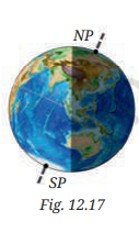
Answer: In the given figure, the North Pole is in darkness, which means it is winter in the Northern Hemisphere. During this time, the North Pole receives 0 hours of sunlight, while the South Pole, experiencing summer, receives 24 hours of sunlight during one rotation of the Earth. This occurs due to the tilt of the Earth’s axis.
2. Fill in the blanks
(i) Stars rise in the _______ and set in the _______.
(ii) Day and night are caused by the Earth’s _______.
(iii) When the Moon fully covers the Sun from our view, it is called a _____ solar eclipse.
Answer: (i) Stars rise in the East and set in the West.
(ii) Day and night are caused by the Earth’s rotation.
(iii) When the Moon fully covers the Sun from our view, it is called a total solar eclipse.
3. State whether True or False
(i) Lunar eclipse occurs when the Sun comes between the Earth and the Moon.
Answer: False.
Reason: A lunar eclipse occurs when the Earth comes between the Sun and the Moon, blocking sunlight from reaching the Moon.
(ii) Sunrise happens earlier in Gujarat than in Jharkhand.
Answer: False
Reason: Since the Earth rotates from west to east, places that are farther east see the Sun first. Jharkhand lies east of Gujarat, so sunrise happens earlier in Jharkhand than in Gujarat.
(iii) In Chennai, the longest day occurs on the summer solstice.
Answer: True.
Reason: Chennai is in the Northern Hemisphere, so its longest day falls around 21 June, the summer solstice, when the Northern Hemisphere is tilted most toward the Sun.
(iv) We should watch the solar eclipse directly with our naked eye.
Answer: False.
Reason: Looking at a solar eclipse directly with the naked eye can seriously damage our eyesight and even cause permanent blindness.
(v) Seasons occur due to the tilt of Earth’s axis of rotation and its spherical shape.
Answer: True.
Reason: The tilt of Earth’s axis (about 23.5°) and its spherical shape cause different parts of the Earth to receive varying amounts of sunlight during the year, due to which seasons occur.
(vi) The Earth’s revolution around the Sun causes day and night.
Answer: False.
Reason: Day and night happen because the Earth spins on its axis, not because it goes around the Sun. As the Earth rotates, the side facing the Sun has daylight and the side facing away has nighttime.
4. Padmashree saw the Orion constellation nearly overhead at 8 pm yesterday. When will she see Orion overhead today?
Answer: Padmashree will see the Orion constellation nearly overhead at around 7:56 pm today. Due to the Earth’s rotation, stars appear to rise about 4 minutes earlier each day (since the Earth’s rotation period is approximately 23 hours 56 minutes, not exactly 24 hours). Thus, Orion will be overhead approximately 4 minutes earlier than the previous day.
5. Nandhini saw a group of stars rising at midnight on 21 June. When will she see the same group of stars rising at midnight next year?
Answer: Nandhini will see the same group of stars rising at midnight on 21 June next year. The Earth’s revolution around the Sun takes about 365 days, so the night sky’s appearance repeats annually. The same group of stars will rise at midnight on the same date (21 June) the following year.
6. Abhay noticed that when it was daytime in India, his uncle who was in the USA was generally sleeping as it was night-time there. What is the reason behind this difference?
Answer: The reason is the Earth’s rotation. The Earth spins on its axis, creating day on the side facing the Sun and night on the side facing away. When it’s daytime in India, that part of the Earth is turned toward the Sun while the USA is on the opposite side in darkness, so it’s night there.
7. Four friends used the following ways to see the solar eclipse. Who among them was being careless?
(i) Ravikiran used a solar eclipse goggle.
(ii) Jyothi used a mirror to project the Sun’s image.
(iii) Adithya saw the Sun directly with his eyes.
(iv) Aruna attended a programme arranged by a planetarium.
Answer: Adithya was being careless. Viewing a solar eclipse directly with the naked eye can damage the eyes and cause blindness.
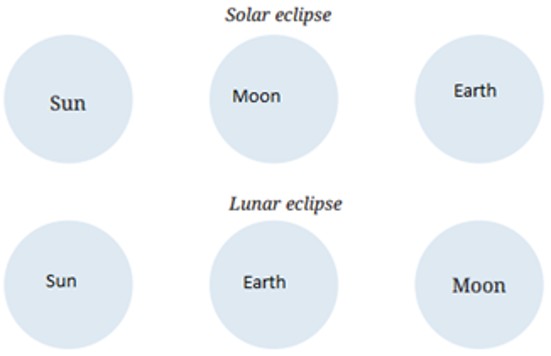
8. Fill in the circles in Fig. 12.18 appropriately with one of the following: Sun, Moon, Earth.
Answer: For Solar eclipse: The order is Sun, Moon, Earth.
For Lunar eclipse: The order is Sun, Earth, Moon.
9. The Moon is much smaller than the Sun, yet it can block the Sun completely from our view during a total solar eclipse. Why is it possible?
Answer: The Moon can block the Sun completely during a total solar eclipse because the apparent sizes of the Moon and the Sun are similar when viewed from Earth.
Even though the Sun is far bigger, its great distance makes it appear about the same size in the sky as the Moon. So, when the Moon passes directly in front of the Sun, it can completely cover it, causing a total solar eclipse.
10. The Indian cricket team matches in Australia are often held in December. Should they pack winter or summer clothes for their trip?
Answer: The Indian cricket team should pack summer clothes for their trip to Australia in December. In December, the Southern Hemisphere, where Australia is located is tilted towards the Sun, experiencing summer, while the Northern Hemisphere including India experiences winter.
11. Why do you think lunar eclipses can be seen from a large part of the Earth when they happen, but total solar eclipse can be seen by only a small part of the Earth?
Answer: Lunar eclipses when the Earth’s shadow falls on the Moon. It can be seen from a large part of the Earth because the Earth’s shadow on the Moon is huge. Anyone on the night side of the Earth can see this.
In contrast, a total solar eclipse can only be seen from a small part of the Earth because the Moon’s shadow covers only a small area on the Earth’s surface. Only those within that area can see the total eclipse.
12. If the Earth’s axis were not tilted with respect to the axis of revolution, explain what would be the effect on seasons?
Answer: If the Earth’s axis were not tilted, there would be no different seasons. Every place would get roughly the same amount of sunlight all year, so the length of day and night would stay about the same. The weather would be fairly constant with no noticeable summer or winter.
Class 7 Science Curiosity Chapter 12 NCERT Solutions
The chapter Earth, Moon, and the Sun introduces students to the movements of the Earth and Moon and their effects on our daily lives. It explains how the Earth rotates on its axis to cause day and night and revolves around the Sun, leading to changes in seasons.
Students learn about the different phases of the Moon and how solar and lunar eclipses occur. The chapter also explains how the positions and movements of the Earth, Moon, and Sun influence various natural phenomena and help us understand our solar system.