

NCERT Solutions for Class 7 Science Chapter 2 Exploring Substances: Acidic, Basic, and Neutral are provided here in simple and easy-to-understand language. These NCERT Solutions for Class 7 are based on the new NCERT Science textbook Curiosity. In this chapter, students learn about acidic, basic, and neutral substances and their properties. The chapter explains how natural indicators such as litmus, turmeric, and rose extract help identify different substances. Students also learn about neutralisation reactions and their applications in everyday life.
Exploring Substances: Acidic, Basic, and Neutral NCERT Class 7 Science Chapter 2 Questions and Answers
Intext Questions (Page no. 10)
Question: What are these red and blue litmus paper strips made of? Why do they change colour when drops of some samples are put on them?
Answer: Red and blue litmus paper strips are made from paper soaked in an extract of lichens. They change colour when drops of certain substances are put on them because litmus is an acid-base indicator.
- Blue litmus turns red in the presence of an acid.
- Red litmus turns blue in the presence of a base.
Intext Questions (Page no. 11)
Question: If litmus is not available, are there some other natural substances that can serve as acid- base indicators?
Answer: Yes, if litmus is not available, there are several natural substances that can serve as acid-base indicators.
These natural indicators include:
- Red rose petals
- Turmeric
- Beetroot
- Purple cabbage
- Red hibiscus
- Indian blackberry
Intext Questions (Page no. 16)
Question: Are there any substances whose odours change on adding acidic or basic substances?
Answer: Yes, some substances do change their odour when an acid or a base is added. These are known as olfactory indicators.
For example, onion can be used as one:
- When a basic substance like baking soda is added to onion-treated strips, the smell fades or disappears.
- When an acidic substance like tamarind water is added, the smell remains unchanged.
This property helps identify whether a substance is acidic or basic by noticing changes in smell.
Let Us Enhance Our Learning (Page No. 20)
1. A solution turns the red litmus paper to blue. Excess addition of which of the following solution would reverse the change?
(i) Lime water
(ii) Baking soda
(iii) Vinegar
(iv) Common salt solution
Answer: (iii) Vinegar
Explanation: The initial solution is a basic solution which turns red litmus paper to blue. To reverse this change (i.e., turn blue litmus back to red), we need to add an acid.
Among the options:
- Lime water – basic
- Baking soda – basic
- Vinegar – acidic
- Common salt solution – neutral
So, only vinegar, being acidic, can neutralize the base and reverse the colour change.
Excess addition of acidic vinegar solution will reverse the change (turn blue litmus to red) as there will be excess acid left over after neutralising the effect of the base.
2. You are provided with three unknown solutions labelled A, B, and C, but you do not know which of these are acidic, basic, or neutral. Upon adding a few drops of red litmus solution to solution A, it turns blue. When a few drops of turmeric solution are added to solution B, it turns red. Finally, after adding a few drops of red rose extract to solution C, it turns green.
Based on the observations, which of the following is the correct sequence for the nature of solutions A, B, and C?
(i) Acidic, acidic, and acidic
(ii) Neutral, basic, and basic
(iii) Basic, basic, and acidic
(iv) Basic, basic, and basic
Answer: (iv) Basic, basic, and basic
Explanation: Solution A is a basic solution because it turns red litmus to blue.
Solution B is a basic solution because it turns turmeric solution to red.
Solution C is a basic solution because it turns china rose indicator to green.
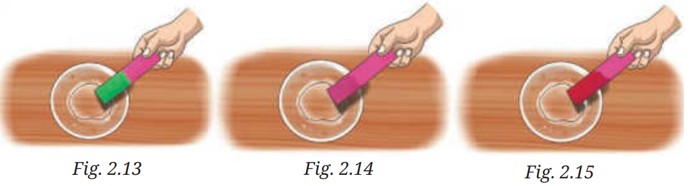
3. Observe and analyse Figs. 2.13, 2.14, and 2.15, in which red rose extract paper strips are used. Label the nature of solutions present in each of the containers.
Answer:
Fig. 2.13 has a basic solution as it turns china rose indicator green.
Fig. 2.14 has a neutral solution as it does not change the colour of china rose indicator.
Fig. 2.15 has an acidic solution as it turns china rose indicator reddish.
4. A liquid sample from the laboratory was tested using various indicators:

Based on the tests, identify the acidic or basic nature of the liquid and justify your answer.
Answer: Based on the tests, the liquid sample is acidic in nature because it turned blue litmus red and showed no colour change with turmeric indicator.
5. Manya is blindfolded. She is given two unknown solutions to test and determine whether they are acidic or basic. Which indicator should Manya use to test the solutions and why?
Answer: Since Manya is blindfolded and cannot see colour changes, she needs an indicator that works through the sense of smell. Onion juice is an olfactory indicator. Onion’s smell fades or disappears in the presence of a base. But the smell remains unchanged in an acidic solution.
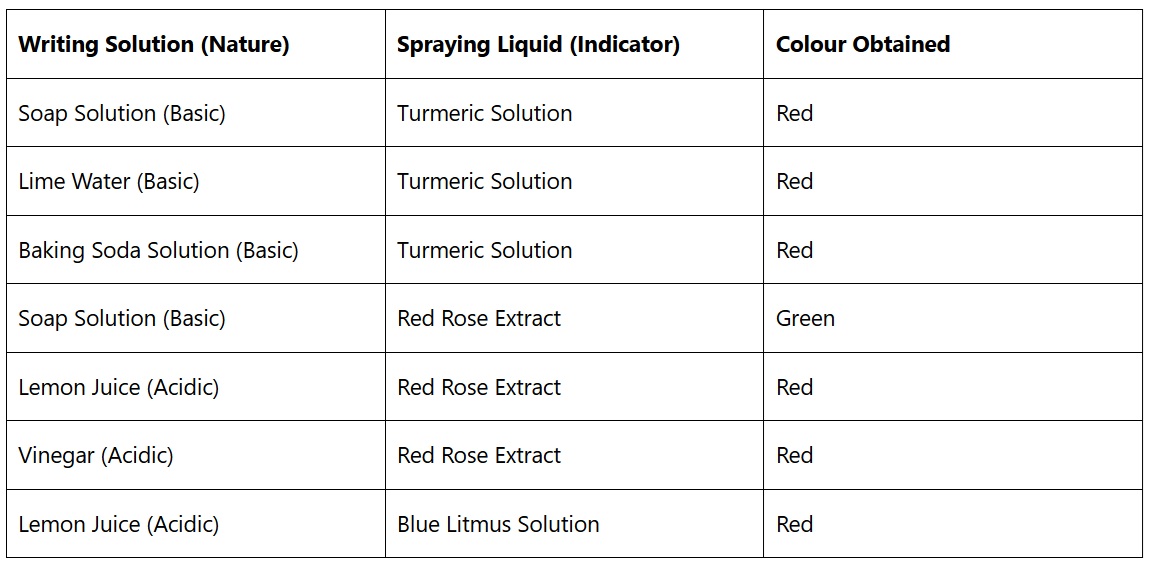
6. Could you suggest various materials which can be used for writing the message on the white sheet of paper (given at the beginning of the chapter) and what could be in the spray bottle? Make a table of various possible combinations and the colour of the writing obtained.
Answer:
7. Grape juice was mixed with red rose extract; the mixture got a tint of red colour. What will happen if baking soda is added to this mixture? Justify your answer.
Answer: When baking soda is added to the grape juice and red rose extract mixture, the colour changes from red to green. This happens because grape juice is acidic and red rose extract appears red in acids. Baking soda is a base, and when added it turns the solution basic, causing the red rose extract to turn green.
8. Keerthi wrote a secret message to her grandmother on her birthday using orange juice. Can you assist her grandmother in revealing the message? Which indicator would you use to make it visible?
Answer: Orange juice is acidic in nature. We know that red rose extract turns red in acidic solutions. Hence, I will tell her grandmother to use red rose extract to reveal the secret message, which will be red in colour.
9. How can natural indicators be prepared? Explain by giving an example.
Answer: We can prepare turmeric indicator which is a natural indicator by the following process:
(i) A spoonful of turmeric (haldi) is taken in a container and a little water is added to make a paste.
(ii) A piece of filter paper is dipped in the turmeric paste until it gets yellow colour.
(iii) It is taken out and allowed to dry.
(iv) This yellow paper is cut into thin strips, which can be used as ‘turmeric paper’
10. Three liquids are given to you. One is vinegar, another is a baking soda solution, and the third is a sugar solution. Can you identify them only using turmeric paper? Explain.
Answer: Using turmeric paper, we can identify only the baking soda solution, but not vinegar or sugar solution. It is because baking soda will turn turmeric paper red because baking soda is a basic substance. The other two liquids, vinegar and sugar solutions, do not change the colour of turmeric paper and hence cannot be distinguished.
11. The extract of red rose turns the liquid X to green. What will the nature of liquid X be? What will happen when excess of amla juice is added to liquid X?
Answer: If the extract of red rose turns liquid X to green, it means that liquid X is basic in nature. When excess amla juice (which is acidic) is added to liquid X, the acid will neutralise the base. If enough amla juice is added, the solution will become acidic. As a result, the green colour will change to red, since red rose extract turns red in acidic solutions.
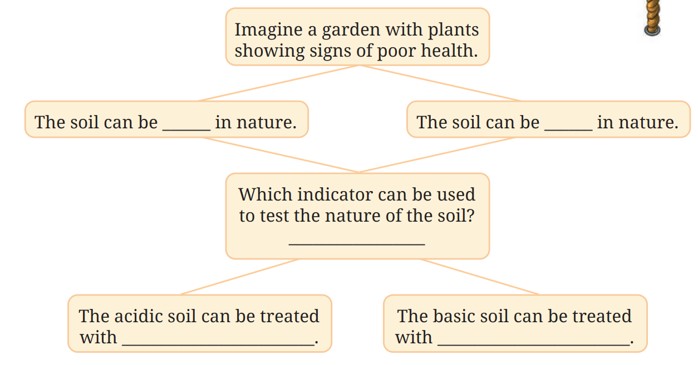
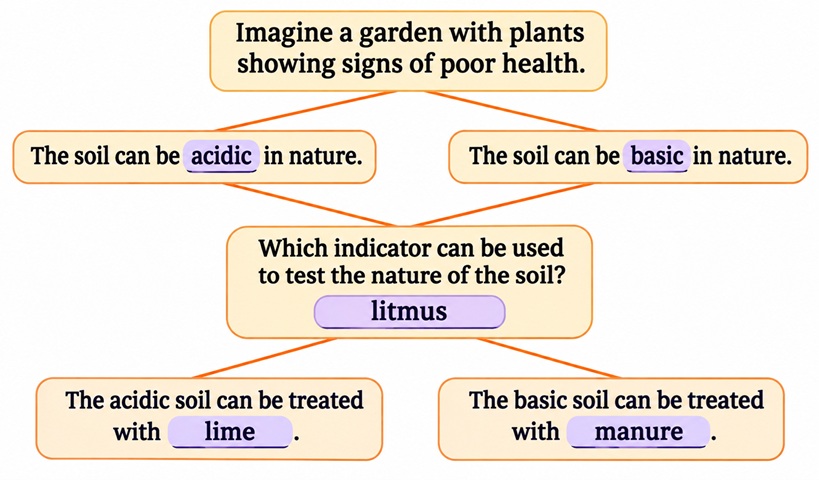
12. Observe and analyse the information given in the following flowchart. Complete the missing in formation.
Answer:
Class 7 Science Curiosity Chapter 2 NCERT Solutions
The chapter Exploring Substances: Acidic, Basic, and Neutral introduces students to different types of substances found in their surroundings. It explains how acids and bases can be identified using natural indicators and how these indicators change colour when they come into contact with acidic or basic substances.
Students learn about the properties of acids, bases, and neutral substances, along with the process of neutralisation. The chapter also explains how neutralisation is useful in daily life, such as treating acidity and improving soil conditions.