

NCERT Solutions for Class 7 Science Chapter 4 The World of Metals and Non-metals are provided here in simple and easy-to-understand language. These NCERT Solutions for Class 7 are based on the new NCERT Science textbook Curiosity. In this chapter, students learn about metals and non-metals, their properties, and their uses in everyday life. The chapter explains the differences between metals and non-metals based on their appearance, hardness, conductivity, malleability, and ductility. Students also learn how metals react with air and water.
The World of Metals and Non-metals NCERT Class 7 Science Chapter 4 Questions and Answers
Intext Questions
Question: Can you give some examples of metal sheets? (Page no. 43)
Answer: Some examples of metal sheets are silver foil, copper sheets, iron sheets and aluminium foil.
Question: Can you name some metals that are used for making cooking vessels? (Page no. 46)
Answer: Metals like aluminium, copper, iron and stainless steel are commonly used for making cooking vessels.
Question: Have you ever seen an electrician using a screwdriver? What type of material is used for making its handle? (Page no. 47)
Answer: Yes. The handle of a screwdriver is usually made of plastic or rubber.
Let Us Enhance Our Learning (Page 55-56)
1. Which metal is commonly used to make food packaging materials as it is cheaper, and its tin sheets can be folded easily into any shape?
(i) Aluminium
(ii) Copper
(iii) Iron
(iv) Gold
Answer: (i) Aluminium
Explanation: Aluminium is commonly used to make food packaging materials because it is cheap, lightweight, and its thin sheets can be easily folded into any shape. It is also non-reactive with food, making it safe for packaging.
2. Which of the following metal catches fire when it comes in contact with water?
(i) Copper
(ii) Aluminium
(iii) Zinc
(iv) Sodium
Answer: (iv) Sodium
Explanation: Sodium is a metal which is stored in kerosene because it reacts vigorously with oxygen and water, thereby catching fire.
3. State with reason(s) whether the following statements are True [T] or False [F].
(i) Aluminium and copper are examples of non-metals used for making utensils and statues. [ ]
(ii) Metals form oxides when combined with oxygen, the solution of which turns blue litmus paper to red. [ ]
(iii) Oxygen is a non-metal essential for respiration. [ ]
(iv) Copper vessels are used for boiling water because they are good conductors of electricity. [ ]
Answer: (i) [F] False.
Reason: Aluminium and copper are examples of metals.
(ii) [F] False.
Reason: When combined with oxygen, metals form basic oxides, the solution of which turns red litmus paper blue.
(iii) [T] True.
(iv) [F] False.
Reason: Copper vessels are used for boiling water because they are good conductors of heat and hence the heat gets transferred to the water inside the vessels.
4. Why are only a few metals suitable for making jewellery?
Answer: Metals used in jewellery must have certain essential properties, including lustre, malleability, ductility, and resistance to corrosion. Metals like gold, silver, and platinum possess these qualities, which is why they are commonly used for making jewellery, while most other metals do not meet all these requirements.
5. Match the uses of metals and non-metals given in Column I with the jumbled names of metals and non-metals given in Column II.
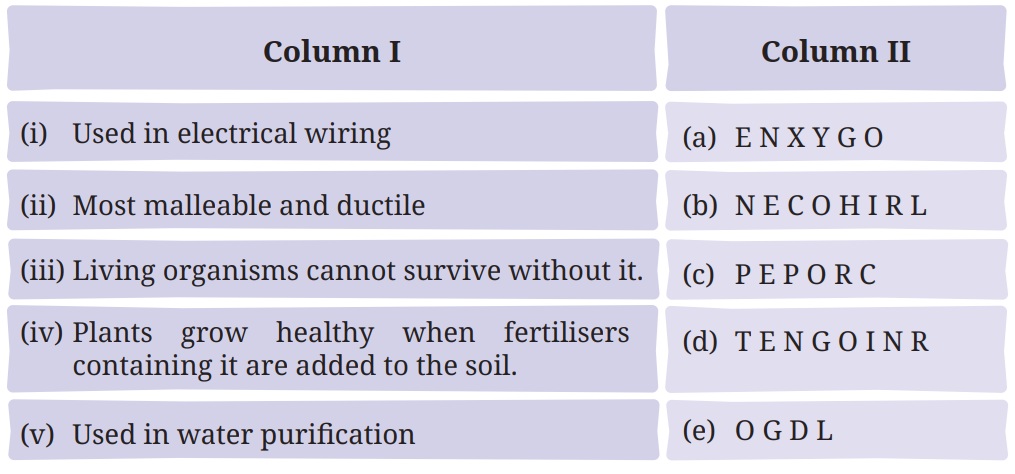
Answer:
| Column I | Column II |
| (i) Used in electrical wiring | (a) COPPER |
| (ii) Most malleable and ductile | (e) GOLD |
| (iii) Living organisms cannot survive without it. | (a) OXYGEN |
| (iv) Plants grow healthy when fertilisers containing it are added to the soil. | (d) NITROGEN |
| (v) Used in water purification. | (e) CHLORINE |
6. What happens when oxygen reacts with magnesium and sulfur. What are the main differences in the nature of products formed?
Answer: Magnesium metal reacts with oxygen to form magnesium oxide. Sulfur (non-metal) reacts with oxygen to form sulfur dioxide. When magnesium oxide is dissolved in water, it forms a basic solution which turns red litmus paper blue. However, when sulfur dioxide is dissolved in water, it forms an acidic solution called sulfurous acid which turns blue litmus paper red.
7. Complete the following flow chart:
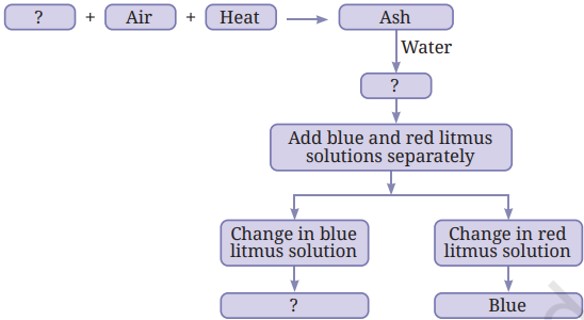
Answer:
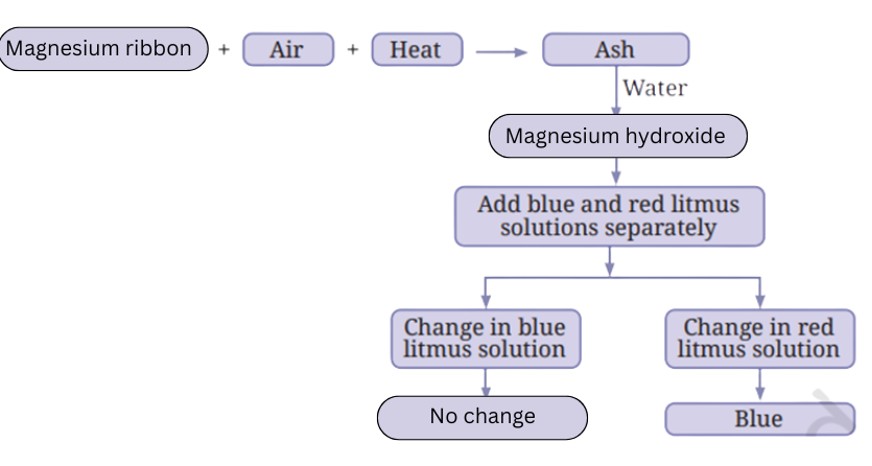
8. You are provided with the following materials. Discuss which material would be your choice to make a pan that is most suitable for boiling water and why?
Iron, copper, sulfur, coal, plastic, wood, cardboard
Answer: The most suitable material for making a pan to boil water is copper. This is because copper is a metal and an excellent conductor of heat, allowing water to heat up quickly and evenly. Materials like sulfur, coal, plastic, wood, and cardboard are poor conductors of heat and may burn or melt, making them unsuitable. Iron, while a good conductor, is prone to rusting, requiring maintenance to prevent corrosion, which makes it less suitable.
9. You are provided with three iron nails, each dipped in oil, water and vinegar. Which iron nail will not rust, and why?
Answer: The iron nail dipped in oil will not rust. This is because the oil forms a protective layer that prevents air and moisture from coming into contact with the iron. Rusting requires both water (moisture) and oxygen. Since the oil blocks both, the iron nail remains protected from rust.
10. How do the different properties of metals and non-metals determine their uses in everyday life?
Answer: The different properties of metals and non-metals determine their uses based on their nature. Metals are lustrous, malleable, ductile, and good conductors of heat and electricity, so they are used in cooking vessels, wires, tools, and jewellery. Non-metals are generally dull, brittle, and poor conductors, so they are used in making fertilizers, antiseptics, and water purification chemicals.
Metals:
- The heat-conducting ability of metals makes them ideal for use in heating pans and cooking vessels.
- Electricity conducting ability of metals enable them to be used as electrical wires.
- Metals are malleable, so they can be beaten into different shapes to make jewellery.
- Being ductile, they can be drawn into wires for uses like suspension bridges.
- Metals are hard and hence used to build tools and structures.
- Metals are sonorous and hence used to make calling bells etc.
- Metals are lustrous and hence used in decoration and jewellery.
Non-metals:
- Oxygen, a non-metal, is essential for breathing.
- Carbon is the building block of life, found in proteins, fats, and carbohydrates, necessary for growth and energy.
- Nitrogen is used in the manufacturing of fertilizers and is vital for plant growth.
- Chlorine is used in water purification.
- Iodine, in solution form, is applied as an antiseptic on wounds.
11. One of the methods of protecting iron from getting rusted is to put a thin coating of zinc metal over it. Since sulfur does not react with water, can it be used for this purpose? Justify your answer.
Answer: No, sulfur cannot be used to protect iron from rusting, even though it does not react with water. This is because sulfur is a non-metal and it is brittle, not malleable, and cannot form a thin, protective coating over iron like zinc.
12. An ironsmith heats iron before making tools. Why is heating necessary in this process?
Answer: An ironsmith heats iron before making tools to make it soft and more malleable. The hot and soft iron can easily be beaten into various shapes for making tools.
Class 7 Science Curiosity Chapter 4 NCERT Solutions
The chapter The World of Metals and Non-metals introduces students to the different properties of metals and non-metals. It explains how metals such as iron, copper, and aluminium are commonly used to make tools, utensils, and electrical wires, while non-metals are used for various other purposes.
Students learn about the physical properties of metals and non-metals, including their ability to conduct heat and electricity. The chapter also explains the process of rusting of iron and the conditions required for it to occur.