

NCERT Solutions for Class 7 Science Chapter 6 Adolescence – A Stage of Growth and Change are provided here in simple and easy-to-understand language. These NCERT Solutions for Class 7 are based on the new NCERT Science textbook Curiosity. In this chapter, students learn about adolescence and the physical, emotional, and mental changes that occur during this stage of life. The chapter explains the role of hormones in growth and development and the importance of maintaining good health, personal hygiene, and a balanced diet during adolescence.
Adolescence – A Stage of Growth and Change NCERT Class 7 Science Chapter 6 Questions & Answers
Intext Questions (Page no. 80)
Question: Adolescents, especially girls, may sometimes suffer from blood-related health problems (s) because of a deficiency of iron or vitamin B12 in the body.
(i) Find out about such health problem(s).
(ii) How can we manage iron deficiency in our body?
(iii) Find out about government schemes aimed to prevent such deficiencies.
Answer:
(i) A common blood-related health problem caused by a deficiency of iron or vitamin B12 is anaemia. Anaemia occurs when there is a lack of healthy red blood cells or haemoglobin in the blood. It can cause symptoms like weakness, tiredness, dizziness, shortness of breath and pale skin.
(ii) By consuming iron-rich foods like green leafy vegetables, beans, lentils, fortified cereals, and meat, one can overcome iron deficiency.
(iii) Some of the government schemes are:
(a) NIPI-National Iron Plus Initiative Control of Iron Deficiency Anaemia
(b) Mid-day Meal Scheme
(c) Anaemia Mukt Bharat (AMB)
Let Us Enhance Our Learning (Page 85)
1. Ramesh, an 11-year-old boy, developed a few pimples on his face. His mother told him that this is because of ongoing biological changes in his body.
(i) What could be the possible reasons for the development of these pimples on his face?
Answer: The pimples are likely caused by a condition called acne, which is common during adolescence. During this stage, the skin produces more oil (sebum) due to hormonal changes. This oil can clog skin pores, leading to the formation of pimples.
(ii) What can he do to get some relief from these pimples?
Answer: To manage and reduce pimples, Ramesh can:
- Keep his face clean by washing it regularly with mild soap and water.
- Avoid touching or squeezing the pimples to prevent infection.
- If pimples are severe or painful, consult a doctor or skin specialist.
2. Which of the following food groups would be a better option for adolescents and why?
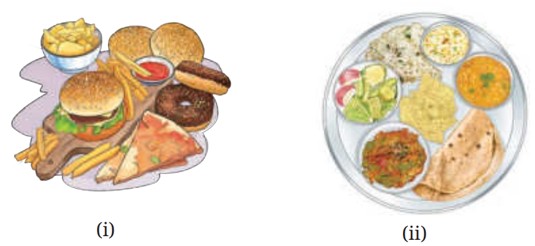
Answer: Food group (ii) would be a better option for adolescents as it is composed of vegetables, grains, daily products, etc. Such foods are rich in essential nutrients like proteins, carbohydrates, vitamins, and minerals, which are important for growth, development and overall health during adolescence. On the other hand, option (i) contains fried foods and junk items, which are high in unhealthy fats and sugars and can lead to poor health if consumed frequently.
3. Unscramble the underlined word in the following sentences
(i) The discharge of blood in adolescent girls which generally occurs every 28-30 days is nstmnoiaretu.
Answer: menstruation.
(ii) The hoarseness in the voice of adolescent boys is due to enlarged iceov xob.
Answer: voice box.
(iii) Secondary sexual characteristics are natural signs that the body is preparing for adulthood and mark the onset of urtypeb.
Answer: puberty.
(iv) We should say NO to lahoclo and srugd as they are addictive.
Answer: alcohol and drugs.
4. Shalu told her friend, “Adolescence brings only physical changes, like growing taller or developing body hair.” Is she correct? What would you change in this description of adolescence?
Answer: Shalu is not completely correct. Adolescence is a stage of growth that brings physical, emotional, and behavioural changes. It also includes internal changes like the development of the reproductive system and the start of the menstrual cycle in girls. So, adolescence is not just about physical appearance, it’s a complete stage of development that prepares the body and mind for adulthood.
5. During a discussion in the class, some of the students raised the following points. What questions would you ask them to check the correctness of these points?
(i) Adolescents do not need to worry about behavioural changes.
Answer: The following questions can be asked for the correctness of the point
- Why do you think behavioural changes do not matter during adolescence?
- Do you think changes in emotions and behaviour can affect your actions and decisions?
- Why is it important to understand and manage your behaviour during adolescence?
- How can being aware of behavioural changes help you grow positively?
(ii) If someone tries a harmful substance once, they can stop anytime they want.
Answer: The following questions can be asked for the correctness of the point
- Do you know what addiction means?
- Can trying harmful substances like tobacco or drugs just once lead to repeated use?
- Why do people find it difficult to stop once they start using such substances?
- What are the long-term effects of substance use on health and behaviour?
6. Adolescents sometimes experience mood swings. On some days, they feel very energetic and happy, while on other days, they may feel low. What other behavioural changes are associated with this age?
Answer: Other behavioural changes in adolescence are
- They often become more sensitive, easily feeling hurt, embarrassed, or irritated.
- Strong emotions like anger, sadness, or excitement may occur more often.
- There is a growing desire for independence and personal decision-making.
- Adolescents begin to explore their identity and think deeply about themselves and their future.
- Peer influence increases, and they may try to copy their friends or feel pressured to fit in.
7. While using a toilet, Mohini noticed that used sanitary pads were scattered near the bin. She got upset and shared her feelings with her friends. They discussed the importance of menstrual hygiene and healthy sanitary habits. What menstrual hygiene and sanitary habits would you suggest to your friends?
Answer: The menstrual hygiene and sanitary habits one should follow are:
- Use sanitary pads or reusable cloth pads during menstruation.
- Change pads every 4-6 hours to stay clean and avoid infections.
- Wrap used pads in newspaper and dispose of them in a dustbin.
- Wash hands before and after changing pads to maintain hygiene.
- Keep the pubic area clean by bathing daily during periods.
8. Mary and Manoj were classmates and good friends. On turning 11, Mary developed a little bulge on the front of her neck. She visited the doctor who gave her medication and asked to take iodine-rich diet. Similarly, a bump was developed on the front of Manoj’s neck when he turned 12. However, the doctor told him that it was a part of growing up. According to you, what could be the possible reason for advising Mary and Manoj differently?
Answer: The reason Mary and Manoj were advised differently is because the bulge on their necks had different causes.
In Mary’s case, the bulge was likely due to a condition called goitre, which is caused by a deficiency of iodine. That’s why the doctor gave her medication and recommended an iodine-rich diet. Goitre is a medical condition and needs treatment.
In Manoj’s case, the bump on his neck was likely the Adam’s apple, which appears in boys during adolescence as the voice box (larynx) grows. This is a normal physical change and a part of growing up, so no treatment is needed.
So, while Mary’s condition was a health issue, Manoj’s change was a normal sign of puberty. That’s why the doctor advised them differently.
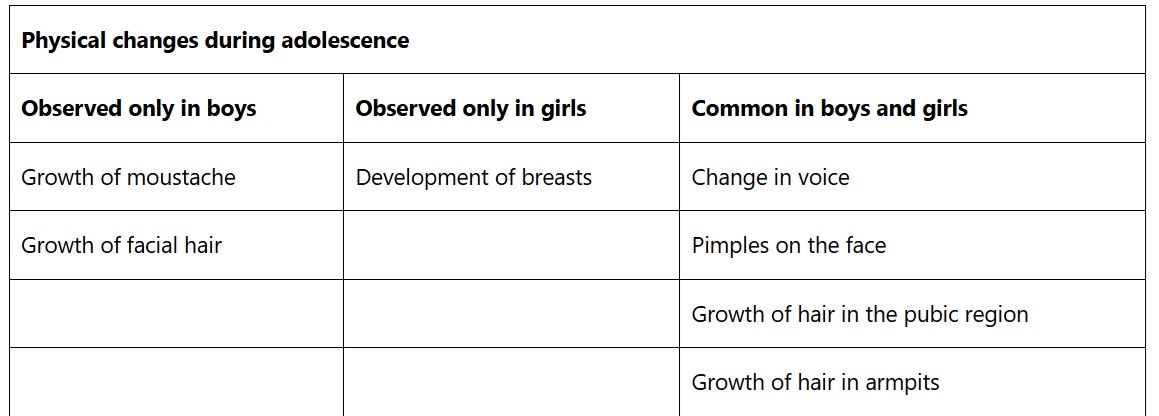
9. During adolescence, the boys and girls undergo certain physical changes, a few of which are given below.
(i) Change in voice
(ii) Development of breasts
(iii) Growth of moustache
(iv) Growth of facial hair
(v) Pimples on the face
(vi) Growth of hair in the pubic region
(vii) Growth of hair in armpits
Categorise these changes in the table given below: Physical changes during adolescence
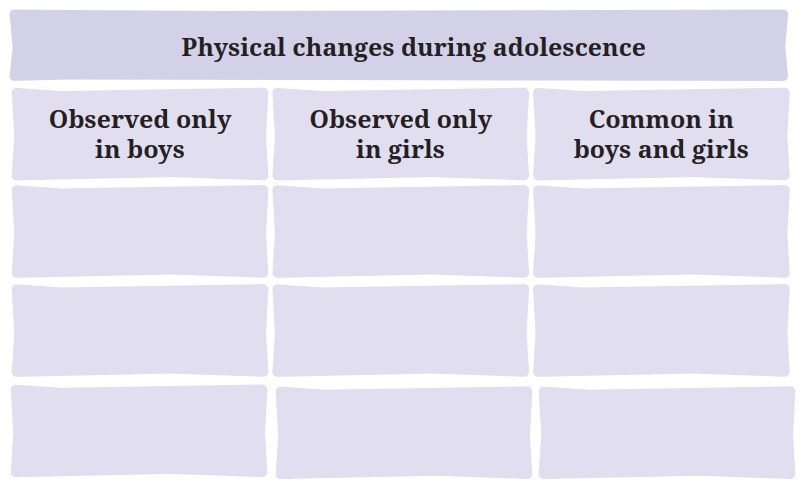
Answer:
10. Prepare a poster mentioning the tips for adolescents to live a healthy lifestyle.
Answer: Try Yourself.
Class 7 Science Curiosity Chapter 6 NCERT Solutions
The chapter Adolescence: A Stage of Growth and Change introduces students to the important changes that take place as children grow into adults. It explains how puberty brings changes in height, body shape, voice, and other physical characteristics.
Students learn about the role of hormones, emotional changes during adolescence, and the importance of healthy habits. The chapter also explains how proper nutrition, regular physical activity, personal hygiene, and emotional well-being contribute to healthy growth and development.