

NCERT Solutions for Class 7 Science Chapter 7 Heat Transfer in Nature are provided here in simple and easy-to-understand language. These NCERT Solutions for Class 7 are based on the new NCERT Science textbook Curiosity. In this chapter, students learn about heat transfer and the different ways heat moves from one place to another. The chapter explains the three methods of heat transfer: conduction, convection, and radiation. Students also learn how heat transfer occurs in nature and everyday life.
Heat Transfer in Nature NCERT Class 7 Science Chapter 7 Questions and Answers
Intext Questions
Question: Why is the smoke going up? (Page no. 92)
Answer: The smoke goes up because the air around the fire gets heated and becomes lighter, and rises. Smoke is made of hot gases and tiny solid particles. Since smoke is warmer than the surrounding air, it rises due to the process of convection.
Question: How does heat transfer take place in liquids? Do liquids also rise up when heated, like air? (Page no. 93)
Answer: Heat transfer in liquids takes place through the process of convection. When a liquid is heated, the particles at the bottom get heated first, become lighter, and rise. The cooler, heavier liquid from the sides then moves down to take its place. This movement continues in a circular pattern, helping heat spread throughout the liquid. Yes, liquids also rise up when heated, just like air, due to this convection process.
Question: How does water seep through the surface of the Earth? (Page no. 96)
Answer: Water seeps through the surface of the Earth by a process called infiltration. When it rains, water moves down through the the soil containing sand, gravel or clay. The water that seeps through gets stored underground in pore spaces and rock openings, forming groundwater.
Let US Enhance Our Learning (Page 102)
1. Choose the correct option in each case.
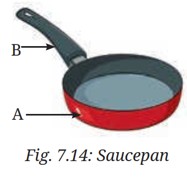
(i) Your father bought a saucepan made of two different materials, A and B, as shown in Fig. 7.14. The materials A and B have the following properties —
(a) Both A and B are good conductors of heat
(b) Both A and B are poor conductors of heat
(c) A is a good conductor and B is a poor conductor of heat
(d) A is a poor conductor and B is a good conductor of heat
Answer: (c) A is a good conductor and B is a poor conductor of heat.
Reason: Part A of the saucepan is the bottom and sides, which need to conduct heat quickly to cook food—so it’s made of a good conductor (like metal).
Part B is the handle, which should not get hot easily for safe handling—so it’s made of a poor conductor (like plastic or wood).
(ii) Pins are stuck to a metal strip with wax and a burning candle is kept below the rod, as shown in Fig. 7.15. Which of the following will happen?
(a) All the pins will fall almost at the same time
(b) Pins I and II will fall earlier than pins III and IV
(c) Pins I and II will fall later than pins III and IV
(d) Pins II and III will fall almost at the same time
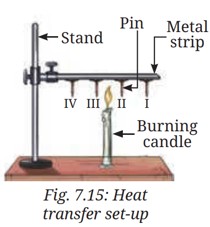
Answer: (b) Pins I and II will fall earlier than pins III and IV.
Explanation: The metal strip is heated at one end (near pin I). Heat transfers through the strip by conduction, moving from the hot end to the cooler end. As the wax holding each pin melts due to the heat, the pins closest to the flame (I and II) fall first, followed by the others. Hence, pins I and II will fall earlier than pins III and IV.
(iii) A smoke detector is a device that detects smoke and sounds an alarm. Suppose you are fitting a smoke detector in your room. The most suitable place for this device will be:
(a) Near the floor
(b) In the middle of a wall
(c) On the ceiling
(d) Anywhere in the room
Answer: (c) On the ceiling.
Explanation: Smoke rises because it is made of hot gases and particles that are lighter than the surrounding air. Therefore, the ceiling is the best place to detect smoke early, as it will reach there first. That’s why smoke detectors should be installed on the ceiling.
2. A shopkeeper serves you cold lassi in a tumbler. By chance, the tumbler had a small leak. You were given another tumbler by the shopkeeper to put the leaky tumbler in it. Will this arrangement help to keep the lassi cold for a longer time? Explain.
Answer: Yes, this arrangement will help to keep the lassi cold for a longer time.
When the leaky tumbler is placed inside another tumbler, air gets trapped between the two layers. Air is a poor conductor of heat (an insulator), so it reduces the transfer of heat from the surroundings to the cold lassi. This slows down the warming of the lassi and helps keep it cold.
3. State with reason(s) whether the following statements are True [T] or False [F].
(i) Heat transfer takes place in solids through convection.
Answer: False
Reason: In solids, heat transfer takes place mainly through conduction, not convection.
Convection involves the movement of particles, which is possible only in liquids and gases, not in solids where particles are tightly packed and do not move freely.
(ii) Heat transfer through convection takes place by the actual movement of particles.
Answer: True
Reason: In convection, heat is transferred by the actual movement of particles in liquids and gases.
Hot particles rise up as they become lighter, and cooler particles move down to take their place, creating a circulation pattern that transfers heat.
(iii) Areas with clay materials allow more seepage of water than those with sandy materials.
Answer: False
Reason: Clay has very small and tightly packed particles, leaving very little space for water to pass through. Sandy materials on the other hand have larger and more open spaces between particles, allowing faster seepage of water. So, clay allows less seepage than sand.
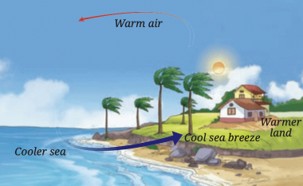
(iv) The movement of cooler air from land to sea is called land breeze.
Answer: True
Reason: At night, the land cools down faster than the sea. The air above the sea stays warmer and rises while the cooler, denser air from the land moves toward the sea to take its place. This movement of cool air from land to sea is called a land breeze.
4. Some ice cubes placed in a dish melt into water after some time. Where do the ice cubes get heat for this transformation?
Answer: The ice cubes get heat from their surroundings, such as the air or any objects nearby. The surrounding environment is warmer than the ice, so heat is transferred to the ice through the processes of conduction, convection, and radiation. This heat increases the temperature of the ice, causing it to melt into water.
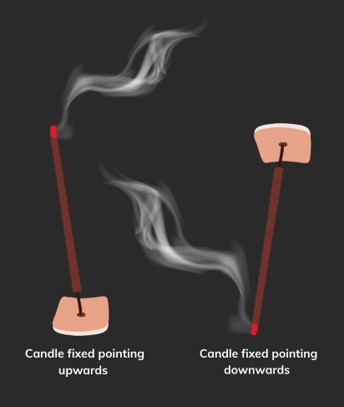
5. A burning incense stick is fixed, pointing downwards. In which direction would the smoke from the incense stick move? Show the movement of smoke with a diagram.
Answer: The smoke from the incense stick will move in the upward direction because smoke is a mixture of hot gases and tiny solid particles. Since hot air rises due to convection, the smoke moves upwards.
6.Two test tubes with water are heated by a candle flame as shown in Fig. 7.16. Which thermometers (Fig. 7.16a or Fig. 7.16b) will record a higher temperature? Explain.
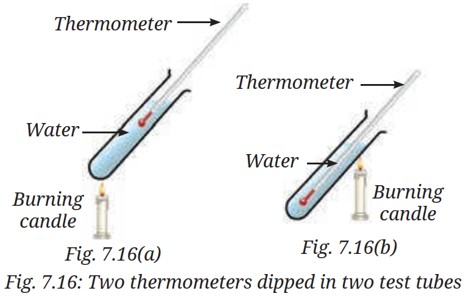
Answer: In Fig. 7.16(b), the thermometer bulb is placed at the bottom of the test tube, close to the flame. When water is heated, the bottom part gets hot first. The warm water becomes lighter and rises, while cooler water moves down, this circulation is called convection.
In Fig. 7.16(a), the thermometer is placed near the top where the water heats up more slowly because heat takes time to move upward through convection.
Therefore, the thermometer in Fig. 7.16(b) shows a higher temperature than the one in Fig. 7.16(a).
7. Why are hollow bricks used to construct the outer walls of houses in hot regions?
Answer: Hollow bricks are used to construct the outer walls of houses in hot regions because they trap air inside, and air is a poor conductor of heat. The air trapped in the hollow spaces of the bricks reduces heat transfer from the hot outside environment to the inside of the house. This helps to keep the house cooler in hot regions.
8. Explain how large water bodies prevent extreme temperature in areas around them.
Answer: Large water bodies prevent extreme temperatures in nearby areas by absorbing and releasing heat slowly. The land heats up faster than water. During the day, water absorbs heat without getting very hot and at night it releases the stored heat slowly. This moderates the temperature of the surrounding areas, keeping them cooler in summer and warmer in winter, and prevents extreme temperature changes.
9. Explain how water seeps through the surface of the Earth and gets stored as groundwater.
Answer: When it rains, water passes through the spaces between soil and rock particles. This seeping water moves downward and gets stored in the pore spaces of sediments and the openings in rocks beneath the surface. These underground layers that store water are called aquifers. This stored water is known as groundwater.
10.The water cycle helps in the redistribution and replenishment of water on the Earth. Justify the statement.
Answer: The water cycle helps in the redistribution and replenishment of water on Earth by continuously moving water through evaporation, condensation, and precipitation. Water from oceans, rivers and lakes evaporates due to the Sun’s heat, forms clouds through condensation, and falls back to Earth as rain or snow through a process called precipitation. This water either flows into water bodies or seeps into the ground, refilling rivers, lakes, and underground aquifers. This process ensures continuous availability of water on Earth.
Class 7 Science Curiosity Chapter 7 NCERT Solutions
The chapter Heat Transfer in Nature introduces students to the different methods through which heat is transferred. It explains how heat travels through solids by conduction, through liquids and gases by convection, and through radiation without requiring a medium.
Students learn about the role of heat transfer in natural phenomena such as sea breezes, land breezes, and the heating of the Earth’s surface. The chapter also explains how different materials conduct heat and how these principles are used in everyday activities.