

NCERT Solutions for Class 7 Social Science Part 1 Chapter 11 From Barter to Money are provided here with simple and easy-to-understand answers. These NCERT Solutions for Class 7 are based on the new NCERT Social Science textbook Exploring Society: India and Beyond Part 1. In this chapter, students learn about the barter system, the need for money, and the development of different forms of exchange. The chapter also explains how these ideas help students understand India’s society and the world around them.
From Barter to Money Questions and Answers Class 7 Social Science Chapter 11
The Big Question (Page 229)
1: How did exchange take place before money?
Answer: Before money was invented, people exchanged goods and services directly with each other. This system was called the barter system. For example, a person could give some rice to another person in return for clothes or tools. In this way, people traded what they had for what they needed, without using money.
2: Why did money come into existence?
Answer: Money came into existence because the barter system had many problems. It was difficult to find people who wanted exactly what you had and could give you what you needed. It was also hard to decide the value of goods and to carry or store things like grain or animals. To make buying and selling easier, people started using money as a common medium of exchange.
3: How has money transformed into various forms over time?
Answer: Over time, money has changed many forms. In the beginning, people used things like shells, salt, and cattle as money. Later, metal coins made of gold, silver, and copper were used. Then came paper money or currency notes, which were easier to carry. Today, money has become digital, and people use debit cards, credit cards, and UPI payments on mobile phones to buy and sell things.
Let’s Explore (Page 239)
Q. The coins shown in Fig. 11.12 were found during excavations in Pudukkottai in Tamil Nadu. Their heads embossed are those of Roman kings. What conclusions can we draw from such a finding?
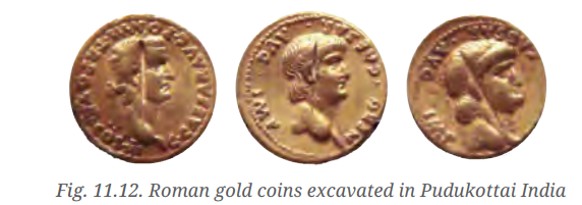
Answer: The Roman coins found in Pudukkottai, Tamil Nadu, show that there was trade between ancient India and the Roman Empire. These coins are proof that India had strong maritime (sea) trade links with the rest of the world, especially with Rome.
Let’s Explore (Page 241)
Question: What do you think happened as coins began to be used for all types of exchanges, whether to buy vegetables or to buy some land? What problems could have come up?
Answer: When coins began to be used for all kinds of exchanges, people faced some problems. For big purchases, people needed a lot of coins. This made it hard to carry them. Storing coins safely was also a problem because they were heavy and took up space. To solve these problems, people later started using paper money, which was lighter and easier to carry and store.
Questions and activities – Exercise (Page 244)
1: How does the barter system take place and what kinds of commodities were used for exchange under the system?
Answer: In the barter system, people exchanged goods and services directly without using money. Different kinds of commodities were used for exchange, such as cowrie shells, salt, tea, tobacco, cloth, cattle, and seeds.
2: What were the limitations of the barter system?
Answer: The barter system had many limitations:
- It was hard to find people who wanted exactly what you had.
- It was hard to decide how much of one item should be exchanged for another.
- Some goods could not be divided easily for exchange, like an ox or a cow.
- Many goods were not durable and could get spoiled, like grains or fruits.
- Big or heavy goods were difficult to carry from place to place.
3: What were the salient features of ancient Indian coins?
Answer: The ancient Indian coins had several important features:
- They were made of precious metals like gold, silver, and copper.
- The coins were made by rulers, and each kingdom had its own coinage.
- Coins had symbols stamped on them, such as animals, trees, hills, kings, queens, and gods.
- Coins were called karṣhapaṇas or paṇas, and the symbols on them were known as rupas.
- Coins helped in easy trade within the kingdom and with other countries.
4: How has money as a medium of exchange transformed over time?
Answer: Money as a medium of exchange has changed a lot over time. In the beginning, people used the barter system, where goods were exchanged for other goods. Later, they started using things like cowrie shells, salt, and cattle as money. After that, metal coins made of gold, silver, and copper were introduced. In modern times, money has become digital, and people now use debit cards, credit cards, and UPI for making payments easily.
5: What steps might have been taken in ancient times so that Indian coins could become the medium of exchange across countries?
Answer: In ancient times, Indian rulers and traders might have taken several steps to make Indian coins a medium of exchange across countries. They could have made coins using valuable metals like gold and silver, which were accepted everywhere. The rulers might have maintained uniform weight and purity of coins to build trust. Strong trade relations with other kingdoms could have helped in spreading the use of these coins beyond India’s borders.
6: Read the following lines from the Arthaśhāstra. “An annual salary of 60 paṇas could be substituted by an āḍhaka of grain per day, enough for four meals…” (One āḍhaka is equal to about 3 kg) What does this indicate about the value of one paṇa?
The fine for failing to help a neighbour was 100 paṇas. Compare this with the annual salary. What conclusion can you draw about the human values being encouraged through this?
Answer: The given lines from the Arthaśhāstra show that one paṇa had a high value, because an annual salary of 60 paṇas could provide enough grain for a whole year. This means even a small number of paṇas could buy a good amount of food and meet daily needs.
The fine for not helping a neighbour was 100 paṇas, which was much higher than the annual salary. This shows that people in those times valued kindness, cooperation, and helping others.
7: Write and enact a skit to show how people may have persuaded each other to use cowrie shells (or other such items) as the medium of exchange.
Answer: Do it yourself.
8: The RBI is the only legal source that prints and distributes paper currency in India. To prevent illegal printing of notes and their misuse, the RBI has introduced many security features. Find out what some of these measures are and discuss them in class.
Answer: The Reserve Bank of India (RBI) has introduced several security features in Indian currency notes to prevent illegal printing and misuse. Some of these important features are:
- Each note has a picture of Mahatma Gandhi and the RBI emblem that can be seen when the note is held against light.
- A special silver or green security line runs across the note, which changes colour when tilted.
- Tiny letters like “RBI” or the value of the note (for example, “₹100”) are printed on the note and can be seen under a magnifying glass.
- The note is printed on a special cotton-rag paper with unique feel and sound, making duplication difficult.
9: Interview a few of your family members and local shopkeepers, and ask them their preferences in making and receiving payments — do they prefer cash or UPI? Why?
Answer: Do it yourself.
Class 7 Social Science: Exploring Society Part 1 Chapter 11 NCERT Solutions
The chapter From Barter to Money explores how people exchanged goods and services before money came into use. Students learn about the difficulties of barter, including the need for both people to want what the other offers, and how money made exchange easier.
Students also learn about the evolution of money, from early forms of currency to coins, paper notes, and digital payments. The chapter explains how money is used to buy goods, measure value, and support economic activities in everyday life.