

NCERT Solutions for Class 7 Social Science Part 1 Chapter 3 Climates of India are provided here with simple and easy-to-understand answers. These NCERT Solutions for Class 7 are based on the new NCERT Social Science textbook Exploring Society: India and Beyond Part 1. In this chapter, students learn about the difference between weather and climate, India’s seasons, and the factors that influence regional climatic conditions. The chapter also explains how these ideas help students understand India’s society and the world around them.
Climates of India Questions and Answers Class 7 Social Science Chapter 3
The Big Questions? (Page 45)
1. What makes India climate so diverse?
Answer: India’s climate is diverse because of its large size and varied geography. Different parts of the country have different landforms like mountains, plateaus, plains, deserts, and coasts, which affect the weather in each region.
The Himalayas in the north make the winters cold and stop cold winds from Central Asia, while the Thar Desert in the west is hot and dry. The coastal areas have moderate temperatures because of the sea, and the southern regions are warm throughout the year as they are close to the Equator.
2. What are the monsoons? How are they formed? (Page 45)
Answer: The monsoons are seasonal winds that bring heavy rain to India and nearby regions. The word monsoon comes from the Arabic word “mausim”, which means season. They are formed because land and water heat and cool at different speeds.
In summer, the land becomes hot faster than the ocean, creating low pressure over land. Moist winds blow from the ocean to the land, bringing rainfall. In winter, the land cools down faster and has high pressure, while the ocean stays warmer. Winds then blow from land to sea, bringing dry weather
3. What is the effect of climate on economy, culture and society? (Page 45)
Answer: The climate has a big effect on a country’s economy, culture, and society. In India, the monsoon rains are very important for agriculture because they help crops grow. When the monsoon fails, crops suffer, and the economy is affected.
Climate also shapes culture and traditions. Many festivals, such as Baisakhi, Pongal, and Onam, are linked to the seasons and harvests. The clothes people wear, the food they eat, and even the houses they build depend on the local climate.
4. How can understanding the climate help us to prepare for natural disasters? (Page 45)
Answer: Understanding the climate helps us to prepare for natural disasters in many ways:
- People can build stronger houses, roads, and shelters in risky areas.
- Farmers can plan their crops and water use during droughts.
- Early warning systems can alert people about cyclones or heavy rain.
- Understanding weather patterns helps reduce damage and save lives.
5. What is climate change? What are its consequences? (Page 45)
Answer: Climate change means a long-term change in the Earth’s temperature, rainfall, and weather patterns. It is mostly caused by human activities such as burning fossil fuels, cutting down forests, and polluting the air. These actions release greenhouse gases that trap heat in the atmosphere, causing the Earth to become warmer
Consequences of climate change:
- The Earth is getting hotter causing heatwaves.
- Ice in polar areas melts, making sea levels rise.
- Farmers suffer due to crop seasons change and unpredictable rainfall.
- It also affects animals, plants, and human health.
Let’s Explore (Page 47)
1. Which are your favourite seasons? Write a short essay explaining your reasons. (Page 47)
Answer: My favourite season is the monsoon. I love this season because it brings cool rain after the hot summer. The air feels fresh, the trees look green, and everything around looks clean and beautiful. I enjoy watching the raindrops fall, hearing the sound of thunder, and smelling the fresh earth after the rain.
During the monsoon, I like to sit near the window with a warm snack and watch the rain outside. Sometimes, I like to go out and play in the rain with my friends. The monsoon makes me feel happy and peaceful.
2. Discuss in groups of three or four and find out whether there are specific events connected to the seasons in your region. Collect information about them songs, feasts with specific types of food practices in different seasons etc. Document these and share your discoveries with your class. (Page 47)
Answer: In my region, different seasons have special events and festivals. For example:
- Winter: People celebrate Makar Sankranti and eat sesame seeds and jaggery sweets.
- Summer: Many families enjoy picnics and mango festivals.
- Monsoon: Farmers celebrate rain-related festivals and people sing songs to welcome the rains.
- Autumn: People celebrate Diwali with sweets, lights, and traditional rituals.
These events show how people enjoy the season and follow traditions related to weather and nature.
3. Do you know which trees in your area change colours before the onset of winter? Are there trees that shed their leaves around this time? Why do you think this happens? Find out and document the local names of these trees. (Page 47)
Answer: Yes, there are some trees in my area that change colour or shed their leaves before winter. One common tree is the Gulmohar (Delonix regia), which turns yellow or orange before shedding its leaves. Another is the Neem (Azadirachta indica) tree, which also drops many of its leaves during this time.
This happens because, in winter there is less sunlight. Trees shed their leaves to save water and energy, as they cannot make enough food through photosynthesis in the cold season. Peepal is Known as Arasa Maram in Tamil, Pippal in Hindi. Gulmohar known as Mayflower tree in English, Krishna Chura in Bengali
Let’s Explore (Page 51)
Udhagamandalam (Ooty) and Coimbatore are almost at the same latitude. The range of summer temperatures in Ooty is 10-25°C while that in Coimbatore is 25-38°C. Why do you think there is such a difference in temperature between these two places?
Answer: The temperature difference between Ooty and Coimbatore is because of their altitude. Ooty is located high in the Nilgiri Hills, while Coimbatore lies in the plains. As altitude increases, the temperature decreases, because the air becomes thinner and cooler at higher places. So even at the same latitude, Ooty is much cooler than Coimbatore.
Think About it (Page 59)
Question: What are clouds? and what are they made of?
Answer: Clouds are white or grey masses that we see in the sky. They are made of tiny water droplets or ice crystals that float in the air. They form when water vapour from the Earth’s surface rises up, cools, and condenses into tiny water droplets or ice crystals. These small drops gather together to form a cloud.
Questions and Activities (Page 66)
1. Match the climatic factors with their effects:
| Column A | Column B |
| 1. Latitude | (a) Brings wet air to India during summer |
| 2. Altitude | (b) Creates different climates in the north and south |
| 3. Proximity to the ocean | (c) Keeps higher places cooler |
| 4. Monsoon winds | (d) Moderates the temperature |
Answer:
| Column A | Column B |
| 1. Latitude | (c) Keeps higher places cooler |
| 2. Altitude | (d) Moderates the temperature |
| 3. Proximity to the ocean | (a) Brings wet air to India during summer |
| 4. Monsoon winds | (d) Moderates the temperature |
2. Answer the following questions:
(i) What is the difference between weather and climate?
Answer: Weather refers to the short-term atmospheric conditions of a place. For example, it may be sunny today, rainy tomorrow, or windy the next day. Climate, on the other hand, is the average pattern of weather in a place over a long period of time, usually many years.
(ii) Why do places near the ocean have milder temperatures than places far away from it?
Answer: Places near the ocean have milder temperatures because the sea controls or moderates the heat. Water heats up and cools down more slowly than land. That means as we move inland from the coast, the temperatures get more extreme. That’s why coastal areas, like Mumbai or Chennai, have less extreme temperatures, while inland places, like Delhi or Nagpur, become very hot in summer and very cold in winter.
(iii) What role do monsoon winds play in affecting India’s climate?
Answer: The monsoon winds play a very important role in India’s climate. During summer, it brings heavy rainfall to most parts of the country. It helps in farming and keeps the land cool and green. In winter, the direction of the winds reverses and they blow from the land towards the sea, bringing dry weather. Thus, the monsoon winds have a big influence on agriculture, seasons, and people’s lives.
(iv) Why is Chennai warm or hot throughout the year, while Leh is cold?
Answer: Chennai is warm or hot throughout the year because it is located near the sea and close to the Equator. On the other hand, Leh is cold because it is situated high in the Himalayas at a very high altitude. As altitude increases, the temperature decreases, and the air becomes thinner and cooler.
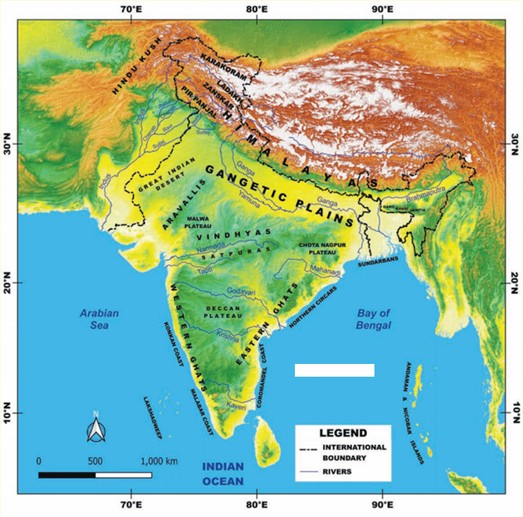
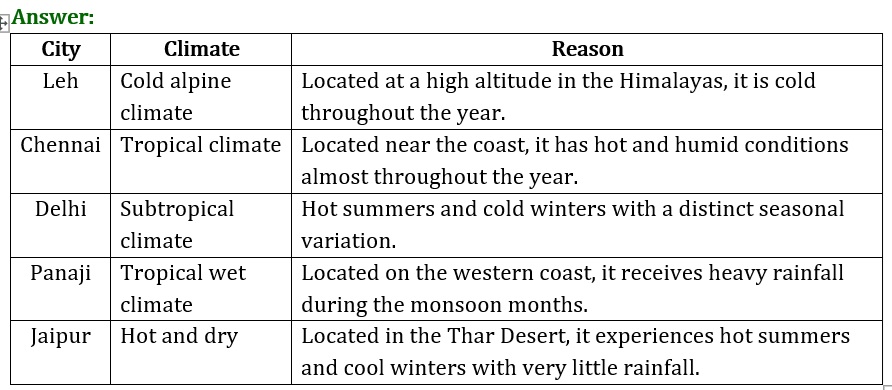
3. Look at a map of India given below. Identify the climate for these cities Leh, Chennai, Delhi, Panaji and Jaipur.
- Is the place near the sea, near the mountains, or in the desert?
- How do these factors affect the climate there?
Answer:
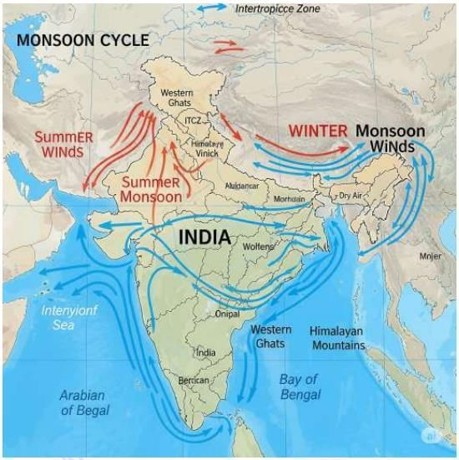
Question 4. Draw the monsoon cycle in summers and winters on a map of India.
- Label where the winds blow in summer and winter.
- Show the direction of winds during the monsoon.
Answer: Summer Monsoon (June to September): Winds blow from the southwest (from the Indian Ocean) bringing moisture and rain to India. The rains start in the southern tip and move northward, covering the entire subcontinent by mid-July.
Winter Monsoon (October to February): Winds reverse and blow from land to the sea, bringing dry weather and cool temperatures. These winds bring some moisture to parts of East and South India.
5. Make a colourful poster showing festivals in India linked to farming and weather (e.g., Baisakhi, Onam). Add pictures or drawings of these festivals.
Answer: Do it yourself.
6. Imagine you are a farmer in India. Write a short diary entry about how you would prepare for the rainy season.
Answer:
Diary Entry – Preparing for the Rainy Season
Date: 12th June
The clouds are gathering, and the air feels cooler — the rains are near. Today I cleaned the field channels and repaired the bunds to stop soil erosion. I also checked the bullocks and tools for the coming days of work.
Tomorrow, I’ll plough the land once more and get the paddy seeds ready for sowing. I just hope the rain comes on time — not too much, not too little. A good monsoon means food for the family and hope for the year ahead.
7. Identify a natural disaster (e.g., cyclone, flood, tsunami, landslide, or forest fire) and write a short essay that includes the causes and impacts. Suggest actions that individuals, communities and the government can take to reduce the impact.
Answer: Essay: Floods – Causes, Impacts, and Prevention
Floods are one of the most common natural disasters in India. They occur when rivers overflow, heavy rain falls continuously, or water from dams is released suddenly. Low-lying areas near rivers and coasts are most affected during the monsoon season.
Floods are mainly caused by heavy rainfall, poor drainage systems, deforestation, and the overflowing of rivers. Human activities like blocking natural waterways and cutting down trees also make floods worse.
Floods destroy homes, crops, and roads. People lose their belongings and sometimes even their lives. Standing water leads to diseases like malaria and cholera. Farmers suffer great losses when their fields are submerged, and it takes months to recover.
Actions to Reduce the Impact:
- Individuals can plant trees, avoid littering drains, and build houses on higher ground.
- Communities can create awareness, clean local water channels, and help each other during emergencies.
- The Government should improve drainage systems, build strong embankments, and provide quick relief and rescue operations.
Class 7 Social Science: Exploring Society Part 1 Chapter 3 NCERT Solutions
The chapter Climates of India explores the variety of climatic conditions found across the country. Students learn how latitude, altitude, distance from the sea, and mountain ranges affect temperature and rainfall. It also explains the monsoon and its importance to India’s seasonal weather patterns.
Students also learn how climate influences agriculture, vegetation, clothing, housing, and daily life. The chapter introduces extreme weather events, natural disasters, and climate change, helping students understand the need for preparedness and care for the environment.