

NCERT Solutions for Class 7 Social Science Part 1 Chapter 5 The Rise of Empires are provided here with simple and easy-to-understand answers. These solutions are based on the new NCERT Social Science textbook Exploring Society: India and Beyond Part 1. In this chapter, students learn about the emergence of large empires in ancient India, the Mauryan Empire, and the contributions of its rulers. The chapter also explains how these ideas help students understand India’s society and the world around them.
The Rise of Empires Questions and Answers Class 7 Social Science Chapter 5
The Big Questions? (Page 83)
Question 1. What is an empire?
Answer: An empire is a large kingdom or state that controls many regions or smaller kingdoms under one ruler. The ruler of an empire is called an emperor. The emperor maintains power through a strong army, efficient administration, and control over trade and resources. Empires often grow by conquering new lands and bringing people from different cultures together under one rule.
Question 2. How did empires rise and shape Indian civilisation?
Answer: Empires in India grew when powerful rulers united smaller kingdoms through wars, alliances, and strong leadership. For example the Magadha kingdom, became powerful because of its fertile land, use of iron tools, and a strong army. Rulers such as the Nandas and Mauryas introduced organised administration, trade systems, and built roads and cities. These efforts brought political unity, economic growth, and cultural exchange among people. As a result, the rise of empires helped create a strong and united Indian civilization.
Question 3. What factors facilitated the transition from kingdoms to empires?
Answer: The transition from kingdoms to empires happened because of several important factors:
- The use of iron tools and weapons improved farming and warfare,
- Fertile land and rich natural resources helped regions like Magadha grow stronger.
- The rise of trade and a strong economy created the need for better administration and control.
- Powerful rulers, such as the Nandas and Mauryas, expanded their territories through wars, alliances, and diplomacy.
- Roads, forts, and markets improved communication, protection and trade.
- The use of coins made buying, selling, and collecting taxes easier.
Question 4. What was life like from the 6th to the 2nd century BCE?
Answer: Life between the 6th and 2nd century BCE was a time of great progress. New cities grew in the Ganga plains, and iron tools improved farming and trade. Cities like Pataliputra became important centres of administration, trade, and culture. New cities grew in the Ganga plains, and iron tools improved farming and trade. People began using coins, and professions like traders and craftsmen became important. Kingdoms like Magadha expanded into large empires, bringing political unity. This period also saw new religions such as Buddhism and Jainism, which spread messages of peace and equality. Overall, it was an age of urban growth, strong kingdoms, and rich cultural change in Indian history.
Let’s Explore (Page 89)
Question 1. Empires extended over vast areas and had diverse people with differing languages, customs and cultures. How do you think the emperors made sure that they lived in harmony? (Page 89)
Answer: Emperors ruled over large empires with people of different languages, customs, and cultures. They maintained harmony in the following ways:
- They created a strong system of administration to ensure proper law and order.
- They appointed local governors who knew the language and customs of their area.
- Emperors showed respect for local traditions, customs, and religions
- They allowed people to follow their religions freely.
- They built roads and communication networks to connect all parts of the empire and promote trade.
- They encouraged the use of a common language or script for official work.
- They promoted art, education, and religious activities, which helped build a shared cultural identity.
Question 2. Looking at the many challenges involved in managing an empire, why should a king be so keen to expand his kingdom into an empire and become an emperor?
Answer: Even though ruling an empire was difficult, many kings wanted to expand their kingdoms and become emperors for several reasons:
- To gain more power and prestige.
- To control more land and resources
- To collect more taxes and build a stronger economy and army.
- To spread their influence, religion, and culture across larger regions.
- Some rulers believed it was their duty or divine right to unite different kingdoms under one rule.
Let’s Explore (Page 91)
Question 1. Warfare apart, what other methods do you think the rulers might have used to expand their empires? Pen your ideas and share them with your class.
Answer: Apart from warfare, rulers used several peaceful methods to expand their empires:
- They married into other royal families to gain territories without fighting.
- They made agreements or alliances with neighbouring rulers to avoid war and extend their influence.
- They encouraged trade and economic ties to build strong connections with nearby regions.
- They spread their religion or culture to earn the loyalty of people in new areas.
- They gave wealth, titles, or positions to local leaders in exchange for their support.
- They placed loyal officials in border areas to bring them under direct control over time.
Let’s Explore (Page 93)
Question 1. Observe the map of the trade routes. Identify geographical features that helped the traders travel across the subcontinent.
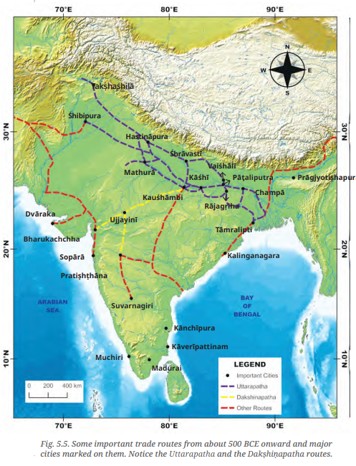
Answer: Several geographical features made trade across ancient India easier:
Several geographical features helped traders travel across the Indian subcontinent:
- The rivers like the Ganga, Yamuna, Godavari, and Narmada served as natural highways, that made it easy to move goods by boat.
- The mountain passes in the Himalayas, such as the Khyber Pass, allowed trade with Central Asia.
- The coastal plains and the Arabian Sea and Bay of Bengal enabled sea trade with distant lands.
- The fertile plains of northern India supported markets and towns along trade routes.
- The Deccan plateau routes connected northern and southern India, linking inland traders with
Question 2. What modes of transport on those roads do you think were available at the time? (Page 93)
Answer: During ancient times, bullock carts and horse-drawn chariots were common for carrying goods and people on land. Elephants were used to move heavy loads and travel long distances. In dry areas, camels and donkeys were preferred because they could travel easily without much water. Along rivers and coastal routes, traders used boats and ships for transporting goods to other regions and countries.
Let’s Explore (Page 96)
Question 1. Take a close look at the panel given below.
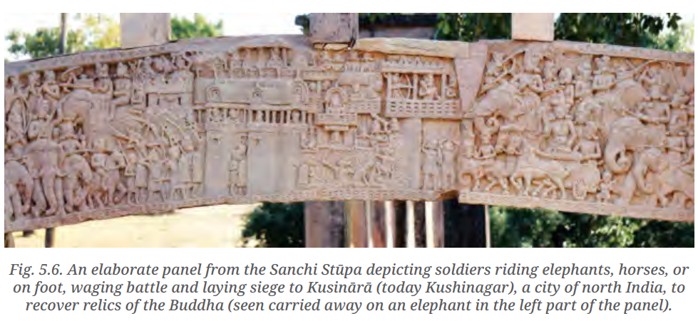
How many types of weapons can you identify? What different uses of iron can you make out?
Answer: From the panel, we can identify several types of weapons made of iron, such as swords, spears, arrows, shields, and axes.
Besides weapons, iron was also used for many peaceful purposes. People made farming tools like ploughs and sickles, household items such as knives and pots, and building tools like hammers and nails.
(ii) In the left part of the panel, a parasol (chhattra) is kept over the casket containing the Buddha’s relics. Why do you think this was done?
Answer: In ancient India, a parasol (chhattra) was a symbol of honour, spiritual protection, and respect. It was often held over the heads of kings, holy men, or sacred objects. In the panel, the parasol is placed over the casket containing the Buddha’s relics to show great reverence for him.
Think About It (Page 97)
Question: Why do you think Alexander wanted to rule over the entire world? What would he have gained from it?
Answer: Alexander wanted to rule over the entire world because he dreamed of becoming the greatest and most powerful ruler in history. He had been taught by his teacher Aristotle that a great king should spread Greek culture and ideas everywhere.
By conquering many lands, Alexander would gain wealth, fame, and glory. Ruling the world would give him control over trade routes, armies, and resources like gold and land. It would also make him respected and feared by other kings.
Think About It (Page 103)
Question: Why do you think it was important to take special care of the countryside? (Hint: Think back to what you have learnt at the beginning of this chapter)
Answer: It was important to take special care of the countryside because the villages were the main source of food, taxes, and resources for the empire. The rulers depended on the countryside for revenue to maintain their armies, roads, and administration. A strong and well-protected countryside meant a strong economy and stable empire.
Questions and Activities (Exercise Questions) Page 114
1: What are the features of an empire, and how is it different from a kingdom? Explain.
Answer: An empire is a large political unit that controls many kingdoms or regions under one powerful ruler called an emperor. It usually covers a vast area with diverse people, languages, and cultures. Empires have a strong central government, organized administration, and large armies to maintain control over distant territories.
A kingdom, on the other hand, is smaller and ruled by a king who governs a limited area or region. The people in a kingdom often share similar customs, languages, and traditions.
2: What are some important factors for the transition from kingdoms to empires?
Answer: Several important factors helped the transition from small kingdoms to large empires in ancient India:
- The use of iron tools and weapons improved farming and warfare, that gave certain kingdoms more strength and resources.
- Fertile land and rivers, especially in regions like Magadha, supported a strong agricultural base.
- The rise of trade and the use of coins made the economy stronger and helped rulers collect revenue.
- Powerful and ambitious rulers, such as the Nandas and Mauryas, used wars, alliances, and diplomacy to unite smaller states.
- The development of a well-organised administration helped rulers govern larger areas efficiently.
All these factors together led to the growth of large empires from smaller kingdoms in ancient India.
3: Alexander is considered an important king in the history of the world — why do you think that is so?
Answer: Alexander the Great is considered an important king in world history because he was one of the most successful conquerors of all time. By the age of thirty, he had built one of the largest empires in the ancient world, stretching from Greece to India.
He was known not only for his military skill and bravery but also for spreading Greek culture, art, and learning across the regions he conquered. This led to the exchange of ideas between the East and the West.
4: In early Indian history, the Mauryas are considered important. State your reasons.
Answer: The Mauryas are considered very important in early Indian history for several reasons:
- They built the first great empire in India, uniting most of the subcontinent under one rule.
- Chandragupta Maurya, the founder, created a strong central government and organised administration and taxation.
- Under Ashoka, the empire reached its greatest size and became known for peaceful rule and moral governance after his conversion to Buddhism.
- The Mauryas built roads, rest houses, and trade routes, which improved communication and commerce.
- Ashoka also spread Buddhism to other countries, influencing Asian culture and religion.
5: What were some of Kauṭilya’s key ideas? Which ones of these can you observe even today in the world around us?
Answer: Kauṭilya (Chanakya) was a great scholar and adviser to Chandragupta Maurya. His ideas are found in the famous book called the Arthasastra, which gives advice on how to rule wisely and manage an empire.
Some of his key ideas were:
- A ruler must be wise, fair, and responsible for the welfare of his people.
- The king should have a strong army and spies to protect the kingdom and maintain order.
- There should be good administration, with proper collection of taxes and care for the countryside.
- The ruler should work for peace and prosperity, not just power.
Key Ideas of Kauṭilya (Chanakya):
- Centralized Governance: Kauṭilya emphasized a strong central government with an emperor having control over the administration, military, and economy.
- Law and Order: He believed that maintaining law and order was essential for the prosperity of the kingdom. His idea of a well-structured administration ensured the welfare of the people.
- Diplomacy and Alliances: Kauṭilya advocated the use of diplomacy and strategic alliances to expand and maintain the empire.
- Economic Management: He focused on the importance of a strong economy, including agriculture, trade, and taxation, to fund the empire’s needs.
- Welfare of the People: Kauṭilya believed that a ruler’s happiness depended on the welfare of the people, and he promoted the idea of providing for the basic need of the population.
Modern governments still follow the idea of a central authority that controls the country’s affairs. Governments today focus on maintaining economic stability, trade networks, taxation systems, and ensuring the well-being of citizens much like Kauṭilya’s ideas.
6: What were the unusual things about Aśhoka and his empire? What of that has continued to influence India and why? Write your opinion in about 250 words.
Answer: Ashoka was one of the most remarkable rulers in Indian history because of his unique way of ruling and his message of peace and compassion. After the war in Kalinga, Ashoka was deeply hurt by the suffering it caused. He decided to give up violence and follow the teachings of Buddhism. This change made him very different from other rulers of his time.
Instead of expanding his empire through wars, Ashoka focused on Dhamma, a set of moral and ethical principles. He taught people to live with honesty, kindness, respect, and non-violence. Ashoka sent messengers and monks to other countries, spreading Buddhism and Indian culture across Asia.
He also worked for the welfare of his people by building roads, hospitals, wells, and rest houses. His edicts, carved on rocks and pillars, shared messages of peace, tolerance, and good governance.
Ashoka’s legacy continues to influence India even today. The Lion Capital of Sarnath from one of his pillars is our national emblem, and the Ashoka Chakra is at the centre of the Indian flag. His ideas of peaceful coexistence, respect for all religions, and care for people are still important in modern India.
7: After reading the above edict of Ashoka, do you think he was tolerant towards other religious beliefs and schools of thought? Share your opinion in the classroom.
Answer: Yes, Ashoka was very tolerant towards other religions and beliefs. His edicts clearly show that he respected all faiths and ways of thinking. He believed that no religion should be treated as superior or inferior, and that everyone should learn from one another. Ashoka encouraged people to live in harmony, avoid arguments, and show respect to monks, teachers, and elders of all traditions.
In my opinion, Ashoka’s attitude was wise and modern, because he valued tolerance and cooperation over division and conflict. His example still teaches us the importance of accepting different beliefs and living together peacefully in a diverse country like India.
8: The Brahmi script was a writing system that was widely used in ancient India. Try to learn more about this script, taking help from your teacher wherever required. Create a small project and include what you have learnt about Brahmi.
Answer: Project: The Brahmi Script
Introduction: The Brahmi script is one of the oldest writing systems of India, used from around the 3rd century BCE during the Mauryan period. It is believed to have been used for writing Prakrit, the common spoken language of that time. Many of Ashoka’s edicts were written in the Brahmi script.
Origin and Development:
- The Brahmi script was probably developed from earlier Indian or foreign symbols.
- It was used across North India and later spread to Sri Lanka and Southeast Asia.
- Over time, it gave rise to many modern Indian scripts such as Devanagari, Tamil, Telugu, Kannada, and Bengali.
Features of the Script:
- It was written from left to right, just like English.
- It had symbols for vowels and consonants, and combinations were used to form syllables.
- The letters were simple and geometric, easy to carve on stone and metal.
Discovery and Deciphering:
- For a long time, people couldn’t read Brahmi.
- In the 1830s, a British scholar named James Prinsep successfully deciphered the Brahmi script using Ashoka’s inscriptions.
- This helped historians understand ancient Indian history much better.
Importance: The Brahmi script is very important because it is the mother of most Indian scripts. It helped preserve the language, culture, and history of ancient India. Without it, many details about Ashoka’s reign and early Indian civilisation would have been lost.
Conclusion: The Brahmi script is a symbol of India’s rich cultural and linguistic heritage. It shows how ancient India valued communication, learning, and record-keeping. The study of Brahmi continues to help historians uncover the stories of our past.
9: Suppose you had to travel from Kaushambi to Kaveripattanam in the 3rd century BCE. How would you undertake this journey, and how long would you expect it to take, with reasonable halts on the way?
Answer: If I had to travel from Kausambi (near modern Prayagraj in Uttar Pradesh) to Kaveripattanam (modern Poompuhar in Tamil Nadu) in the 3rd century BCE, it would be a long and difficult journey across ancient India.
I would travel mostly by land routes using bullock carts or on horseback, following the royal roads built during the Mauryan Empire. In some parts of the journey, especially across rivers like the Narmada or Godavari, I might use boats or ferries. The journey would take me through forests, plains, and hills, passing towns such as Ujjain, Pratishthana (Paithan), and Madurai before reaching Kaveripattanam on the southern coast.
The journey would be long and slow, taking about 3 to 4 months with regular stops for rest and supplies.
Class 7 Social Science: Exploring Society Part 1 Chapter 5 NCERT Solutions
These NCERT Solutions for Class 7 Social Science Chapter 5 help students understand important concepts, complete textbook exercises, and prepare for school examinations.
The chapter The Rise of Empires explores how powerful kingdoms expanded into empires that brought large territories under a common administration. Students learn about the rise of Magadha, Chandragupta Maurya, and the organisation of the Mauryan Empire. It also introduces sources that help historians understand this period.
Students also learn about Ashoka, the Kalinga war, and his ideas of dhamma. The chapter explains the importance of administration, communication, trade, and public welfare in governing an empire and highlights the lasting influence of Mauryan rule.