

NCERT Solutions for Class 7 Social Science Part 2 Chapter 1 The Story of Indian Farming are provided here with simple and easy-to-understand answers. These NCERT Solutions for Class 7 are based on the new NCERT Social Science textbook Exploring Society: India and Beyond Part 2. In this chapter, students learn about the development of agriculture in India, different farming practices, and the importance of farming in people’s lives. The chapter also explains how these ideas help students understand India’s society and the world around them.
The Story of Indian Farming Questions and Answers Class 7 Social Science Chapter 1
The Big Question (NCERT Textbook Page No. 1)
1: What are the main characteristics of Indian agriculture?
Answer: The main characteristics of Indian agriculture are:
- Diverse crops are grown because India has different climates, soils and landforms.
- Indian agriculture has three main cropping seasons — kharif, rabi and zaid.
- Farming depends greatly on water and rainfall, especially the monsoon.
- India has different types of soils, and different crops grow well in different soils.
- Indian agriculture includes both traditional and modern farming methods.
- Farmers use both animals and modern machines like tractors and harvesters.
- Farming is an important part of India’s life and economy.
2: How are farming, climate, soil, and water interrelated?
Answer: Farming depends mainly on climate, soil and water. Climate decides the temperature and rainfall, which affects the crops that can grow in a region. Soil provides nutrients to plants, and different soils support different crops. Water is also necessary for crops, and may come from rainfall or irrigation. Thus, the right combination of climate, soil and water helps farmers grow suitable and healthy crops.
OR
Farming in any region depends mainly on its climate, soil and water.
Climate determines the temperature and rainfall of a place. Different climates support different crops. For example, rice grows well in warm and wet conditions, while wheat grows better in cooler conditions.
Soil is also important because it provides nutrients to plants. Different types of soil are suitable for different crops. For example, alluvial soil is suitable for crops like rice and wheat, while black soil is especially suitable for cotton.
Water is essential for the growth of crops. Some areas depend mainly on rainfall, while others use irrigation to supply water to their fields. The availability of water therefore affects the type of farming practised in a region.
Thus, climate, soil and water work together to determine which crops can be grown and how farming is carried out in different parts of India.
3: How can traditional practices and contemporary ones complement each other?
Answer: Traditional and contemporary farming practices can work together to make agriculture more productive and sustainable.
Traditional methods such as crop rotation, mixed cropping, organic manure and mulching help protect the soil and reduce the use of chemicals.
Modern methods use better irrigation technology, machines, HYV (High Yielding Variety) seeds, and precise use of fertilisers to increase production and save time.
By combining both, farmers can get good yields while also protecting soil, water and the environment.
Let’s Explore (NCERT Textbook Page No. 22)
Question: Identify modern agricultural solutions inspired by traditional practices (for example, neem-based practices).
Answer: Modern agricultural solutions inspired by traditional practices include:
- Neem-based pesticides – Neem is used to make natural pesticides that are much less harmful to the environment than chemical pesticides.
- Organic farming – Farmers use natural fertilisers such as compost, seed cake and animal manure instead of chemical fertilisers.
- Beejamrit for seeds – ICAR has developed methods using beejamrit, made from cow dung, cow urine and other materials, to coat seeds. It helps protect seeds and reduces germination time.
- Traditional water harvesting – Old water-harvesting methods are still useful today, especially in areas facing drought or irregular rainfall.
- Mulching – Farmers once covered soil with dry leaves or straw to retain moisture. Modern mulching uses plastic sheets or organic materials to reduce evaporation and protect the soil.
Questions and Activities (NCERT Textbook Page No. 27-28)
1: Why do farmers in Kerala grow rice while farmers in Punjab grow mostly wheat? What would happen if they swapped?
Answer: Farmers in Kerala grow rice because the state has a warm, humid climate with heavy rainfall, which suits rice cultivation. Farmers in Punjab grow mostly wheat because Punjab has cool winters, lower rainfall, fertile plains, and good irrigation, which are suitable for wheat.
If they swapped crops, the crops would not grow as well under the natural conditions. Wheat may suffer in Kerala because of excess heat and moisture, while rice in Punjab would require much more irrigation water. This could reduce yields and increase farming costs.
2: Match the following:
| Column A | Column B |
| (a) Kharif crops | (i) Crops during the winter |
| (b) Rabi crops | (ii) Crops grown during the monsoon |
| (c) Alluvial soil | (iii) Thin, rough, and rocky soil in mountains |
| (d) Terrace farming | (iv) Crops grown in summer |
| (e) Alpine soil | (v) Soil rich in nutrients deposited by rivers |
| (f) Zaid crops | (iv) Crops grown in summer |
Answer:
| Column A | Column B |
| (a) Kharif crops | (ii) Crops grown during the monsoon |
| (b) Rabi crops | (i) Crops during the winter |
| (c) Alluvial soil | (v) Soil rich in nutrients deposited by rivers |
| (d) Terrace farming | (vi) Method of farming on hillsides |
| (e) Alpine soil | (iii) Thin, rough, and rocky soil in mountains |
| (f) Zaid crops | (iv) Crops grown in summer |
3: Why do certain crops thrive in specific regions?
Answer: Certain crops thrive in specific regions because different crops need different conditions for healthy growth. These conditions include climate, soil, water and terrain. Some crops need plenty of rainfall, while others can grow in drier conditions. Similarly, different types of soil provide different nutrients and hold different amounts of water.
For example, rice grows well in warm and wet regions, while wheat grows better in cooler and drier conditions. Therefore, a crop grows well when the climate, soil and water of a region match its needs. This is why different crops are grown in different parts of India.
4: How has modern technology helped farmers?
Answer: Modern technology has made farming faster, easier and more productive. The use of high-yielding varieties (HYV) of seeds, improved irrigation, chemical fertilisers and pesticides, tractors, harvesters and other machines has helped farmers increase crop production and reduce the time and labour needed for farming.
The Green Revolution was an important step in this development. It greatly increased the production of wheat and rice and helped India become self-sufficient in food.
OR
Modern technology has helped farmers in many powerful ways, making farming faster, easier, and more productive. Some of them are as follows:
- Improved irrigation: Drip and sprinkler systems help farmers save water and irrigate fields more efficiently.
- Better seeds: High-yielding Varieties (HYV) and disease-resistant seeds increase production and reduce crop loss.
- Use of machines: Tractors, harvesters, threshers, and seed-drills make farming quicker and reduce manual labour.
- Weather forecasting: Farmers can plan sowing, irrigation, and harvesting by using accurate weather updates.
- Fertilisers and pesticides: Help protect crops from pests and increase soil nutrients for better growth.
- Cold storage and better transport: Reduces spoilage and helps farmers sell crops in distant markets for better prices.
5: Why is sustainable agriculture important? Write a short note on this.
Answer: Sustainable agriculture is important because it helps farmers produce food while protecting natural resources and the environment for the future. Modern farming has increased production, but excessive use of chemical fertilisers and pesticides can damage soil, pollute water and harm living organisms. Therefore, sustainable agriculture combines modern technology with eco-friendly traditional practices, such as efficient irrigation, organic farming, natural fertilisers and neem-based pesticides. It helps maintain soil fertility, conserve water, reduce pollution, and ensure that farming can continue for future generations.
6: Name some challenges that farmers face today. What might be their impact for people?
Answer: Farmers face several challenges today, such as:
- Small landholdings, which can make farming less profitable.
- Climate change, which can affect rainfall, temperature and crop production.
- High cost of modern equipment, which makes it difficult for some farmers to use new technology.
- Market challenges, such as difficulties in getting good prices for their produce.
- Dependence on seed companies for high-yielding seeds.
These challenges can lead to lower crop production, reduced income for farmers and higher food prices for people. If farming is badly affected, it can also affect the availability of food.
7: Have a debate in class on the topic “Traditional irrigation methods are better than modern ones.”
Answer: Debate For and Against the motion on “Traditional irrigation methods are better than modern ones.
For the Motion: Traditional irrigation methods can be better because they are often simple, affordable and environment-friendly. They are based on local knowledge and use resources available in the area. Traditional practices can also help conserve water and protect the soil.
Against the Motion: Modern irrigation methods such as drip and sprinkler irrigation use water more efficiently. Drip irrigation supplies water directly to the roots, while sprinklers provide water like artificial rain. These methods can reduce water wastage and allow farming even in areas with low rainfall
Conclusion: Neither method is always better. A combination of traditional knowledge and modern technology can make irrigation more efficient and sustainable.
8: Write a short essay describing what farming might be like when you are 60 years old. You could also draw/paint a picture to illustrate what you envision.
Answer:
Farming in the Future
When I am 60 years old, farming may be very different from what it is today. Farmers may use robots, drones, sensors, and smart machines to sow seeds, water crops, remove weeds, and harvest fields. Computers may help farmers choose the best crops by studying weather, soil, and water conditions.
Farming may also become more environment-friendly. Farmers may use solar-powered machines, save water through drip irrigation, and reduce the use of harmful chemicals. Crops that can survive droughts, floods, and high temperatures may become more common.
I imagine future farms producing more food with less water, land, and labour. Technology and sustainable methods together could make farming easier, safer, and better for both people and the environment.
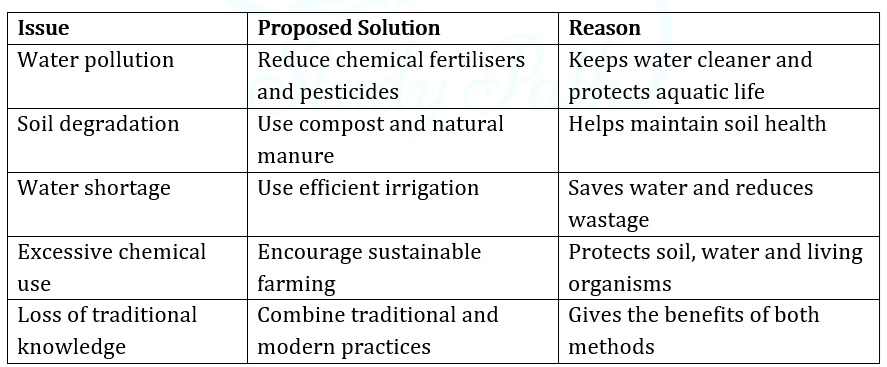
9: Form small groups and discuss the issues affecting the Ganga basin. Prepare a presentation proposing your solutions and their rationale (your reasons). Share and discuss in class. Your teacher will guide you in this exercise.
Answer: The Ganga basin is an important agricultural region. Some major issues affecting it are water pollution, excessive use of chemical fertilisers and pesticides, soil degradation and pressure on water resources. The chapter explains that excessive use of chemicals can pollute soil and water and harm ecosystems.
Conclusion
The Ganga basin can be protected by following sustainable farming practices, saving water, reducing pollution and combining traditional knowledge with modern technology. This will help farmers produce food while protecting the environment.
10: Looking at the crops listed in the section ‘Echoes from the Past’, which ones do you find in use in your home? What conclusion can you draw from your observations?
Answer: In my home, I find rice, wheat, barley and millets being used in different foods. These crops were also grown in India thousands of years ago. The chapter mentions that rice was present in the Ganga Plain, barley and millets were cultivated at Mehrgarh, and barley and wheat were staple crops of the Harappans.
This shows that many crops grown and eaten by people today have been a part of Indian agriculture and food traditions since ancient times. Thus, there is a strong connection between ancient farming and our present-day food habits.
Class 7 Social Science: Exploring Society Part 2 Chapter 1 NCERT Solutions
The chapter The Story of Indian Farming explores how agriculture has shaped India’s economy and society over time. Students learn about the relationship between farming and natural conditions such as soil, rainfall, and water availability. It also introduces the crops, tools, and methods that farmers use to produce food.
Students also learn about changes in farming practices and the challenges faced by farming communities. The chapter highlights the contribution of farmers to food security and explains why responsible use of land and water is important for the future of agriculture.