

NCERT Solutions for Class 7 Social Science Part 2 Chapter 3 Empires and Kingdoms: 6th to 10th Centuries are provided here with simple and easy-to-understand answers. These NCERT Solutions for Class 7 are based on the new NCERT Social Science textbook Exploring Society: India and Beyond Part 2. In this chapter, students learn about the rise of regional kingdoms and empires between the 6th and 10th centuries and their political and cultural contributions. The chapter also explains how these ideas help students understand India’s society and the world around them.
Empires and Kingdoms: 6th to 10th Centuries Questions and Answers Class 7 Social Science Chapter 3
The Big Questions (NCERT Textbook Page No. 61)
1: What major changes characterised this period?
Answer: The period from the 6th to the 10th saw the rise of many regional kingdoms after the decline of the Guptas. Powerful dynasties like the Palas, Gurjara-Pratiharas, Rashtrakutas, Chalukyas, Pallavas, and Cholas expanded their territories. The land-grant system expanded, more uncultivated land was brought under cultivation. Irrigation works such as wells, ponds and tanks were built. Local markets and long-distance trade flourished. Bhakti became widespread from the 6th century onward. The Alvars and Nayanars played an important role in spreading devotional traditions. Important developments took place in art, temple architecture, literature, mathematics, and astronomy, making this a time of major political and cultural change.
2: How did the political, cultural, and religious developments shape India during this period?
Answer: The period from the 6th to the 10th centuries brought major changes to India in political, cultural and religious life. Many kingdoms and empires rose and competed with one another. Important dynasties included the Palas, Gurjara-Pratiharas, Raṣhṭrakuṭas, Chalukyas, Pallavas and Cholas. These kingdoms built powerful administrations, fought wars for territory, and improved local governance through village assemblies and land grants.
Culturally, rulers patronised learning, literature, and temple architecture. Great universities like Nalanda and Vikramashila flourished, while Sanskrit works like Harshacharita and Rajatarangini recorded history. Monumental temples at Ellora and Mamallapuram showed artistic and architectural growth.
Religiously, the period encouraged diversity. Hinduism, Buddhism, and Jainism received royal support. Bhakti became widely popular from the 6th century. Large monasteries, temples, and religious centres spread education, philosophy, and spiritual traditions. These developments together strengthened India’s identity, economy, and cultural heritage.
3: What was the impact of foreign invasions and interactions on Indian society and polity during this period?
Answer: Foreign invasions and interactions had both political and cultural effects on India during this period: Indian rulers had to defend their kingdoms against foreign invasions. The Huṇas weakened the Gupta Empire but by the early 6th century, Indian rulers defeated them and ended their political power. The Huṇas later became part of Indian society.
Arab invasions had only limited political success. Muhammad bin Qasim conquered Sindh, but Indian chiefs soon recovered much of the territory. Other Indian rulers, including the Gurjara-Pratiharas and the rulers of Kashmir, resisted further Arab expansion. The religious impact of Arab rule was also limited. In Sindh, Hindus and Buddhists were eventually allowed to rebuild temples and continue their worship.
Foreign interaction also brought peaceful cultural exchange. India and Arabia had long-standing sea trade. Along with spices and textiles, ideas, words and stories travelled between the two regions. In the 9th century, Sanskrit works on mathematics, astronomy and medicine were translated into Arabic. The Arabs adopted the Indian decimal system, including zero and Indian numerals, which later reached Europe.
Let’s Explore (NCERT Textbook Page No. 64)
Question: Do you recall where the capital of the earlier Maurya and Gupta empires was located? How do you think this shift may have shaped the sub-continent’s politics in the years to come?
Answer: Yes. I recall, the capital of both the Maurya Empire and the Gupta Empire was located at Pataliputra, near present-day Patna in Bihar. The shift of political power towards Kannauj and other regional centres during this period likely encouraged the rise of strong regional kingdoms and political rivalry.
Harṣhavardhana ascended the throne at Kannauj in 606 CE and expanded his empire over large parts of northern and eastern India. Kannauj later became extremely important politically. During the 8th and 9th centuries, the Pālas, Gurjara-Pratīhāras and Rāṣhṭrakūṭas repeatedly fought for it. This became known as the Tripartite Struggle. As a result, instead of one large empire dominating India, several strong regional powers competed with one another.
Let’s Explore (NCERT Textbook Page No. 68)
Question: Why was Kannauj so attractive to those powerful dynasties? Observe its location on the map given below and discuss in class.
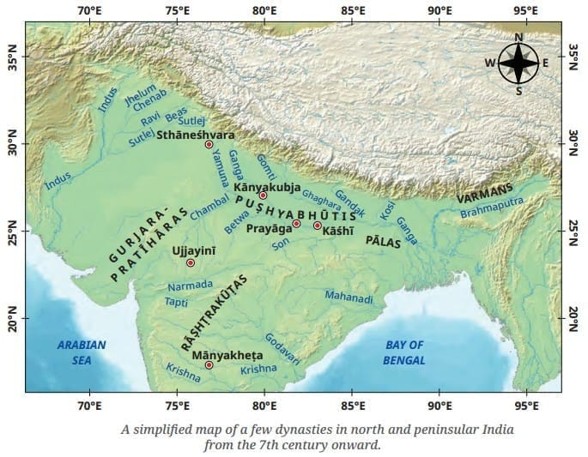
Answer: Kannauj was attractive to powerful dynasties because of its strategic location in northern India. It lay in the fertile Ganga-Yamuna region and was well connected to important parts of northern India. Controlling Kannauj therefore gave a ruler an important position from which to control territory and expand power. This is why the Palas, Gurjara-Pratiharas and Raṣhṭrakuṭas fought repeatedly for control of Kannauj during the 8th and 9th centuries.
Let’s Explore (NCERT Textbook Page No. 74)
Q: Form groups in your class to discuss the following questions,then compare the groups’ answers.
(a) What qualities does Kalhana think a historian should have?
Answer: Kalhaṇa believed that a historian should be truthful, fair and impartial while writing about the past. He said that a historian should study earlier works, inscriptions, royal grants and other records before writing history. A historian should be “free from love or hatred”, meaning that personal likes and dislikes should not affect the account of past events. He believed history should also help people learn from the good and bad actions of rulers.
(b) What do these lines reveal about his method of gathering information? In what ways does it resemble or differ from the way history is currently written?
Answer: These lines show that Kalhana gathered information by consulting earlier written works, inscriptions, temple records, royal grants, and historical accounts of kings, and then comparing them to remove errors. His method is similar to modern history because historians today also use reliable sources, evidence, and cross-check information.
However, it differs from modern history because Kalhaṇa also wanted history to teach moral lessons about good and bad rulers, while modern historians usually focus more on explaining the past from evidence rather than judging rulers morally.
(c) Kalhana also writes, “That nobleminded poet is alone worthy of praise whose words, like that of a judge, remain free from love or hatred in relating the facts of the past.” What does he mean by ‘free from love or hatred’? How would meeting this condition make a historian more reliable?
Answer: By saying a historian should be “free from love or hatred,” Kalhana means that a historian should not allow personal likes, dislikes, friendships or prejudices to affect the way they describe historical events. Like a judge, the historian should present the facts fairly and without bias.
When a historian meets this condition, they present facts fairly and truthfully, rather than exaggerating the achievements of some or hiding the faults of others. This makes their work more reliable because readers can trust that the information is based on evidence, not personal feelings.
Let’s Explore (NCERT Textbook Page No. 75)
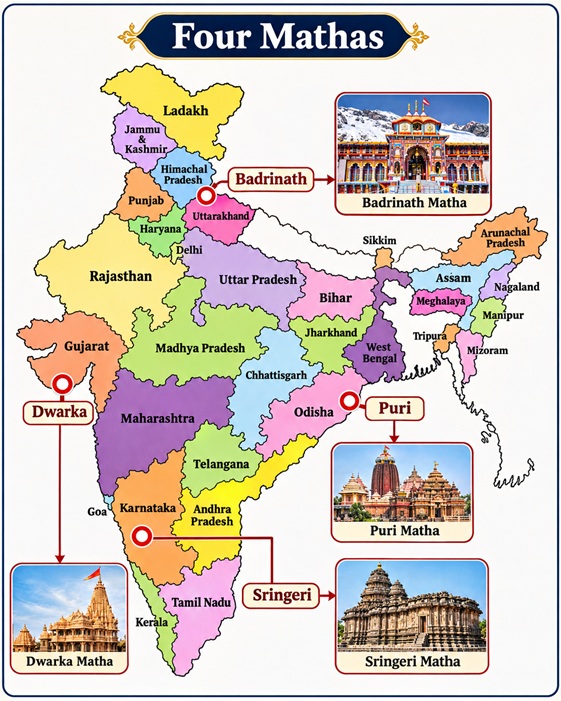
Q: Shankaracharya taught that brahman is the ultimate reality or the pure consciousness, and that the world as we perceive it is maya or illusion. He established four mathas (monasteries and centres of learning) at Badrinath, Puri, Dwarka, and Sringeri. Mark the location of these cities on a map; why do you think he chose four different corners of India rather than more central locations?
Answer: Shankaracharya established mathas at Badrinath (North in Uttarakhand), Puri (East in Odisha), Dwarka (West in Gujarat), and Sringeri (South in Karnataka)-each located at a different corner of India. He did this for several important reasons:
- To unite the whole country spiritually: Placing mathas in all four directions helped spread his Advaita philosophy across all regions of India, not just the central areas.
- To ensure equal access for all people: People from different regions could reach a mathas closer to their area, making spiritual learning more accessible.
- To symbolise the unity of India: The four mathas acted like four pillars, showing that the entire subcontinent shared a common religious and philosophical foundation.
- To strengthen Hinduism against regional divisions: By spreading centres far apart, he reduced the chances of regional isolation and encouraged cultural and intellectual exchange.
- To promote pilgrimage and cultural connections: Pilgrims travelling to these corners created routes for communication, knowledge-sharing, and cultural unity.
Let’s Explore (NCERT Textbook Page No. 79)
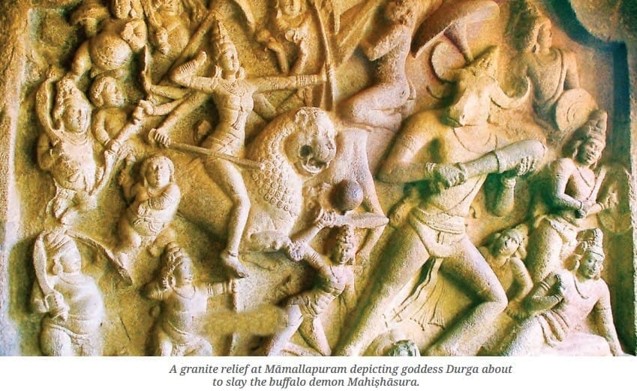
Question: Note this panel’s highly dynamic three-dimensional composition, expressing Durga’s confident assault on the demon.
(a) Can you identify some of Durga’s many weapons? And her vahana? (Page 79)
Answer: In this panel, Goddess Durga is shown with multiple weapons, symbolising her power, like a trident (trishul), a sword, a bow and arrow, a club/mace, and a spear in different hands. These are gifts from various gods to help her defeat the buffalo demon Mahishasura. Her vahana (vehicle) is the lion, which stands beside her. The lion represents courage, strength, and fearlessness.
(b) What are the main differences between her attendants and the demon’s attendants? (Page 79)
Answer: Durga’s attendants look confident, organised, and supportive, standing firmly with alert postures. They appear calm, loyal, and ready to help their goddess. In contrast, the demon’s attendants look frightened, confused, and weak. Their faces and body language show panic and defeat, suggesting that they are losing the battle. These differences highlight Durga’s power and the fear and disorder on the demon’s side.
(c) What does the demon’s slanted posture and general attitude indicate? (Page 79)
Answer: The demon’s slanted posture and overall attitude indicate weakness, imbalance, and defeat. His body appears to be falling back, showing that he is losing control and cannot stand firmly against Durga’s attack. This posture symbolises fear, confusion, and the inevitable collapse of evil in the face of divine power.
Don’t Miss Out (NCERT Textbook Page No. 81)
Question: During this period, inscriptions began using both Sanskrit and regional languages simultaneously. In land grants, the ruler and his dynastic history were often praised in Sanskrit, while the operative details of the grant were recorded in the local language. Why do you think such inscriptions were written in two languages?
Answer: Inscriptions were probably written in both Sanskrit and regional languages because they served different purposes. Sanskrit was used to praise the ruler and describe his dynasty and achievements, giving the inscription a formal and prestigious character. The regional language was used for the practical details of the land grant, such as the land being given, its boundaries and the conditions of the grant, so that local people could understand them.
This use of two languages shows that rulers wanted to preserve their royal image and dynastic history while also making the important details of the grant clear and useful to local communities. It also reflects the growing importance of regional languages during this period.
Think About It (NCERT Textbook Page No. 85)
Question: How does a professional group transform into a jati?
Answer: A professional group becomes a jati when people doing the same occupation start treating themselves as a separate community. Over time, they begin to follow common customs, marry within their group, pass their profession from one generation to the next, and create their own rules. This makes the occupation-based group turn into a social group, or jati.
Let’s Explore (NCERT Textbook Page No. 90)
Question: What details do you observe in these coins?
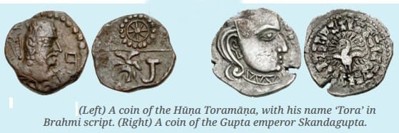
Answer: Both coins show the profile of the ruler’s face on one side. On the other side, there are symbols and designs, such as a wheel or decorative marks. The coin of Toramana also has his name “Tora” written in Brahmi script.
Question: Why do the coins of Toramana and Skandagupta appear so similar? (Page 90)
Answer: The coins look similar because the Huna rulers adopted the Gupta style of coin making. They copied the design, shape, and symbols of Gupta coins to show power and legitimacy. By doing so, Toramana wanted to look like a rightful Indian king, just like the Guptas.
Question: What conclusions can you draw? (Page 90)
Answer: These coins show that coin design was a way of showing authority. Foreign rulers like the Hunas used local Indian cultural symbols to gain acceptance. They wanted people to believe they were proper rulers, not outsiders.
Let’s Explore (NCERT Textbook Page No. 91)
Question: The Chachnama records that when King Dahar was killed, his widowed queen put up a brave resistance, and when the situation became hopeless, she immolated herself along with other ladies. Another queen ordered her treasure to be distributed among the brave soldiers and inspired them to stand against the invaders.
(a) What does this suggest about the way the indigenous people responded to invasions? (Page 91)
Answer: This suggests that the indigenous people resisted foreign invasions bravely and courageously. Even when the situation became difficult, they continued to fight and encouraged their soldiers to defend their kingdom. The queens also showed great courage and leadership during the resistance.
(b) Why do you think the queen chose to give away her treasure? (Page 91)
Answer: The queen chose to give away her treasure to encourage and support the brave soldiers who were fighting against the invaders. By giving them the treasure, she showed her support and inspired them to continue their resistance courageously.
(c) What does this reveal about the role of women in warfare? (Page 91)
Answer: It shows that women were not passive or weak. They took leadership roles, guided soldiers, inspired them, and made sacrifices for their kingdom. Women played an active and courageous part during times of war.
Think About It (NCERT Textbook Page No. 92)
Question: Sulaiman, a 9th-century Arab merchant and traveller, makes this comment on a Gurjara-Pratihara ruler: “This king maintains numerous forces, and no other Indian prince has so fine a cavalry. He is unfriendly to the Arabs … there is no greater foe of the Muhammadan faith than he. … He has riches, and his camels and horses are numerous. … There is no country in India safer from robbers.” Why do you think the author calls the ruler a ‘foe to the Muslim faith’? (Page 92)
Answer: Sulaiman calls the Gurjara-Pratihara ruler a “foe to the Muslim faith” because the ruler was unfriendly towards the Arabs and opposed their expansion into India. He had a strong army and cavalry, which made him a powerful opponent of Arab forces. The statement also shows that the Gurjara-Pratihara ruler was strong enough to protect his kingdom and maintain security, as Sulaiman noted that his country was very safe from robbers.
Questions and activities (NCERT Textbook Page No. 96)
1: If you lived in Kannauj during the struggle between the Palas, the Pratiharas and the Rashtrakutas, how would it change your daily life and your estimate of the rulers? Write a letter on this to your friend living in Kanchipuram.
Answer:
Kannauj
Date: 25.10.2026
Dear friend,
I hope you are well in Kanchipuram. Life in Kannauj has become difficult because the Palas, Pratiharas and Raṣhṭrakuṭas are repeatedly fighting to control the city. Armies march through the region, and many people are afraid to travel or open their shops. Our markets and daily activities are sometimes disturbed because of the fighting.
The city itself is still beautiful, but we live in constant tension. We never know which ruler may control Kannauj next. I used to think rulers protected their people, but now it feels like they are mainly interested in power, land and glory. Instead of improving our daily lives, they spend their time fighting each other.
I wish they would stop fighting and bring peace and stability to our region. I hope your city is safer than ours and that your rulers care more about the people.
Please write to me soon and tell me how things are in Kanchipuram.
Your friend
Murugan
2: Emperors and kings during this period controlled only core regions and governed other regions through subordinate vassals. What would be the advantages and the challenges of such a system?
Answer: Such a system had both advantages and challenges.
Advantages: The king could control a large territory without directly governing every region. Local vassals could manage their own areas, making administration easier and allowing the main ruler to focus on important matters.
Challenges: The king had to depend on the loyalty of the vassals. If a vassal became disloyal or too powerful, it could lead to rebellion, rivalry and political instability. This could make it difficult for one ruler to maintain lasting control over the whole kingdom.
3: In what ways were the invasions of the Hunas and the Arabs different in their aims, methods, and impact on the Indian subcontinent? Prepare a write-up, discuss and present it in the class.
Answer: The Huṇas and the Arabs invaded India for different reasons and had different effects on the subcontinent.
The Huṇas were a nomadic people from Central Asia. They were fierce conquerors who used horse-riding, archery and fast attacks. Their invasions weakened the Gupta Empire, but they were eventually defeated by Indian rulers. Later, many Huṇas settled in India and became part of Indian society, serving as soldiers and administrators.
The Arabs, on the other hand, had already established a powerful presence in West Asia and entered Sindh in the early 8th century. Their invasion was connected with the expansion of the Islamic world. The Arabs first attempted naval raids on western coastal towns such as Thane, Bharuch and Debal. Later, Muhammad bin Qasim led a more organised land campaign into Sindh, capturing Debal and defeating King Dahar. However, Arab rule remained limited mainly to small areas in Sindh and Punjab because Indian rulers offered strong resistance.
The Arab presence also led to cultural exchange. Indian knowledge of mathematics, astronomy and medicine was translated into Arabic, and the Indian numeral system, including zero, spread to the Arab world.
4: Imagine you are a common citizen watching the Prayaga assembly. How would you react to Harsha giving away most of his wealth?
Answer: If I were a common citizen at the Prayāga assembly, I would be impressed by Harṣha’s generosity. Every five years, after performing sacred rites, he gave away a large amount of wealth to Buddhists, Brahmins and the poor.
I would feel that Harṣha was a kind and charitable ruler who cared about different religious groups and needy people. At the same time, I might also wonder whether giving away so much royal wealth could make it harder to meet future needs of the kingdom.
5: Forming groups, let each group choose one Alvar and one Nayanar and prepare a biography poster or booklet. Include their life stories and a sample poem or two (in translation).
Answer: For this activity, I choose Aṇḍal as the Alvar and Appar (Tirunavukkarasar) as the Nayanar.
Anḍal – Alvar
Anḍal was one of the Alvars, the Tamil poet-saints devoted to Viṣṇu. The Alvars composed devotional poems in Tamil and helped spread the Bhakti tradition in South India. Anḍal is especially remembered for her deep devotion to Viṣṇu. Her poems expressed her love and devotion towards him and became an important part of the Tamil Bhakti tradition.
Her poems express a deep longing for and devotion to Viṣṇu, showing that sincere love and devotion were at the heart of the Bhakti tradition.
Appar (Tirunavukkarasar) – Nayanar
Appar, also known as Tirunavukkarasar, was one of the Nayanars, the Tamil poet-saints devoted to Śiva. The Nayanars travelled to temples and composed devotional hymns in Tamil. Through their songs and devotion, they helped make Bhakti an important religious tradition in South India.
His hymns express deep devotion and surrender to Siva, showing his strong faith and love for his chosen deity.
6: You will notice that our maps show only ancient names for the kingdoms capitals and main cities. Using a pencil, mark the modern names next to their original names. Refer the current map of India and try to locate those cities on it.
Answer: Students may write the modern names next to the ancient names on the map and locate them in the current states.
Ancient Names → Modern Names
- Pataliputra → Patna (Bihar)
- Kanyakubja → Kannauj, Uttar Pradesh
- Sthanesivara → Thanesar (Haryana, near Kurukshetra)
- Kanchi → Kanchipuram, Tamil Nadu
- Vatapi → Badami (Karnataka)
- Manyakheta → Malkhed/Malkheda
- Madurai → Madurai, Tamil Nadu
- ŚriLanka → Sri Lanka (separate country today, south of India)
- Nalanda → Nalanda, Bihar
- Vikramashila → Near Bhagalpur, Bihar
- Somapura Mahavihara → Paharpur, Bangladesh
- Parihasapura/Srinagar → (Jammu Srinagara Kashmir, India)
- Kancipuram Pallava capital → Kanchipuram (Tamil Nadu)
- Tanjavur – Chola capital → Thanjavur (Tamil Nadu)
- Kaveri delta region → Tamil Nadu
7: Match the ruler or the dynasty with the city.
| Dynasty/Kingdom | Capital (Match) |
| (a) Rāṣṭrakūṭas | (i) Kānchī |
| (b) Gurjara-Pratīhāras | (ii) Tañjāvūr |
| (c) Cholas | (iii) Mānyakheṭa |
| (d) Harṣavardhana | (iv) Ujjayinī |
| (e) Pallavas | (v) Kānyakubja |
Answer:
| Dynasty/Kingdom | Capital (Match) |
| (a) Rāṣṭrakūṭas | (iii) Mānyakheṭa |
| (b) Gurjara-Pratīhāras | (v) Kānyakubja |
| (c) Cholas | (ii) Tañjāvūr |
| (d) Harṣavardhana | (iv) Ujjayinī |
| (e) Pallavas | (i) Kānchī |
Class 7 Social Science: Exploring Society Part 2 Chapter 3 NCERT Solutions
The chapter Empires and Kingdoms: 6th to 10th Centuries explores the changing political landscape of the Indian subcontinent during this period. Students learn how different dynasties governed their territories, developed centres of power, and interacted through alliances and conflicts.
Students also learn about developments in trade, religious life, literature, art, and architecture. The chapter explains how regional kingdoms contributed to India’s cultural heritage and how historical sources help us understand the achievements and changes of this era.