

NCERT Solutions for Class 7 Social Science Part 2 Chapter 4 Turning Tides: 11th and 12th Centuries are provided here with simple and easy-to-understand answers. These NCERT Solutions for Class 7 are based on the new NCERT Social Science textbook Exploring Society: India and Beyond Part 2. In this chapter, students learn about political developments during the 11th and 12th centuries, changing kingdoms, and encounters that influenced Indian history. The chapter also explains how these ideas help students understand India’s society and the world around them.
Turning Tides: 11th and 12th Centuries Questions and Answers Class 7 Social Science Chapter 4
The Big Questions (NCERT Textbook Page No. 97)
1: Why are the 11th and 12th centuries seen as a period of transition in Indian history?
Answer: The 11th and 12th centuries are seen as a period of transition because India was going through many important changes.
- New kingdoms and dynasties rose to power, while some older ones declined.
- There were changes in politics, society and regional powers.
- Trade, towns, literature, temple architecture and religious traditions continued to develop.
- New political and cultural developments were taking shape, preparing the way for the changes of the 13th century.
OR
The 11th and 12th centuries are considered a transitional period in Indian history because India experienced major changes in political power and society. During this time, several older dynasties began to weaken, while new powers and kingdoms emerged in different parts of the subcontinent.
In this period foreign invasions became more serious. Unlike the earlier Arab attacks, Turkic powers penetrated much deeper into north India. In the 11th century, Mahmud of Ghazni repeatedly raided north India, took away large amounts of wealth, destroyed temples and carried away prisoners, though he did not establish permanent rule over most of India.
In the 12th century, Muhammad Ghuri and his generals conquered Delhi and large parts of the Gangetic plains up to Bengal. This marked a much bigger political change in north India. At the same time, new regional powers such as the Senas, Eastern Gangas, Kakatiyas and Hoysalas rose, while older powerful kingdoms such as the Gurjara-Pratiharas, Palas and Rashtrakutas declined.
Despite wars and invasions, there was also continuity. Trade, agriculture, art, literature, science and temple building continued to develop, and Indian culture continued to spread to Southeast Asia and China. Thus, the 11th and 12th centuries were a period of both change and continuity, marking the transition from the earlier political order to a new phase in Indian history.
2: Which new powers emerged during this period? What were the essential features of their economic, military and administrative systems?
Answer: During the 11th and 12th centuries, several powerful regional kingdoms emerged or became stronger, such as the Cholas, Kakatiyas, Hoysalas and Eastern Gangas. The Western Chalukyas were also an important power in the Deccan.
- Economic system: Their economy was mainly based on agriculture, supported by irrigation. Trade within India and with countries such as China and Southeast Asia also grew.
- Military system: Powerful kingdoms maintained large armies with soldiers, horses and elephants. The Cholas were especially famous for their powerful navy and overseas expeditions.
- Administrative system: Rulers collected taxes and tribute to support their kingdoms and armies. The Kakatiyas had a strong local administration, village self-governance, efficient revenue collection and irrigation system.
3: What high accomplishments in art, architecture, literature, science, etc., do we come across during this period?
Answer: The 11th and 12th centuries saw great achievements in art, architecture, literature and science.
- Science and Mathematics: Scholars like Bhaskaracharya wrote important works such as Lilavati on mathematics, Bijaganita on algebra and Siddhantashiromani on mathematical astronomy. His methods influenced scholars for centuries.
- Architecture and Art: Grand temples were built, such as the Bṛihadishvara Temple at Thanjavur, the Jagannatha Temple at Puri, and the temples at Khajuraho, Belur and Halebidu. These temples had beautiful sculptures and detailed carvings.
- Literature and Philosophy: Important works were written in Sanskrit and regional languages such as Tamil, Telugu, Kannada and others. King Bhoja promoted Sanskrit literature and himself wrote on architecture, governance, poetry, medicine and other subjects. Chalukya ruler Someshvara III wrote Manasollasa, an encyclopaedia. Basavanna wrote short Kannada poems called vachanas, expressing his spiritual and ethical ideas.
Let’s Explore (NCERT Textbook Page No. 100)
Q: (a) Observe the sketch of the Khyber Pass (Fig. 4.3). What kind of terrain does it depict? (Page 100)
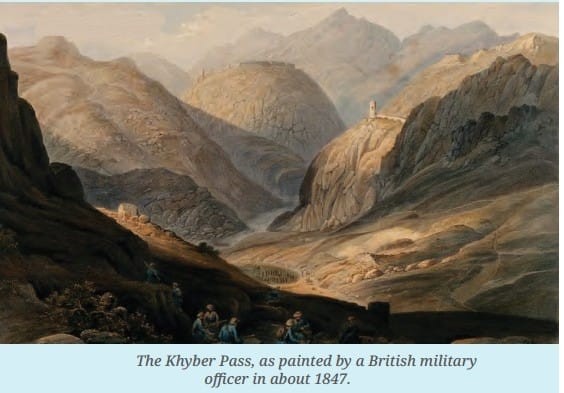
Answer: The sketch of the Khyber Pass depicts a rugged, mountainous and rocky terrain, with steep mountain slopes and a narrow passage between them. It is a mountain pass through the Hindu Kush range.
(b) What advantages would it offer to an army trying to reach the Indus plains? But also, what dangers?
Answer: The Khyber Pass offered an army a route through the mountains to reach the Indus plains. It was a major passage into the Indian subcontinent. However, the steep and rugged mountain terrain could make movement difficult and dangerous. An army could also be attacked by defenders from the surrounding heights.
(c) Thinking of the caravans of traders that passed through the Khyber Pass for many centuries, let’s ask the same questions about the advantages as well as dangers.
Answer: For traders, the Khyber Pass was useful because it was an important trade route connecting the Indian subcontinent with Central Asia and beyond. Traders could use it to carry goods between these regions. However, the rugged mountain terrain made travel difficult and dangerous. Traders and their caravans could also face attacks or robbery while passing through the mountains.
Let’s Explore (NCERT Textbook Page No. 103)
Q: In later centuries, the Somanatha temple was rebuilt and destroyed again several times; the existing temple was built in 1950 and inaugurated the next year by the then President of India, Rajendra Prasad. Why do you think it was decided to fund the construction entirely from public donations?
Answer: It was probably decided to rebuild the Somanatha temple through public donations so that the reconstruction would be seen as a collective effort of the people rather than a project funded by the government.
This would have several meanings:
- It showed that ordinary people themselves wanted to restore an important cultural and religious monument.
- Public donations made the rebuilding a symbol of shared participation and national pride.
- It also kept the government from directly using public money for the construction of a religious temple.
- Since the temple had been destroyed and rebuilt several times, rebuilding it through voluntary contributions could represent cultural continuity and resilience.
Let’s Explore (NCERT Textbook Page No. 121)
Q: In Kalyani, Basavanna established an anubhava mandapa (literally, ‘pavilion of experience’), where men and women from every social, economic, religious or linguistic background, including saints and philosophers, could assemble to discuss all aspects of life, including moral values and religion. (Page 121)
(a) Why, in your opinion, did Basava want people from all backgrounds to come together and exchange ideas?
Answer: Basava wanted people from all backgrounds to come together because he believed that everyone should have an equal opportunity to share ideas and discuss life, moral values and religion. Such discussions could help people learn from one another, understand different viewpoints and reduce social divisions.
(b) If something like an anubhava mandapa existed today, what important topics do you think people ought to discuss there?
Answer: If an anubhava mandapa existed today, people could come together to discuss important issues such as education, equality, the environment, technology, poverty, health, social problems, and moral values. They could share different ideas and find peaceful solutions to common problems.
(c) What lessons can we draw from the anubhava mandapa spirit to create a just and civil society today?
Answer: The anubhava mandapa teaches us that a just and civil society should give everyone an equal opportunity to speak and be heard, regardless of their social or economic background. We should respect different opinions, discuss problems peacefully, and learn from one another.
Questions and activities (NCERT Textbook Page No. 121)
1: Why is the period under consideration in this chapter regarded as a major transition in Indian history? Give two examples each of change and continuity from this period.
Answer: This period is regarded as a major transition because there were important changes in politics, society, economy, religion, art and culture, while many older traditions continued.
Two examples of change:
- Older kingdoms such as the Gurjara-Pratiharas, Palas and Rashtrakutas declined, while new regional powers such as the Cholas, Senas, Eastern Gangas, Kakatiyas and Hoysalas became stronger.
- Turkic invasions brought major political changes and caused the destruction of some temples, cities and centres of learning.
Two examples of continuity:
- Agriculture remained the mainstay of the economy, while trade with China and Southeast Asia continued to grow.
- Large temples continued to be built, while literature, science and religious life developed further.
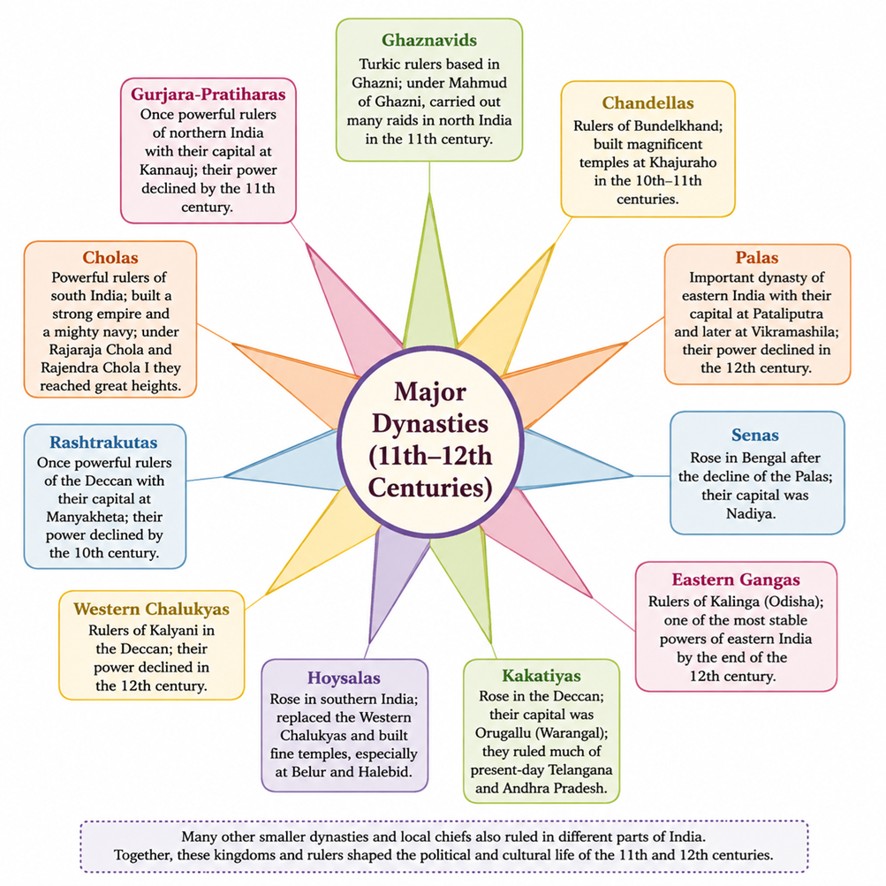
2: Observe Fig. 3.27 in the previous chapter and draw a similar ‘star of dynasties’ gathering all or most of the dynasties that appear in this chapter.
Answer: ‘Star of dynasties’
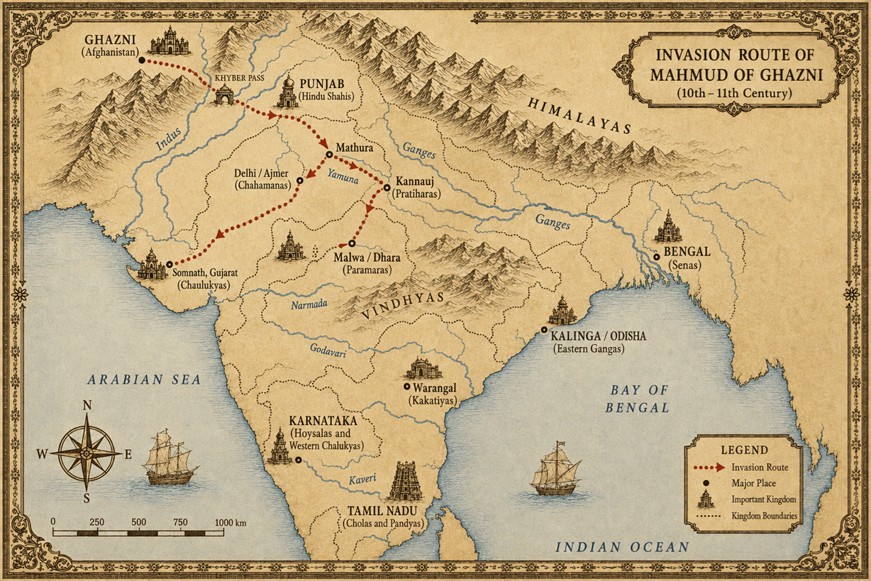
3: Taking a map of the Subcontinent, draw a geographical tour that covers all or most dynasties in this chapter (you may draw inspiration from some of the ‘travels’ the chapter’s narration follows).
Answer: Start at Ghazni (Afghanistan) → Khyber Pass → Punjab (Hindu Shahis) → Mathura → Kannauj (Pratiharas) → Somnath, Gujarat (Chaulukyas) → Malwa/Dhara (Paramaras) → Delhi/Ajmer (Chahamanas) → Bengal (Senas) → Kalinga/Odisha (Eastern Gangas) → Warangal (Kakatiyas) → Karnataka (Hoysalas, Western Chalukyas) → Tamil Nadu (Cholas, Pandyas).
4: With the help of a map of India and Southeast Asia, can you calculate the approximate distance that Rajendra I’s fleet of ships had to navigate to reach their objective?
Answer: Rajendra I’s fleet had to travel several thousand kilometres across the Bay of Bengal from the Chola coast to Southeast Asia, reaching areas such as Srivijaya (in present-day Indonesia). Using a map, the approximate sea distance can be taken as about 2,500 to 3,000 km.
5: Match these two pairs:
| Dynasty/Kingdom | Temple (Match) |
| (a) Eastern Gangas | (i) Belur |
| (b) Chandellas | (ii) Bṛihadīśvara Temple |
| (c) Paramāras | (iii) Konark Sun Temple |
| (d) Hoysalas | (iv) Kandāriyā Mahādeva Temple |
| (e) Cholas | (v) Bhojeshwar Temple |
Answer:
| Dynasty/Kingdom | Temple (Match) |
| (a) Eastern Gangas | (iii) Konark Sun Temple |
| (b) Chandellas | (iv) Kandāriyā Mahādeva Temple |
| (c) Paramāras | (v) Bhojeshwar Temple |
| (d) Hoysalas | (i) Belur |
| (e) Cholas | (ii) Bṛihadīśvara Temple |
6: Working in groups, compare the dynasties in this chapter and in the preceding one; create a table to list the dynasties present in both, those that disappear from the preceding period, and those that appear in this chapter’s period.
Answer:
| Category | Dynasties |
| Present in both chapters | Cholas, Eastern Gangas, Paramāras, Chāhamānas |
| Disappear from the preceding period | Pālas, Varmans, Puṣhyabhūtis, Kārkoṭas, Pallavas, Rāṣhṭrakūṭas, Gurjara-Pratīhāras, Cheras, Pāṇḍyas, Eastern Chālukyas |
| Appear in this chapter’s period | Hoysalas, Kākatiyas, Ghaznavids, Ghūrids, Senas, Chandellas |
7: Using the chapter and any additional reading, prepare a short note explaining (1) why centres of learning like Nalanda were important; (2) how their destruction may have affected education and culture in India.
Answer: (1) Nalanda was one of the greatest centres of learning in ancient India. It was like a big university where thousands of students and teachers lived and studied together. People came from many countries such as China, Tibet, and Korea to learn subjects like medicine, mathematics, astronomy, literature, and especially Buddhism. Nalanda showed how India was a land of wisdom and knowledge, and it became famous all over the world for its libraries and teaching methods.
(2) After Bakhtiyar Khilji’s attack, Nalanda’s library is said to have burned for months. This meant that many valuable books and ideas collected over hundreds of years were lost forever. Tibetan scholars fled with as many manuscripts as they could carry, and the institution was later found partly ruined. Large numbers of monks were killed and the destruction of these major centres of learning contributed to the decline of Buddhism in India.
8: Why do you think Mahmud of Ghazni carry out repeated raids from Afghanistan into India, while Muhammad Ghuri sought territorial expansion into India and long-term control? Write a short note on how their motives shaped the outcomes of their campaigns.
Answer: Mahmud of Ghazni and Muhammad Ghuri had different aims in India. Mahmud of Ghazni mainly carried out repeated raids to collect wealth and strengthen his kingdom. In the 11th century, he invaded north India several times, looted cities and temples, and carried away large amounts of wealth and prisoners. However, he did not try to establish permanent rule over most of India.
Muhammad Ghuri had a different plan. He wanted to conquer territories and establish long-term political control. After defeating Prithviraj Chauhan, his generals captured Delhi and large parts of the Gangetic plains, and they continued expanding towards Bengal. His conquests therefore created a lasting political presence in north India.
Class 7 Social Science: Exploring Society Part 2 Chapter 4 NCERT Solutions
The chapter Turning Tides: 11th and 12th Centuries explores a period of political change in the Indian subcontinent. Students learn about important powers, military encounters, and shifts in control over territories. It also introduces the historical context in which kingdoms responded to new challenges.
Students also learn how political developments affected society and how regional traditions continued through changing circumstances. The chapter encourages students to examine historical evidence and understand the connections between rulers, communities, and wider events.