

NCERT Solutions for Class 7 Social Science Part 2 Chapter 5 India, a Home to Many are provided here with simple and easy-to-understand answers. These NCERT Solutions for Class 7 are based on the new NCERT Social Science textbook Exploring Society: India and Beyond Part 2. In this chapter, students learn about the communities and cultural traditions that have contributed to India’s diversity and shared heritage. The chapter also explains how these ideas help students understand India’s society and the world around them.
India, a Home to Many Questions and Answers Class 7 Social Science Chapter 5
The Big Questions (NCERT Textbook Page No. 125)
1: What has made India a home for people from different parts of the world?
Answer: India became a home for people from different parts of the world because of its culture of tolerance, peaceful coexistence and acceptance of different religions and communities. Its rich culture, knowledge traditions, geography, climate and thriving economy also attracted people seeking safety or new opportunities.
Indian values such as “vasudhaiva kutumbakam” (the whole world is one family), “atithi devo bhava” (a guest is like God) and compassion encouraged people to welcome and accept newcomers.
2: Why did oppressed or persecuted people from other countries seek refuge in India?
Answer: Oppressed or persecuted people from other countries sought refuge in India because India had a tradition of tolerance, peaceful coexistence and acceptance of different religions and communities. They felt that they could live safely, practise their faith freely and preserve their traditions in India.
The Parsis came to India from Persia after facing religious persecution. They settled in Gujarat. Jews who faced persecution settled in places such as Cochin. Syriac Christians who faced persecution in West Asia travelled to the Malabar coast.
3: What is it about the nature of Indian society that enables people to assimilate here?
Answer: Indian society has a strong tradition of acceptance, tolerance and peaceful coexistence. It respects different religions, cultures and ways of life. Values such as “vasudhaiva kutumbakam” (the whole world is family) and compassion help people from different backgrounds live together and become part of society.
Let’s Explore (NCERT Textbook Page No. 129)
Question: Observe the picture Fig. 5.4. What clues do you get about the integration of the Jewish community into Indian society over time?
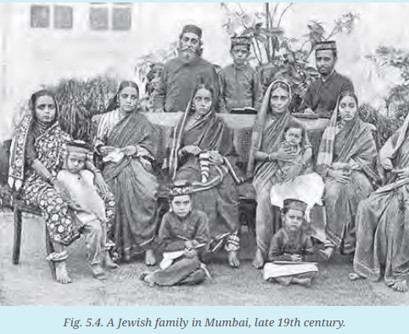
Answer: The picture shows a Jewish family wearing Indian-style clothes and living in an Indian setting. They lived and worked in India while maintaining their own religious and cultural traditions. Over time, they became an accepted part of Indian society.
Let’s Explore (NCERT Textbook Page No. 130)
Question: Observe the pictures below. What are the clues you get about the integration of the Syriac Christian community into Indian society?
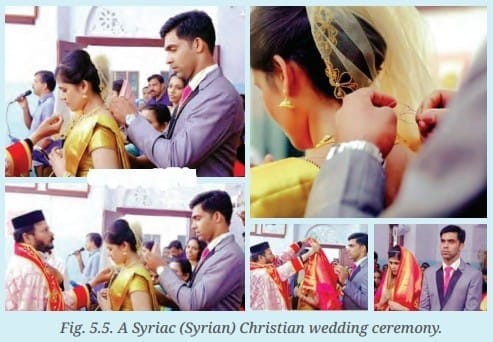
Answer: The wedding shows Indian-style clothing and customs along with Christian rituals. The pictures show that the Syriac Christian community became an integrated part of Indian society while keeping its own religious traditions. This proves successful cultural integration into Indian society.
Think About It (NCERT Textbook Page No. 131)
Question: What do you think dissolving the sugar in the milk without spilling it meant?
Answer: Dissolving the sugar in the milk without spilling it” suggests blending something sweet and valuable into life or society quietly and carefully, without waste or harm.
Let’s Explore (NCERT Textbook Page No. 132)
Question: This painting of a Parsi bride getting ready for her wedding shows many aspects of Indian culture. Do any of them seem familiar to you? Based on what you see, can you draw any conclusions about the integration of Parsi culture in India?
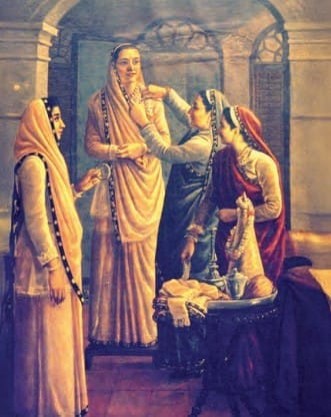
Answer: The painting shows that Parsi culture has become well integrated with Indian culture. Some things in the bride’s wedding preparations may look familiar, such as Indian-style clothing, jewellery and wedding customs. This suggests that the Parsis have kept their Zoroastrian religious traditions while also adopting some Indian cultural practices.
Let’s Explore (NCERT Textbook Page No. 134)
Question: What clues do you get about African and Indian cultural integration from the pictures here and above? Identify and name a few features that are distinctly Indian. (Page 134)
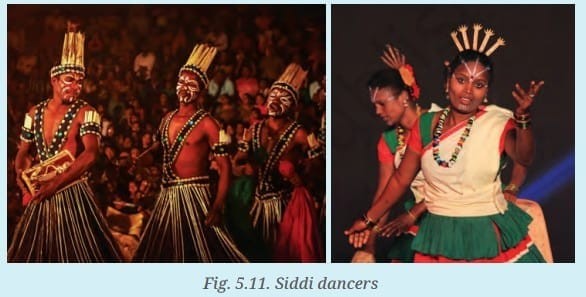
Answer: The pictures show that the Siddi community has blended African and Indian traditions. The Siddis wear Indian-style clothes and ornaments. Their dances use African style drums with Indian influence. Their life shows a mix of African and Indian culture. This shows how they adapted and became part of India.
Questions and activities (NCERT Textbook Page No. 142)
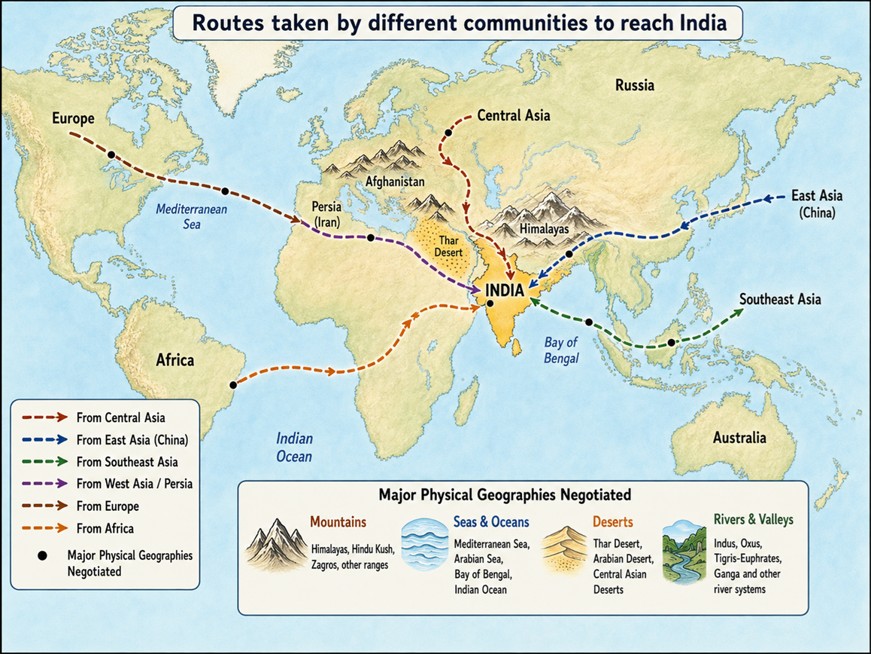
1: On the outline of a world map, try to trace the routes that the communities mentioned in this chapter may have used to reach India. What types of physical geographies did they have to negotiate?
Answer: The communities mentioned in the chapter reached India through different land and sea routes.
- Arabs travelled by sea across the Arabian Sea and settled along the western coast of India.
- Siddis from Africa reached India mainly through the Indian Ocean and Arabian Sea.
- Jews and Parsis also travelled long distances by sea to reach India.
- Tibetan refugees came through the mountainous Himalayan region.
They had to cross or travel through different physical features such as seas and oceans, mountains, deserts and rivers, depending on their route.
2: What are the key values intrinsic to Indian culture that enable it to welcome people of different backgrounds?
Answer: The key values are vasudhaiva kutumbakam (the whole world is one family), atithi devo bhava (a guest is like God), sarve bhavantu sukhinah (may all be happy), compassion, tolerance, peaceful coexistence and acceptance of different faiths and beliefs. These values encourage people to welcome others, respect their traditions and live together peacefully.
3: Homi Bhabha, Sam Maneckshaw, Ratan Tata, Fali Nariman, Nani Palkivala, and Cornelia Sorabji are a few names of Parsis who excelled in their respective fields. Find out more about people from other communities that made India their home and their contributions.
Answer: People from other communities that made India their home and contributed are:
- Mother Teresa (Albanian origin) – Served the poor in India.
- Dalai Lama (Tibetan) – Promoted peace and compassion worldwide.
- Annie Besant (British) – Freedom fighter and educationist.
- Sister Nivedita (Ireland)- A disciple of Swami Vivekanand, she worked for women’s education and social upliftment in India.
4: Take up a class project. Divide the class into groups. Each group takes up a small project to study a little more about the communities that we have been listed here. Share what you have gathered with your classmates through one of these ways – drama, posters, song, painting, etc.
Answer: For this class project, the class can be divided into groups, with each group studying one community mentioned in the chapter, such as the Jews, Parsis, Syriac Christians, Arabs, Siddis, or Tibetans.
Each group can prepare a poster, drama, song, or painting showing:
- Where the community came from
- Why they came to India
- Where they settled
- How they preserved their traditions
- How they became part of Indian society
- Their contributions to India
For example, a group studying the Siddis could make a poster showing their African origins, settlement in India, distinctive dance and African-style drumming, and the blending of African and Indian traditions.
Class 7 Social Science: Exploring Society Part 2 Chapter 5 NCERT Solutions
The chapter India, a Home to Many explores how people from different backgrounds have made India their home. Students learn about the movement of communities, the traditions they brought with them, and the exchanges that enriched social and cultural life.
Students also learn how diverse communities preserved aspects of their identity while participating in a wider society. The chapter highlights coexistence, mutual respect, and the contributions of different groups to India’s cultural richness.