

NCERT Solutions for Class 7 Social Science Part 2 Chapter 6 The State, the Government, and You are provided here with simple and easy-to-understand answers. These NCERT Solutions for Class 7 are based on the new NCERT Social Science textbook Exploring Society: India and Beyond Part 2. In this chapter, students learn about the meaning of the State, the functions of government, and the relationship between public institutions and citizens. The chapter also explains how these ideas help students understand India’s society and the world around them.
The State, the Government, and You Questions and Answers Class 7 Social Science Chapter 6
The Big Questions (NCERT Textbook Page No. 143)
1: What is the difference between a state and a government?
Answer: A state is a political organisation that has the authority to govern a defined territory and its population. It has four important features: people, land, government and sovereignty. Sovereignty means that the state has the power to make its own laws and decisions without outside control.
A government, on the other hand, is the group of people or system that runs the country. It includes leaders, ministers and officials who make laws, enforce laws and resolve disputes. The government is only one part of the state.
The main difference is that the state is permanent, while the government can change, especially after elections. The state remains the same even when a new government comes to power.
2: What is the difference between a democracy and a republic? What makes India a democratic republic?
Answer: A democracy means “rule by the people.” People have the power to choose their government through free and fair elections.
A republic is a system in which the head of state is elected rather than inheriting the position as a king or queen would. The powers of the rulers are also limited by the Constitution or laws.
The following points make India a democratic republic:
- People elect their leaders, from local bodies to the Parliament – this makes India a democracy.
- India does not have a hereditary king or queen. The President is the head of state and is elected indirectly by elected representatives.
- The elected government must work within the framework of the Constitution, which protects the fundamental rights of citizens.
3: How do citizens engage with the government in day-to-day life? How can one make government work for the people?
Answer: Citizens engage with the government in day-to-day life through schools, hospitals, roads, police, transport, welfare schemes and other public services. Government officials and departments, especially the permanent executive or bureaucracy, interact with people and help deliver these services.
Citizens can also make the government work better for the people in several ways:
- File complaints and grievances through government grievance offices or online portals.
- Use the Right to Information (RTI) to ask for information about government actions, spending and projects.
- Use newspapers, television and social media to raise public issues and contact officials.
- Work through civil society groups or NGOs to press for action on issues such as education, health and the environment.
- Write to elected representatives such as local representatives, ministers or parliamentarians.
- Vote in elections and choose representatives who are expected to work for the people.
Let’s Explore (NCERT Textbook Page No. 148)
Question: Make lists of different government departments you are familiar with, or whose names you may have seen on boards around your home or on your way to school. What functions do you think they perform?
Answer:
| Government Department | Main Function |
| Education Department | Runs schools and works to improve education. |
| Health Department | Provides healthcare services and runs government hospitals. |
| Police Department | Maintains law and order and protects people. |
| Transport Department | Manages transport services and road-safety rules. |
| Public Works Department (PWD) | Builds and maintains roads, bridges and other public infrastructure. |
| Food and Civil Supplies Department | Helps ensure the supply of essential food items to people. |
Think About It (NCERT Textbook Page No. 162)
Question: If a streetlamp in your neighbourhood is broken, who would you contact to fix it? If a village road needs to be repaired, would the local people reach out to the Central Government?
Answer: If a streetlamp in my neighbourhood is broken, I would contact the local municipal or local government authority responsible for street lighting. If a village road needs repair, the local people would normally approach the local government, such as the Gram Panchayat or other local authorities, rather than the Central Government.
Let’s Explore (NCERT Textbook Page No. 162)
Question: What might be the reasons that decisions regarding local concerns should be taken locally to the extent possible?
Answer: Decisions about local concerns should be taken locally because local people and their representatives understand local problems better. They can respond to these problems more quickly and effectively.
For example, a broken streetlamp or a village road can be dealt with by the local government instead of waiting for the Central Government. This is an important part of decentralisation, where power is shared among different levels of government.
Let’s Explore (NCERT Textbook Page No. 165)
Question: It has been more than 75 years since India became a republic. During this time, we have had many governments at the national, state and local levels. Many policies and programs have been designed and implemented. We have come a long way by increasing literacy of our people, improving roads, trains, and airports, and strengthening communication systems such as the telephone and the internet. But we still have a long way to go in addressing India’s challenges. Have a class discussion on the following: (Page 165)
(a) List five major achievements of our country in improving the lives of ordinary people in your village, town or city. Which level of government made this possible and how?
Answer: Five major achievements of our country in improving the lives of ordinary people in villages, towns or cities are:
- Better roads and transport
- Improved local facilities such as water supply, sanitation
- Better education and higher literacy
- Improved healthcare
- Improved railways and airports
(b) List five problems that ordinary people face frequently. At which level of government should these be addressed and how?
Answer: Five Problems that ordinary people face frequently and the way they can be addressed are:
(a) Drinking Water Problem
- Level of Government: Local Government (Municipality)
- How: Promote rainwater harvesting, ensure proper pipelines, install Water ATMs in markets, repair leaking pipes, and maintain regular water supply.
(b) Issue of Garbage
- Level of Government: Local Government (Municipality)
- How: Raise public awareness, employ more sanitation workers, improve waste collection vehicles, and impose strict penalties for littering.
(c) Traffic Jams
- Level of Government: Local Government and State Traffic Police
- How: Raise awareness about road safety, improve traffic signals, upgrade and expand public transport, introduce measures like odd-even, build flyovers, and deploy traffic police at busy junctions.
(d) Women’s Safety
- Level of Government: State Government (Police Department)
- How: Increase police patrolling, install CCTV cameras, set up women helplines, and ensure quick emergency response.
(e) High Pollution Levels (Air & Noise Pollution)
- Level of Government: State Government and Central Government
- How: Enforce pollution control laws, check industries and vehicles, monitor air quality, and plant more trees to improve the environment.
Questions and activities (NCERT Textbook Page No. 166-167)
1: “Every democracy is a republic.” Is this statement true or false? Explain.
Answer: The statement “Every democracy is a republic” is false. A democracy is a system in which people choose their government through free and fair elections. A republic is a system in which the head of state is elected, directly or indirectly, and the position is not hereditary. Some countries are democracies but not republics. For example, the United Kingdom, Canada and Sweden are democracies, but they have a monarch as their head of state. Therefore, they are not republics. India is both a democracy and a republic because people elect their representatives, and the President, who is the head of state, is elected rather than inheriting the position.
2: Give two reasons why decentralisation is important in India.
Answer: Decentralisation is important in India because:
- It strengthens democracy at the grassroots by allowing local people to participate directly in decision-making.
- It helps solve local problems faster and better because decisions are taken by people and representatives who understand local needs.
3: Imagine you are part of your school’s student council. The council works like a mini-parliament – it has members elected by students, debates issues and makes decisions.
(a) In this context, do you think it would be better if only the council president makes all the decisions or if power is to be shared among all members?
Answer: If only the president decides everything, it may lead to unfair or one-sided decisions. It would be better if power were shared among all the council members. This would allow different members to discuss issues, share ideas and take decisions together. It would also make the council more democratic and fair.
(b) Should the student council have the power to make rules about the food you eat, or the language you speak?
Answer: No, the student council should not make rules about the food students eat or the language they speak. These are personal choices and should be respected. Such matters should be left to individual students because food habits are influenced by culture.
(c) What can go wrong if the student council is the most powerful body in your school and no one questions its decisions?
Answer: If the student council is the most powerful body and no one questions its decisions, it may become unfair or misuse its power. It could make decisions without considering students’ views, ignore their rights, or favour certain students.
4: Think about these real-life situations in relation to India’s democracy:
(a) Should the Parliament be the most powerful institution in the country? Why or why not?
Answer: No, Parliament should not be the most powerful institution in the country. In a democracy, power is divided among the legislature, executive and judiciary so that no single institution becomes too powerful. This system provides checks and balances and helps protect citizens’ rights.
(b) Should the Parliament have the power to make any law it wants, even if it affects your rights?
Answer: No. Parliament should not have unlimited power to make any law it wants, especially if it affects citizens’ rights. In a democracy, the judiciary acts as a guardian of the law and protects people’s rights.
(c) What could go wrong if lawmaking has no limits? Can it lead to unfair or unjust laws?
Answer: Yes, lawmaking without limits can lead to unfair or unjust laws. If lawmakers had unlimited power, they might make laws that violate people’s rights or favour certain groups. Therefore, laws must follow the Constitution, which protects citizens’ rights and prevents misuse of power.
(d) Who is more powerful in India, the Parliament or the Supreme Court? Give your reasons.
Answer: Neither Parliament nor the Supreme Court is completely more powerful than the other. Both have important but different roles under the Constitution.
- Parliament is the legislature. It makes laws for the country.
- The Supreme Court is part of the judiciary. It interprets the Constitution, settles disputes and protects people’s rights.
- The Constitution places limits on the powers of both, so neither institution can simply do whatever it wants.
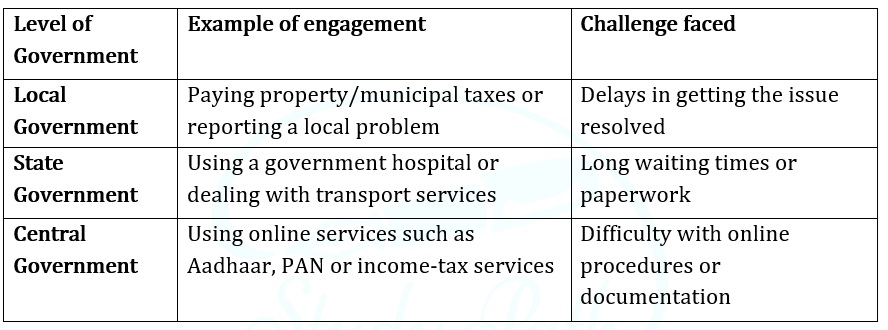
5: Ask your parents/guardians how they engaged with the government over the past year. Make a list and classify the items based on the level of government they had to work with. What challenges did they face?
Answer:
Class 7 Social Science: Exploring Society Part 2 Chapter 6 NCERT Solutions
The chapter The State, the Government, and You explores how the State and government organise public life. Students learn to distinguish between the State and the government and understand the roles of institutions in making decisions, implementing laws, and providing services.
Students also learn about citizens’ rights, responsibilities, and participation in democratic governance. The chapter connects government functions with everyday concerns and explains why accountability and public involvement are important for the common good.