

NCERT Solutions for Class 7 Social Science Part 2 Chapter 8 Banks and the Magic of Finance are provided here with simple and easy-to-understand answers. These NCERT Solutions for Class 7 are based on the new NCERT Social Science textbook Exploring Society: India and Beyond Part 2. In this chapter, students learn about the functions of banks, the importance of saving, and the role of finance in everyday economic activities. The chapter also explains how these ideas help students understand India’s society and the world around them.
Banks and the Magic of Finance Questions and Answers Class 7 Social Science Chapter 8
The Big Questions (NCERT Textbook Page No. 193)
1: What is financial infrastructure, and what does it comprise?
Answer: Financial infrastructure is the system that helps in the flow of money among people, businesses and the government. It comprises financial institutions such as banks, payment systems, the stock market and other related institutions. It helps people save money, get credit, make payments and invest, which supports economic activity and the prosperity of the nation.
2: What are the main functions performed by banks and how do they impact people’s lives?
Answer: Banks perform many important functions such as accepting deposits, giving loans, and offering payment services. They keep people’s money safe, encourage regular savings, and allow easy withdrawal through ATMs, debit cards, online payments or cheques. Banks also pay interest on savings and provide loans for purposes such as buying a house or vehicle and funding education. Businesses can borrow money to buy machinery, raw materials and expand their activities.
3: How does financial infrastructure contribute to a nation’s progress?
Answer: Financial infrastructure contributes to a nation’s progress by ensuring the smooth flow of money between people, businesses and the government. It promotes savings, credit and investment, which increase economic activity.
Banks provide loans to people and businesses, payment systems make transactions easier, and institutions such as NABARD support farming, village industries and infrastructure. These activities help businesses grow, create opportunities and contribute to the prosperity of the nation.
Think About it (NCERT Textbook Page No. 196)
Question: Why does Navdeep think that saving at the bank is better than keeping cash at home?
Answer: Navdeep thinks saving money in a bank is safer than home because it cannot be easily lost or stolen from the bank. The bank also pays interest, which helps his money grow over time.
Question: Can Navdeep and Rima lend to each other directly without the bank? What could happen in that case? Discuss. (Page 196)
Answer: Yes, Navdeep and Rima can lend money directly to each other without a bank. However, there could be problems if they disagree about the amount, interest rate or repayment date. There may also be less security or proof of the transaction.
Question: How does one track so many transactions of deposits and withdrawals? (Page 198)
Answer: One can track many deposits and withdrawals using a passbook. It is like a diary that records all receipts and payment transactions. It can be updated regularly at the bank.
Question: Look at the passbook in Fig. 8.7. Observe all the particulars under the expenses (debit) and income (credit). Why is keeping records of financial transactions important? Discuss in the class. (Page 198)
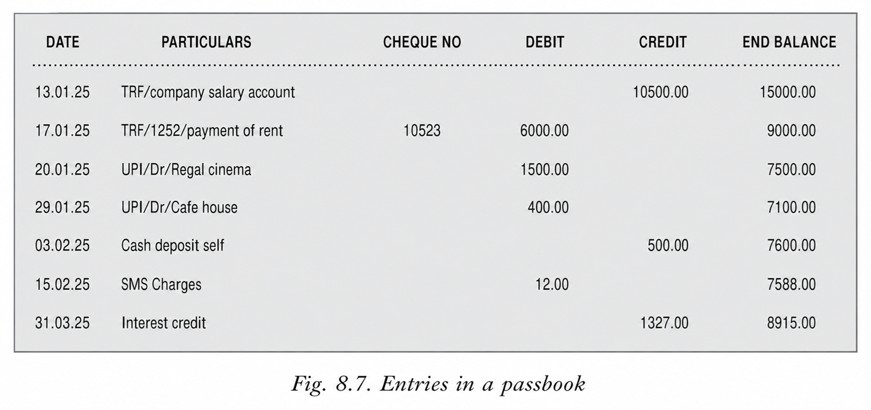
Answer: Keeping records of financial transactions is important because it helps us know how much money we have, track our income and expenses, and check that all transactions are correct. It also helps us plan our spending and savings and identify any mistakes or unauthorised transactions.
Question: Why do companies issue shares, and why do people buy them? Are there any benefits of owning shares? (Page 209)
Answer: Companies issue shares to raise money for their business activities, such as expansion and investment. People buy shares because they can become part-owners of the company and may earn returns if the company performs well.
Benefits of owning shares:
- People may receive dividends if the company distributes profits.
- The value of the shares may increase, allowing the owner to earn a profit by selling them.
Questions and activities (NCERT Textbook Page No. 211-212)
1: What is financial infrastructure? How does it complement physical infrastructure?
Answer: Financial infrastructure is the system that helps in the flow of money among people, businesses and the government. It includes banks, payment systems, the stock market and other financial institutions. It complements physical infrastructure because just as physical infrastructure such as roads, railways, ports and communication networks helps move people, goods and information, financial infrastructure helps move money.
2: How does having a bank account help people? Should everyone be required to have a bank account?
Answer: A Having a bank account helps people keep their money safe, earn interest on savings, withdraw money when needed, and borrow money through loans. It also makes payments and other financial transactions easier. I think everyone should have access to a bank account, but people should not necessarily be forced to have one.
3: What could be the possible advantages and disadvantages of compound interest for savers and borrowers?
Answer: Compound interest means earning interest not only on the original money but also on the interest earned earlier.
For savers:
- Advantage: Their savings grow faster because they earn interest on previously earned interest.
- Disadvantage: If interest rates are low, the growth may be slow.
For borrowers:
- Advantage: Compound interest can be useful in some investment situations where borrowed money generates higher returns.
- Disadvantage: The amount to be repaid can grow quickly because interest is charged on accumulated interest.
4: How does financial infrastructure enable the flow of money between households and businesses? Can you think of how the government can facilitate this flow?
Answer: Financial infrastructure enables the flow of money between households and businesses through banks and other financial institutions. Households can save their money in banks, while businesses can borrow money to buy machinery, raw materials, expand and carry out other activities. Banks also make payments and money transfers easier. The government can facilitte this flow by creating digital systems like UPI, setting banking rules through the RBI, providing subsidies, and ensuring financial services reach rural and urban areas.
5: What could be the reason for the higher interest rate earned on fixed deposits as compared to a savings account?
Answer: Fixed deposits usually offer a higher interest rate than savings accounts because the money is kept in the bank for a fixed period and cannot normally be withdrawn freely. This gives the bank a more stable source of funds to lend to others. In a savings account, people can regularly deposit and withdraw money, so the bank has less certainty about how long the money will remain available.
6: Sahil received ₹ 10,000 as a prize in a poster-making competition. His father promises to pay him 12 per cent interest per year if he does not spend the amount. After 3 years, how much money would Sahil have?
Answer: Sahil received ₹ 10,000 as a prize. His father promised to give him 12% interest per year if he does not spend the money.
If it is simple interest: Each year, Sahil will earn 12% of ₹ 10,000, which is ₹ 1,200
Over 3 years, he will earn ₹ 1,200 × 3 = ₹ 3,600 as interest.
Adding this to his original ₹ 10,000, he will have a total of ₹ 13,600 after 3 years.
If it is compound interest: With compound interest, the interest earned each year is added to the total amount, so the next year’s interest is calculated on a slightly larger amount. After 3 years of adding interest in this way, Sahil will have
After 1st year =10,000 + 1200=₹ 11,200
After 2nd year =11,200+(12 % on 11,200 = 1344) = ₹ 12,544
After 3rd year =12,544+(12 % on 12,544 = 1505.28) = ₹ 14,049.28
7: How does the stock market help mobilise the savings of individuals? In what ways do companies benefit by issuing shares to people?
Answer: The stock market helps mobilise people’s savings by allowing them to invest their money in shares of companies. Instead of keeping all their savings unused, people can invest and potentially earn returns. Companies benefit from issuing shares because they can raise money from many people without relying only on bank loans. They can use this money to expand their business, buy machinery, develop new products or fund other activities.
8: How can we balance the convenience of digital payments with the risk of cyber fraud?
Answer: We can balance the convenience of digital payments with the risk of cyber fraud by using digital payments carefully and following safety measures.
- Never share UPI PIN, OTPs, passwords or bank details with anyone.
- Be careful of fake calls, messages and suspicious links asking for bank information.
- Check the receiver’s details and payment amount before making a transaction.
- Use secure banking apps and keep passwords and PINs private.
- Report any suspicious or fraudulent transaction immediately.
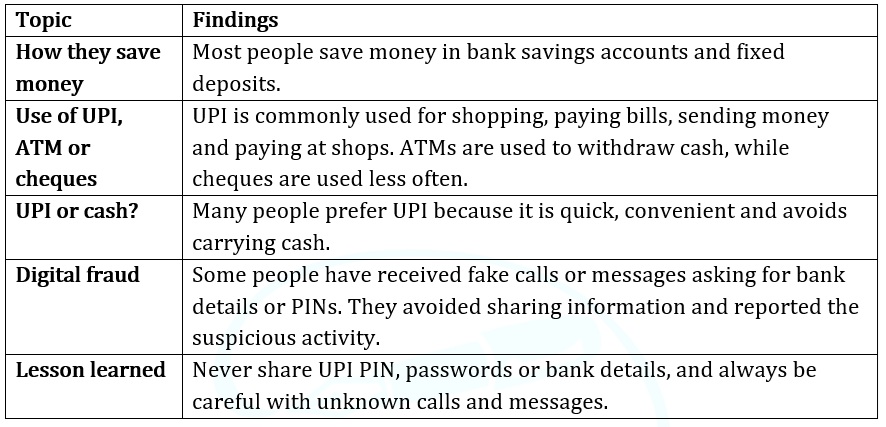
9: Ask your family members or neighbours about-
- how they save money?
- whether they use UPI, ATM or cheques, the kinds of transactions they perform through UPI; do they find UPI better than using cash or not, and why.
- if they or their acquaintance have experienced digital fraud, for instance, through a fake call or message asking for bank details. What did they do when they realised it was a scam, and what did they learn from that experience?
Summarise your findings in a table or short report. Share one surprising insight with your class.
Answer:
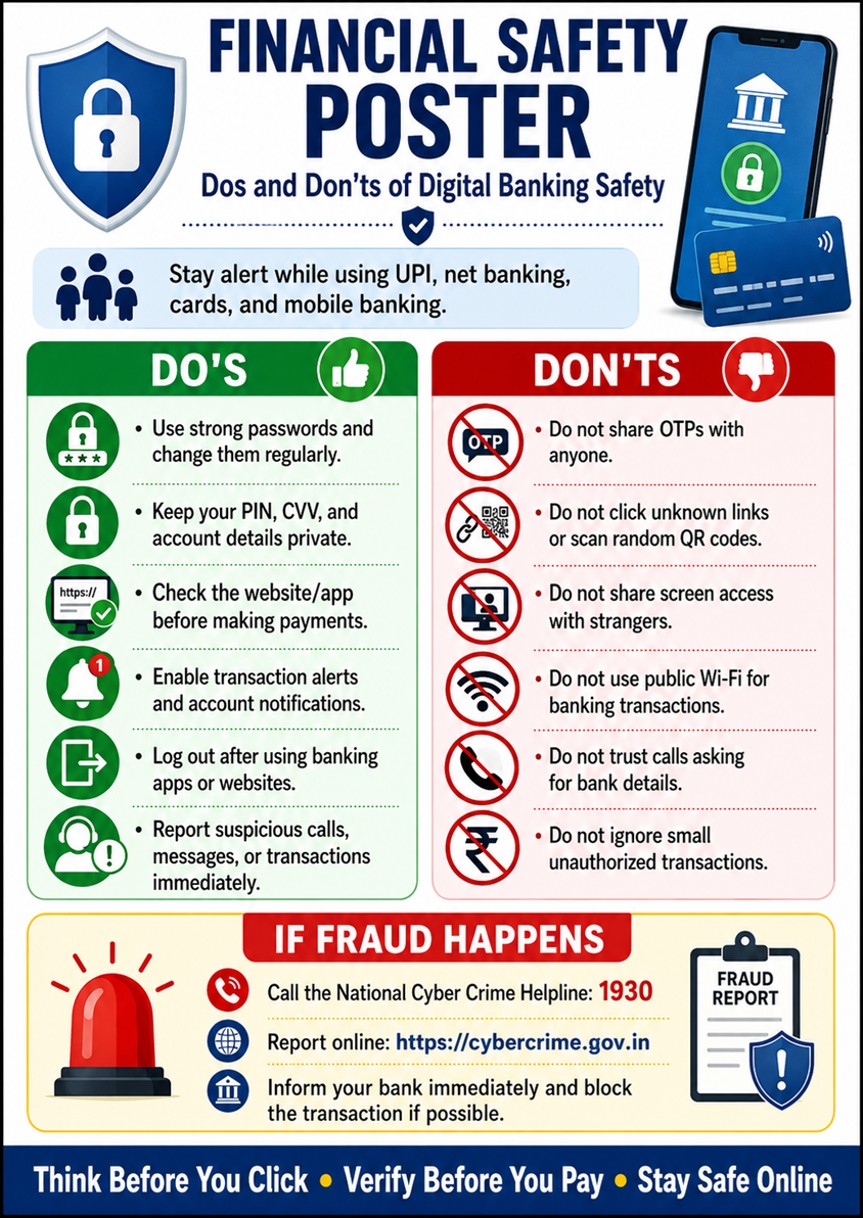
10: Create a Financial Safety Poster.
- Design a poster with dos and don’ts of digital banking safety (example, not sharing OTPs, reporting frauds).
- Include emergency numbers or websites like https://cybercrime.gov.in or 1930 helpline.
- Hang the posters in school corridors or the library.
Answer:
11: Cheques are often used to pay utility bills. Ask your parents to allow you to fill out the cheques for a few monthly payments.
Answer: Do it yourself, as directed.
12: Suppose you have to withdraw ₹10,000 from your bank account, how would you fill out the cash withdrawal slip at your bank? Let us try below!
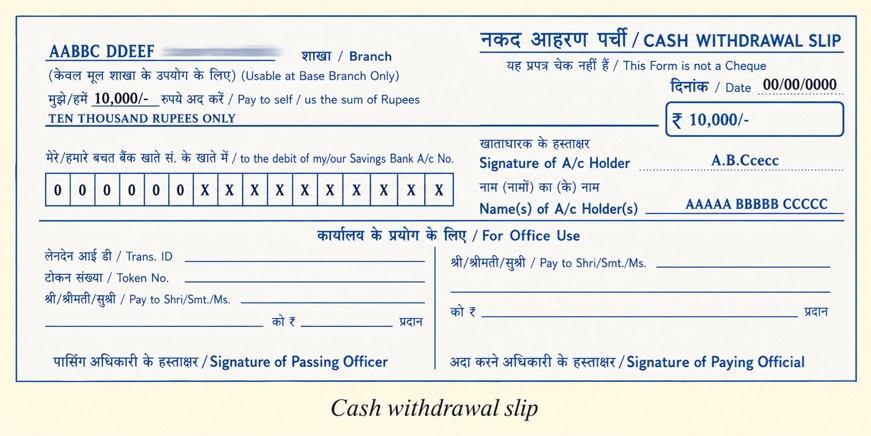
Answer: Observe the sample withdrawal slip and fill the details.
To fill a cash withdrawal slip, I would write my name, account number, date, and the amount I want to withdraw, which is ₹ 10,000. I would also write the amount in words, sign the slip, and attach it with my passbook before giving it to the bank cashier. The cashier would verify my details and then pay the amount in cash to me.
Class 7 Social Science: Exploring Society Part 2 Chapter 8 NCERT Solutions
The chapter Banks and the Magic of Finance explores how banks help people manage money. Students learn about deposits, savings, loans, and interest, along with the ways banks connect people who save money with those who need funds for different purposes.
Students also learn about banking services, financial decisions, and the importance of using money responsibly. The chapter connects finance with familiar situations and helps students understand how banking supports households, businesses, and the wider economy.