

NCERT Solutions for Class 6 English Chapter 13 Hamara Bharat – Incredible India help students understand India’s rich cultural heritage, natural beauty and unity in diversity. The lesson introduces students to the country’s diverse traditions, geographical features, languages and art forms. It also highlights how people from different states and communities live together as one nation. Here, we provide answers to the textbook questions and activities from Poorvi in simple, student-friendly language.
Class 6 English Poorvi Chapter 13 Hamara Bharat Incredible India NCERT Solutions
Let Us Discuss (Page 132)
1. What has Bharat aways been known for?
Answer: Bharat has always been known for its wise and heroic individuals.
2. What is attractive about Bharat?
Answer: Bharat is attractive because it has a rich anddiverse culture. Bharat also has beautiful rivers, lakes, mountains, and green forests. All these things make Bharat a very beautiful and special country.
3. What is special about the fact that the people live here in unison?
Answer: It is special because even though the people of Bharat are different in many ways they all live together in peace and unity. This shows “unity in diversity,” which means people are different but still one nation.
4. What geographical features does the passage mention?
Answer: The passage mentions rivers, lakes, high mountains, and green forests, which are home to many plants, insects, birds and animals.
5. What is the advice given to everyone?
Answer: The advice given to the people of Bharat is to continue working hard and ensure that the country prospers.
Kalakritiyon ka Bharat (Page 132)
Let us do these activities before we read.
Our country is beautiful and every state has its own uniqueness. The words given below are part of our identity. Complete these words with the correct vowels (A, E, I, O, U).
1. We like to decorate our homes with our f __ l k __ r t.
Answer: We like to decorate our homes with our folkart.
2. Our c __ l t __ r e consists of our ideas, customs, traditions, values, arts, and languages.
Answer: Our culture consists of our ideas, customs, traditions, values, arts, and languages.
3. All of us celebrate our f __ s t __ v __ l s together.
Answer: All of us celebrate our festivals together.
4. We tell stories to our children to teach them about our c __ l t __ r e, h __ s t __ r y, and l __ g __ n d s.
Answer: We tell stories to our children to teach them about our culture, history, and legends.
5. We have our own l __ n g __ a g __ s to talk to each other.
Answer: We have our own languages to talk to each other.
Let us discuss (Page 133)
1. What is the Ek Bharat, Shreshtha Bharat programme all about?
Answer: The ‘Ek Bharat, Shreshtha Bharat’ programme is about promoting a sense of unity among people from different parts of India. It helps us understand and respect the different cultures, languages, and traditions in our country. It shows our unity in diversity and makes us feel proud to be one nation.
2. Why is this programme being conducted?
Answer: The Ek Bharat, Shreshtha Bharat programme is being conducted to celebrate the cultural diversity of the country. It teaches us to share our culture, language, and traditions and to respect one another. This programme helps to make our country strong and united.
Let us discuss (Page 136)
On the basis of what the speakers said about the art forms, complete the table given below:
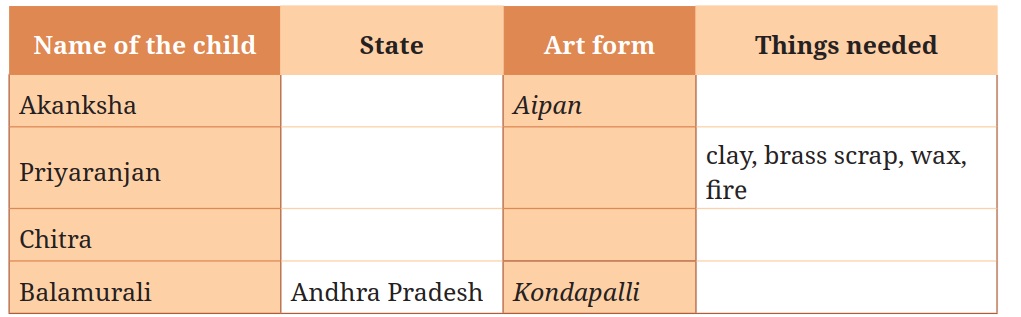
Answer:
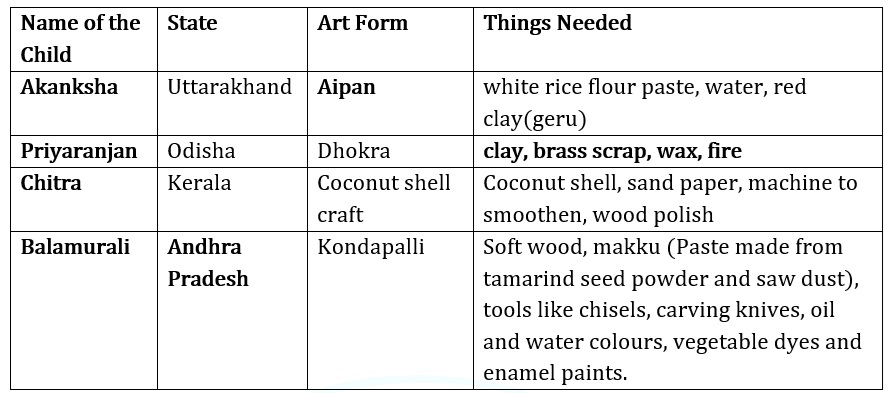
Let us think and reflect (Page 136)
I. Fill in the blanks to complete the following sentences.
1. The designs for Aipan are taken from ________________ and ________________.
2. Dhokra metal craft is very old because it is ________________ old.
3. A base is needed for coconut shell craft to make it ________________.
4. Soft wood, ________________ and colours are used to make Kondapalli toys.
Answer:
1. The designs for Aipan are taken from cultural traditions and nature.
2. Dhokra metal craft is very old because it is 4000 years old.
3. A base is needed for coconut shell craft to make it stable.
4. Soft wood, makku, a paste of tamarind seed powder and sawdust and colours are used to make Kondapalli toys.
II. Why does Akanksha’s family make Aipan?
Answer: Akanksha’s family makes Aipan during family functions and festivals to decorate their home. It is made on floors and walls of puja rooms, and outside the main door of the home. It is an art form made by the women in the family.
III. In Dhokra, why does wax come out of the small openings?
Answer: In Dhokra art, after covering the wax figure with clay, it is put into the fire. The heat melts the wax, and it flows out through small holes in the clay layer. It creates a hollow space in the shape of the wax model. This space is later filled with molten brass to form the final metal figure.
IV. What is common in the toys made in Balamurali’s village and coconut shell craft in Kerala?
Answer: The toys made in Balamurali’s village (Kondapalli) and the coconut shell craft in Kerala are both handmade and biodegradable. They also show the local art and traditions of the people.
Let us learn (Page 137)
I. Priyaranjan, Chitra and Balamurali share how art works of their states are made. They use some words to show the order of making it. Those words are given in the box below.

Now, use some of these words to complete the paragraph given below. Use one word only once.
How I Get Ready for School
1. ____________ I get up and go to take a shower. 2. ____________, I wear my school dress. 3. ____________, I eat my food. 4. ____________, I wear my shoes. 5. ____________, I pick up my bag and go out of my home.
Answer: 1. To begin I get up and go to take a shower. 2. then, I wear my school dress. 3. next, I eat my food. 4. After that, I wear my shoes. 5. Finally, I pick up my bag and go out of my home.
II. The children from different states each speak about one art form from their state. When they speak, they use the first form of the verb. It shows something that happens regularly. It is called the present tense. With he, she and it, -s/-es is used with the verb to show the present tense.
Make five sentences with the help of the words given in the table below.
Use -s/-es wherever necessary. Two examples are given.
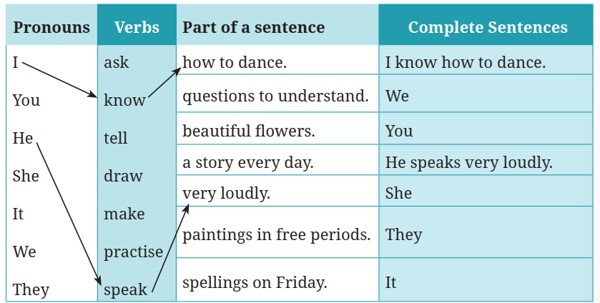
Answer:
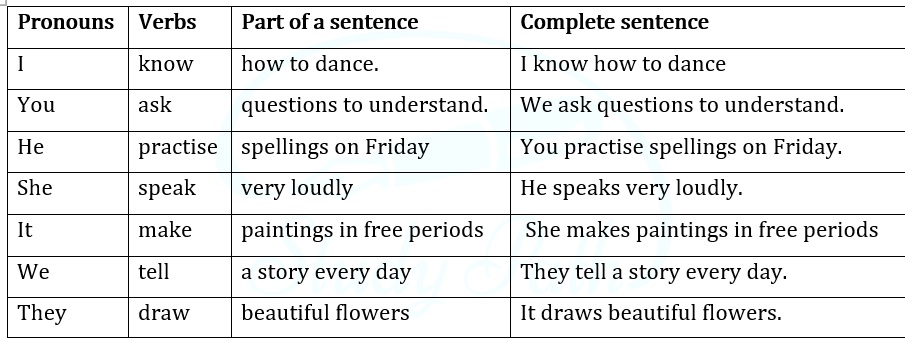
Let us listen (Page 138)
I. Listen to the description of gakkad bharta and complete the notes given below. (refer to page 162 for transcript)
Gakkad Bharta
1. Name of the speaker: ________________
2. The town of the speaker: _____________
3. The state he belongs to: _______________
4. The name of the food item: _____________
5. Vegetables roasted for bharta: _________
Answer:
1. Name of the speaker: Sushil
2. The town of the speaker: Jabalpur
3. The state he belongs to: Madhya Pradesh
4. The name of the food item: Gakkad Bharta
5. Vegetables roasted for bharta: Brinjals and tomatoes
2. Now, listen to the description again and complete the flowchart on how to make gakkad bharta.
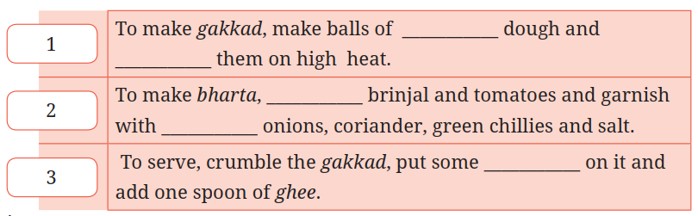
Answer:
| 1. To make gakkad, make balls of wheat dough and roast them on high heat. |
| 2. To make bharta, roast brinjal, and tomatoes and garnish with chopped onions, coriander, green chilies, and salt. |
| 3. To serve, crumble the gakkad, put some bharta on it, and add one spoonful of ghee. |
Let us write (Page 139)
You heard children from different states speak about the art forms from their state. Discuss in pairs which art form you liked the most.
Now, write a paragraph with five sentences giving your reasons for liking it.
Answer: I liked the Aipan art from Uttarakhand the most. It is made with white rice flour on red walls, and the designs are very beautiful and neat. I like that it is made by women during festivals and family functions. It shows their love for culture and nature. I like Aipan because it makes homes look pretty and special.
NCERT Solutions for Class 6 English Unit 5 Hamara Bharat Incredible India!
Hamara Bharat—Incredible India! is an informative lesson that celebrates India’s cultural and geographical diversity. It describes Bharat as a land known for its wise and heroic people, rich traditions, beautiful rivers, lakes, mountains and green forests. The lesson also highlights the idea of unity in diversity and explains how people with different languages, customs and traditions live together in harmony. Through the related section Kalakritiyon ka Bharat, students also explore traditional art forms and handicrafts from different Indian states. The lesson encourages everyone to respect the country’s heritage and contribute to its progress.
We hope these NCERT Solutions for Class 6 English Poorvi help students understand the lesson, revise its important ideas and prepare confidently for their examinations.