

Looking for NCERT Solutions for Class 6 Science Curiosity Chapter 10 Living Creatures: Exploring their Characteristics? Here, you will find easy-to-understand answers to all the important questions and activities from the NCERT Class 6 Science textbook. These solutions are prepared in simple language to help students understand the concepts, complete their homework and prepare for examinations.
Class 6 Science Chapter 10 Living Creatures: Exploring their Characteristics NCERT Questions and Answers
Textbook Intext Questions
Question: How would you now categorise a seed, as living or non-living? (Page – 191)
Answer: Seed is a living thing as it can germinate and grow into a plant under favourable conditions.
Question: How can the life cycle of a mosquito be disrupted? (Page – 197)
Answer: The life cycle of a mosquito can be disrupted by
- Eliminating stagnant water where mosquitoes lay eggs
- Using larvicides to kill larvae
- Introducing natural predators like fish that feed on mosquito larvae
- Spraying insecticides to kill adult mosquitoes and prevent breeding.
Let us enhance our learning (Exercise Questions)
1. List the similarities and differences in life cycles of plants and animals.
Answer: Similarities in Life Cycles of Plants and Animals
- Both plants and animals grow from a small initial stage (Seed or egg) into a mature form.
- Both have reproductive stages where they produce offspring.
- Both animals and plants have male and female organs required for reproduction.
Differences in Life Cycles of Plants and Animals
| Life Cycle of Plants | Life Cycle of Animals |
| A plant’s life cycle starts with seed germination. | An animal’s life cycle begins with a new born or egg. |
| Plants can grow throughout their life. | Animals stop growing after certain stage of time. |
| Seeds or reproductive parts are produced throughout their life cycle. | Animals have definite time for reproduction. |
| Plants can’t move from one place to another. | Animals move from one place to another. |
| Plants use flowers, cones, or spores for reproduction. | Animals have specialized organs for reproduction |
| Plants use stomata and lenticels for the respiration. | Animals have specialised organs like lungs or gills for respiration. |
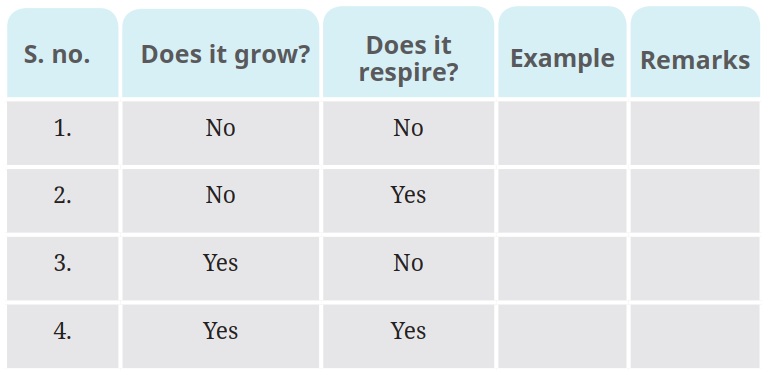
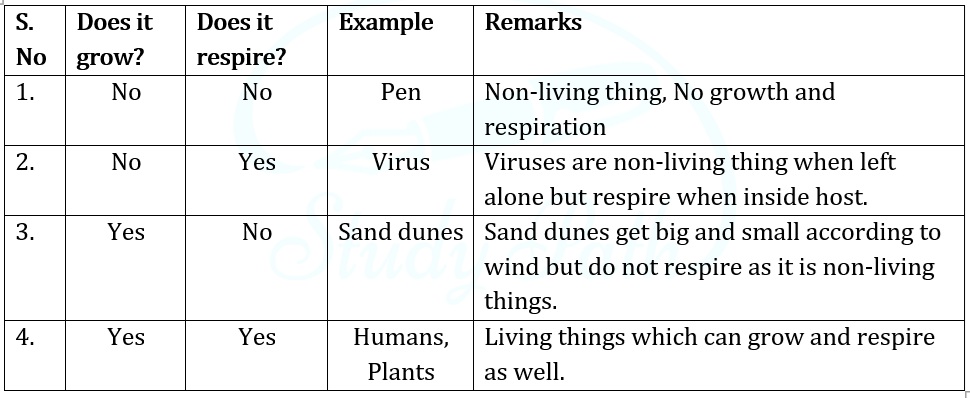
2. The table on the next page shows some data. Study the data and try to find out examples appropriate for the conditions given in the second and third columns. If you think that an example for any of the conditions given below is not possible, explain why.
Answer:
3. You have learnt that different conditions are required for seed germination. How can we use this knowledge for proper storage of grains and pulses?
Answer: We learnt that water, air and suitable temperature are required for seed germination. So, we will store the grains and pulses in cool and dry place such as:
- Cold Storage
- Airtight Containers
4. You have learnt that a tail is present in a tadpole but it disappears as it grows into a frog. What is the advantage of having a tail in the tadpole stage?
Answer: Advantages of having a tail
- The tail helps the tadpole in swimming and changing direction in water.
- Helps in finding food and keeping itself safe from predators
- It also helps the tadpole in maintaining balance and stability while moving in water.
5. Charan says that a wooden log is non-living as it cannot move. Charu counters it by saying that it is living because it is made of wood obtained from trees. Give your arguments in favour or against the two statements given by Charan and Charu.
Answer: Charan’s Argument (Wooden log is non-living):
In favour: A wooden log cannot move, grow, reproduce, or respond to stimuli thus it is non-living.
Against: While a wooden log is non-living, it is derived from a living tree and retains some properties of life, such as cellular structure.
Charu’s Argument (Wooden log is living):
In favour: The log is made from cells that were once part of a living tree, hence it has a biological origin.
Against: Once the wood is separated from the tree, it cannot move, respire, grow or perform any other life processes, making it non-living.
6. What are the similarities and distinguishing features in the life cycles of a mosquito and a frog?
Answer: Similarities between life cycle of Mosquito and Frog:
- Life cycle of both frog and mosquito has four stages.
- Both begin life as eggs.
- Both have a larval stage (tadpole in frogs, larvae in mosquitoes) that is aquatic.
Differences between life cycle of Mosquito and Frog:
| Life Cycle of Mosquito | Life Cycle of Frog |
| Life cycle of mosquito has four stages—egg, larva, pupa and adult. | The life cycle of frog has four stages— egg, tadpole, froglet and adult frog. |
| The adult mosquito cannot live in water. | The adult frog can live both on land and in water. |
| The adult mosquito may survive for 10 to 15 days. | The adult frog may survive for 14 weeks. |
| Larvae and pupae breathe through siphons. | Tadpoles have gills, adults have lungs and can respire through their skin. |
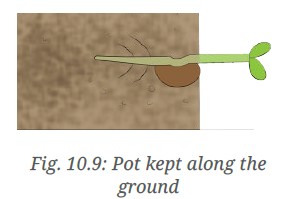
7. A plant is provided with all the conditions suitable for its growth (Fig. 10.9). Draw what you expect to see in the shoot and the root of the plant after one week. Write down the reasons.
Answer: Expected observations after one week:
- Shoot: Growth upwards, exhibit movement towards sunlight.
- Root: Growth downwards, exhibit movement towards the soil
Reasons:
- Shoots grow towards light (phototropism) for photosynthesis.
- Roots grow downwards (gravitropism) for stability and nutrient absorption.
8. Tara and Vijay set up the experiment shown in the picture (Fig. 10.10). What do you think they want to find out? How will they know if they are correct?
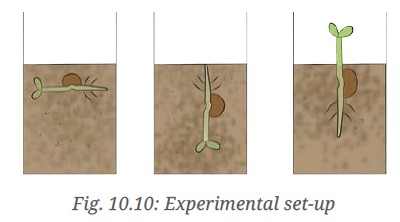
Answer: Tara and Vijay want to find out in which direction the root and shoot of a plant would grow and move if the plant is placed inverted or along the ground.
Observation: The shoot always grows upwards (towards the light) and the root always grows downwards (into the soil), regardless of how the seed is placed, this shows that plants have natural mechanisms (like phototropism and gravitropism) that guide their growth direction.
9. Design an experiment to check if temperature has an effect on seed germination.
Answer: Aim: To check if temperature has an effect on seed germination.
Materials: Identical pots, soil, seeds, thermometers, and different temperature controlled environments (e.g., refrigerator, room temperature, heated environment).
Procedure:
- Each pot is filled with the same type of soil.
- Seed is planted in each pot.
- Now, each pot is kept in a different environment with controlled temperatures (e.g., cold temperature, room temperature and warm temperature).
For example: one pot outside in balcony to get sunlight, another pot in shade in the room and the third one in basement or at coldest part of the house. - Each pot is given water in equal quantity.
- Number of seeds germinated in each environment is recorded daily for two weeks.
Observation: Measure and compare the rate of germination and growth in different temperatures.
Conclusion: Determine the optimal temperature for seed germination based on observations.
Living Creatures: Exploring their Characteristics Class 6 Science Chapter 10 NCERT Solutions
We hope these NCERT Solutions for Class 6 Science help students understand the textbook activities, revise important concepts and prepare confidently for their examinations.
Class 6 Science Chapter 10, Living Creatures: Exploring their Characteristics, introduces students to the basic features that distinguish living things from non-living things. It explains how living organisms grow, need food, respire, respond to their surroundings, reproduce and eventually die. Students also learn about movement, life processes and the different characteristics of plants and animals. The chapter helps learners understand how living organisms interact with their environment and carry out essential activities to survive.
Class 6 Science Chapter 10 – What Will You Learn?
The chapter Living Creatures: Exploring their Characteristics helps students understand the features that make an organism living. It explains the different life processes that take place in plants, animals and other living organisms and how these processes help them survive.
The important concepts covered in this chapter are:
- Living and Non-Living Things: Understanding the differences between living organisms and non-living objects through their characteristics.
- Growth: Learning how living organisms grow and develop throughout their lives.
- Nutrition: Understanding why living organisms need food and how plants and animals obtain nutrition.
- Respiration: Learning how living organisms release energy from food to carry out different activities.
- Movement: Exploring how plants and animals show movement in different ways.
- Response to Stimuli: Understanding how living organisms respond to changes in their surroundings, such as light, temperature and touch.
- Reproduction: Learning how living organisms produce young ones of their own kind to continue their species.
- Excretion: Understanding how living organisms remove waste materials produced inside their bodies.
- Life Span and Death: Learning that every living organism has a life cycle and eventually dies.
- Characteristics of Living Organisms: Revising the major life processes that distinguish living creatures from non-living things.