

Looking for NCERT Solutions for Class 6 Science Curiosity Chapter 11 Nature’s Treasures? Here, you will find easy-to-understand answers to all the important questions and activities from the NCERT Class 6 Science textbook. These solutions are prepared in simple language to help students understand the concepts, complete their homework and prepare for examinations.
Class 6 Science Chapter 11 Nature’s Treasures NCERT Questions and Answers
Question: What will happen if the Sun is not visible for a few days? (Page – 216)
Answer: If sun is not visible for a few days we will face the following
- We may have to depend on artificial lighting during day time also.
- Growth of living beings will be affected.
- Plants may not be able to produce food.
- The production of solar energy will be stopped.
- The temperature will decrease.
Let us enhance our learning (Exercise Questions)
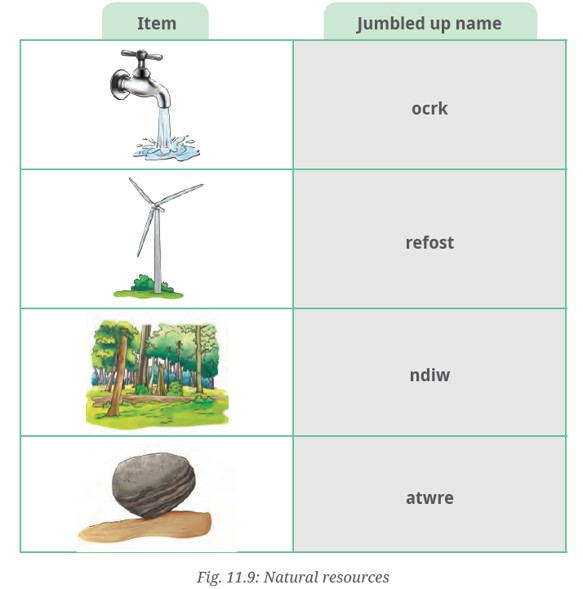
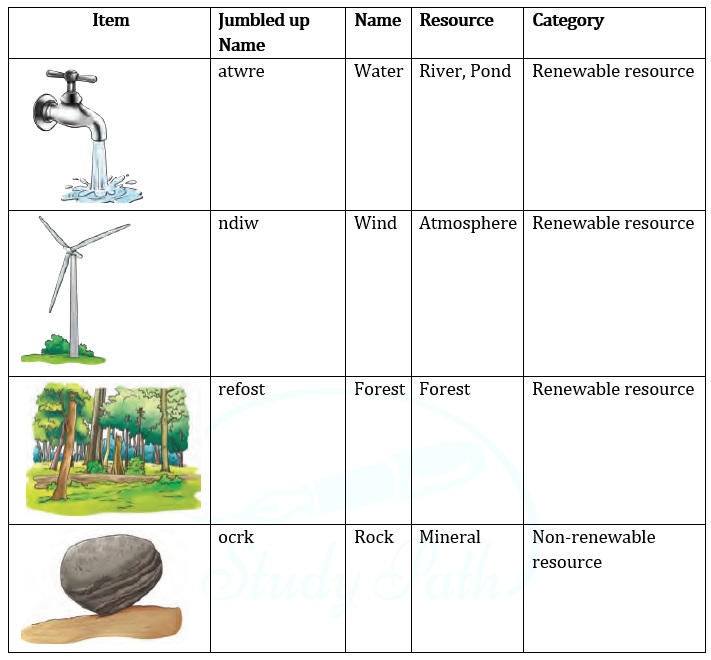
1. Fig. 11.9 shows items related to natural resources. Match them with their jumbled up names. Make another table and write the names of these resources. Classify these resources as renewable or non-renewable.
Answer:
2. State whether the following statements are True [T] or False [F]. If False, correct them.
(i) Nature has all the resources to meet human needs. [ ]
(ii) Machines are a resource found in nature. [ ]
(iii) Natural gas is a non-renewable resource. [ ]
(iv) Air is a renewable resource. [ ]
Answer:
(i) Nature has all the resources to meet human needs. [T]
(ii) Machines are a resource found in nature. [F]
(iii) Natural gas is a non-renewable resource. [T]
(iv) Air is a renewable resource. [T]
3. Fill in the blanks using the most appropriate option –
(i) A fuel that is commonly used in two wheelers like scooters or bikes is _____
(a) Kerosene
(b) Petrol
(c) Diesel
(d) LPG
Answer: (b) Petrol
(ii) An example of a renewable resource is _____
(a) Coal
(b) Water
(c) Natural gas
(d) Petrol
Answer: (b) Water
4. Classify the following as renewable or non-renewable resources – coal, natural gas, forests and minerals.
Answer: Renewable resources: Forests
Non-renewable resources: Coal, natural gas and minerals
5. Why do we say that petroleum is a non-renewable resource?
Answer: Petroleum forms from the remains of microorganisms and plants buried deep inside the earth. This process takes it takes millions of years. Petroleum is found in limited quantities and once used, it cannot be replenished. Thus, it is a non-renewable resource.
6. It is difficult to regrow forests. Justify this statement.
Answer: It is difficult to regrow forests because:
- the process of growing trees to maturity takes many years.
- the soil may become degraded due to deforestation making it less suitable for new plant growth.
- Human activities such as agriculture, mining and urbanisation can also hinder forest regeneration.
- The ecological balance and biodiversity that develop in a forest over centuries cannot be easily replicated.
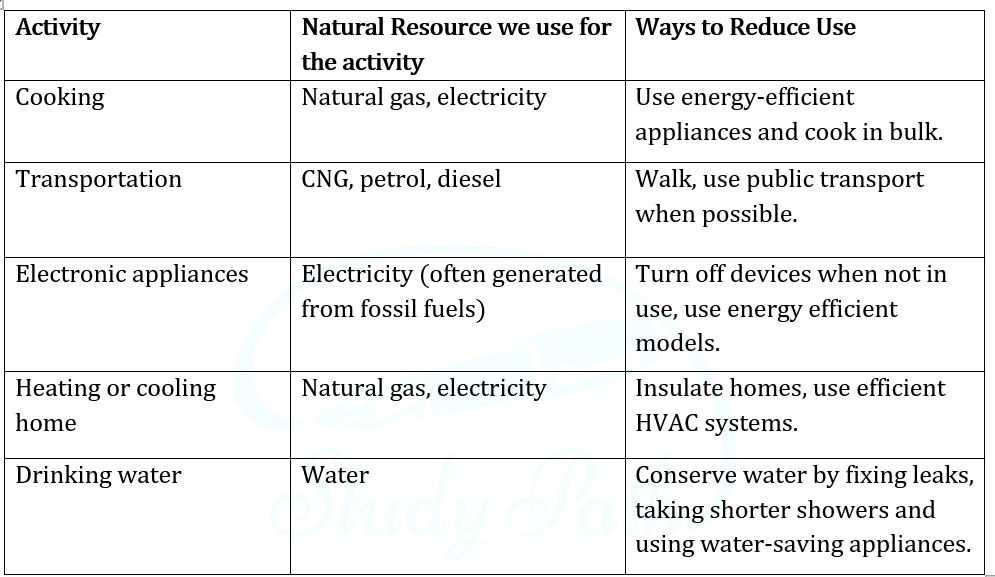
7. Make a list of five daily activities in which you use natural resources. Suggest ways by which you can reduce their use.
Answer:
8. List four activities that are possible due to the presence of air.
Answer: Four activities that are possible due to the presence of air:
- Breathing
- Flying kites
- Inflating balloons
- Generating wind energy through windmills
9. How can you contribute towards enhancing the green cover of your locality? Make a list of actions to be taken.
Answer: List of actions towards enhancing the green cover of locality:
- Planting trees and shrubs in the locality.
- Encouraging other to participate in tree-planting.
- Protecting existing trees from being cut down.
- Creating awareness about the importance of green cover.
- Supporting local initiatives that aim to increase green spaces.
10. In the given illustration, we see that food is being cooked.
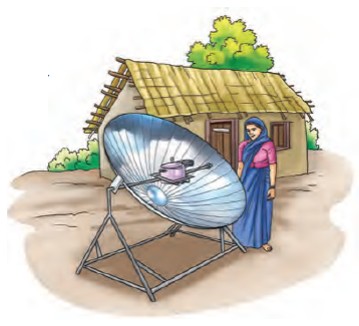
Answer the following questions—
(i) What type of energy is being used for cooking?
(ii) Name one benefit and one drawback of using this type of energy for cooking.
Answer:
(i) Solar energy is being used for cooking.
(ii) Benefit: Solar energy is a renewable and clean source of energy. Hence, it is environment friendly.
Drawback: Solar cooking is dependent on sunlight and may not be suitable in cloudy conditions or during nighttime.
11. Cutting down trees on a large scale impacts the quality of the soil. Why do you think it is so?
Answer: Trees help keep the soil in place with their roots. When trees are removed, the soil can be easily washed away during rain, leading to soil erosion. Additionally, trees add nutrients to the soil through their fallen leaves, which decompose and enrich it. Without trees, the soil may lose these important nutrients.
12. Explain two ways in which human activities pollute the air. Propose one action which can help in reducing air pollution.
Answer: Two ways in which human activities pollute the air:
- Emission of harmful gases and smoke from vehicles by burning of fossil fuels.
- Industrial emissions releasing harmful gases.
Action to reduce pollution:
- Use of electric vehicles and public transportation to reduce emissions from vehicles.
- Walking and biking are also good options to reduce air pollution.
- Establishing air filters in chimneys of industries to capture air pollutants.
- Use of clean fuels and solar utensils for cooking of food.
13. A family uses solar panels to generate electricity, a gas stove to cook food and a windmill for pumping water from a well. What would happen if there were no sunlight for a week?
Answer: If there were no sunlight for a week, the family would face issues with generating electricity through solar panels, which would affect their power supply. They might need to rely on alternative sources of energy for electricity.
14. Fill up the blanks using the following terms- (fossil fuels, forest, air, petroleum, coal, water and non-renewable resource)
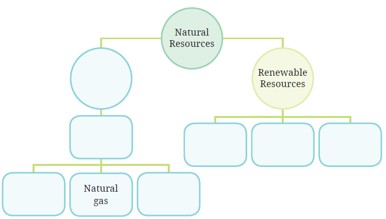
Answer:
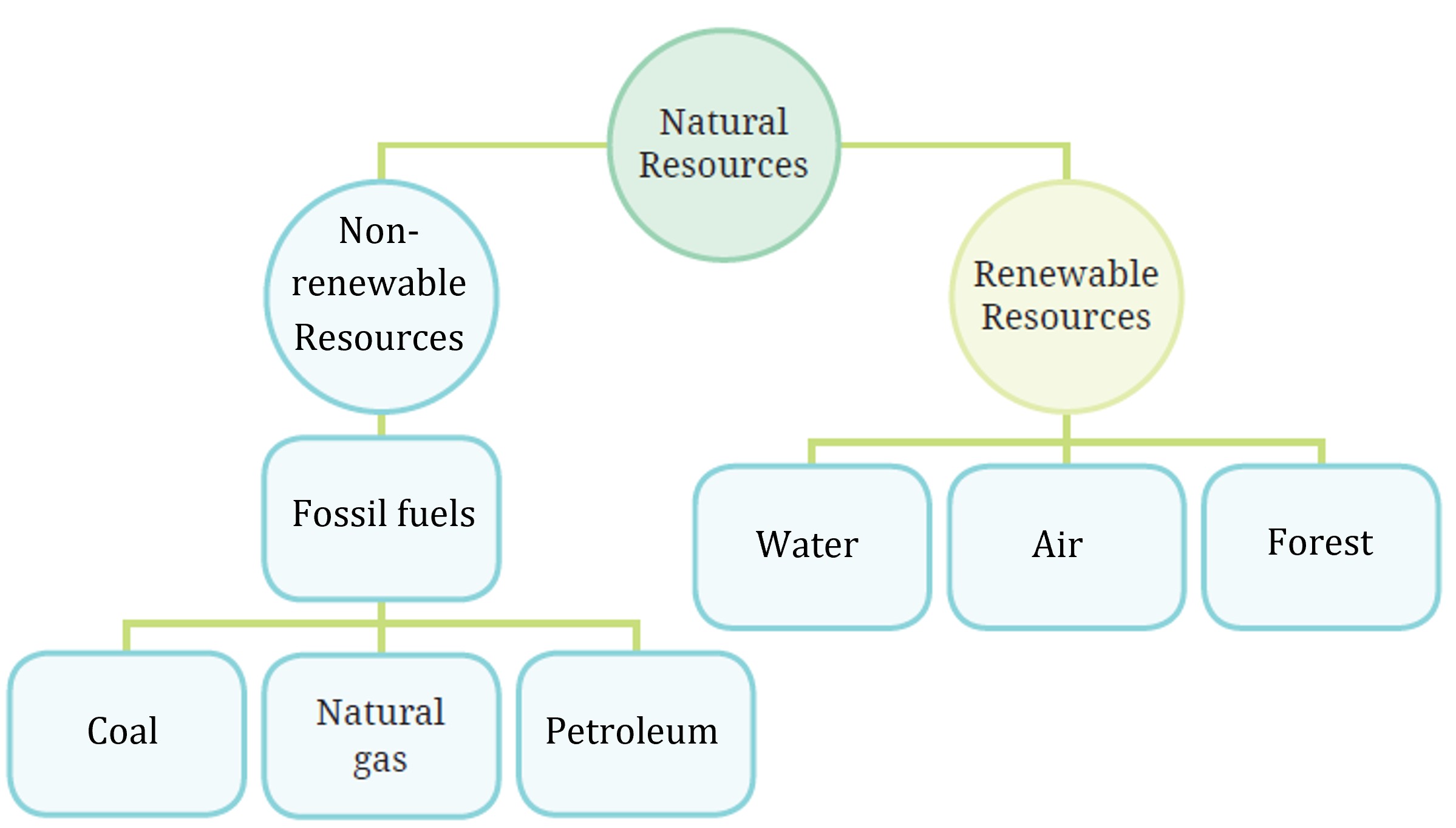
15. There is an increasing demand of trees to meet the requirements of industries and for housing. Therefore, trees are being felled. Is it justified? Discuss and prepare a brief report.
Answer: The increasing demand for trees to meet industrial and for housing is leading to deforestation, which is not justified.
Problems Caused by Cutting Down of Trees
- Cutting of trees disrupts habitats of many wild animals, including birds and insects.
- Deforestation also and leads to soil erosion and contributes to climate change.
- Trees provide us with fresh oxygen for breathing.
- Trees also protect us from various natural calamities like drought, flood, etc.
- Trees provide us with food which is the basic need of humans.
While it is important to meet the needs of people, it is also crucial to balance this with the conservation of trees. By planting more trees and using resources wisely, we can help in balancing human needs with the conservation of natural resources.
16. Propose a plan to use less water in your school. What steps would you take to make this plan happen and how would it help the environment?
Answer: Plan to use less water:
- Use grey water for gardening purposes.
- Implement a rainwater harvesting system.
- Install water-efficient faucets and toilets.
- Fix leaks quickly to prevent water wastage.
Steps to implement the plan:
- Monitor water usage regularly and set reduction targets.
- Conduct audits to identify areas where water is being wasted.
- Encourage student-led initiatives for water conservation.
- Collaborate with local authorities and experts to install water saving devices.
Environmental benefits:
- Decreases the energy used in water treatment and distribution.
- Help to maintain groundwater level.
- Preserve aquatic ecosystem.
Nature’s Treasures Class 6 Science Chapter 11 NCERT Solutions
We hope these NCERT Solutions for Class 6 Science help students understand the textbook activities, revise important concepts and prepare confidently for their examinations.
Class 6 Science Chapter 11, Nature’s Treasures, introduces students to the valuable resources provided by nature and their importance in supporting life on Earth. It explains how air, water, soil, sunlight, forests and minerals are essential for living organisms and human activities. Students also learn about renewable and non-renewable natural resources, the importance of conserving them and the need to use natural resources responsibly. The chapter helps learners understand how human activities affect the environment and why protecting nature is important for future generations.
Class 6 Science Chapter 11 – What Will You Learn?
The chapter Nature’s Treasures helps students understand the importance of natural resources and how they support life on Earth. It explains why these resources should be used carefully and how everyone can contribute to protecting the environment.
The important concepts covered in this chapter are:
- Natural Resources: Understanding the different resources obtained from nature, such as air, water, soil, sunlight, forests and minerals.
- Importance of Air: Learning why air is essential for respiration, combustion and other natural processes.
- Importance of Water: Understanding the role of water in supporting life and maintaining the balance of nature.
- Soil and Its Importance: Learning how soil supports plant growth and provides a habitat for many living organisms.
- Forests: Exploring how forests provide food, shelter, oxygen and other valuable resources while maintaining ecological balance.
- Sunlight: Understanding the importance of sunlight for photosynthesis, warmth and the functioning of natural systems.
- Renewable Resources: Learning about natural resources that can be replenished through natural processes, such as sunlight, wind and water.
- Non-Renewable Resources: Understanding resources such as coal, petroleum and natural gas that take millions of years to form and are available in limited quantities.
- Conservation of Natural Resources: Learning why resources should be used wisely to reduce wastage and protect the environment.
- Sustainable Use of Resources: Understanding how responsible use of natural resources can help protect the Earth for future generations.