

Looking for NCERT Solutions for Class 6 Science Curiosity Chapter 12 Beyond Earth? Here, you will find easy-to-understand answers to all the important questions and activities from the NCERT Class 6 Science textbook. These solutions are prepared in simple language to help students understand the concepts, complete their homework and prepare for examinations.
Class 6 Science Chapter 12 Beyond Earth NCERT Questions and Answers
Textbook Intext Questions
Question: Do we find patterns among the stars just for fun, or is there some use of these patterns? (Page – 233)
Answer: We find patterns among the stars not just for fun but for practical reasons too:
- Navigation: Help in finding directions such as using the Pole Star to locate north.
- Calendars: Constellations helped track seasons for farming.
- Culture: Myths and stories were told through star patterns.
- Astronomy: Modern science uses constellations to map the sky.
Question: How can we identify some of these constellations in the night sky? (Page – 235)
Answer: To identify constellations in the night sky:
- Use star maps or apps that show constellations visible at your location and time.
- Look for bright, easily recognisable stars, such as Sirius in Canis Major or Betelgeuse in Orion.
- Identify common patterns, like the Big Dipper’s shape in Ursa Major or Orion’s Belt.
- Refer to seasonal guides, as some constellations are visible only at certain times of the year.
- Locate the Pole Star (Polaris) to find the Little Dipper and orient yourself in the Northern Hemisphere.
Question: Can we try to find any constellation or star of our choice on any night from our location? (Page – 236)
Answer: No, not all constellations or stars are visible from every location on every night. The visibility of constellations and stars depends on several factors such as time, location, pollution level, weather condition etc.
Question: Which star is closest to us? (Page – 238)
Answer: The Sun is closest star to us that is about 150 million km away.
Question: Our Sun is also a star. So how is it that the Sun appears big and lights up the sky while the other stars look like bright dots in the night sky and are not even visible during the daytime? (Page – 239)
Answer: As the stars (other than the Sun) are much farther away they appear like bright dots even though some of those stars are much bigger than our Sun. During the daytime due to the extreme brightness of the Sun, it is not possible to view the other stars.
Question: Are stars the only objects in the sky? Or, are there more objects which we may not have noticed? (Page – 240)
Answer: No, stars aren’t the only objects in the sky. There are also planets, moons, comets, asteroids, galaxies, satellites, and more.
Question: Can we also identify a planet in the way we identified the constellations? (Page – 242)
Answer: Among the planets, it is easiest to identify Venus which is very bright. After the Sun and the Moon, Venus is the brightest object in the sky. Mercury, Mars, Jupiter and Saturn can also be seen with the naked eye. They are so far away that they look like shining dots, just like stars.
Question: How can we see the planets which are not visible to the naked eye? (Page – 243)
Answer: We use telescope to see the planets which are not visible to the naked eye.
Question: We know that planets move around the Sun. Are there any objects that move around planets? (Page – 243)
Answer: Yes, objects that move around planets are called natural satellites. For example: Moon is a natural satellite which orbits our planet Earth.
Question: What is beyond the Solar System? (Page – 246)
Answer: Beyond the Solar System lies an incredibly vast and largely unexplored region of space.
Question: What is beyond the Milky Way Galaxy? (Page – 247)
Answer: There are many galaxies in the outer space beyond the Milky Way Galaxy.
Question: Is there life anywhere else in the Universe? (Page – 247)
Answer: Till today we do not know yet if life exists elsewhere in the Universe.
Let us enhance our learning (Exercise Questions)
1. Match the column:
| Column I | Column II |
| (i) Satellite of Earth | (a) Orion |
| (ii) Red planet | (b) Venus |
| (iii) Constellation | (c) Mars |
| (iv) Planet which is commonly called an evening star | (d) Moon |
Answer:
| Column I | Column II |
| (i) Satellite of Earth | (d) Moon |
| (ii) Red planet | (c) Mars |
| (iii) Constellation | (a) Orion |
| (iv) Planet which is commonly called an evening star | (b) Venus |
2. (i) Solve the following riddle. My first alphabet is in MAN but not in CAN
My second alphabet is in ACE and also in FAN
My third alphabet is in RAT and not in CAT
My fourth alphabet is in SUN but not in FUN
I am a planet that moves around the Sun.
Answer: MARS
(ii) Make two similar riddles by yourself.
(a) My first alphabet is in VAN but not in PAN
My second alphabet is in EARTH and also in HEAVEN
My third alphabet is in ONE and not in TWO
My fourth alphabet is in SUN and also in FUN
My last alphabet is in STAR but not in RADAR
I am a planet that moves around the Sun.
Answer: VENUS
(b) My first alphabet is in MAN but not in CAN ‘,
My second alphabet is in ROSE and also in BOAT.
My third alphabet is in OIL and not in LIME
My fourth alphabet is in SUN but not in SON
Answer: MOON
3. Which of the following is not a member of our Solar System?
(i) Sirius
(ii) Comets
(iii) Asteroids
(iv) Pluto
Answer: (i) Sirius
4. Which of the following is not a planet of the Sun
(i) Jupiter
(ii) Pluto
(iii) Neptune
(iv) Saturn
Answer: (ii) Pluto
5. Which is the brighter star, the Pole Star or Sirius?
Answer: Sirius
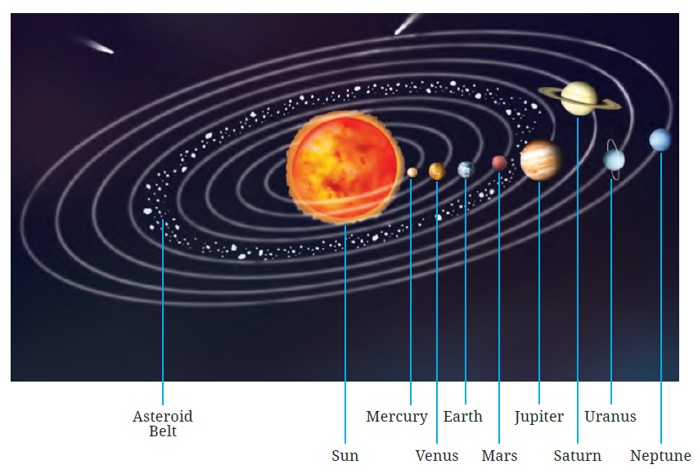
6. An artist’s representation of the Solar System is given in Fig. 12.12. Is the order of the planets correct? If not, write the correct order in the boxes in the figure.
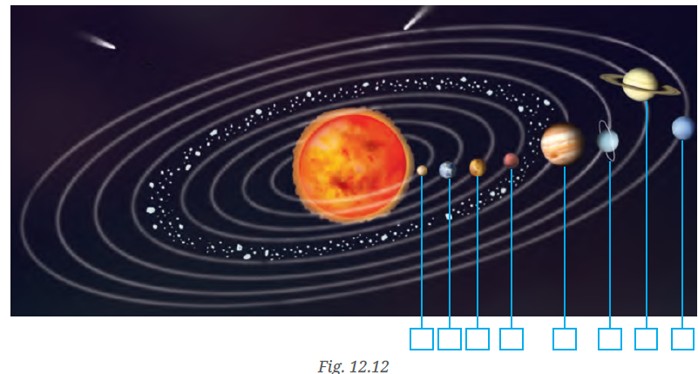
Answer: The order of the planets in the figure is not correct. The correct order from the Sun is: Mercury, Venus, Earth, Mars, Jupiter, Saturn, Uranus, Neptune.
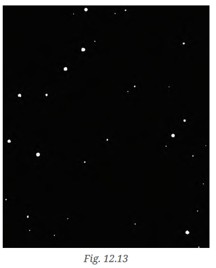
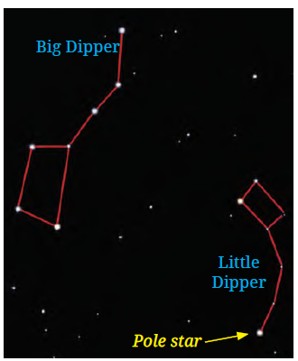
7. A portion of night sky with stars is shown in Fig. 12.13. Look carefully and identify the groups of stars that form the patterns—the Big Dipper and the Little Dipper. Draw lines to connect the stars for these patterns and label them. Also, identify and label the Pole Star. You may refer to Fig. 12.4 for help.
Answer: The Big Dipper, the Little Dipper and the Pole Star are shown below.
8. A portion of the night sky is shown in Fig. 12.14. Draw lines to connect the stars for Orion and label the star Sirius. You may refer to Fig. 12.3.
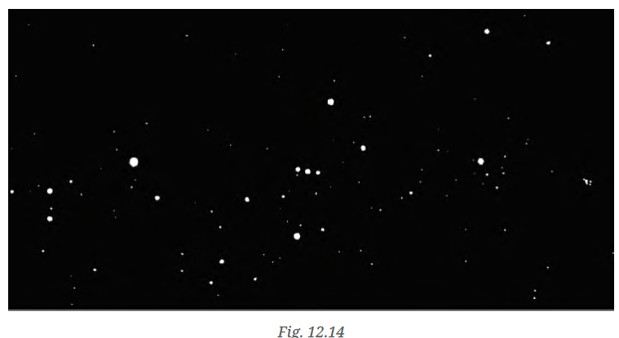
Answer: Orion and the star Sirius are shown below.
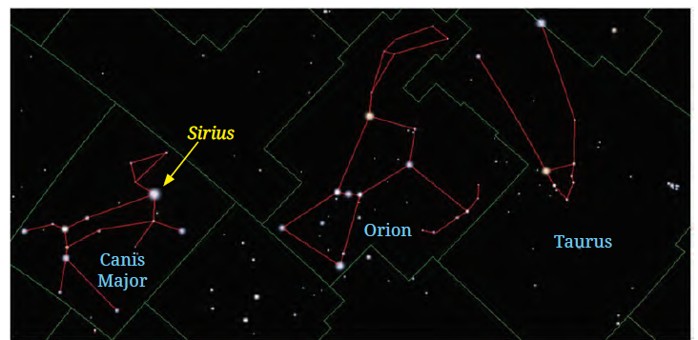
9. You can see stars fading away at dawn and appearing at dusk. During the day we do not see the stars. Explain why.
Answer: Stars fade away at dawn and appear at dusk because of the brightness of the Sun. During the day the sunlight is so bright that it outshines the light from the stars making them invisible. At dusk as the Sun sets and the sky darkens the stars become visible again.
10. During a clear night, try to observe the Big Dipper 3-4 times at an interval of 2 to 3 hours. Also try to locate the Pole Star each time. Does the Big Dipper appear to move? Draw a rough sketch to illustrate this, mentioning the time in each case.
Answer: The big dipper appears to move around the Pole Star due to the rotation of the Earth. Over a few hours, its position changes, making it seems as if it is rotating around the Pole Star.
11. Think about the night sky and write a poem or a story on it.
Answer: Poem
The sky unfolds its velvet dark,
A canvas brushed with silver spark.
Stars like lanterns softly gleam,
Guardians of each midnight dream.
The Moon sails by, a glowing guide,
With silent grace and glowing pride.
Planets wink from far and near,
Telling tales we long to hear.
A comet streaks—a fleeting light,
A wish is made in quiet night.
Beneath it all, we lie and gaze,
Lost in wonder, caught in daze.
For in the sky, both vast and deep,
The universe begins to speak.
A whisper from the stars above—
Of mystery, magic, hope, and love.
Beyond Earth Class 6 Science Chapter 12 NCERT Solutions
We hope these NCERT Solutions for Class 6 Science help students understand the textbook activities, revise important concepts and prepare confidently for their examinations.
Class 6 Science Chapter 12, Beyond Earth, introduces students to the fascinating world of space and the celestial objects found beyond our planet. It explains the Solar System, the Sun, planets, moons, stars and other objects in space. Students also learn about the phases of the Moon, constellations and how the positions of celestial objects help us understand the night sky. The chapter encourages learners to explore the universe and develop an interest in astronomy and space science.
Class 6 Science Chapter 12 – What Will You Learn?
The chapter Beyond Earth helps students understand the objects present in space and the arrangement of different celestial bodies in the universe. It introduces the Solar System and explains how we can observe and identify various objects in the night sky.
The important concepts covered in this chapter are:
- Celestial Objects: Understanding the different natural objects found in space, such as stars, planets, moons, asteroids and comets.
- The Sun: Learning about the Sun as the nearest star to Earth and the main source of light and heat for our planet.
- The Solar System: Exploring the Sun and the eight planets that revolve around it.
- Planets: Learning about the characteristics and order of the eight planets in the Solar System.
- The Moon: Understanding the Moon as Earth’s natural satellite and learning about its surface and movement.
- Phases of the Moon: Exploring why the Moon appears to change its shape during different nights of the lunar cycle.
- Stars and Constellations: Learning how groups of stars form patterns in the night sky and how some constellations can be identified.
- Earth in Space: Understanding Earth’s position in the Solar System and its importance as the planet that supports life.
- Exploring Space: Developing an interest in astronomy and understanding how scientists study celestial objects through telescopes and other instruments.