

Looking for NCERT Solutions for Class 6 Science Curiosity Chapter 5 Measurement of Length and Motion? Here, you will find easy-to-understand answers to all the important questions and activities from the NCERT Class 6 Science textbook. These solutions are prepared in simple language to help students understand the concepts, complete their homework and prepare for examinations.
Class 6 Science Chapter 5 Measurement of Length and Motion NCERT Questions and Answers
Intext Questions
Question 1. Would it be convenient to use the unit metre to measure larger lengths, such as the length of a railway track between two cities, or to measure smaller lengths, such as the thickness of a page of a book? (Page – 83)
Answer: No, it would not be convenient to use the unit metre to measure very large or very small lengths.
OR
Using the metre as a unit of measurement is not always convenient for very large or very small lengths:
- For larger lengths, such as the length of a railway track between two cities, a metre is too small unit. Instead, units like kilometres (1 kilometre = 1000 metres) are more suitable.
- For smaller lengths, such as the thickness of a page in a book, a metre is too large. In this case, units like millimetres (1 millimetre = 0.001 metres) would be more appropriate.
Question: Why are some length-measuring devices made up of flexible materials? (Page – 86)
Answer: Some measuring tools are made of flexible materials so they can bend around curved or uneven surfaces. They’re also easy to roll up, carry, and store, making them useful for measuring long or tricky shapes.
OR
Flexible length measuring devices are often made of materials like cloth or metal tapes because they offer several advantages over rigid rulers or yardsticks:
- They are easy to carry and store.
- They can be bent or curved to measure irregular shapes or surfaces.
- Many flexible measuring devices are made from durable materials that can withstand wear and tear.
Question: Padma was travelling by bus to visit her grandparents in Delhi. She was eager to reach Delhi and was reading the kilometre stones on the side of the road. On one of the kilometre stones, it was written Delhi 70 km (Figure 5.12). Further on, the next kilometre stone read ‘Delhi 60 km’. Each kilometre stone indicated to her that she was getting closer to her grandparents’ house. These kilometre stones indicated her distance from Delhi. So, Delhi is the reference point in this situation. What do such kilometre stones indicate? How could Padma conclude that she was getting closer to her destination? (Page – 89)
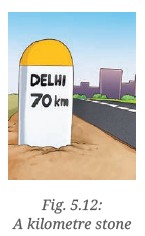
Answer: Kilometre stones indicate the distance from a specific reference point, which in this case is Delhi. Each stone tells the traveller how far they are from a particular location. As Padma was travelling and reading these kilometre stones, she noticed that the distance to Delhi was decreasing-from 70 km to 60 km. This decrease in the number of kilometre stones indicated that she was getting closer to her destination.
Question: Does this mean that the position of Padma; with respect to the reference point, is changing with time? When does the position of an object change with respect to a reference point? Does it change when an object is moving? (Page – 89)
Answer: Yes, the position of Padma with respect to the reference point (Delhi) is changing with time.
The position of an object changes with respect to a reference point when the object is in motion. Motion refers to the change in position of an object with time.
Question: Suppose you are travelling on a ship which is moving at a constant speed along a straight line on a calm sea. Suppose there is no window on the ship. Is there any way that you can determine whether the ship is moving or is stationary? (Page – 91)
Answer: Yes, there are ways to determine if the ship is moving even without a window.
Here are a few methods:
- Vibrations: If the ship is moving, we might feel vibrations.
- Engine sound: When a ship moves, it’s engine make sound.
Let us enhance our learning (Exercise Questions – Page 97)
Question 1. Some lengths are given in Column I of Table 5.5. Some units are given in Column II. Match the lengths with the units suitable for measuring those lengths.
Table 5.5
| Column I | Column II |
| Distance between Delhi and Lucknow | centimetre |
| Thickness of a coin | kilometre |
| Length of an eraser | metre |
| Length of school ground | millimetre |
Answer: The correct table is shown below:
| Column I | Column II |
| Distance between Delhi and Lucknow | kilometre |
| Thickness of a coin | millimetre |
| Length of an eraser | centimetre |
| Length of school ground | metre |
Question 2. Read the following statements and mark True (T) or False (F) against each.
(i) The motion of a car moving on a straight road is an example of linear motion. [ ]
(ii) Any object which is changing its position with respect to a reference point with time is said to be in motion. [ ]
(iii) 1 km = 100 cm [ ]
Answer:
(i) True (T)
(ii) True (T)
(iii) False (F)
1 km = 10,000 cm
Question 3. Which of the following is not a standard unit of measuring length?
(i) millimetre
(ii) centimetre
(iii) kilometre
(iv) handspan
Answer: (iv) handspan
Question 4. Search for the different scales or measuring tapes at your home and school. Find out the smallest value that can be measured using each of these scales. Record your observations in a tabular form.
Answer:
| Type of Scale, Tape, Device | Smallest Value of Measurement |
| 15 cm Scale | 1 mm |
| Flexible Tape | 1 mm, 1 inch |
| Long Tape Roll | 1 cm, 1 inch |
| Vernier Calliper (from School Lab) | 0.1 mm |
| Screw Gauge (from School Lab) | 0.01 mm |
Question 5. Suppose the distance between your school and home is 1.5 km. Express it in metres.
Answer: We know that 1 km = 1000 m
∴ 1.5 km = 1.5 × 1000 = 1500 metres
So, the distance between my school and home is 1500 m.
Question 6. Take a tumbler or a bottle. Measure the length of the curved part of the base of glass or bottle and record it.
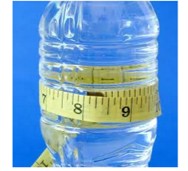
Answer: A flexible measuring tape, such as a tailor’s tape is suitable for measuring the length of the curved part of the base of glass or bottle. The length will depend on the specific tumbler or bottle we choose.
Question 7. Measure the height of your friend and express it in:
(i) metres
(ii) centimetres and
(iii) millimetres.
Answer: We know that,
1 m = 100 centimetres (cm) and,
1 cm = 10 millimetres (mm)
So, if the height of the friend is 1.35 metres.
(i) Metres = 1.55 m
(ii) Centimetres = 1.35 × 100 = 135 cm
(iii) Millimetres = 1350 × 10 = mm
Question 8. You are given a coin. Estimate how many coins are required to be placed one after the other lengthwise, without leaving any gap between them, to cover the whole length of the chosen side of a notebook. Verify your estimate by measuring the same side of the notebook and the size of the coin using a 15-cm scale.
Answer: Diameter of the coin = 2 cm
Length of the notebook = 30 cm
∴ Number of coins required = 30 ÷ 2 = 15
Question 9. Give two examples each for linear, circular and oscillatory motion.
Answer:
- Linear motion: A car moving on a straight road, an object dropped from height.
- Circular motion: Motion of ceiling fan, movement of satellite around earth.
- Oscillatory motion: A swinging pendulum, vibrating strings of guitar.
Question 10. Observe different objects around you. It is easier to express the lengths of some objects in mm, some in cm and some in m. Make a list of three objects in each category and enter them in the Table 5.6.
Table 5.6: Sizes of objects around us
| Size | Objects |
| mm | |
| cm | |
| m |
Answer:
| Size | Objects |
| mm | (i) thickness of a coin (ii) diameter of a small screw (iii) thickness of wire |
| cm | (i) length of a pencil (ii) height of a water bottle (iii) length of a smartphone |
| m | (i) height of a building (ii) width of a playground (iii) height of a man |
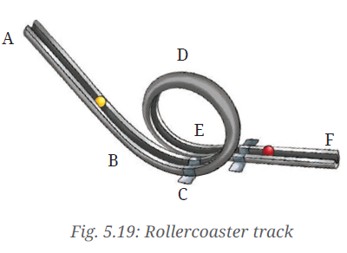
Question 11. A rollercoaster track is made in the shape shown in Fig. 5.19. A ball starts from point A and escapes through point F. Identify the types of motion of the ball on the rollercoaster and corresponding portions of the track.
Answer:
From point A to B: Linear motion
From point B to C: Circular motion
From point C to D: Circular motion
From point D to E: Circular motion
From point E to F: Linear motion
Question 12. Tasneem wants to make a metre scale by herself. She considers the following materials for it—plywood, paper, cloth, stretchable rubber and steel. Which of these should she not use and why?
Answer: Tanseem shouldn’t use the following materials:
- Stretchable rubber: It can be stretched easily and cannot give precise measurements.
- Cloth: It can be stretched and wrinkled which make it unfit for measurement.
- Paper: It is very fragile, deform with moisture and tear easily.
Plywood and steel are more suitable as they maintain consistent lengths.
Question 13. Think, design and develop a card game on conversion of units of length to play with your friends.
Answer: Create cards with different lengths and corresponding units (mm, cm, m, km). Each card can have a length in one unit and players must match it to its equivalent in another unit.
For example, a card with “100 cm” would match with “1 m”.
We hope these NCERT Solutions for Class 6 Science help students understand the textbook activities, revise important concepts and prepare confidently for their examinations.
Measurement of Length and Motion Class 6 Science Chapter 5 NCERT Solutions
Class 6 Science Chapter 5, Measurement of Length and Motion, introduces students to the importance of measuring distances and understanding the movement of objects. It explains how standard units are used to measure length accurately and why proper measuring instruments are necessary. Students also learn about different types of motion, such as straight-line, circular and periodic motion, through simple examples from everyday life.
In this article, we have provided Class 6 Science Chapter 5 NCERT question answers. All the answers are explained in a clear and student-friendly manner so that learners can understand the concepts without difficulty. Whether you are looking for NCERT textbook solutions or revising the chapter before an examination, these solutions will help you study more effectively.
Class 6 Science Chapter 5 – What Will You Learn?
The chapter Measurement of Length and Motion helps students understand how distances are measured and how objects move from one place to another. It introduces standard units of length and explains the importance of accurate measurement in science and everyday activities.
The important concepts covered in this chapter are:
- Measurement of Length: Understanding the meaning of length and why measurement is important in our daily lives.
- Need for Standard Units: Learning why standard units are necessary to ensure accurate and uniform measurements.
- Units of Length: Understanding commonly used units such as millimetre, centimetre, metre and kilometre.
- Measuring Instruments: Learning how to use rulers, metre scales and measuring tapes to measure different objects and distances.
- Correct Measurement: Understanding how to measure length properly by placing the measuring scale correctly and avoiding common errors.
- Motion: Learning what motion is and how we identify whether an object is moving or at rest.
- Types of Motion: Exploring different types of motion, including straight-line motion, circular motion and periodic motion.
- Motion in Everyday Life: Identifying different types of motion in objects such as vehicles, swings, fans and wheels.