

NCERT Solutions for Class 7 English Poorvi Chapter 15 Rani Abbakka are provided here with simple and easy-to-understand answers. This graphic story is a part of Unit 5: Bravehearts in the NCERT English textbook Poorvi. It explores Rani Abbakka’s courage, leadership, and resistance to Portuguese expansion on India’s western coast. These NCERT Solutions for Class 7 help students understand the main ideas, complete textbook exercises, improve their language skills, and prepare for school examinations.
Rani Abbakka Questions and Answers Class 7 English Poorvi Chapter 15
Let us do these activities before we read (Page No. 206)
I. Solve the riddle given below and share your answer with your classmates and the teacher.
She was a queen who led the fight,
She fought for her country and her right.
With a shining sword in her hand,
Her son on her back in a cloth band
Remembered as a warrior grand,
She died defending her beloved Motherland.
1. Who is she?
Answer: She is Rani Abbakka. She was the brave queen of Ullal who fought against the Portuguese and defended her land with courage.
2. Think of any other women warriors who made a significant contribution to India’s struggle for Independence. Share your answers with your classmates and the teacher.
Answer: Some other women warriors include Rani Lakshmibai, Rani Chennamma of Kittur, Kanaklata Barua, Captain Lakshmi Sahgal, and Jhalkari Bai. They bravely fought for India’s freedom and inspired future generations.
OR
Other courageous women warriors who contributed to India’s freedom struggle include Rani Lakshmibai, who fought bravely in the 1857 revolt; Rani Chennamma of Kittur, an early freedom fighter; Kanaklata Barua from Assam; and Jhalkari Bai, who fought alongside Rani Lakshmibai. These women displayed exceptional courage and inspired many.
Let us discuss (Page No. 213)
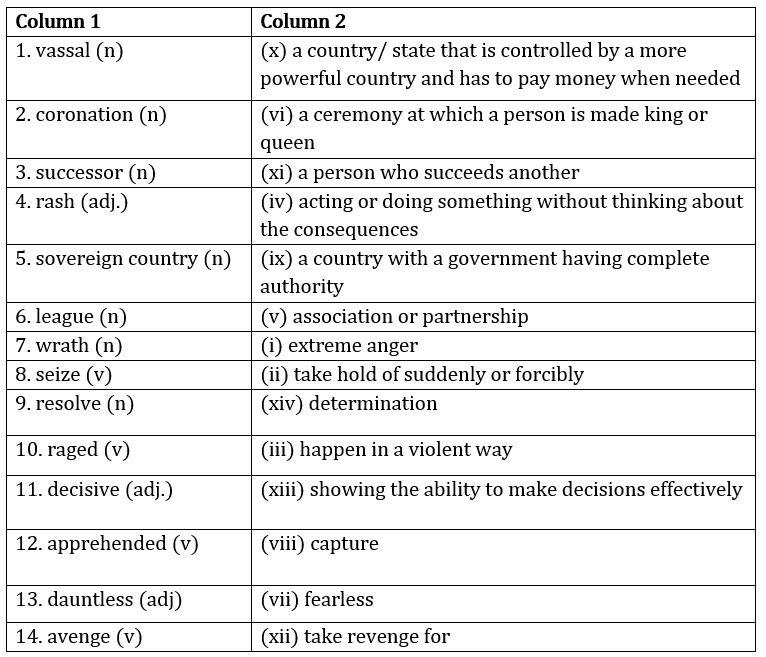
I. Match the words in Column 1 with their meanings in Column 2. Share your answers with your classmates and the teacher.
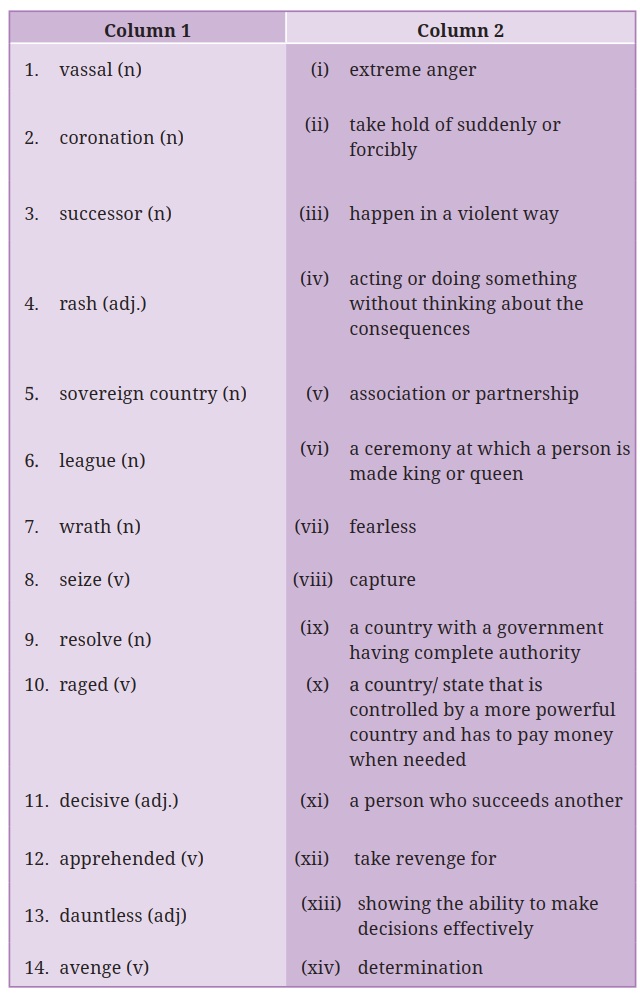
Answer:
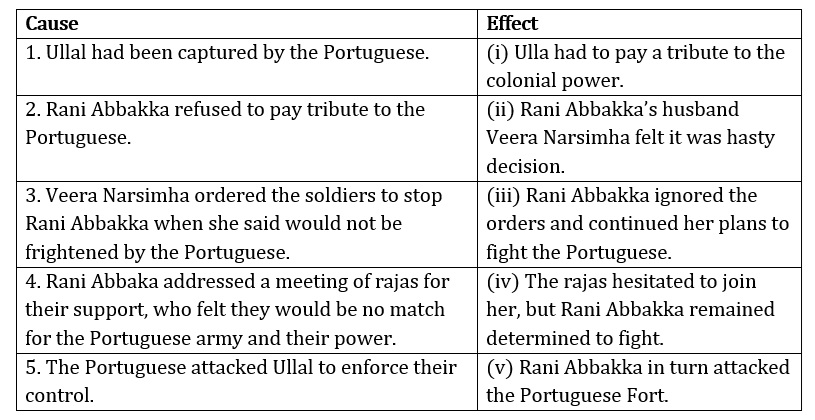
II. Complete the table given below based on your understanding of the story. An example has been done for you. Share your answers with your classmates and the teacher.
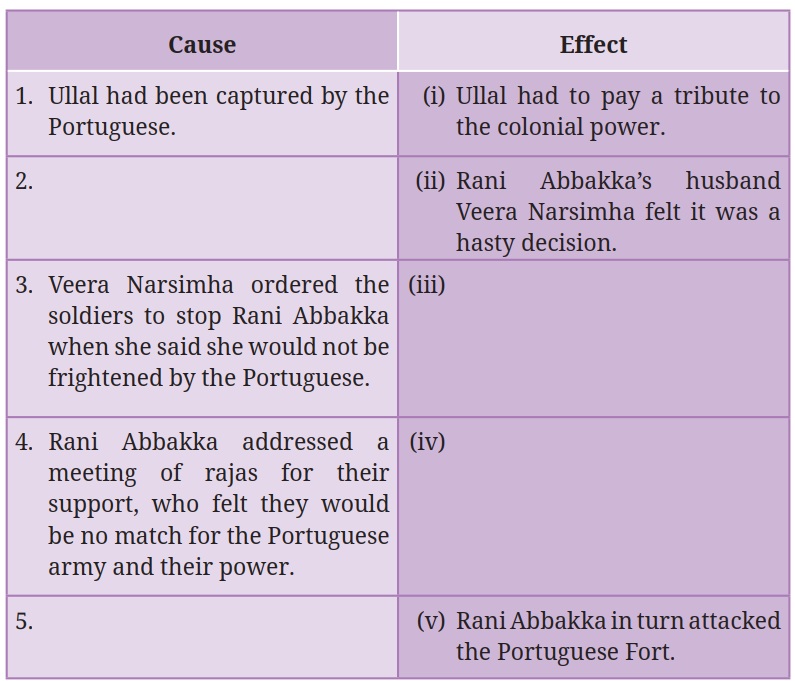
Answer:
Let us think and reflect (Page No. 214)
I. Read the extract given below and answer the questions that follow.
Portuguese envoy: Our Governor has sent me to remind you that the annual tribute from Ullal is long overdue and…
Rani Abbakka: We are a sovereign country. We don’t pay tribute to Portugal. And we don’t take orders from the Portuguese!
Portuguese envoy: Your Majesty, you will regret your stand.
Abbakka ordered merchant ships to be built and in alliance with the Zamorin of Kozhikode, she defied the Portuguese and established a hugely profitable trading relation with Arabia.
1. What does the word ‘tribute’ mean in this context?
Answer: In this context, ‘tribute’ means a payment or tax that Ullal was expected to give to the Portuguese as a sign of their control.
2. Complete the sentence with a suitable reason. Rani Abbakka says, “We are a sovereign country” because ____________.
Answer: Rani Abbakka says, “We are a sovereign country” because Ullal was a free and self-governing kingdom, not controlled by the Portuguese.
3. Identify whether the following statement is true or false. The Portuguese envoy threatened Rani Abbakka. (Page 215)
Answer: True. The Portuguese envoy did threaten Rani Abbakka when he said, “Your Majesty, you will regret your stand.”
4. Choose a word given in brackets to replace the underlined word. “… she defied the Portuguese and established a hugely profitable trading relation with Arabia.” (defeated/disobeyed)
Answer: The word to replace ‘defied’ is ‘disobeyed’.
5. Choose the option that lists the qualities of Rani Abbakka, based on this extract.
(i) bold (ii) thoughtful (iii) capable (iv) generous (v) determined
A. (i), (ii), and (v)
B. (ii), (iii), and (iv)
C. (i), (iii), and (v)
D. (ii), (iv), and (v)
Answer: C. (i), (iii), and (v)
Rani Abbakka was bold in refusing the Portuguese, capable in building trade relations, and determined to defy foreign control.
II. Answer the following questions. (Page 215)
1. Rani Abbakka spoke to her mother on her deathbed. How might these words have made her mother feel?
Answer: Rani Abbakka’s words must have filled her mother with pride and a sense of peace. Even on her deathbed, she would feel relieved knowing that Abbakka was determined, bold, and ready to protect their land and people with honour.
2. What does the support of the people of Ullal and the soldiers for Rani Abbakka suggest about their mindset?
Answer: The support of Ullal’s people and soldiers shows they were courageous, loyal, and strongly united under Rani Abbakka’s leadership. They believed in her ability to protect their kingdom and resist foreign control. Their willingness to fight alongside her reflects a fearless mindset and a strong sense of pride in defending their motherland.
3. How might the people of Ullal have felt when the mighty Portuguese were defeated? (Page 215)
Answer: The people of Ullal would have felt proud, relieved, and inspired. Defeating the powerful Portuguese might have gave them confidence and strengthened their faith in Rani Abbakka’s courage and leadership.
4. Why do you think Rani Abbakka’s victory against the Portuguese would have inspired other rulers to go against a foreign power
Answer: Rani Abbakka’s victory against the Portuguese showed that courage, unity, and strong leadership could defeat even mighty foreign powers. Her success would have inspired other rulers to believe in their strength and rise against foreign dominance.
Let us learn (Page No. 215)
I. Study the following words from the text.
seize, sovereign, their, soldiers.
The spelling of the given words have ‘ei’ and ‘ie’ in them.
Spelling tip: ‘i’ before ‘e’ except after ‘c’.
For example: receive, deceive.
Now, fill in the blanks with ‘ie’ or ‘ei’ for the following words.
1. c___ling 2. bel___ve 3. th___f 4. ach___ve 5. perc___ve 6. prot___n 7. soc___ty 8. sh___ld 9. w___ght 10. fr___nd
Answer: 1. c_ei_ling – ceiling
2. bel_ie_ve – believe|
3. th_ie_f – thief
4. ach_ie_ve – achieve
5. perc_ei_ve – perceive
6. prot_ei_n – protein
7. soc_ie_ty – society
8. sh_ie_ld – shield
9. w_ei_ght – weight
10. fr_ie_nd – friend
II. Study the highlighted word in the following sentence from the text. (Page 216)
…; and Bangadi too may have to face their wrath.
Was the initial letter ‘w’ pronounced? There are many words in the English language where certain letters are not pronounced but are spelt. They are called ‘silent letters’.
For example: campaign, knowledge, pneumonia, honour, calm. Now, find more words with silent letters.
Answer: The initial ‘w’ in ‘wrath’ is not pronounced; it is a silent letter. More words with silent letters include:
- doubt (silent ‘b’)
- wrist (silent ‘w’)
- knight (silent ‘k’)
- debt (silent ‘b’)
- listen (silent ‘t’)
III. Read the following expressions from the text.
laughing stock, last laugh.
Use the dictionary page given below to find the meanings of the following. burst out laughing, don’t make me laugh, laugh until you cry, have a good laugh. Now, use these expressions in sentences of your own.
Answer:
- burst out laughing: Suddenly start laughing.
Sentence: When Rani Abbakka tricked the Portuguese, her soldiers burst out laughing at their confusion. - don’t make me laugh: Used to show something is impossible or ridiculous.
Sentence: The Portuguese thought they could scare Rani Abbakka—don’t make me laugh! - laugh until you cry: Laugh so hard that tears come to your eyes.
Sentence: The people of Ullal laughed until they cried when they heard how Rani Abbakka outsmarted the enemy. - have a good laugh: Find something amusing.
Sentence: After the victory, Rani Abbakka and her soldiers had a good laugh about the Portuguese’s failed attack.
IV. Read the following dialogues from the text.
- Rani Abbakka said, “I will make them pay for this.”
- The merchants said to the Arabians, “Visit us again, brother.”
The given sentences are the direct words of the speaker; hence, they are in direct speech.
The reported forms or indirect forms of speech for the given sentences are:
- Rani said that she would make them pay for that.
- The merchants told the Arabian brothers to visit them again.
While reporting direct speech to indirect speech, we make certain modifications related to time, place, and person.
- Time (Tense): Verbs are typically shifted back from a present tense to a past form in reported speech to reflect the change in time.
- Place (Adverbs of Place): Words indicating place are adjusted to fit the new context.
- Person: Pronouns and subjects are modified to align with the perspective of the reporter.
Changes made with reference to time (tense)
| Direct Speech | Indirect Speech |
| Present Tense | Past Tense |
| Past Tense | Past Perfect Tense |
| Past Perfect Tense | No change |
| Present Progressive Tense | Past Progressive Tense |
| Past Progressive Tense | Past Perfect Progressive Tense |
| Past Perfect Progressive Tense | No change |
| Present Perfect Tense | Past Perfect Tense |
| Present Modal | Past Modal |
| Past Modal | No change |
- Changes made in pronouns
| Direct Speech | Indirect Speech |
| I | she, he |
| you (singular) | she, he |
| you (plural) | they |
| we | they |
| my | her, his |
| our | their |
| your | her, his, their |
| me | her, him |
| us | them |
| mine | hers, his |
| ours | theirs |
| yours | hers, his, theirs |
- Changes in time and place expressions
| Direct Speech | Indirect Speech |
| now | then |
| ago | before |
| today | that day |
| tomorrow | the day after/the following day |
| yesterday | the day before/the previous day |
| next week/month/year | the following week/month/year |
| here | there |
| this | that |
| these | those |
Rewrite the following sentences in direct speech to indirect speech. Remember to make the necessary changes.
1. The teacher said, “Women of valour have made significant contributions throughout history.”
The teacher remarked that ___________
Answer: The teacher remarked that women of valour had made significant contributions throughout history.
2. “I enjoy reading historical novels,” said Smitha.
Answer: Smitha said that she enjoyed reading historical novels.
3. The captain said to the coach, “Our team won the championship last year.”
Answer: The captain told the coach that their team had won the championship the previous year.
4. The class teacher said, “Please turn off the lights when you leave.”
Answer: The class teacher requested that they turn off the lights when they left.
5. “Finish the work before dinner,” said mother to Ravi.
Answer: Mother advised Ravi to finish the work before dinner.
6. The vet said to the pet owner, “Take the dog for a walk.”
Answer: The vet instructed the pet owner to take the dog for a walk.
V. Read the conversation between the Captain and the team.
Captain: We need to focus on our strategy for the final match.
Player: I have some ideas on how we can improve our strategy.
Captain: Make sure to share those ideas with the team during practice.
Complete the following paragraph by transforming the dialogue in the indirect form of speech.
The Captain remarked that 1. ________________________________________.
To which one of the players replied that 2. ___________________________.
The Captain advised the player to 3. _______________________________
Answer: The Captain remarked that 1. they needed to focus on their strategy for the final match.
To which one of the players replied that 2. he had some ideas on how they could improve their strategy.
The Captain advised the player to 3. share those ideas with the team during practice.
Let us write (Page No. 221)
India’s past was heroic, and at present, the pace of her development is inspiring. Women play a significant role in it. These women are around us, inspiring us all the time. With these thoughts, write a conversation between two students, Pratap and Tarana, discussing the role played by women in forming India’s identity as a strong nation.
Answer:
Pratap: Tarana, I have a lot of respect for women like Rani Abbakka, who fought bravely against the Portuguese to protect Ullal.
Tarana: I believe in the capabilities of women. Did you know Rani Lakshmibai led her army in the 1857 revolt against the British?
Pratap: Yes, their courage shaped India’s identity as a fearless nation. Women like Indira Gandhi also strengthened India as a global leader.
Tarana: Absolutely! Modern women like Kalpana Chawla, who became an astronaut, inspire us to aim high and contribute to India’s progress.
Pratap: I admire how women in the Armed Forces, like Captain Lakshmi Sahgal, fought for freedom and now serve the nation.
Tarana: And women like Kiran Bedi, who reformed policing, show how women lead with strength and vision.
Pratap: These women prove that India’s strength comes from their determination and leadership.
Tarana: I agree, Pratap. Their contributions make India a proud and powerful nation today.
Class 7 English Poorvi Chapter 15 NCERT Solutions
The graphic story Rani Abbakka introduces Rani Abbakka of Ullal and her determination to defend her kingdom. Students learn about her leadership and resistance to Portuguese power. The combination of pictures and dialogue brings the events to life and highlights her courage in facing a powerful opponent.
Students also explore the values of independence, strategic thinking, and commitment to one’s people. The chapter helps them interpret visual details, follow historical events, and explain how the queen’s actions make her an inspiring figure of resistance.