

NCERT Solutions for Class 7 English Poorvi Chapter 2 Try Again are provided here with simple and easy-to-understand answers. This poem is a part of Unit 1: Learning Together in the NCERT English textbook Poorvi. It explores the importance of perseverance, patience, and continued effort when facing difficulties. These NCERT Solutions for Class 7 help students understand the main ideas, complete textbook exercises, improve their language skills, and prepare for school examinations.
Try Again Questions and Answers Class 7 English Poorvi Chapter 2
Let Us do these activities before we read (Page 16)
Question: Who inspires you to do your best?
Answer: My mother inspires me to do my best. She works hard, supports me in everything I do, and always encourages me to stay confident. Her determination and positive attitude motivate me to improve myself every day.
Let us discuss (Page 19)
I. Complete the summary of the poem by filling in the blanks with suitable words from the text given in the box below. Share your answers with the teacher.

Answer: The poem, written in a narrative style, tells the story of King Bruce of Scotland, who was feeling 1. low after failing multiple times to achieve something 2. great for his people. In a moment of 3. despair, he observed a spider trying to reach its web high above. The spider 4. tried every time it fell after getting close to its goal. It made nine 5. attempts and finally succeeded. The king said that the spider had 6. conquered and so would he. Inspired by the spider’s determination, KingBruce decided to 7. strive. When he 8. mounted this time, he ultimately succeeded.
II. Complete the following sentences suitably.
Answer: 1. We can say that the poet uses the narrative style because the poem tells a story about King Bruce and the spider in a clear, sequential way.
2. The central idea of the poem is that we must never give up. Determination and repeated efforts lead to success.
III. Pick three examples from the poem for each of the following:
1. lines that describe the spider’s efforts
Answer: (i) It soon began to cling and crawl
Straight up with strong endeavour.
(ii) Up, up it ran, not a second to stay,
To utter the least complaint.
(iii) Steadily, steadily, inch by inch,
Higher and higher he got.
2. alliteration (the repetition of the same consonant sounds at the beginning of closely connected words)
(i) cling and crawl
(ii) slippery sprawl
(iii) defied despair
IV. Why does the poet repeat the following words or phrases in the poem? tried and tried; steadily, steadily; up, up
Answer: The poet repeats phrases like tried and tried, steadily, steadily, and up, up to emphasize the spider’s continuous effort and determination to reach its web despite falling many times.
V. Fill in the blanks by choosing the correct answer from within the brackets.
1. The rhyme scheme of the poem is ____________. (AABB/ ABBA/ ABAB)
Answer: AABB
2. ‘Bravo’ is an example of ____________. (conjunction/ interjection/ adjective)
Answer: Interjection
3. The poet uses ‘twas and ‘tis for the sake of ____________. (rhythm/ rhyme/ contraction)
Answer: contraction
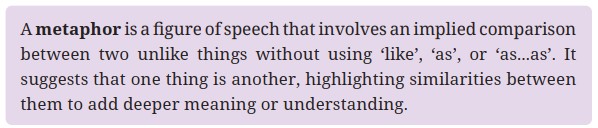
VI. The spider’s climbing is compared to King Bruce’s own struggles. Just as the spider repeatedly attempts to reach its web, Bruce is trying to achieve a great deed for his people. This poetic device is called metaphor. It strengthens the poem’s message about perseverance—keep trying till we succeed. (Page 10)
1. Read the following sentences and identify metaphors and similes. Write M for metaphor and S for simile.
Answer:
(i) He ran as fast as a cheetah. (S)
(ii) The world is a stage. (M)
(iii) The night was as dark as coal. (S)
(iv) He sang like an angel. (S)
(v) Her voice was music to his ears. (M)
(vi) The classroom was a zoo. (M)
(vii) The baby slept like a log. (S)
(viii) Her smile was as bright as the sun. (S)
(ix) The lake was a mirror, reflecting the sky. (M)
2. Read the following sentences and transform the similes to metaphors and metaphors to similes.
(i) Knowledge spreads like the branches of a mighty tree.
Knowledge is a spreading branch of a mighty tree.
(ii) His courage was a beacon, guiding us through the storm.
• His courage was as bright as a beacon guiding us through the storm.
• His courage was like a beacon guiding us through the storm.
(iii) The book was a treasure chest, filled with endless adventures.
Answer: Simile: The book was like a treasure chest filled with endless adventures.
(iv) Her laughter was a melody that brightened the darkest days.
Answer: Simile: Her laughter was like a melody that brightened the darkest days.
(v) The mountain stood as a guard, watching over the valley below.
Answer: Metaphor: The mountain was a guard watching over the valley below.
(vi) The night was like a velvet cloak, wrapping the world in mystery.
Answer: Metaphor: The night was a velvet cloak wrapping the world in mystery.
(vii) Her thoughts were like butterflies in a summer meadow.
Answer: Metaphor: Her thoughts were butterflies in a summer meadow.
Let us think and reflect (Page 21)
I. Read the extracts given below and answer the questions that follow.
1. He flung himself down in low despair,
As grieved as man could be;
And after a while he pondered there,
“I’ll give it all up,” said he.
Now just at that moment a spider dropped,
With its silken, filmy clue;
(i) Select the phrase which shows the physical expression of the King’s emotional state.
Answer: The phrase “He flung himself down in low despair” shows the physical expression of the King’s emotional state.
(ii) Why does the poet use the word ‘low’ before despair?
Answer: The poet uses the word ‘low’ before despair to show the depth of the king’s sadness. It emphasizes how discouraged and hopeless he feels after failing many times.
(iii) Choose the correct option to complete the sentence.
In the line, ‘And after a while he pondered there’, the word ‘pondered’ means _____________________.
1. paused
2. thought
3. noticed
4. rested
Answer: 2. thought
(iv) Choose the correct option from the words given in the brackets.
The phrase ‘silken filmy clue’ creates an image of something that is _____________________ (long and light/very delicate and soft).
Answer: very delicate and soft.
2. “…when it toils so hard to reach and cling, And tumbles every time.”
But up the insect went once more,
Ah me! ‘tis an anxious minute;
He’s only a foot from his cobweb door,
Oh say, will he lose or win it?
(i) Choose the correct option to complete the analogy.
toil: hard::_______________: _______________
A. roll: tumble
B. tumble: circle
C. compress: roll
D. jump: tumble
Answer: A. roll: tumble.
(ii) List any two characteristics of the spider highlighted in the line, ‘But up the insect went once more’.
Answer: Determination and perseverance are the two characteristics of the spider highlighted in the line “But up the insect went once more”.
(iii) Choose the correct option to complete the sentence.
The expression ‘Ah me!’ in the extract indicates a sense of _______________.
A. happiness
B. stress
C. relief
D. loneliness
Answer: B. stress
(iv) Complete the sentence with an appropriate reason.
Readers are able to relate to this extract because ____________.
Answer: Readers are able to relate to this extract because just like the king and the spider they also face failures in life and understand how difficult it is to keep trying again and again.
II. Answer the following questions. (Page 22)
1. How does the first stanza help in setting the mood of the poem?
Answer: The first stanza helps set a sad and discouraging mood. It shows King Bruce feeling hopeless after failing many times. His grief and decision to give up create a serious and emotional beginning.
2. Describe how King Bruce’s attitude changes from the beginning towards the end of the poem.
Answer: At the beginning of the poem, King Bruce feels hopeless and wants to give up after failing many times. But after watching the spider try again and again, he becomes inspired. By the end, his attitude changes from despair to determination, and he decides to try once more with confidence.
3. The poet describes every action of the spider in great detail. What does this tell us about his attitude towards the spider? (Page 22)
Answer: The poet’s detailed description of every action of the spider shows his admiration and respect for the spider’s effort. The poet views the spider as a small but strong example of courage and persistence. He uses it as a source of inspiration for King Bruce and the readers.
4. How does the spider inspire us to overcome despair and not give up?
Answer: The spider inspires us by showing that success comes through repeated efforts. Even after falling many times, it keeps trying until it reaches its web. Its determination teaches us that we should not give up because persistence leads to success.
5. The poem teaches us that failures are stepping stones to success. Explain.
Answer: The poem shows that every failure brings us closer to success. King Bruce fails many times, and the spider also falls again and again. But instead of giving up, the spider keeps trying until it finally reaches its web. This shows that each failure is a lesson that brings us closer to success.
6. The spider’s journey tells us that anyone can be a source of inspiration in our lives. Elaborate. (Page 22)
Answer: The spider’s journey shows that inspiration can come from the smallest and simplest things around us. Even though the spider is tiny, its determination, courage, and repeated efforts motivate King Bruce to try again.
Let us learn (Page 22)
I. Write the opposites of the following words taken from the poem.
1. up × _____________
2. fast × _____________
3. glad × _____________
4. win × _____________
5. succeed × _____________
Answer:
1. up × down
2. fast × slow
3. glad × sad
4. win × lose
5. succeed × fail
II. Choose the correct meaning of the underlined words in the following sentences from the box given below. Frame sentences of your own for these words.
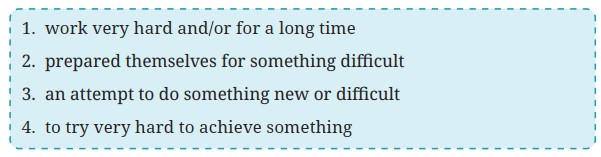
(i) Please make every endeavour to arrive on time.
(ii) Ants toil tirelessly to save food for rainy season.
(iii) We encourage all students to strive to do their best.
(iv) The sailors braced themselves against the strong wind.
Answer:
(i) Endeavour – an attempt to do something difficult.
Sentence: Riya made every endeavour to finish her project before the deadline.
(ii) Toil – work very hard for a long time.
Sentence: Farmers toil in the fields from early morning till sunset.
(iii) Strive – to try very hard to achieve something.
Sentence: Students should strive to improve a little every day.
(iv) Braced – to get ready for hardship or danger
Sentence: The team braced themselves for the final match.
III. The poem uses words that show distance.
For example:
a long way up, inch by inch, higher and higher, half-yard higher
Classify the words or phrases in the box given below based on the distance (far or near) and write in the space provided. You may take the help of a dictionary.

Answer:
| Far | Near |
| Middle of nowhere | Proximity |
| Remoteness | Vicinity |
| Yonder | Adjacent |
| Afar | A stone’s throw |
| Light year | Hairline |
| Farther |
IV. Read the following line from the poem.
‘Twas a delicate thread it had to tread,
Now repeat the lines five to six times. Are you able to say it clearly? Create more tongue twisters of your own.
Answer: Yes, when the line “’Twas a delicate thread it had to tread” is repeated quickly, it becomes difficult to say clearly.
Some of my tongue twisters:
(i) Tiny turtles tiptoe through thick thorns.
(ii) Quick queens quietly quilt quality quilts.
(iii) Seven slippery snakes slid silently south.
Let us listen (Page 24)
I. You will listen to a story about an ant. Read the questions given below and before you listen, guess the answers to these questions. (Transcript for the teacher on pg. 40)
1. What was the ant known for?
(i) determination
(ii) strength
(iii) wisdom
Answer: (i) determination
2. Why was the ant unable to take the roti home?
(i) It was stuck under a rock.
(ii) It was too heavy to carry.
(iii) It was pulled by other ants.
Answer: (ii) It was too heavy to carry.
3. What was the bird doing?
(i) playing with the ant
(ii) searching for food
(iii) picking up leaves
Answer: (iii) picking up leaves
4. How did the bird make the ant feel?
(i) proud
(ii) inspired
(iii) relaxed
Answer: (ii) inspired.
5. How did the fellow ants help?
(i) by advising the ant continuously.
(ii) by standing still near the ant.
(iii) by joining the ant in her efforts.
Answer: (iii) by joining the ant in her efforts.
Let us speak (Page 25)
Narrate a personal experience about a time when you were motivated by someone or something to carry on and never give up. Your perseverance helped you.
Use the following sentence prompts as a guide for your narration. Use as per your topic.
1. Introduction:
- I remember a time when I felt like giving up. It was when…
- There was a moment in my life when I faced a big challenge. It happened when…
2. Describe the challenge:
- The challenge I faced was…
- I was struggling with…
- The problem seemed too big because …
3. Feeling disheartened:
- At first, I felt discouraged and thought about giving up because…
- I didn’t think I could succeed because …
- I felt upset and wanted to leave because…
4. The source of motivation:
- But then, I saw/heard/read about…
- Someone/something inspired me to keep going. It was…
- I remembered the poem… do not quit…
5. Taking action:
- After feeling inspired, I decided to…
- I gathered my strength and…
- With a new sense of willpower, I…
- I asked for help from…
6. The result:
- In the end, I was able to…
- Thanks to standing firm and never giving up, I achieved…
- I felt proud because …
- It was worth it because …
7. Reflection:
- This experience taught me that…
- I learned that perseverance is the key to success…
- Now, I always remember to…
- The lesson I learnt from this is…
Answer:
Never Give Up
I remember a time when I felt like giving up. It was when I was preparing for my Mathematics exam. The challenge I faced was solving word problems. I was struggling with understanding the steps, and the problem seemed too big because my marks were getting lower.
At first, I felt discouraged and thought about giving up because I believed I could never improve. I didn’t think I could succeed and felt upset every time I made mistakes.
But then, my teacher told me stories of students who worked hard and improved slowly. My mother also motivated me and reminded me of the poem “Don’t Quit,” saying success comes to those who keep trying.
After feeling inspired, I decided to practise daily. I gathered my strength and focused more in class. With a new sense of willpower, I cleared my doubts and asked for help whenever needed.
In the end, I was able to score good marks in Maths. Thanks to standing firm and never giving up, I achieved confidence in myself. I felt proud because my hard work brought success. It was worth it because I proved that improvement is possible.
This experience taught me that perseverance is the key to success. Now, I always remember to keep trying, even when things are difficult. The lesson I learnt from this is — never give up on your goals.
Let us write (Page 26)
Q. King Bruce was inspired by the spider that kept on trying till it was successful. Think about the steps you can take to overcome a difficult situation and write them down.
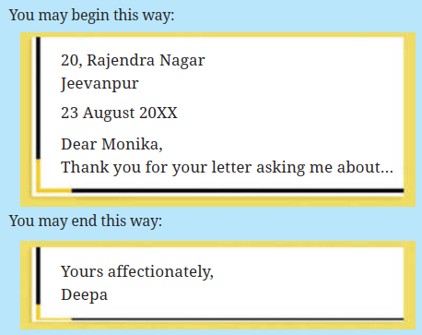
Now, write a letter to your cousin on how you plan to overcome any difficult situation. Also, advise not to quit and persevere. Remember to use transition words like ‘To begin with …,’ ‘Next…,’ ‘After that…,’ ‘Then…,’ ‘Finally…,’ to share the steps of /our plan.
Answer:
20, Rajendra Nagar
Jeevanpur
23 August 2025
Dear Monika,
I hope you are doing well. In your last letter, you asked me how I plan to overcome difficult situations. So, I am writing to share the steps I follow whenever I face a challenge.
To begin with, I try to stay calm and understand the problem clearly. Next, I break the problem into small, manageable steps so it feels less overwhelming. After that, I look for possible solutions and choose the one that seems most practical. Then, I work on it patiently, even if progress is slow. Finally, I remind myself never to quit, because every effort brings me closer to success.
I hope you also follow these steps whenever you face a tough situation. Always remember: do not give up, because success comes to those who keep trying.
Yours affectionately,
Deepa
Class 7 English Poorvi Chapter 2 NCERT Solutions
The poem Try Again encourages readers to keep trying when they do not succeed at first. It presents failure as an experience that can be overcome through practice and determination. Its clear, encouraging message helps students understand why effort matters when learning something new.
Students also explore the central idea, the speaker’s advice, and the language used to inspire confidence. The poem offers opportunities to practise comprehension and express how persistence can help in studies, games, and everyday challenges.