

NCERT Solutions for Class 7 English Poorvi Chapter 4 Animals, Birds, and Dr. Dolittle are provided here with simple and easy-to-understand answers. This story is a part of Unit 2: Wit and Humour in the NCERT English textbook Poorvi. It explores Doctor Dolittle’s ability to communicate with animals and the humorous situations that follow. These NCERT Solutions for Class 7 help students understand the main ideas, complete textbook exercises, improve their language skills, and prepare for school examinations.
Animals, Birds, and Dr. Dolittle Questions and Answers Class 7 English Poorvi Chapter 4
Let us do these activities before we read (Page No. 43)
I. Do you have a pet or a domestic animal? If yes, why? If not, why not? How do people usually spend time with a pet or domestic animal? Share your thoughts with your classmates and the teacher.
Answer: No, I do not have a pet because it is difficult to give proper time and care. People usually spend time with their pets by playing with them, feeding them, taking them for walks, and showing affection. Pets give comfort, joy, and companionship.
II. You must have read stories where animals and birds talk. If you had a chance to communicate with an animal or a bird, who would you like to speak to and why? Share your thoughts with your classmates and the teacher.
Answer: If I had a chance to communicate with an animal, I would like to speak to a parrot because parrots are intelligent and can imitate human speech. I want to know what it thinks about flying and living in trees.
III. If we closely observe the body language of animals and birds, we can understand what they want to tell us. Work in pairs and study the pictures given below. Find out what emotions these animals and birds are trying to convey. Share your observations with your classmates and the teacher.
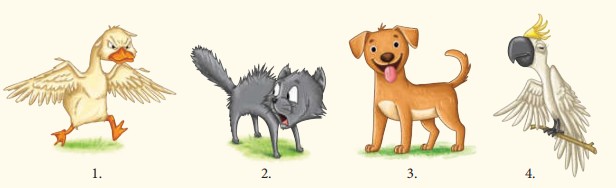
Answer: The emotions revealed by the body language of the animals depicted are shown below:
- The duck seems to be angry.
- The cat appears frightened.
- The dog seems happy
- The bird seems contented.
Let us discuss (Page 46)
I. Complete the following sentence by selecting a suitable reason. The Cat’s-food-Man suggests to Doctor Dolittle that he should become an animal doctor because he believes that Dolittle ________________________.
1. earns less fee by treating human patients
2. enjoys the company of animals as they speak less
3. dislikes spending time with human patients
4. knows more about animals than the local veterinarians
Answer: 4. knows more about animals than the local veterinarians
II. Fill in the blanks by choosing the suitable option given in the brackets.
Doctor Dolittle reacts to Polynesia’s information about animal languages with both excitement and ______ (certainty/curiosity). He rushes to _____ (write/memorise) the bird words she provides and is interested in learning more.
Answer: Doctor Dolittle reacts to Polynesia’s information about animal languages with both excitement and curiosity. He rushes to write the bird words she provides and is interested in learning more.
III. Do you think Doctor Dolittle would be famous as an animal doctor? If yes, why? If not, why not?
Answer: Yes, Doctor Dolittle would be famous as an animal doctor because he can understand and speak the language of animals. It helps him diagnose their problems correctly and treat them easily.
Let us discuss (Page 49)
I. What became a common sight in Puddle by after Doctor Dolittle started treating animals?
1. Humans talking to farm animals
2. Farm animals wearing glasses
3. Farm animals learning bird language
4. Birds riding atop farm animals
Answer: 2. Farm animals wearing glasses
II. What challenges do you think Doctor Dolittle might face if more and more animals come to him for help? How might he overcome these challenges to ensure that he provides good treatment?
Answer: Doctor Dolittle might face challenges such as overcrowding of animals, lack of time to treat each one properly, and difficulty in managing many different species at once.
He can overcome these challenges by creating separate doors and waiting areas for different animals, organising them in order, and continuing to use his special ability to understand their problems quickly.
III. Arrange the following events in correct order according to the story. Two have been done for you. Share your answer with your classmates and the teacher.
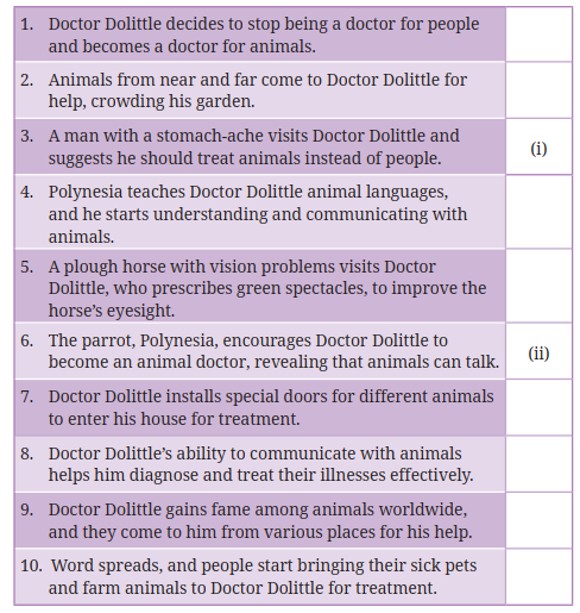
Answer:
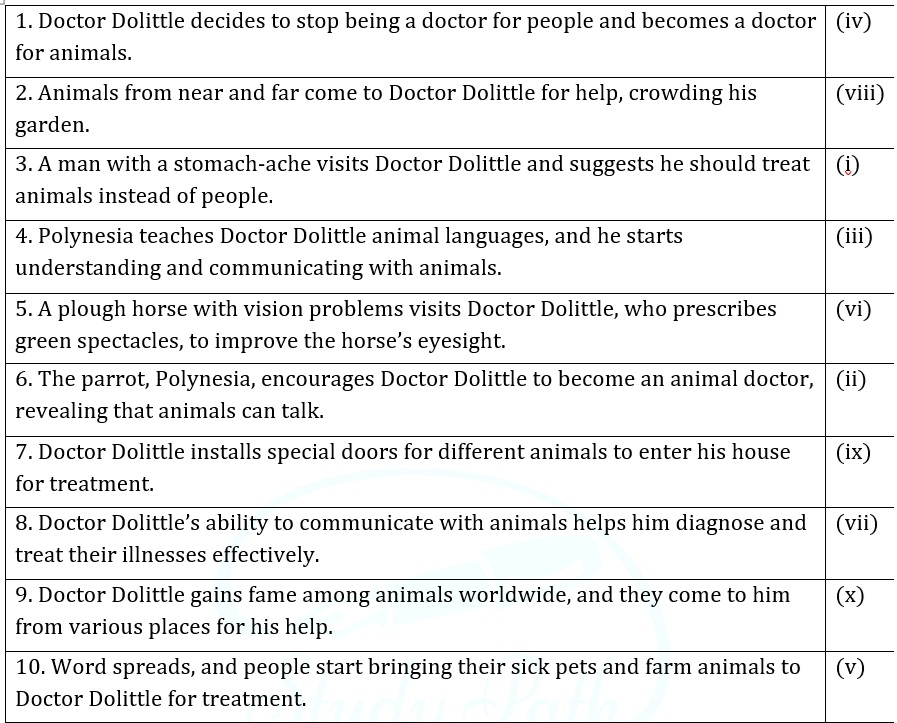
Let us think and reflect (Page No. 50)
I. Read the extracts given below and answer the questions that follow.
1.“If I say, ‘Polly wants a cracker’, you understand me. But hear this: Kaka oi-ee, fee-fee?”
“Good Gracious!” cried the Doctor. “What does that mean?”
“That means, ‘Is the porridge hot yet?’—in bird language.”
“My! You don’t say so!” said the Doctor. “You never talked that way to me before.”
“What would have been the good?” said Polynesia, dusting some cracker crumbs off her left wing. “You wouldn’t have understood me if I had.”
(i) Complete the sentence by choosing the correct option. In the line, “Good Gracious!” cried the Doctor, the expression ‘Good Gracious’ can be replaced by______!
A. bravo
B. gosh
C. alas
D. hurray
Answer: B. gosh
(ii) Why had Polynesia never used bird language with the Doctor earlier?
Answer: Polynesia never used bird language earlier because the Doctor would not have understood it at that time, so it would have been useless to speak that way.
(iii) Identify whether the following statement is true or false. Polynesia had been munching on a food item while talking to Doctor Dolittle.
Answer: True
(iv) How did Doctor Dolittle feel according to the extract?
A. anxious
B. surprised
C. angry
D. relaxed
Answer: B. surprised
2. “I would like a pair like yours,” said the horse—“only green. They’ll keep the Sun out of my eyes while I’m ploughing the field.”
“Certainly,” said the Doctor. “Green ones you shall have.”
“You know, the trouble is, Sir,” said the plough horse as the Doctor opened the front door to let him out—“the trouble is that anybody thinks she can doctor animals— just because the animals don’t complain. As a matter of fact, it takes a much cleverer man to be a really good animal doctor than it does to be a good people’s doctor.”
(i) Choose a word from the extract to complete the analogy. digging: flower bed :: ____ : field
Answer: digging: flower bed :: ploughing : field
(ii) Choose the correct word to complete the sentence. Doctor Dolittle’s attitude in the extract is
A. respectful
B. sentimental
C. understanding
D. careful
Answer: C. understanding
(iii) Complete the sentence with an appropriate reason.
Based on the extract, we can conclude that doctors take animals for granted because ____.
Answer: Based on the extract, we can conclude that doctors take animals for granted because animals cannot complain or express their problems clearly.
(iv) Do you agree with the concluding sentence of the extract? Why/why not?
Answer: Yes, I agree with the concluding sentence because treating animals is harder than treating people. Animals cannot explain their pain, so a doctor must be more skilled, observant, and patient to understand their problems and cure them properly.
II. Answer the following questions. (Page 51)
1. How can we say that Polynesia was a good trainer of animal language?
Answer: Polynesia was a good trainer because she patiently taught Doctor Dolittle the bird language. She helped him understand how animals communicate through sounds and body movements.
2. Explain how Doctor Dolittle gave equal and individual attention to each animal who came to him for treatment.
Answer: Doctor Dolittle gave equal and individual attention to every animal by listening to their problems in their own language and treating them according to their specific needs. He even built separate doors for different animals like a big door for horses and a tiny tunnel for mice. This showed that he cared for every creature and treated them with respect and patience.
3. How does Doctor Dolittle’s readiness to follow the parrot’s advice highlight the importance of listening to different viewpoints? (Page 82)
Answer: Doctor Dolittle’s readiness to follow Polynesia’s advice shows that listening to different viewpoints can open new opportunities. He trusted the parrot, understood her logic, and discovered that animals have their own language. This changed his life and made him a successful animal doctor. It proves that being open-minded can lead to better decisions and new opportunities.
4. Which qualities of Doctor Dolittle made him famous among the animals? Explain with evidence from the text.
Answer: Doctor Dolittle became famous among animals because he was kind, patient, and had the ability to understand their language. He listened carefully to their problems, treated them with care. He even made special doors for different animals to enter his house. These qualities made him loved and respected by all animals.
5. What changes do you think would happen in the world if people suddenly gained the ability like Doctor Dolittle, to understand and communicate with animals? (Page 82)
Answer: If people could suddenly communicate with animals like Doctor Dolittle, many positive changes would happen. Animals could clearly express their needs, illnesses, and feelings, so doctors could treat them properly. People would treat animals more kindly, protect wildlife better, and avoid harming them. However, there might also be disagreements or conflicts between what humans want and what animals need.
Let us learn (Page No. 52)
I. Read the following words from the text.
Cat’s-food-Man, bird language, flowerpots
Are all the words that are combined to form another word written the same way?
Compound words are formed by combining two words of different parts of speech to create a new word that has an entirely new meaning. They are of three types─ hyphenated (Cat’s-food-Man), open compound words (bird language) and closed compound words (flowerpots).
Complete the following table correctly by choosing words from the box given below. An example has been done for you.
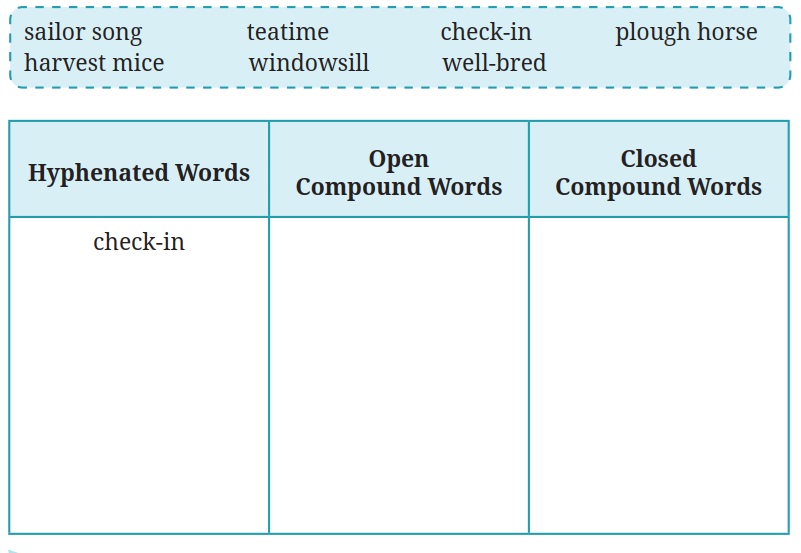
Answer:

II. Create compound words from the table given below.
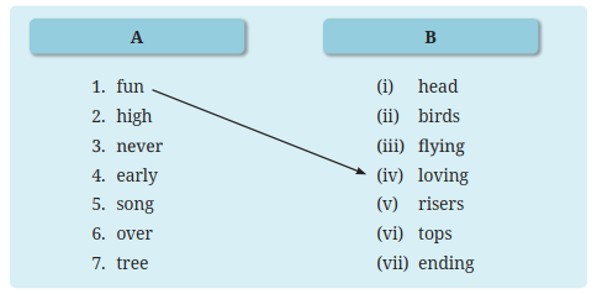
Now, complete the paragraph with suitable compound words from the table.
After being treated by Doctor Dolittle, the A. fun-loving dolphins danced playfully in his sanctuary. The B. _______________ chatter of monkeys echoed through the C. _______________, their ailments cured. D. ______________ eagles soared gracefully E. _______________ their health restored. F. _______________ among the G. _______________ chirped joyfully from the branches. All creatures were happy with Doctor Dolittle’s care
Answer: After being treated by Doctor Dolittle, the A. fun-loving dolphins danced playfully in his sanctuary. The B. never-ending chatter of monkeys echoed through the C. tree-tops, their ailments cured. D. High-flying eagles soared gracefully over-tops, their health restored. E. Song-birds among the F. early-risers, chirped joyfully from the branches. All creatures were happy with Doctor Dolittle’s care.
III. Underline the names of animals that are hidden in the sentences given below. Clues are given within the brackets.
1. Dr. Dolittle was eating oatmeal for his breakfast. (a farm animal)
2. Old ladies began to bring him their pets. (an insect)
3. The author sees the connection between humans and animals. (a farm animal)
4. The three baby dinosaurs are from ice age. (field animal)
5. The patients who came late didn’t know where to go. (ship of the desert)
Answer:
1. Dr. Dolittle was eating oatmeal for his breakfast. (a farm animal)
2. Old ladies began to bring him their pets. (an insect)
3. The author sees the connection between humans and animals. (a farm animal)
4. The three baby dinosaurs are from ice age. (field animal)
5. The patients who came late didn’t know where to go. (ship of the desert)
IV. Read the following sentence from the text. Study the highlighted words.
But that stupid man over the hill never even looked at my eyes.
The highlighted words spell and read the same backwards too.
| A word, phrase, or sequence that reads the same backwards as forwards is a palindrome. Some of the common palindromes include ‘Was it a car or a cat I saw?’, ‘Madam, I’m Adam’ and ‘A man, a plan, a canal—Panama’ |
Read the sentences below and identify the palindrome words and sentences.
- Step on no pets.
- Naman saw a race car at the show.
- Nitin speaks in Malayalam.
- The engineer used a rotator to check the surface level.
- The pilot relied on the radar to navigate safely.
- Eva can I see bees in a cave?
Answer:
1. Step on no pets.
2. Naman saw a race car at the show.
3. Nitin speaks in Malayalam.
4. The engineer used a rotator to check the surface level.
5. The pilot relied on the radar to navigate safely.
6. Eva can I see bees in a cave?
Now, create your own palindrome.
Answer:
- level
- noon
- radar
- civic
- pop
- wow
- deed
V. Underline the verbs and identify the tense form in the following sentences from the text.
- He is asking you a question.
- Oh, there are plenty of animal doctors.
- I am going blind in one eye.
- … the trouble is that anybody thinks he can doctor animals.
Answer:
- He is asking you a question. (Present continuous)
- Oh, there are plenty of animal doctors. (Simple present)
- I am going blind in one eye. (Present continuous)
- … the trouble is that anybody thinks he can doctor animals. (Simple present)
VI. Read the following sentences from the text.
- That man’s (man has) got sense.
- Can’t you see that it has stopped raining?
In the first sentence the verbs, ‘has got’ denote an action that is relevant at the time of speaking. In the second sentence, the verbs‘has stopped’ denote an action that is recently completed.
We use present perfect tense to indicate:
- a recently completed action
- an action that started in the past and is relevant even at the moment of speaking
- an action in the past where the focus is on the action and not on the time of occurrence (but relevant at the time of speaking)
Structure of Present Perfect Tense: has/ have + V3 (past participle)
Fill in the blanks using the correct form of verbs (present perfect) given within brackets.
Since becoming an animal doctor, Doctor Dolittle 1. _____(learn) to communicate with all animals and birds. He 2. _____ (treat) countless farm animals and pets with care.The parrot, Polynesia, 3. _____ (teach) him bird-language, and he 4. _____ (write) books about his adventures. Many people 5. _____ (bring) their sick animals to his door. Over the years, Dolittle 6. _____ (become) renowned worldwide for his unique abilities.
Answer: Since becoming an animal doctor, Doctor Dolittle 1. has learnt (learn) to communicate with all animals and birds. He 2. has treated (treat) countless farm animals and pets with care. The parrot, Polynesia, 3. has taught (teach) him bird-language, and he 4. has written (write) books about his adventures. Many people 5. have brought (bring) their sick animals to his door. Over the years, Dolittle 6. has become (become) renowned worldwide for his unique abilities.
Let us write (Page 57)
A notice is a means of formal communication for a particular group of persons. It informs them about some important event, such as an invitation to a meeting, an announcement, to give instructions, make appeals, etc.
Write a notice in about 50 words about the Annual Health Check-up for students of Grades 6–8. Remind students to collect their health check-up cards from the class teacher. Include all other necessary details about date, time, and venue.
Complete the draft of the notice by using the words and phrases given in the box below.
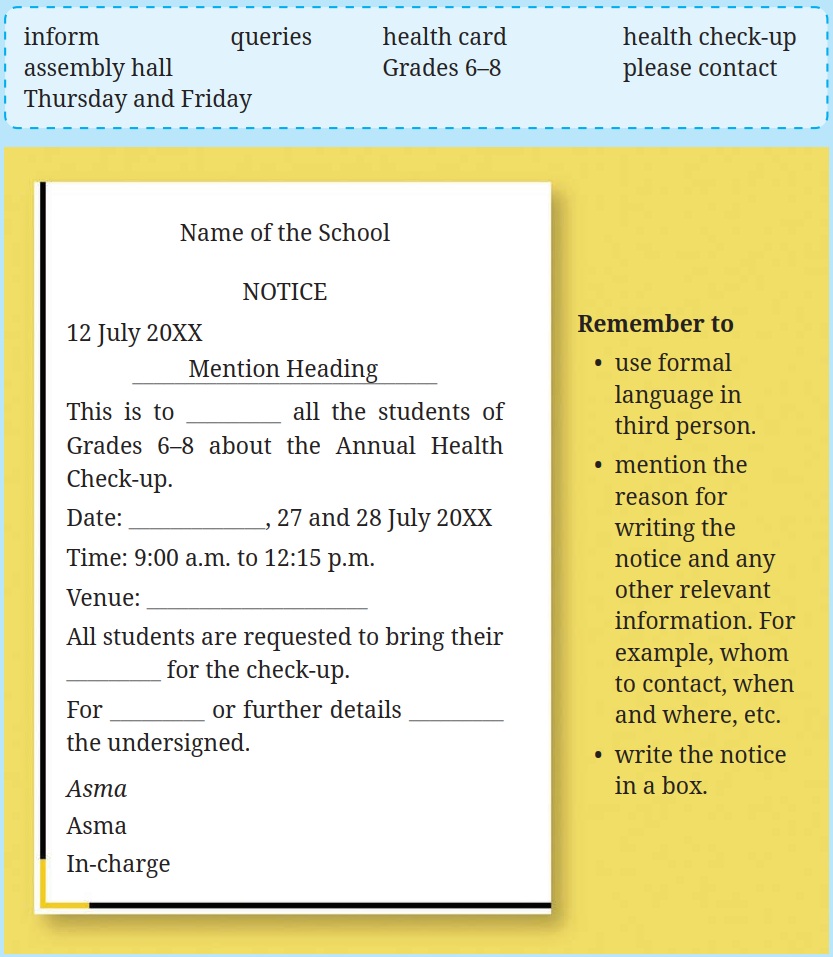
Answer:
Swami Vivekananda School
NOTICE
12 July 20XX
Annual Health Check-up
This is to inform all the students of Grades 6-8 about the Annual Health Check-up.
Date: 27 and 28 July 20XX
Time: 9:00 a.m. to 12:15 p.m.
Venue: Assembly hall
All students are requested to bring their health card for the check-up. For queries or further details, please contact the undersigned.
Asma
In-charge
Class 7 English Poorvi Chapter 4 NCERT Solutions
The story Animals, Birds, and Dr. Dolittle introduces Doctor Dolittle and his unusual interest in understanding the language of animals. With help from the parrot Polynesia, he learns to communicate with them and better understand their needs. The imaginative events combine humour with kindness towards living creatures.
Students also explore how listening carefully can improve understanding between others. The chapter develops comprehension and vocabulary while encouraging students to notice character traits, amusing situations, and the importance of empathy and care for animals.