

NCERT Solutions for Class 7 English Poorvi Chapter 6 Say the Right Thing are provided here with simple and easy-to-understand answers. This play is a part of Unit 2: Wit and Humour in the NCERT English textbook Poorvi. It explores the importance of polite conversation and the humour caused by saying the wrong thing. These NCERT Solutions for Class 7 help students understand the main ideas, complete textbook exercises, improve their language skills, and prepare for school examinations.
Say the Right Thing Questions and Answers Class 7 English Poorvi Chapter 6
Let us do these activities before we read. (Page 70)
I. Work in pairs and discuss.
1. What does ‘Athithi Devo Bhava’ mean?
Answer: ‘Atithi Devo Bhava’ is a Sanskrit saying that means “A guest is like God.” It teaches us to treat guests with respect, kindness, and warmth.
2. Why is it important to be polite to guests?
Answer: It is important to be polite and courteous to guests to show that we are well-mannered and cultured. It makes them feel valued, welcome, and puts them at ease. Warm hospitality forges strong relationships and leaves a good impression of the host.
II. Choose the statements that display polite behaviour when you have guests at home.
1. Offer the guests a glass of water.
2. Enquire about the well-being of the guests.
3. Ask the guests when they would leave.
4. Comment critically about the habits of guests.
5. Accompany the guests to the door when they leave.
Answer: The following statements display polite behaviour when we have guests at home:
1. Offer the guests a glass of water.
2. Enquire about the well-being of the guests.
5. Accompany the guests to the door when they leave.
III. Sometimes you find that a few friends in class are rude while disagreeing with each other on certain issues. Work in groups. How would you deal with such a situation? Share at least three ways in which you can do this.
Answer: To deal with friends who are rude while disagreeing, we can:
- Stay calm and remind them to speak politely instead of shouting.
- Listen to both sides and help them understand each other’s point of view.
- Encourage them to solve the issue peacefully.
Let us discuss (Page 74)
I. Complete the table given below based on Scene I of the play. An example has been done for you. Share your answers with your classmates and the teacher.
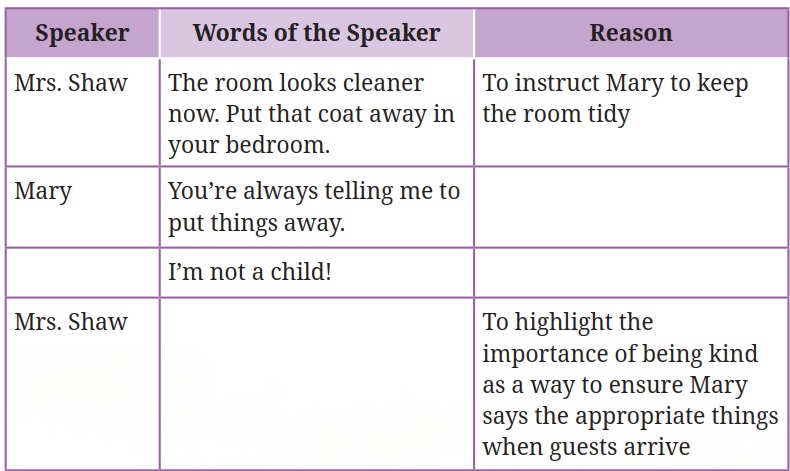
Answer:
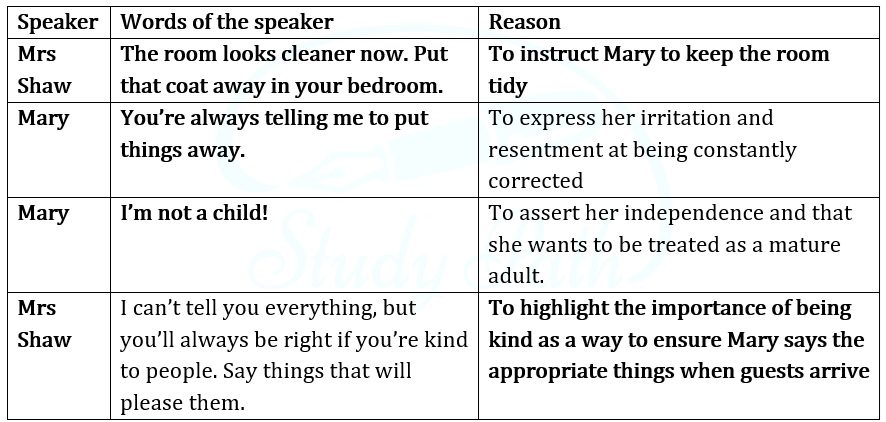
II. Do you think Mary will be able to follow her mother’s advice successfully when Mrs. Harding and Mrs. Lee visit? Why or why not?
Answer: No, Mary will not be able to follow her mother’s advice successfully because she speaks without thinking and often says the wrong things. During the visit, she makes several inappropriate remarks that offend the guests. This shows that she cannot control her words despite her mother’s instructions.
Let us discuss (Page 77)
I. Rectify the false statements given below from Scene II of the play. An example has been done for you. Share your answers with your classmates and the teacher.
1. Mrs. Harding states that they do not like London as it is not the same as Lanfield.
Rectification: Mrs. Harding states that they like Lanfield very much even though it is not the same as London.
2. Mrs. Harding was pleased to know that Mary was familiar with her children.
Answer: Rectification: Mrs. Harding was not pleased because she clearly said that she had no children, and Mary had mistaken someone else’s children for hers.
3. Mrs. Shaw shared that she liked Mrs. Best as she read a lot of newspapers.
Answer: Rectification: Mrs. Shaw said she liked Mrs. Best because she was a nice woman, not because she read a lot of newspapers.
4. Mrs. Harding and Mrs. Shaw agree that wearing a blue dress with a red coat is unfashionable.
Answer: Rectification: Mrs. Harding and Mrs. Shaw do not agree that wearing a blue dress with a red coat is unfashionable. In fact, Mrs. Shaw quickly says she likes blue dresses and red coats to avoid offending Mrs. Harding.
5. Mary shares that she finds the dog outside the window cute.
Answer: Rectification: Mary does not say the dog is cute. She says the dog looks very dirty and questions why people keep dogs.
Let us think and reflect (Page 78)
I. Read the extracts given below and answer the questions that follow.
1. Mary: What are you going to talk about?
Mrs. Shaw: I don’t know. All kinds of things. One day you’ll have to go to some of these houses yourself and talk to the people there.
Mary: I can talk now. I’ve been able to talk for a long time.
Mrs. Shaw: Yes, that’s true. You always talk too much. But does anyone want to hear the things that you say?
Mary: I can talk very well when I like. I’ll stay with you today and talk to them when they come.
Mrs. Shaw : Oh, I don’t think so. You can go out for a walk. It will be better if you do that.
(i) What does Mrs. Shaw imply when she says, “One day you’ll have to go to some of these houses yourself and talk to the people there”?
A. She believes Mary should start learning about hosting guests then.
B. She thinks Mary is ready to visit these houses independently.
C. She wants Mary to develop social skills for the future.
D. She hopes Mary will avoid these social interactions entirely.
Answer: C. She wants Mary to develop social skills for the future.
(ii) Complete the following sentence with the correct option from the brackets.
Mrs. Shaw and Mary are discussing how to _____________________.(have a polite conversation/ get to know people better)
Answer: Mrs. Shaw and Mary are discussing how to have a polite conversation.
(iii) Why did Mary insist on staying with her mother when the guests arrived?
Answer: Mary insisted on staying with her mother because she wanted to prove that she could talk politely and behave well in front of the guests.
(iv) Match the following character traits to the characters in the extract:
A. eager
B. inexperienced
C. cautious
Mary Mrs. Shaw
Answer:
| Character | Character Trait |
| Mary | A. eager |
| Mrs Shaw | C. cautious |
2. Mary: I saw Mrs. Cotter this afternoon. I met her in the street. No one sees her in the morning because she always stays in bed then. And she’s always asking the doctor to go to see her. I can’t understand women who stay in bed in the morning. And why must she always ask for the doctor? I’ve never been to a doctor in my life.
Mrs. Harding: I stay in bed in the morning myself.
(i) Complete the following sentence suitably.
Mary could spot Mrs. Cotter in the street because _________.
Answer: Mary could spot Mrs. Cotter in the street because she went out in the afternoon when Mrs Cotter is out and about.
(ii) What does Mary’s comment about Mrs. Cotter staying in bed and calling the doctor suggest about her understanding?
A. She is worried about why Mrs. Cotter stays in bed all morning.
B. She is unable to understand why people need medical help.
C. She thinks Mrs. Cotter is scared and lonely for staying in bed.
D. She believes Mrs. Cotter is right to rest and take care of herself.
Answer: B. She is unable to understand why people need medical help.
(iii) How can we say that Mary enjoyed good health?
Answer: We can say that Mary enjoyed good health because she mentions that she has never been to a doctor in her life which shows that she rarely fell sick.
(iv) Identify whether the following statement is true or false.
Mary might have unintentionally offended Mrs. Harding.
Answer: True
II. Answer the following questions. (Page 79)
1. What does Mary’s comment about Mr. Best’s routine and profession reveal about her viewpoint on bankers and their way of life?
Answer: Mary’s comment about Mr. Best’s routine shows that she thinks bankers live a dull and monotonous life. She believes travelling daily by train, reading only newspapers, and having no time for other interests makes their life uninteresting. She assumes bankers “can’t think,” revealing her immature and critical viewpoint.
2. What can we infer about Mary’s understanding of polite conversation based on her interactions with the guests?
Answer: Based on her interactions, we can infer that Mary has very little understanding of polite conversation. She speaks without thinking, makes personal and offensive remarks, and forgets her mother’s advice. This shows she is immature and lacks social manners.
3. What do you think the repeated stage direction ‘no one speaks’ indicates about the atmosphere in the room when Mary speaks?
Answer: The repeated stage direction ‘no one speaks’ indicates an uncomfortable and awkward atmosphere in the room. It shows that Mary’s comments embarrass the guests and leave everyone shocked, unsure of how to respond.
4. How does Mary’s attitude towards the guests change throughout the play?
Answer: At first, Mary is confident and eager to talk to the guests. But soon becomes nervous and confused as she realises she is making mistakes. By the end, she becomes frustrated and careless, saying the opposite of what her mother taught her.
5. What do Mrs. Harding’s and Mrs. Lee’s responses to Mary’s blunders during their visit reveal about their characters?
Answer: Mrs. Harding’s and Mrs. Lee’s responses show that they are polite, patient, and well-mannered. Even when Mary makes rude or inappropriate comments, they do not react angrily. Instead, they remain calm and try to continue the conversation respectfully, showing their maturity and good social behaviour.
6. In what way does the play show the importance of knowing how to engage in polite conversation?
Answer: The play shows the importance of polite conversation by demonstrating how rude remarks can offend others and spoil social interactions. Mary’s mistakes create awkward moments, while her mother’s advice highlights that kindness, careful speech, and good manners help to build positive relationships.
Let us learn (Page 80)
I. Study the following words taken from the text.
humorous, hilariously, coming, beautiful
The given words are made by adding word endings like -ous, -ly, -ing, and -ful to the root words humour, hilarious, come, and beauty. Such word endings are called suffixes.
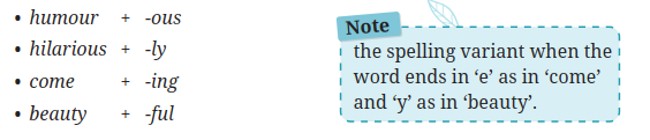
Now, divide the following words from the text as root words and suffixes.

Check your answer with the teacher.
Answer:
- Gladly: glad + -ly
- Banker: bank + -er
- Guidance: guide + -ance
- Quietly: quiet + -ly
- Walking: walk + -ing
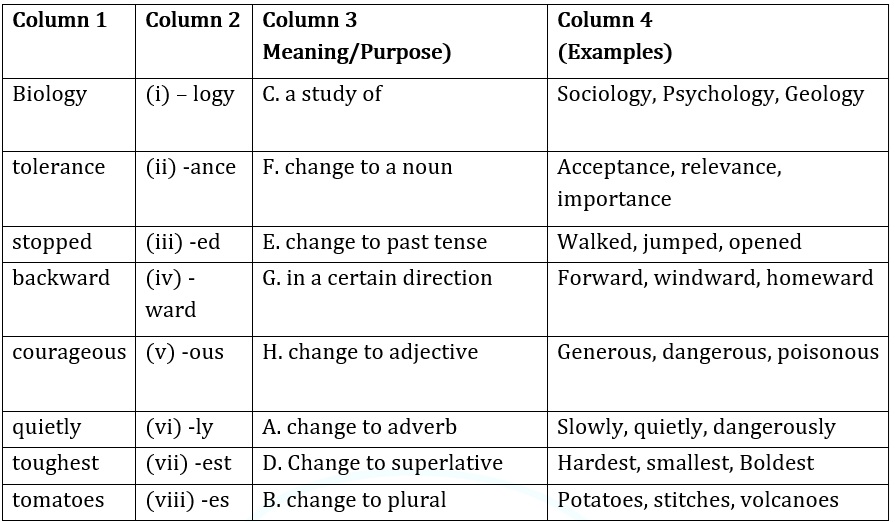
1. Study the words in Column 1. Match the suffixes in Column 2 with their meanings or purpose in Column 3. Write a few examples for
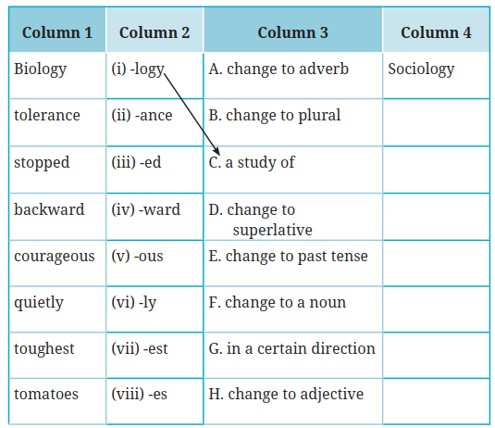
Answer:
2. Fill in the blanks using words given in the brackets by adding suitable suffixes.
To communicate (i) ___________ (effective), choose your words and topics (ii) ___________ (wise). Avoid (iii) ___________ (discuss) things you don’t know much about or that could upset someone. Remember to be (iv) ___________ (respect) towards others, including yourself, and express your (v) ___________ (appreciate). Finally, always be (vi) ___________ (response) by replying promptly to communicate.
Answer: To communicate (i) effectively (effective), choose your words and topics (ii) wisely (wise). Avoid (iii) discussing (discuss) things you don’t know much about or that could upset someone. Remember to be (iv) respectful (respect) towards others, including yourself, and express your (v) appreciation(appreciate). Finally, always be (vi) responsive (response) by replying promptly to communicate.
II. Read the highlighted words in the following sentences from the text.
• But does anyone want to hear the things that you say?
• I can’t tell you everything.
Select the correct answer.
Is there a difference in the meanings of ‘say’ and ‘tell’? (Yes/ No)
Answer: YES
• ‘Say’ focuses on the message and does not always require a listener.
• ‘Tell’ focuses on who receives the message and always needs a listener.
1. Fill in the blanks with suitable words from the sets of words given in the box below. Make changes in the verb forms (tense), if necessary.
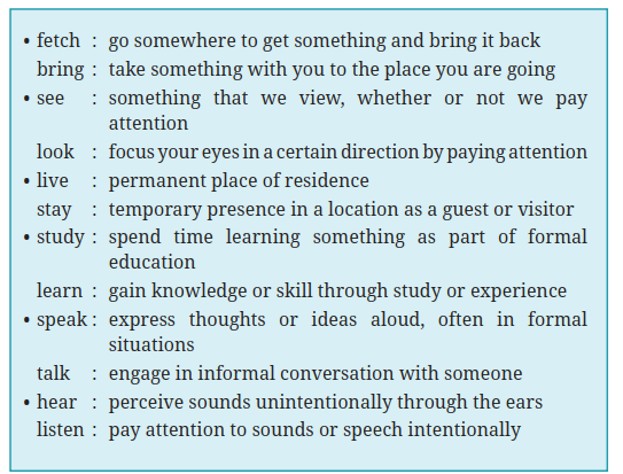
(i) I _________ at the photo, but I didn’t _________ anyone familiar.
(ii) I’d better go and _________ my mother from the station, and then _________ her home.
(iii) I need to _________ for my mathematics exam this weekend, so I hope to _________ new concepts along the way.
(iv) I can _________ the music from my neighbour’s house, but I need to _________ to it carefully to understand the lyrics.
(v) “Could I _________ to Mrs. Kalpana, who is going to _________ to us about gardening,” said Ritu.
(vi) I _________ in a small town, but I often _________ with my relatives in the city.
Answer:
(i) I looked at the photo, but I didn’t see anyone familiar.
(ii) I’d better go and fetch my mother from the station, and then bring her home.
(iii) I need to study for my mathematics exam this weekend, so I hope to learn new concepts along the way.
(iv) I can hear the music from my neighbour’s house, but I need to listen to it carefully to understand the lyrics.
(v) “Could I talk to Mrs. Kalpana, who is going to speak to us about gardening,” said Ritu.
(vi) I live in a small town, but I often stay with my relatives in the city.
II. Read the following sentences from the text and underline the verbs.
- They lived in London before.
- I met her in a shop and asked her to come.
As you know, the verbs you have underlined are in simple past tense. (actions that happened in the past or distant past)
Read the following sentence from the text and underline the verb.
She has been staying with them for a while.
The verb you have underlined is in present perfect continuous tense.
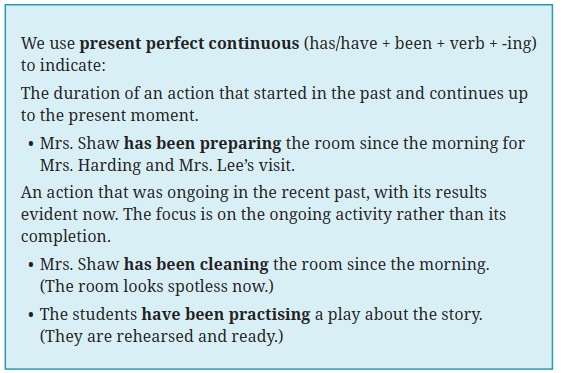
1. Fill in the blanks using the verbs given in brackets in present continuous or present perfect continuous tense.
The students (i) ______________ (organise) a play and setting up the stage. They (ii) ______________ (prepare) for weeks to make everything perfect. The performers (iii) ______________ (rehearse) every day, and their excitement (iv) ______________ (grow). The sound in-charge (v) ______________ (test) the microphones to check the sound quality. Everyone (vi) ______________ (work) hard, and now the place (vii) ______________ (buzz) with energy and excitement.
Answer: The students (i) are organising (organise) a play and setting up the stage. They (ii) have been preparing (prepare) for weeks to make everything perfect. The performers (iii) have been rehearsing (rehearse) every day, and their excitement (iv) is growing (grow). The sound in-charge (v) is testing (test) the microphones to check the sound quality. Everyone (vi) is working (work) hard, and now the place (vii) is buzzing (buzz) with energy and excitement.
IV. Read the explanation about the kinds of sentences given in the table below. (Page 83)
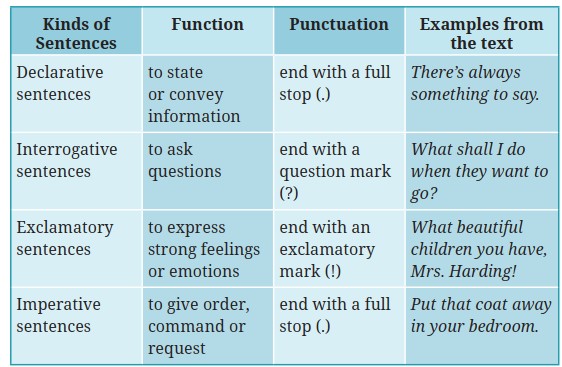
1. Identify the kinds of sentences and punctuate them appropriately.
(i) The meeting starts at 10.00 a.m. in the conference room.
Answer: Declarative
(ii) What an exciting adventure it was!
Answer: Exclamatory
(iii) How did you solve the problem so quickly?
Answer: Interrogative
(iv) What is the weather forecast today?
Answer: Interrogative
(v) How beautiful is the rainbow!
Answer: Exclamatory
(vi) Clean up your room before dinner.
Answer: Imperative
(vii) The children are planning a surprise party for their mom.
Answer: Declarative
(viii) Turn off the music.
Answer: Imperative
Let us listen (Page 84)
I. Mrs. Shaw wanted Mary to learn to say the right thing. You will listen to a conversation between a mother and her son about basic manners. As you listen, fill in the blanks given below by selecting the correct option. (Transcript for the teacher on pg. 89 )
1. How did the son behave in the grocery queue?
(i) strangely (ii) impatiently (iii) politely
Answer: (ii) impatiently
2. The mother finally refers to her son as a __________________.
(i) polite young man (ii) responsible son (iii) grateful person
Answer: (i) polite young man
II. You will once again listen to the conversation. As you listen, select four true statements from 1– 7 given below.
1. The mother uses the grocery store incident as an opportunity to teach her son about patience and fairness.
2. The son recognises the value of apologising and understands that it shows he notices others.
3. The son is gradually learning the importance of polite words and actions from his mother’s guidance.
4. The mother discourages her son from speaking softly in public, suggesting that people should adjust to his voice level.
5. The son feels that covering his mouth when coughing is only important when he’s at home.
6. The son receives all advice readily while understanding its importance.
7. The mother uses praise to support the polite behaviours she wants her son to continue practising
Answer: 1, 2, 3, 7 are TRUE:
Class 7 English Poorvi Chapter 6 NCERT Solutions
The play Say the Right Thing follows Mary as she tries to join a conversation with visitors after receiving advice from her mother. Her attempts to be helpful lead to awkward and amusing remarks. The dialogue shows how good intentions can produce misunderstandings when words are chosen without enough thought.
Students also learn to recognise humour in dialogue and understand the difference between honesty and tact. The chapter encourages careful listening, considerate speech, and attention to other people’s feelings while developing comprehension and speaking skills.