

NCERT Solutions for Class 7 English Poorvi Chapter 8 Paper Boats are provided here with simple and easy-to-understand answers. This poem is a part of Unit 3: Dreams and Discoveries in the NCERT English textbook Poorvi. It explores a child’s paper boats, dreams of distant places, and imaginative connection with the world. These NCERT Solutions for Class 7 help students understand the main ideas, complete textbook exercises, improve their language skills, and prepare for school examinations.
Paper Boats Questions and Answers Class 7 English Poorvi Chapter 8
Let us do these activities before we read (Page No. 109)
I. Read the questions given below. Share your answers with your classmates and the teacher.
1. What comes to mind when you think about ‘paper boats’
Answer: When I think about paper boats, I imagine childhood fun, rainy days, and watching the boats float in small streams or puddles. They remind me of simple joys, imagination, and happy memories.
2. What do you think someone might hope for when they send a paper boat down a stream
Answer: Someone sending a paper boat down a stream might hope that it travels far, reaches someone, or carries their wishes and dreams to a new place.
3. Read the title of the poem ‘Paper Boats’ and predict what the poem might be about.
Answer: The poem “Paper Boats” is likely about a child’s imagination and dreams. It may describe the child floating paper boats in a stream and imagining where they go or who finds them.
II. Read the given paragraph and match the highlighted words with their meanings given in the box below.

I love to play beside a 1. running stream at a short distance from my grandparent’s house. I love to see it 2. skipping along to join a river. On the river, I can see boats with 3. bulging sails moving swiftly. Some of them take the people from one shore to the other, while in some of them people can be seen 4. lading things too. I can spend hours watching the busy river and dreaming about them, 5. burying my head in my pillow at night.
Answer:
1. running – speedily flowing
2. skipping – bouncing
3. bulging – swelling
4. lading – loading
5. burying – putting
Let us discuss (Page No. 111)
I. Choose the correct words from the brackets to complete the summary of the poem given below.
The poet sends paper boats down a 1. _____ (stream/river) each day, writing his name and the name of his 2. _____ (school/ village) on them. He hopes that someone in a 3. _____ (strange/familiar) land will find them and know who he is. The poet fills his boats with 4. _____(rose/shiuli) flowers from his garden, hoping they will be safely carried to another land at 5. _____ (night/morning). As he launches his boats, he imagines that the 6. _____ (clouds/birds) in the sky are like friends, racing with his boats. At night, he dreams that his paper boats continue to 7. _____ (swim/float) under the midnight stars, with the fairies of sleep sailing in them, their baskets full of 8. _____ (dreams/fruits).
Answer: The poet sends paper boats down a 1. stream each day, writing his name and the name of his 2. village on them. He hopes that someone in a 3. strange land will find them and know who he is. The poet fills his boats with 4. shiuli flowers from his garden, hoping they will be safely carried to another land at 5. night. As he launches his boats, he imagines that the 6. clouds in the sky are like friends, racing with his boats. At night, he dreams that his paper boats continue to 7. float under the midnight stars, with the fairies of sleep sailing in them, their baskets full of 8. dreams.
II. Choose the correct option for the following. The theme of the poem is _______.
1. innocence
2. imagination
3. ignorance
4. playfulness
5. travel
(i) 1, 2 and 3
(ii) 3, 4 and 5
(iii) 1, 4 and 5
(iv) 1, 2 and 4
Answer: (iv) 1, 2 and 4 (innocence, imagination, playfulness)
III. Identify whether the following statement is true or false.
The setting of the poem is a natural, outdoor environment.
Answer: True
IV. Complete the following sentence by choosing the correct word given within the brackets.
The tone is _______ (sad and serious/gentle and wishful) and the mood is _______ (thoughtful/boring).
Answer: The tone is gentle and wishful and the mood is thoughtful.
V. Identify the examples of alliteration from the poem.
Answer: Examples of Alliteration:
- “Day by day” – repetition of the d sound
- “Paper boats” – repetition of the p sound
- “Blooms of the dawn” – repetition of the b sound
- “Midnight stars” – repetition of the m sound
VI. Fill in the blanks with suitable words from the poem.
1. The repetition of words ______ and _____ emphasises the passage of time.
2. The poet uses imagery like _____ and _____ to create a clear picture in the minds of the readers.
Answer: 1. The repetition of words day by day and one by one emphasises the passage of time.
2. The poet uses imagery like midnight stars and fairies of sleep to create a clear picture in the minds of the readers.
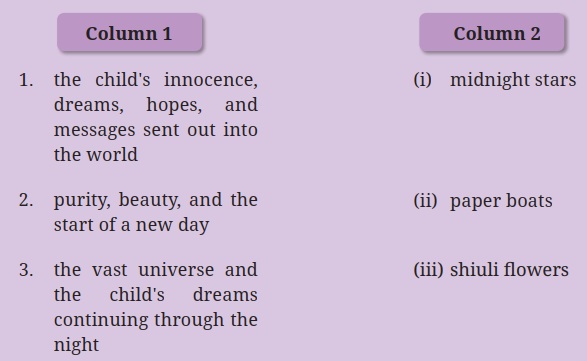
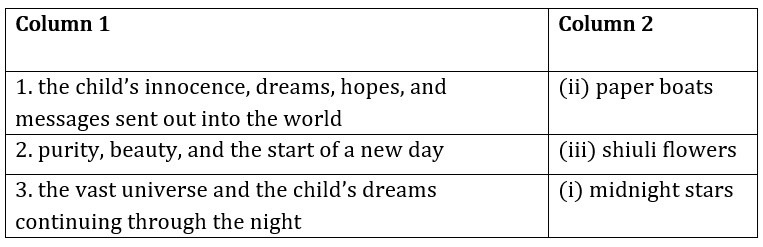
VII. Match the descriptions in Column 1 with what they symbolise in Column 2. (Page 112)
Answer:
Let us think and reflect (Page No. 112)
1. Read the extract given below and answer the questions that follow.
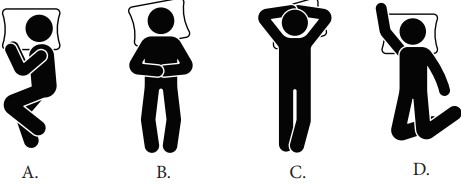
1. When night comes I bury my face in my arms and dream that my paper boats float on and on under the midnight stars. The fairies of sleep are sailing in them, and the lading is their basketsfull of dreams.
(i) Select the option that is most likely to be the speaker as per the extract.
Answer: C
(ii) What can be inferred about the speaker’s feelings when night comes?
Answer: The speaker feels dreamy and imaginative, thinking about paper boats floating under the stars.
(iii) What kind of beings are the ‘fairies of sleep’ imagined as? Select the most appropriate option.
A. mischievous
B. gentle
C. fearsome
D. playful
Answer: B. gentle
(iv) Fill in the blank by selecting the correct option from those given in the brackets.
The phrase ‘lading is their baskets full of dreams’ suggests that the speaker imagines the fairies of sleep carefully ________(carrying his dreams /collecting his wishes) in their baskets.
Answer: The phrase ‘lading is their baskets full of dreams’ suggests that the speaker imagines the fairies of sleep carefully carrying his dreams in their baskets.
II. Answer the following questions. (Page 113)
1. Why do you think the poet writes his personal details on the paper boats?
Answer: The poet writes his personal details on the paper boats because he hopes someone in a distant place will find them and know who he is. It shows his wish to connect with people far away.
2. The poet talks about the imagination of a child. Support this view with examples from the poem.
Answer: The poem shows a child’s imagination through the way he thinks and dreams. He imagines that someone in a strange land will find his paper boats and know about him. He feels that the clouds in the sky are like playmates racing with his boats. At night, he dreams that fairies of sleep sail in his paper boats, carrying baskets full of dreams.
3. How does the poet bring together imagination and reality to make the poem more interesting?
Answer: The poet brings imagination and reality together by describing real actions, like floating paper boats in a stream and then adding imaginative ideas, such as clouds racing with his boats and fairies of sleep sailing in them at night. This mix of real experiences and creative thoughts makes the poem feel magical and enjoyable to read.
Let us learn (Page No. 113)
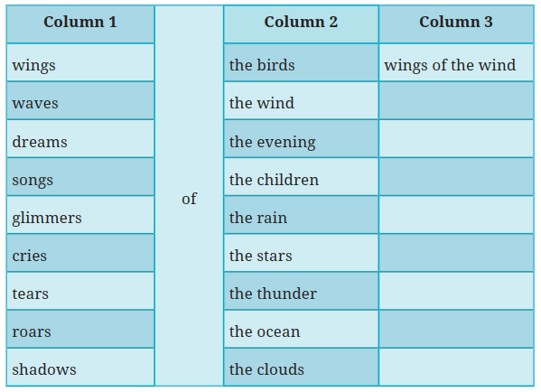
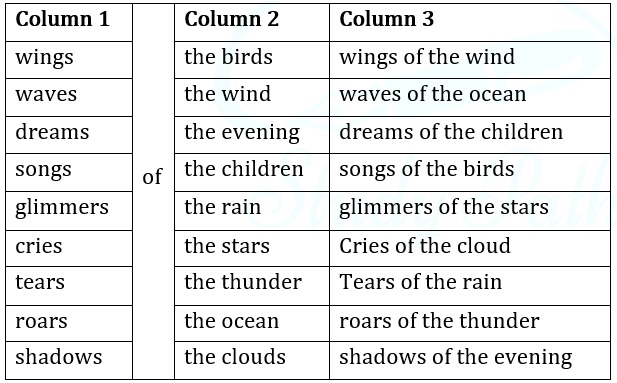
I. The poet has used phrases like ‘blooms of the dawn’ and ‘fairies of sleep’ in the poem. In the same way we can create phrases. Now, select words from Column 1 and Column 2 and combine them with ‘of’. Write as many phrases as possible in Column 3.
Answer:
II. The poet uses words like ‘dawn’, ‘night’ and ‘midnight’ to show different parts of the day. The box given below has some more words. Write the words in the appropriate columns.

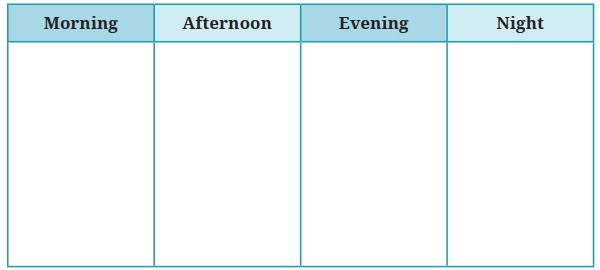
Answer:

III. Match the words from the text given in Column 1 with their opposites in Column 2.
2.
| Column 1 | Column 2 |
| 1. strange | (i) halt |
| 2. dawn | (ii) emptying |
| 3. launch | (iii) sink |
| 4. bulging | (iv) dusk |
| 5. float | (v) ordinary |
| 6. lading | (vi) shrinking |
Answer:
| Column 1 | Column 2 |
| 1. strange | (v) ordinary |
| 2. dawn | (iv) dusk |
| 3. launch | (i) halt |
| 4. bulging | (vi) shrinking |
| 5. float | (iii) sink |
| 6. lading | (ii) emptying |
Let us listen (Page No. 114)
Let us listen You will listen to a conversation between a girl and her father about the art of paper folding called origami. As you listen, select the true statements from 1–7. (Transcript for the teacher on pg. 137)
- Father : Sai dear! What are you working on there with all that paper?
- Sai : Baba, I am trying to make an origami crane, but it’s a bit tricky. I keep messing up the folds.
- Father : Ah, origami! I remember doing that when I was your age. You know, Sai, origami has a really interesting history.
- Sai : Really? I thought it was just something fun to do with paper.
- Father : It is fun, but it’s also an age-old art form. Origami started in Japan over a thousand years ago. Back then, paper was really expensive, so it was only used for special occasions, like religious ceremonies.
- Sai : Wow, I didn’t know that. So, it wasn’t just for doing crafts?
- Father : It wasn’t until the seventeenth century that people began making animals, flowers and other designs just for fun.
- Sai : So, people have been making paper cranes for hundreds of years?
- Father : Yes, and the crane is especially important in Japanese culture. It’s a symbol of peace and long life. There’s even a belief that if you fold a thousand paper cranes, you can make a wish, and it will come true.
- Sai : A thousand cranes? That’s a lot! But it sounds like a really nice tradition.
- Father : It is. Origami isn’t just about the final shape—it’s about the process, the patience and the creativity involved. And over the years, it’s spread all over the world, with people adding their own styles and techniques.
- Sai : I had no idea origami had such a long history. It makes folding this crane feel even more special.
- Father : I’m glad you think so, Sai. Perhaps we can start with something simpler next time. How about we make an origami paper boat next? It’s easier, and we can float it in the stream outside.
- Sai : A boat sounds awesome! Let’s do it! But first, I want to finish this crane. Can you help me with the last few steps?
- Father : Of course! Let’s finish this crane together. After that, we’ll sail our paper boat.
1. Sai was trying to make an origami boat.
Answer: False. She was trying to make an origami crane.
2. Sai’s father used to do origami as a child.
Answer: True.
3. Paper was very expensive so it was used only for special occasions.
Answer: True.
4. People have been making paper cranes for thousands of years.
Answer: False. Origami began over a thousand years ago, but making cranes and decorative items for fun started around the 17th century.
5. There is a belief that if you make a thousand paper cranes, your wish will come true.
Answer: True.
6. The art of origami is about enjoying the process.
Answer: True. The father says origami is about the process, patience, and creativity—not just the final shape.
7. Sai’s father suggests making a paper bookmark next time.
Answer: False. He suggests making a paper boat next time.
Let us write (Page No. 116)
A diary entry is a personal document. It records an individual’s account of a day of her or his life expressing the thoughts, feelings and opinions in the individual’s mind.
The guidelines to compose a diary entry include:
- mentioning day, date and time of writing it
- beginning with a general sentence describing the day or feelings towards an event or experience
- giving details
- concluding with a final remark
Now, write a diary entry expressing your joy in experiencing a rainy day. You may begin as given below:
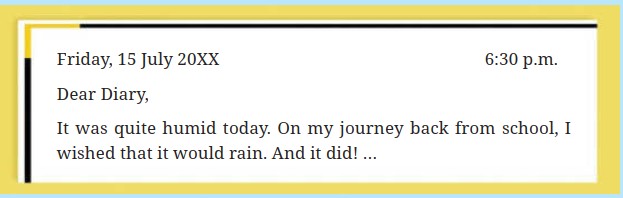
Answer:
Friday, 15 July 20XX
6:30 p.m.
Dear Diary,
Today turned out to be one of the happiest days ever. It was very hot in the morning, and on my way back from school, I wished it would rain. And it did! Suddenly, dark clouds gathered, and cool raindrops started falling. I felt so excited that I forgot all about the heat and simply enjoyed the moment.
When I reached home, I stood near the window and watched the rain splashing everywhere. The trees looked fresh and green, and the smell of wet earth made me feel peaceful.
Yours,
Suman
Let us explore (Page No. 116)
I. Shiuli flowers often find a mention in Rabindranath Tagore’s poems. These flowers are found in many parts of our country.
Look at the pictures of shiuli flowers and recall what you call them in your language.
1. Find out names of some more trees or plants in your locality which have fragrant flowers. Write their names in your language and English language. Draw any two flowers and colour them.
Answer: Name of Shiuli Flower in Different Languages:
- English: Night Jasmine / Coral Jasmine
- Hindi: हरसिंगार (Harsingar)
- Bengali: শিউলি (Shiuli)
- Tamil: பரிஜாதம் (Parijatam)
- Telugu: పారిజాతం (Parijatam)
- Marathi: पारिजातक (Parijatak)
Other Trees or Plants with Fragrant Flowers:
| Local Language Name | English Name |
| चमेली (Chameli) | Jasmine |
| गुलाब (Gulab) | Rose |
| बेला (Bela) | Arabian Jasmine |
| रजनीगंधा (Rajnigandha) | Tuberose |
| मोगरा (Mogra) | Jasmine (variety) |
| चम्पा (Champa) | Plumeria / Frangipani |
Draw and Colour Any Two Flowers:
You can draw:
- Rose – Colour it red or pink
- Jasmine – Colour it white with green leaves
II. Solve the riddles given below. Share your answers with your classmates and the teacher.
Riddle 1:
I have water that you cannot drink,
People come to see how in me the Sun sinks.
I can be rough, I can be calm,
I hold within myself plenty of charm.
My depths tell a never-ending tale.
Who am I with dolphins and the whale?
Answer: Sea or Ocean
Riddle 2:
I sit in stillness, but move with the wind,
My surface mirrors the world you are in.
The trees around me live happily,
In me, you can take a dip daily.
Home to ducks, frogs, fish, and all,
Can you guess what I am, after all?
Answer: Pond or Lake
Riddle 3:
I gently travel through valleys deep,
My soft murmur can make you sleep.
Little paper boats float on me in rain
The merry laughter of the kids I gain.
You may sit beside me without any fear,
Who am I who skips along, crystal clear?
Answer: Stream or Brook
Riddle 4:
I have a bed, but I do not sleep.
I have a bank, but no money I keep.
I carry stories, old and new,
High mountains to the oceans blue.
I journey far to meet the sea,
Can you guess, who I can be?
Answer: River
Class 7 English Poorvi Chapter 8 NCERT Solutions
The poem Paper Boats follows a child who floats paper boats down a stream and imagines their journey to faraway places. The boats carry the child’s hopes of reaching someone beyond the familiar surroundings. Simple details from nature bring the child’s imaginative world to life.
Students also explore the poem’s imagery, sense of wonder, and central idea. The activities encourage them to understand the child’s feelings, appreciate poetic language, and express their own dreams and observations through creative writing.