

NCERT Solutions for Class 8 English Poorvi Chapter 1 The Wit that Won Hearts are provided here with simple and easy-to-understand explanations. This story is a part of Unit 1: Wit and Wisdom in the NCERT textbook Poorvi. It explores how wit, empathy, and understanding can resolve a misunderstanding. These NCERT Solutions for Class 8 help students understand the main ideas, complete textbook activities, improve their language skills, and prepare for school examinations.
The Wit that Won Hearts Class 8 English NCERT Questions and Answers
Let us do these activities before we read (Page No. 1)

I. Select qualities of a person who uses wit from the box given below:
Answer: A witty person shows qualities such as cleverness, humour, creativity, charm, and observation. They are also wise, confident, energetic, and punctual. These qualities help them think quickly, respond smartly, and handle situations with ease. Their humour and intelligence make them stand out and win people’s hearts.
Discuss in Pairs (Page No. 2)
1. Why are qualities like humour and wit important in a person?
Answer: Humour and wit help a person handle difficult situations calmly, reduce tension, and improve relationships. They make communication pleasant and help solve problems wisely without arguments or anger.
2. Why do you think kings and queens preferred to have witty people among their courtiers?
Answer: Kings and queens preferred witty courtiers because they could solve problems intelligently, ease tense situations, entertain the court, and offer clever advice. Their humour and quick thinking helped maintain harmony and support wise decision-making in the palace.
3. If you were asked to solve a disagreement between two people, what approach would you take?
Answer: I would listen to both sides calmly, understand the cause of the disagreement, and speak politely to them. I would help them see each other’s point of view and suggest a fair solution that keeps both people respectful and peaceful.
4. Have you ever been in a situation where a small misunderstanding led to a big problem? How was it resolved?
Answer: Yes, once a small misunderstanding with a friend became a big issue because we both assumed wrong things. Later, we talked calmly, explained our feelings, and cleared the confusion. Once we understood each other, the problem was solved and our friendship improved.
Let us discuss (Page No. 7)
I. Rectify the following false statements from the text:
1. The queen insulted the king by speaking against the quality of his poem.
Answer: The queen did not insult the king or criticise his poem. She only yawned because she was tired, which the king mistakenly took as disrespect.
2. Tenali Rama immediately went to the king and convinced him to talk to the queen.
Answer: Tenali Rama did not go to the king immediately. He first planned a clever strategy and later made the king realise his mistake during the court discussion.
3. The courtiers admired the king’s poem and praised his literary talent.
Answer: The courtiers did not admire or praise the king’s poem. They avoided him by making excuses when he tried to recite it to them.
4. The ministers in the court were eager to hear Tenali Rama’s idea about paddy cultivation.
Answer: The ministers were not eager to hear Tenali Rama’s idea. Some courtiers mocked him and made sarcastic remarks when he spoke about the paddy seeds.
5. The king never realized his mistake and continued to stay angry with the queen.
Answer: The king realised his mistake after Tenali Rama’s explanation and understood that yawning was natural. He apologised to the queen and ended the quarrel.
Let us think and reflect (Page No. 7)
Read the extracts and answer the questions that follow:
Extract 1:
“… The king thought I was disrespecting his poem and stormed off. Since then, he has not spoken to me. If I had known this would happen I would have chosen another day. Help me, please, Rama. Only you can help the king understand.” Rama nodded thoughtfully. “If you like, I will try my best to resolve this matter, Your Highness. But this needs a well-planned approach and I may need time to find the right strategy.”
(i) Why does the queen believe that only Tenali Rama can help?
Answer: The queen believes only Tenali Rama can help because he is witty, wise, and known for solving difficult problems cleverly. She trusts that he can make the king understand the truth without hurting his feelings.
(ii) What does the queen’s statement, “If I had known this would happen, I would have chosen another day,” suggest about her feelings?
She is angry at the king for overreacting.
A. She is angry at the king for overreacting
B. She regrets the unintended misunderstanding.
C. She believes the poem was not worth listening to.
D. She is worried that the ki
Answer: B. She regrets the unintended misunderstanding.
Explanation: The queen’s statement shows that she feels regret. She did not intend to hurt the king and is sorry that her tired yawning caused an unwanted misunderstanding.
(iii) How does Tenali Rama’s response reflect his wisdom and problem-solving skills?
Answer: Tenali Rama’s response reflects his wisdom because he understands that the problem cannot be solved immediately. Instead of confronting the king directly, he plans a well-thought-out strategy. His calm, patient, and intelligent approach helps resolve the conflict without hurting the king’s pride.
(iv) Fill in the blank by choosing the correct option:
The king’s reaction shows that he is sensitive and ______ (has a lot of faith/takes great pride) in his poetry.
Answer: The king’s reaction shows that he is sensitive and takes great pride in his poetry.
Extract 2
That evening, the king approached the queen with a softened expression. “Thirumalambal,” he began, his voice gentle, “I have been foolish. I see now that I overreacted. I let my pride blind me. I’m so sorry.” The queen, who had longed for this moment, smiled and replied, “If you like, we can leave this quarrel behind us. I would very much like to listen to your poem.”
(i) Complete the following with a suitable explanation:
When the king said, “I let my pride blind me,” he means that __________.
Answer: When the king said, “I let my pride blind me,” he means that his ego stopped him from seeing the truth, and he reacted without understanding the queen’s innocent mistake.
(ii) Why does the queen say, “If you like, we can leave this quarrel behind us”?
Answer: The queen says this because she wants to end the misunderstanding peacefully. She is relieved that the king realised his mistake and is ready to forgive him and move forward without holding any bitterness.
(iii) Fill in the blank by choosing the correct option:
The king acknowledges that his pride clouded his judgement, which shows ________. (intelligence and courage/maturity and self-awareness).
Answer: The king acknowledges that his pride clouded his judgement, which shows maturity and self-awareness.
(iv) State any one characteristic that the queen’s response to the king’s apology shows about her.
Answer: The queen’s response shows her forgiving and understanding nature. Instead of blaming the king, she willingly accepts the king’s apology and agrees to leave the quarrel behind.
II. Answer the following questions. (Page 8)
1. Why was the Vijayanagara Empire considered to be in its ‘Golden Era’ during Krishnadeva Raya’s reign?
Answer: The Vijayanagara Empire’s time under King Krishnadeva Raya (1509-29 CE) is called the ‘Golden Era’ because it was a period when art, literature, and architecture flourished. He was a wise ruler, a great warrior, and a patron of learning who encouraged poets and scholars. His works, like Amuktamalyada and Jambavati Parinayam, also contributed to the empire’s cultural glory.
2. How did Tenali Ramakrishna gain a special place in the king’s court?
Answer: Tenali Ramakrishna gained a special place in the king’s court because of his quick wit, humour, and clever problem-solving skills. As one of the Ashtadiggajas, he impressed the king with his clever solutions to difficult problems. His unique ability to use humour wisely and resolve issues intelligently made him the advisor of King Krishnadeva Raya.
3. How did the quarrel between the king and the queen affect the palace? (Page 8)
Answer: The quarrel made the palace gloomy and silent. The king stopped speaking to the queen and avoided visiting her, which created sadness and tension. The once cheerful palace became quiet and forlorn.
4. What strategy did Tenali Rama use to make the king realize his mistake?
Answer: Tenali Rama presented a special variety of paddy seeds in court and claimed they would increase the yield by three times. When questioned, he said the real outcome depended on the sower, humorously adding that yawning while sowing would scatter seeds unevenly. At that time the king himself yawned and realised that yawning is natural and not disrespectful. This gentle analogy made him and understand his mistake about the queen.
5. What was the reaction of the courtiers when Tenali Rama introduced his ‘special’ paddy seeds? (Page 9)
Answer: When Tenali Rama introduced his ‘special’ paddy seeds, the courtiers mocked him and made sarcastic comments. One courtier sarcastically suggested that Rama had found magical seeds and would next claim they could grow without water. Another man joked that the seeds might have been discovered on the moon. Their remarks and laughter showed they did not take Rama’s claim seriously.
6. How does the story conclude, and what lesson can be learned from it?
Answer: The story concludes with the king understanding that he had overreacted and apologising sincerely to the queen. Joy returns to the palace, and Tenali Rama is rewarded for his wisdom.
The lesson teaches that pride and anger cause misunderstandings, while wisdom, patience, and humour help resolve problems peacefully.
Let us learn (Pages No. 9-11)
I. Fill in the blanks and complete the paragraph by choosing suitable expressions from the box given below.

My mother is quite witty, and her sense of humour always lightens stressful moments. Once, at a family dinner, an argument began over a minor issue, and 1. ______, making everyone feel uncomfortable. Just as things were getting serious, she made a clever remark and laughter 2. ______ the gathering, making everyone relaxed. The person who started the argument 3. ______. Everyone disapproved of the action and a 4. ______. My 5. ______ to how my mother had saved other situations like this. Without her, such moments would have 6. ______ over the gatherings. I hope that I grow up to be as witty as my mother.
Answer: My mother is quite witty, and her sense of humour always lightens stressful moments. Once, at a family dinner, an argument began over a minor issue, and 1. murmur swept through the room making everyone feel uncomfortable. Just as things were getting serious, she made a clever remark and laughter 2. rippled through the gathering, making everyone relaxed. The person who started the argument 3. stormed off. Everyone disapproved of the action and a 4. hush fell over. My 5. mind raced back to how my mother had saved other situations like this. Without her, such moments would have 6. cast a shadow over the gatherings. I hope that I grow up to be as witty as my mother.
II The writer uses words like ‘roared’, ‘murmur’ in the text to indicate the sound produced. Fill in the blanks with suitable sound words from the box given below. You may refer to a dictionary.
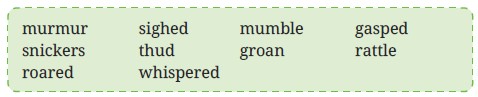
1. As the teacher began the riddle challenge, a __________ of excitement spread through the classroom.
2. Anaya __________ in relief—she loved riddles more than solving Mathematics problems.
3. ‘Think carefully,’ the teacher began to ___________ , as she wrote a riddle on the board.
4. When the question was revealed, a few students __________ , realising it wasn’t as easy as they had expected.
5. Some exchanged ____________ , wondering if anyone at all would be able to solve it.
6. Just then, Anaya tapped her book on the desk with a small ___________ , deep in thought.
7. ‘Ah, I see it now!’ she said stretching with a ___________ , as if it had taken her great effort.
8. A small breeze made the windows __________ , adding to the suspense of the moment.
9. ‘So, what’s the answer?’ the students ___________ , their voices filled with playful enthusiasm.
10. Leaning forward with a smile, Anaya __________ , ‘Sometimes, the trickiest questions have the simplest answers.’
Answer:
1. roar
2. Sighed
3. murmur
4. gasped
5. groans
6. thud
7. mumble
8. rattle
9. snickered
10. whispered
III. As you have learnt, a compound word is formed when two or more words are combined to create a new word with a distinct meaning. These are of three types: closed compounds (sunlight, courtroom), hyphenated compounds (well-planned), and open compounds (paddy seeds). (Page 10)
1. Create new compound words by matching words in Column 1 with those in Column 2
| Column 1 | Column 2 |
| (i) quick | A. hall |
| (ii) soft | B. tempered |
| (iii) common | C. spoken |
| (iv) house | D. blue |
| (v) book | E. store |
| (vi) ill | F. sense |
| (vii) sky | G. witted |
| (viii) dance | H. Hold |
Answer:
| Column 1 | Column 2 |
| (i) quick | G. witted |
| (ii) soft | B. tempered |
| (iii) common | F. sense |
| (iv) house | H. hold |
| (y) book | E. store |
| (vi) ill | C. spoken |
| (vii) sky | D. blue |
| (viii) dance | A. hall |
2. Fill in the blanks with the words created in the previous question.
Ravi was (i) __________, always speaking calmly even in arguments. He grew up in a lively (ii) __________, where he learned to handle different personalities. His friend Arun, however, was (iii) __________ and often lost his patience. Despite this, Arun admired Ravi’s (iv) __________ thinking. One evening, as they passed a (v) __________, they saw some performers rushing out. Ravi noticed that one of them dropped a (vi) __________ book on the ground. “Is this yours?” he asked. “Oh thank you, young man!” the performer smiled. “It’s a recent purchase from the (vii) ________ round the corner.” True to his nature Arun promptly said to Ravi, “ It’s (viii) ________ that it’s not from a bakery but bookshop!” Ravi smiled and they walked on.
Answer: Ravi was (i) soft-spoken, always speaking calmly even in arguments. He grew up in a lively (ii) household, where he learned to handle different personalities. His friend Arun, however, was (iii) ill-tempered and often lost his patience. Despite this, Arun admired Ravi’s (iv) quick-witted thinking. One evening, as they passed a (v) dance hall, they saw some performers rushing out. Ravi noticed that one of them dropped a (vi) sky-blue book on the ground. “Is this yours?” he asked. “Oh thank you, young man!” the performer smiled. “It’s a recent purchase from the (vii) bookstore round the corner.” True to his nature Arun promptly said to Ravi, “It’s (viii) common sense that it’s not from a bakery but bookshop!” Ravi smiled and they walked on.
IV. Read the sentences from the text and their explanation given in the table below.
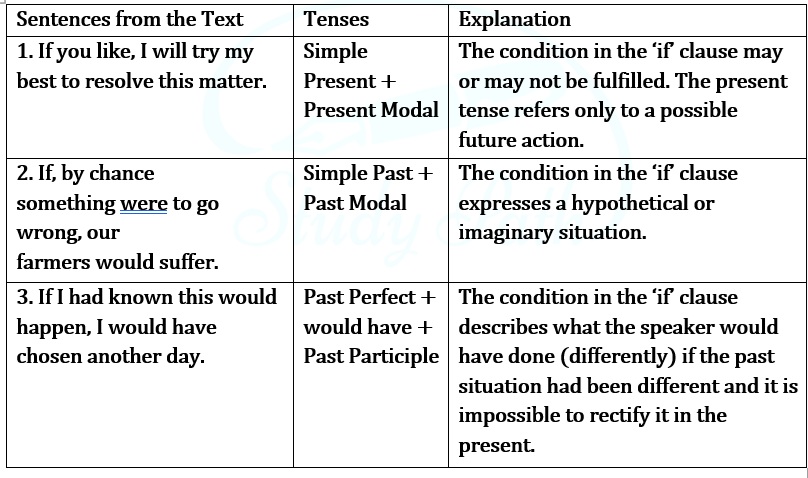
In sentence 1 ‘if you like’ is the subordinate clause (if clause) and ‘I will try my best to resolve this matter’ is the main clause.
Identify the subordinate and main clauses in sentences 2 and 3.
Answer: 2. Main clause – If, by chance something were to go wrong
Subordinate clause – our farmers would suffer
3. Main clause– I would have chosen another day.
Subordinate clause– If I had known this would happen
Let us write (Pages No. 15-16)
Now, match the subordinate clauses (if clauses) in Column 1 with the appropriate main clauses in Column 2 to make complete sentences.
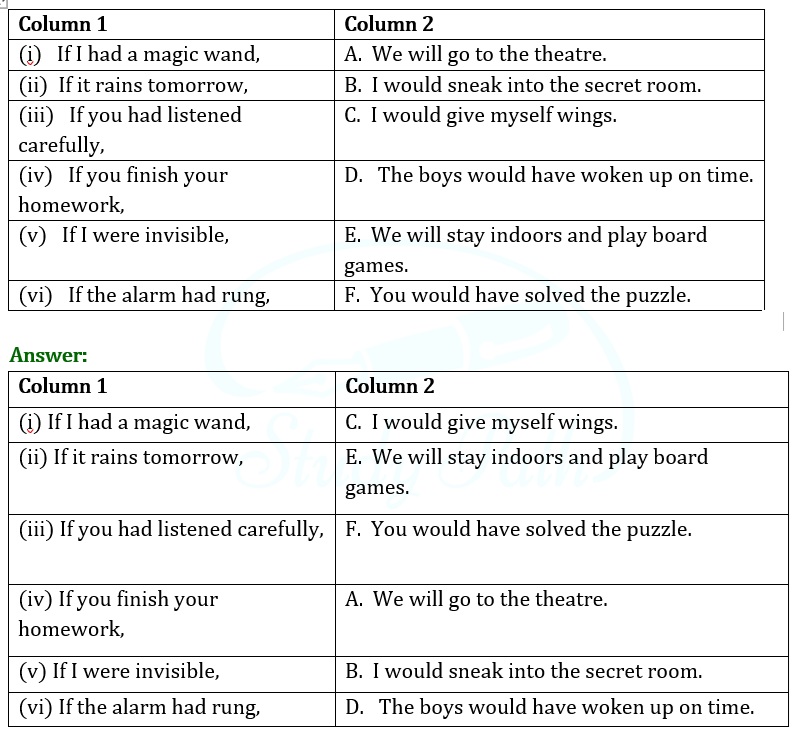
V Complete the following sentences appropriately with either the main clause or the subordinate clause (if clause).
1. Your teacher will be unhappy if _______________________.
2. They would have caught the train if _______________________.
3. _______________________ if you continue to stay up late every night.
4. If she knew the answer, _______________________.
5. _______________________ if she had studied harder.
6. If I had a million rupees, _______________________.
Answer:
1. Your teacher will be unhappy if you don’t finish your homework.
2. They would have caught the train if they had reached the station on time.
3. You will feel tired if you continue to stay up late every night.
4. If she knew the answer, she would raise her hand.
5. She would have scored better if she had studied harder.
6. If I had a million rupees, I would help the poor and save some for the future.
VI. Complete the following sentences. One example has been done for you.
1. If I were a tree, I would play with the wind and talk to the birds.
2. If I were the Head Teacher of my school, _______.
3. If I were a bird, _______.
4. If I were a magician, _______.
5. If I had studied harder, _______.
Answer:
2. If I were the Head Teacher of my school, I would make learning more fun.
3. If I were a bird, I would fly high above the clouds and explore different places.
4. If I were a magician, I would use my magic to help people.
5. If I had studied harder, I would have scored much better in my exams
Let us listen (Page 12-13)
I. You will listen to a woman narrating a story. As you listen, fill in the blanks in the following sentences by selecting the correct options. (Transcript for teacher on page 46)
1. The rope tying the bundle of sticks was _____.
(i) loose
(ii) thick
(iii) short
Answer: (ii) thick
2. The scholar is finally referred to as ________.
(i) irritable
(ii) mischievous
(iii) arrogant
Answer: (iii) arrogant
II You will once again listen to the story. As you listen, number the events of the story in the correct order of occurrence.
1. The great scholar was ashamed because he did not know what to say.
2. Rama accepted the challenge thrown by the visitor.
3. Rama had a bundle tied in silk when he came to the palace.
4. The king laughed at the explanation given by Rama.
5. The visitor wanted to show his superiority over others in the palace.
6. Rama showed the work to be a bundle of sticks tied together by a rope.
7. The king wanted to know more about the work mentioned by Rama.
8. The court scholars were afraid of the king’s anger
Answer: Correct order:
5. → 2. → 3. → 7. → 6. → 4. → 1. → 8.
About the Chapter: The Wit that Won Hearts
The story The Wit that Won Hearts follows Tenali Rama as he helps resolve a quarrel between King Krishnadeva Raya and the queen. Rather than offering direct criticism, he uses a clever example to help the king reconsider his reaction. The episode shows how humour and good judgement can restore harmony.
Students also explore pride, patience, and the importance of understanding another person’s feelings. The activities develop comprehension and vocabulary while encouraging thoughtful responses to the characters’ actions and the story’s message.