

NCERT Solutions for Class 8 English Poorvi Chapter 14 Magnifying Glass are provided here with simple and easy-to-understand explanations. This poem is a part of Unit 5: Science and Curiosity in the NCERT textbook Poorvi. It explores the hidden details revealed by a lens and the wonder of looking closely at ordinary things. These NCERT Solutions for Class 8 help students understand the main ideas, complete textbook activities, improve their language skills, and prepare for school examinations.
Magnifying Glass Class 8 English Questions and Answers
Let us do these activities before we read (Page no. 222)
I. Work in pairs. Answer the questions that follow the pictures given below.
Share your answers with your classmates and teacher.
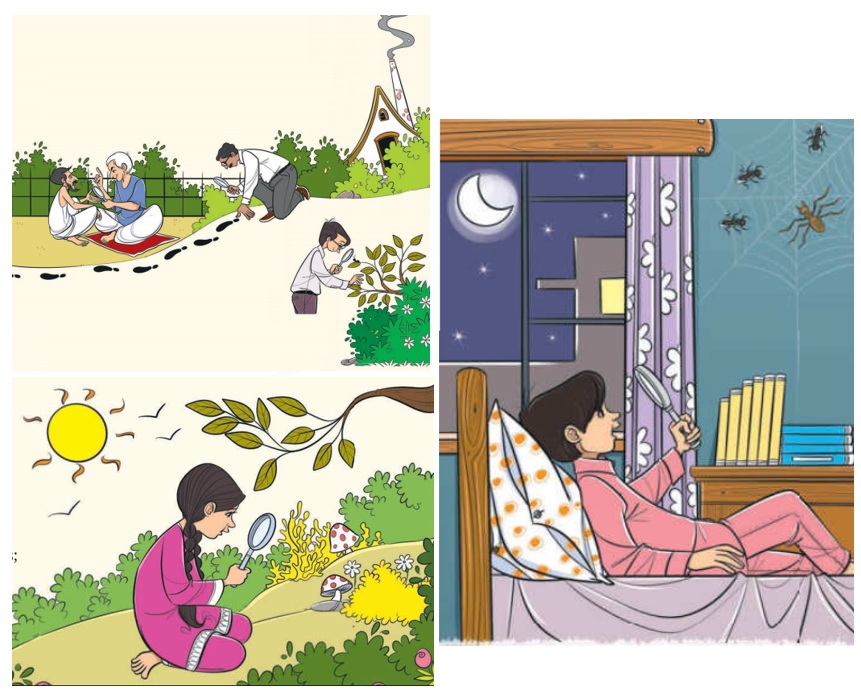
1. What is common in all these pictures?
Answer: People using magnifying glass is common in all these pictures.
2. Select the pictures you are familiar with.
Answer: The picture I am familiar with is the picture of a boy using the magnifying glass to study the ant on the leaf. (Responses may differ person to person).
3. Why do you think the people in the pictures need to use a magnifying glass?
Answer: The people in the pictures use a magnifying glass to closely observe small objects and details that cannot be seen clearly with normal eyesight. In the picture, an astrologer uses it to examine a person’s palm for palm-reading. A detective uses it to study the footprints of a criminal. A boy uses it to observe an ant on a leaf.
4. What other instruments magnify objects?
Answer: Other instruments that magnify objects include microscopes, telescopes, binoculars, and cameras with zoom lenses.
II. If you have a magnifying glass, what would you like to use it for and why? Share your answers with your classmates and teacher.
Answer: If I had a magnifying glass, I would use it to observe small insects, leaves, and flowers closely. It would help me notice tiny details such as patterns, veins, and movements that are not visible to the naked eye. This would help me understand nature better through careful observation.
Let us discuss (Page no. 223)
I. Complete the summary of the poem given below with suitable words from the poem.
The poem describes the magic of seeing the world through a 1. __________. It reveals how tiny things like 2. __________ and 3. __________ can appear vast and complex. Even a 4. __________ of water can seem like a hive of 5. __________. The poet is impressed at how the spider spins its 6. __________ from its 7. __________. The poem ends with the idea that, through lenses, the 8. __________ could seem within reach.
Answer: The poem describes the magic of seeing the world through a 1. magnifying glass. It reveals how tiny things like 2. chalk and 3. forests can appear vast and complex. Even a 4. drop of water can seem like a hive of 5. bees. The poet is impressed at how the spider spins its 6. web from its 7. spinnerets. The poem ends with the idea that, through lenses, the 8. moon could seem within reach.
II. Fill in the blanks by choosing the correct answer from the brackets.
1. The main idea of the poem is the transformative power of __________ (wonders in nature/close observation) through the magnifying glass.
Answer: close observation
2. The tone of the poem is __________ . (wonder and curiosity/peaceful and emotional)
Answer: wonder and curiosity
3. The poem has __________ stanzas with __________ lines in each stanza. Hence, it is a quatrain. (four; six/six; four)
Answer: six; four
4. The rhyme scheme of the poem is __________. (ABCD; ABCB)
Answer: ABCB
III. Pick examples from the poem for the following poetic devices.
1. Simile
Answer: “A drop of water, Like hive of bees.”
(The drop of water is compared to a hive of bees using “like”.)
2. Alliteration
Answer: “The woven web-silk.”
(Repetition of the ‘w’ sound.)
3. Metaphor
Answer: “With this round glass
I can make Magic talk – ”
(The magnifying glass is described as if it can talk, showing it as magical.)
IV. The poem is rich in visual imagery, painting vivid pictures of small, everyday things magnified into something grand.
1. In the line, ‘A myriad shells show in a scrap of chalk’, the magnifying glass reveals ______________________.
Answer: tiny shell-like patterns and composition of an ordinary piece of chalk.
2. In the line, ‘A forest—flowers and trees’ the poet uses the imagery of nature to emphasise ______________________.
Answer: how a very small patch of moss appears vast and rich like a forest when viewed through a magnifying glass.
V. Complete the following sentences with a reason.
1. The poet uses exclamation marks in lines, ‘The tigerish claws he has!’, ‘With all those eyes!’ and ‘In an afternoon!’ because it _______________________.
Answer: expresses the poet’s sense of wonder, excitement, and amazement at what the magnifying glass reveals.
2. In the phrase, ‘Magic talk’ the poet uses personification to describe the magnifying glass because it ______________________.
Answer: is shown as having the human ability to speak and reveal hidden secrets.
3. Each stanza follows a repetitive pattern of introducing a small or ordinary object and then describing the extraordinary details revealed through magnification.
This is because it supports the theme of __________ as the speaker reveals ____________.
Answer: This is because it supports the theme of close observation as the speaker reveals hidden beauty and complexity in ordinary things.
4. In the final stanza the poet shifts from small, everyday objects being magnified to a celestial body like moon because __________.
Answer: it shows that magnification can extend human curiosity from tiny details on Earth to vast objects in space.
Let us think and reflect (Page no 224-225)
I. Read the given extracts and answer the questions that follow.
1. With this round glass
I can make Magic talk—
A myriad shells show
In a scrap of chalk;
Of but an inch of moss
A forest—flowers and trees;
(i) Identify whether the following statement is true or false.
The poet uses his magical powers to make the round glass powerful.
Answer: False
Reason: The poet does not use magical powers. The round glass is a magnifying glass that naturally reveals hidden details through magnification, not magic.
(ii) Select the line from the extract that expresses the presence of intricate patterns in ordinary objects.
Answer: A myriad shells show / In a scrap of chalk.
(iii) What does the comparison of ‘an inch of moss’ to a ‘forest’ suggest about the speaker’s view of the world through the magnifying glass?
Answer: The comparison suggests that the speaker sees even tiny things as vast and rich when observed closely. The magnifying glass reveals hidden beauty and complexity in the natural world.
(iv) How does the poet feel about the ability of the magnifying glass to reveal hidden wonders?
A. Satisfied
B. Fascinated
C. Grateful
D. Determined
Answer: B. Fascinated
II. Answer the following questions.
1. What is the significance of the spider in the poem?
Answer: The spider represents the hidden skill and complexity found in small creatures. Through the magnifying glass, the poet notices the spider’s clever web-making and sharp claws. It shows that even small creatures possess strength, intelligence, and beauty when closely observed.
2. How might the speaker’s view of the natural world change if there was no use of a magnifying glass?
Answer: If there was no use of a magnifying glass, the speaker’s view of the natural world might change drastically. The poet might think that the natural world has nothing interesting or any small details that reveal secrets about the natural world.
3. Why does the poem end with the idea of the moon being within reach?
Answer: The poem ends with the idea of the moon being within reach to invoke a sense of curiosity in the readers. If the magnifying glass can magnify small creatures like spiders and celestial objects like the moon, just imagine what all the magnifying glass can reveal.
4. What is the speaker’s attitude towards nature and the act of observation?
Answer: The speaker’s attitude towards nature and the act of observation is positive. The speaker loves nature and its interesting details. The speaker has a keen, observant eye to study the nature better through the magnifying glass.
5. Which is your favourite part of the poem? Why?
Answer: My favourite part of the poem is the description of the spiders through the magnifying glass because it is interesting to know spider’s secrets.
Let us learn (Page no 224-225)
I. Fill in the blanks in the sentences with the words given in the box below.
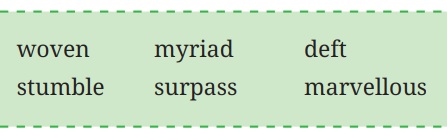
With his 1. ____________ description, the author has written the story beautifully 2. ____________with fascinating details. When you read the story, you will surely enjoy the 3. ____________storytelling technique that attracts all kinds of readers. What makes the story interesting is the superb way of describing the 4. ____________emotions and feelings of the characters. The reader will 5. ____________upon the unexpected twists and turns that 6. ____________ all our understanding and make us wonder at the narrative power of the author.
Answer: With his 1. deft description, the author has written the story beautifully 2. woven with fascinating details. When you read the story, you will surely enjoy the 3. marvellous storytelling technique that attracts all kinds of readers. What makes the story interesting is the superb way of describing the 4. myriad emotions and feelings of the characters. The reader will 5. stumble upon the unexpected twists and turns that 6. surpass all our understanding and make us wonder at the narrative power of the author.
II. The collective noun ‘a hive of bees’, is used in the poem. Match the phrases in Column 1 with suitable words in Column 2 to make collective nouns.
| Column 1 | Column 2 |
| 1. a swarm of | (i) ships |
| 2. a constellation of | (ii) soldiers |
| 3. a grove of | (iii) dancers |
| 4. a troupe of | (iv) locusts |
| 5. a battalion of | (v) trees |
| 6. a fleet of | (vi) stars |
Answer:
| Column 1 | Column 2 |
| 1. a swarm of | (iv) locusts |
| 2. a constellation of | (vi) stars |
| 3. a grove of | (v) trees |
| 4. a troupe of | (iii) dancers |
| 5. a battalion of | (ii) soldiers |
| 6. a fleet of | (i) ships |
III. The poet uses the expression ‘eyeing the moon’ in the poem. Match the idiomatic expressions with ‘eye’ given in Column 1 with their meanings in Column 2. You may refer to a dictionary.
| Column 1 | Column 2 |
| 1. apple of one’s eye | (i) watch something or someone closely |
| 2. in the blink of an eye | (ii) act as if you do not see or notice |
| 3. keep an eye on something or somebody | (iii) something that happens very quickly |
| 4. turn a blind eye | (iv) an overall look at something |
| 5. see eye to eye | (v) a person who is very precious or important |
| 6. bird’s-eye view | (vi) agree with each other |
Answer:
| Column 1 | Column 2 |
| 1. apple of one’s eye | (v) a person who is very precious or important |
| 2. in the blink of an eye | (iii) something that happens very quickly |
| 3. keep an eye on something or somebody | (i) watch something or someone closely |
| 4. turn a blind eye | (ii) act as if you do not see or notice |
| 5. see eye to eye | (vi) agree with each other |
| 6. bird’s-eye view | (iv) an overall look at something |
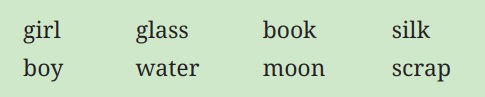
IV. The poet uses the adjective form ‘tigerish’ in the poem by adding the suffix -‘ish’ to the noun ‘tiger’. In the same way, we can make adjectives by adding the suffix -‘ish’ to some nouns.
Choose the nouns to which you can add the suffix -‘ish’ to make adjectives.

Let us listen (Page no 227)
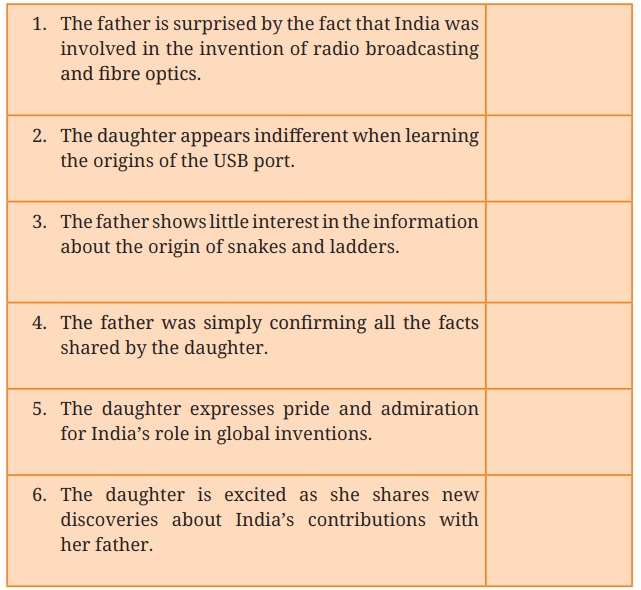
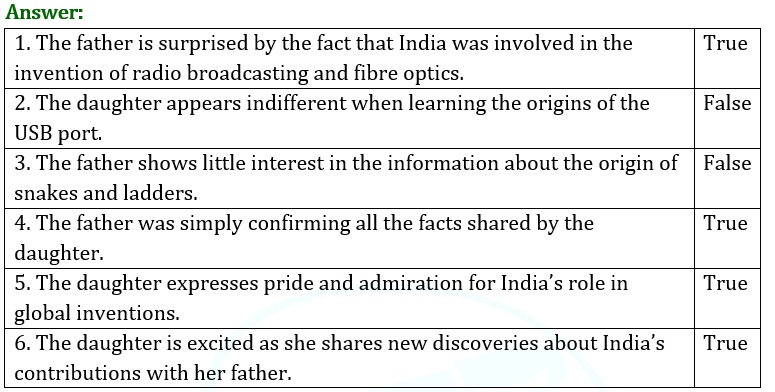
I. You will listen to a conversation between a father and daughter about lesser-known Indian inventions. As you listen, mark the four true statements from (1)–(6) given below. (Transcript for teacher on page 250).
Answer:
About the Poem: Magnifying Glass
The poem Magnifying Glass explores how close observation can transform familiar objects into sources of amazement. Through a magnifying lens, small details in materials, plants, and tiny living things appear rich and unexpected. The poem celebrates the discoveries that begin with curiosity.
Students also explore imagery, comparisons, and the connection between imagination and scientific observation. The activities encourage them to appreciate poetic language and describe how a closer look can change the way they understand the world around them.