

NCERT Solutions for Class 8 English Poorvi Chapter 9 Spectacular Wonders are provided here with simple and easy-to-understand explanations. This lesson is a part of Unit 3: Mystery and Magic in the NCERT textbook Poorvi. It explores remarkable natural phenomena and the curiosity they inspire. These NCERT Solutions for Class 8 help students understand the main ideas, complete textbook activities, improve their language skills, and prepare for school examinations.
Spectacular Wonders Class 8 Questions and Answers
Let us do these activities before we read (Page no. 137)
1. Look at the pictures given below and sort them into natural and man-made wonders.
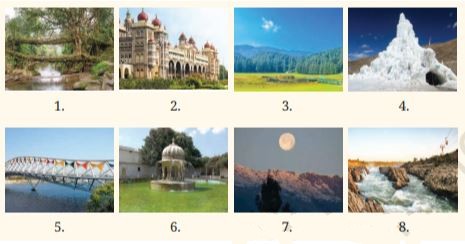
Natural: ______, ______, ______, and ______
Man-made: ______, ______, ______, and ______
Answer: Natural Wonders: 3, 4, 7, and 8
Man-made Wonders: 1, 2, 5, and 6
II. Which of these wonders—man-made or natural—are more appealing and why? Share your answers with your classmates and teacher.
Answer: Both are appealing in different ways. Natural wonders, like the Valley of Flowers, show nature’s full glory. Man-made wonders, like living root bridges, are incredible feats of engineering created by human innovation.
III. Work in pairs. Write down two wonders of nature that have amazed you. Discuss what makes them impressive. Share your answers with your classmates and teacher.
Answer: Two wonders of nature that have amazed me are the Valley of Flowers in Uttarakhand and Lonar Crater Lake in Maharashtra. The Valley of Flowers is impressive because it has rare wildlife and 600 flower species. Lonar Lake is a spectacular “geological wonder” created when a colossal meteorite crashed into Earth.
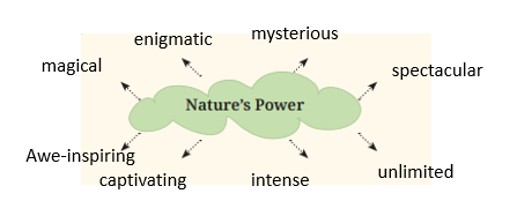
IV. Work in groups of four. Complete the web chart given below with words that you associate with the phrase, ‘Nature’s Power’. Share your answers with your classmates and teacher.
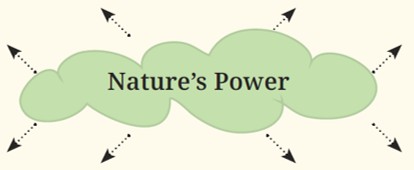
Answer:
Let us discuss (Page no. 142)
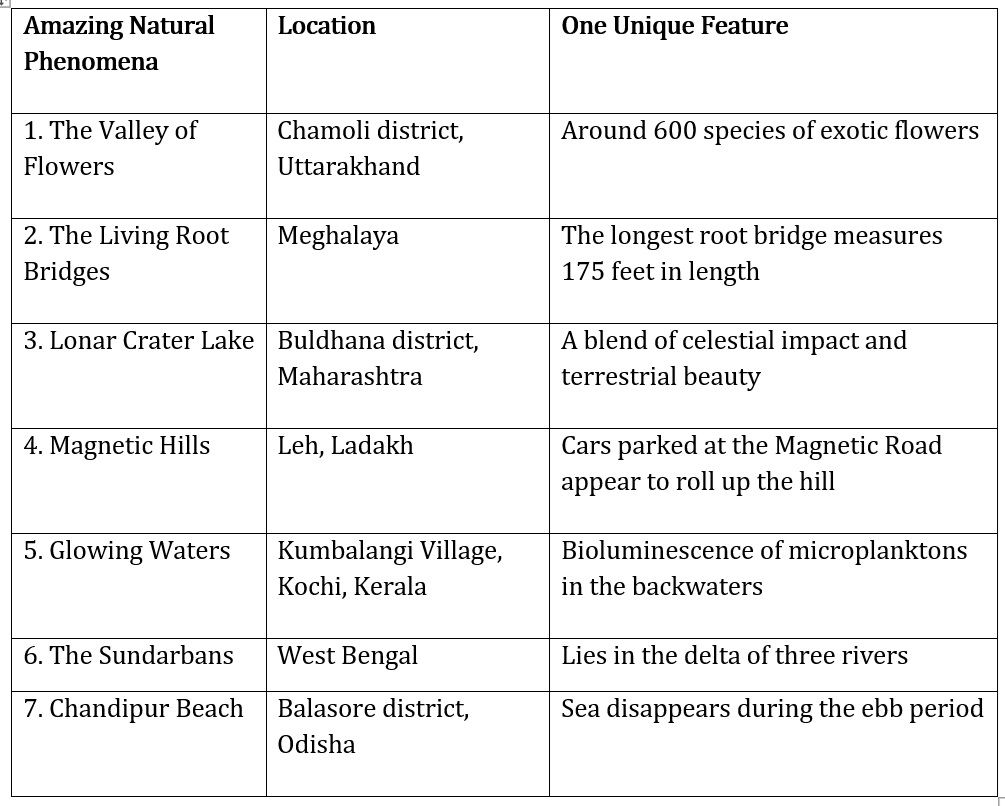
I. Complete the information in the table given below. One example has been done for you. Share your answers with your classmates and teacher.
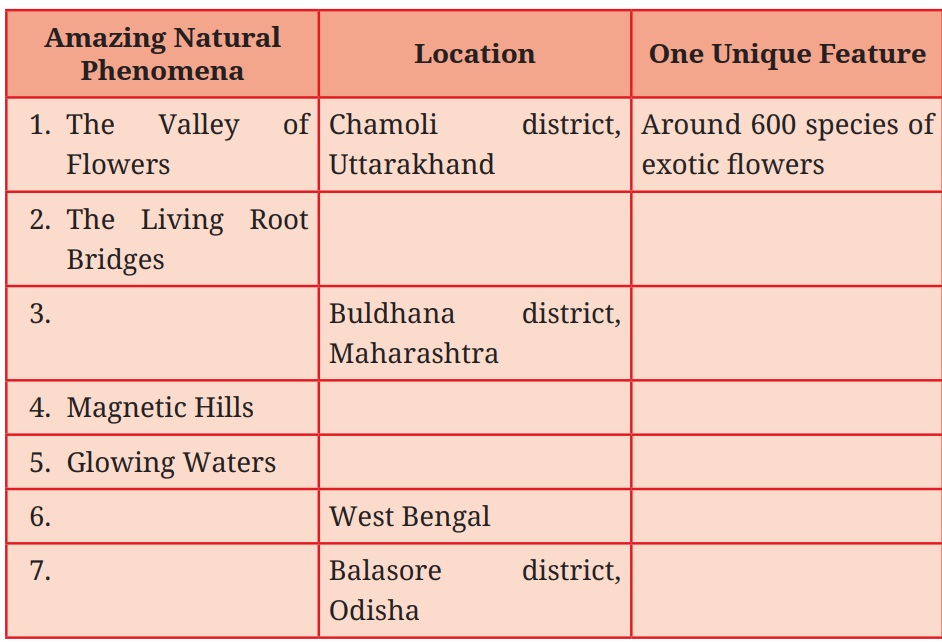
Answer:
Let us think and reflect (Pages no.142-144)
I. Read the given extracts and answer the questions that follow.
1. India is home to some of the most mystifying natural phenomena that surprise and spark our imagination.
(i) Replace the underlined phrase with one from the extract.
India is the birthplace of several rare species of flora and fauna that thrive in its diverse ecosystems.
Answer: India is home to several rare species of flora and fauna that thrive in its diverse ecosystems.
(ii) What does the phrase ‘nature’s unusual side’ suggest about the phenomena described?
Answer: The phrase ‘nature’s unusual side’ suggests that the phenomena described are rare, mysterious, and extraordinary.
(iii) Complete the similarity by choosing the correct option. spark: imagination : : ______________ : ______________.
A. inspiration; creativity
B. wonder; amazement
C. effort; reward
D. knowledge; books
Answer: B. wonder; amazement
(iv) Identify whether the following statement is true or false. Some natural phenomena can surprise people.
Answer: True
2. Have you seen things disappearing in front of your eyes? Well, such things happen at times, when we keep things at some place, and just forget where we have kept them. But, what if there’s a sea that disappears?
This happens in Odisha. It is a beach in the Balasore district where one can witness the sea disappearing mysteriously—the Chandipur Beach which is known for its unique feature of playing hide-and-seek with its visitors.
(i) Complete the following sentence with a suitable reason.
The writer’s most likely purpose to introduce the information about the Chandipur Beach phenomenon with a question is to ____________________. (engage the reader’s curiosity and create a sense of suspense/draw the reader to learn more about the unusual phenomenon/set the tone for the surprising nature of the content that follows)
Answer: draw the reader to learn more about the unusual phenomenon
(ii) Select the option that is correct for both Assertion (A) and Reason (R).
(A): Chandipur Beach in Odisha is known for its unique feature of the sea disappearing. (R): The tides retreat drastically, exposing the Chandipur beach.
A. Both (A) and (R) are true, and (R) is the correct explanation of (A).
B. Both (A) and (R) are true, but (R) is not the correct explanation of (A).
C. (A) is true, but (R) is false.
D. (A) is false, but (R) is true
Answer: A. Both (A) and (R) are true, and (R) is the correct explanation of (A).
(iii) What does the term ‘unique’ suggest about the beach in Balasore?
A. very popular
B. one of its kind
C. ancient place
D. far from city
Answer: B. one of its kind
(iv) What does the writer want to convey with the use of the phrase ‘playing hide-and-seek with its visitors’?
Answer: Through this phrase, the writer wants to convey how the Chandipur Beach disappears and appears periodically. The sea water retreats by about 2–5 km during ebb tide and returns during high tide. This unusual movement creates the illusion that the sea is disappearing and reappearing.
II. Answer the following questions. (Page 144)
1. How are the living root bridges a boon for the local people of Meghalaya?
Answer: The wood and bamboo bridges cannot withstand the heavy and harsh monsoon of Meghalaya. Living root bridges are a boon for the local people of Meghalaya because they provide safe passage across rivers, especially during monsoons. Made from tree roots, they last for hundreds of years and grow stronger with time.
2. Why is the Lonar Crater Lake considered a remarkable and rare site?
Answer: Lonar Crater Lake is considered remarkable and rare because it was formed thousands of years ago by a meteorite striking the Earth. It is the only crater in India formed in basaltic rock and is among the largest craters in the world. Its circular shape and saline lake make it scientifically important.
3. What might be the writer’s purpose of highlighting the awe-inspiring natural wonders of India? (Page 144)
Answer: The writer’s purpose is to showcase the rich and diverse natural wonders of India and create a sense of pride among readers. By describing their beauty and uniqueness, the writer also encourages people to respect, preserve, and protect nature for future generations.
4. The writer uses descriptive language and introductory questions for some of the natural phenomena. What impact does it have on the readers?
Answer: The use of descriptive language and introductory questions makes the text lively and engaging. It draws readers into the topic, arouses curiosity, and helps them visualise the natural phenomena clearly. This style keeps readers interested and makes the information easier to understand and remember.
5. Which of these unusual phenomena did you find the most interesting and why?
Answer: I found the Invisible Chandipur Beach most interesting because of its “hide-and-seek” nature. The way the sea mysteriously disappears during ebb tide and then reappears during high tide is fascinating. Seeing a massive body of water vanish in front of eyes is a perfect example of nature’s extraordinary and surprising power.
Let us learn (Page no. 144-148)
1. Fill in the blanks with the correct expressions from the text given in the box below.

1. I have read many stories _____________________.
2. Do you know when this little town _____________________?
3. His hard work has helped him _____________________.
4. There are no simple solutions to the _____________________ of traffic jams.
5. He opened the ancient wooden box and stared at the treasure _____________________.
6. The garden is _____________________ in spring with lots of beautiful flowers in bloom.
Answer:
1. to name a few
2. came into existence
3. to no end
4. age-old problem
5. In disbelief
6. in full glory
II. Select the correct synonyms from the box given below that match the list of words in 1–5. You may refer to a thesaurus.
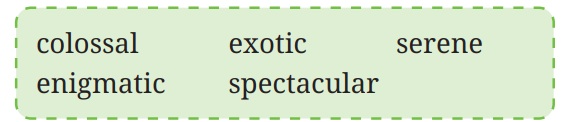
1. mysterious, puzzling, baffling
2. mighty, gigantic, huge
3. breath-taking, stunning, awe-inspiring
4. peaceful, calm, tranquil
5. unusual, peculiar, foreign
Answer:
1. enigmatic
2. colossal
3. spectacular
4. serene
5. exotic
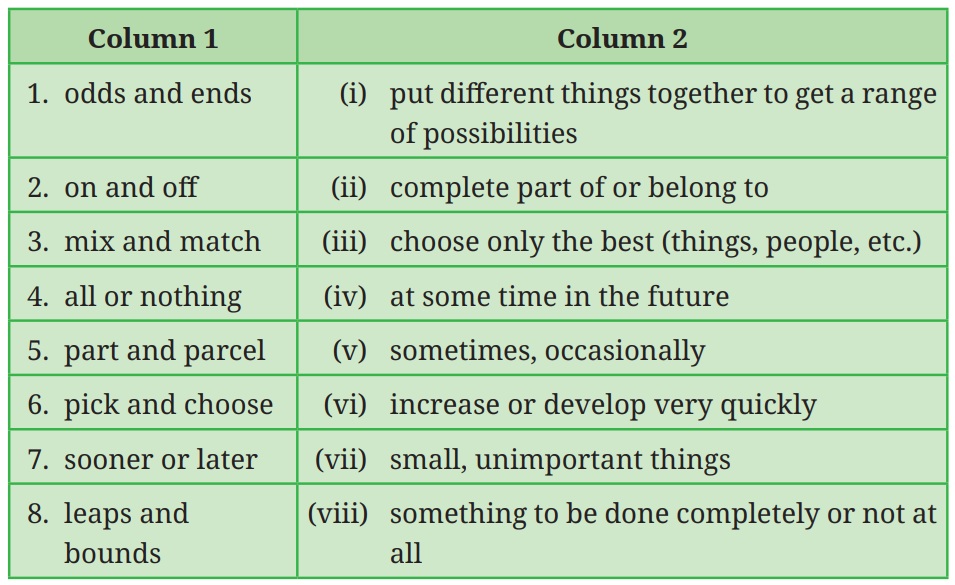
III. The expressions ‘hide-and-seek’ and ‘flora and fauna’ are used in the text. These are called binomials—a pair of fixed words joined by ‘and’ or ‘or’. The binomials are mostly synonyms, antonyms, rhyming words, same sound words (alliterations), etc.
Match the binomials in Column 1 with their meanings in Column 2. You may refer to a dictionary.
Answer:
| Column 1 | Column 2 |
| 1. odds and ends | (vii) small, unimportant things |
| 2. on and off | (v) sometimes, occasionally |
| 3. mix and match | (i) put different things together to get a range of possibilities |
| 4. all or nothing | (viii) something to be done completely or not at all |
| 5. part and parcel | (ii) complete part of or belong to |
| 6. pick and choose | (iii) choose only the best (things, people, etc.) |
| 7. sooner or later | (iv) at some time in the future |
| 8. leaps and bounds | (vi) increase or develop very quickly |
Use the binomials given in Column 1 in sentences of your own.
Answer:
1. Odds and ends: I cleaned my drawer and found many odds and ends that I had forgotten about.
2. On and off: It has been raining on and off since morning.
3. Mix and match: You can mix and match these clothes to create a new outfit.
4. All or nothing: The final match was an all or nothing situation for both teams.
5. Part and parcel: Hard work is a part and parcel of success.
6: Pick and choose: We were allowed to pick and choose our favourite books from the library.
7: Sooner or later: Sooner or later, everyone realises the importance of honesty.
8: Leaps and bounds: With regular practice, her confidence improved leaps and bounds.
IV. Study the highlighted words in the following sentences from the text.
• The living root bridges are one of Meghalaya’s most beautiful…
• …creating a striking visual contrast against the surrounding rugged terrain.
In the given sentences, the highlighted words ‘living’, ‘striking’, and ‘rugged’ are examples of verbs used as adjectives. Such verbs are called participles.
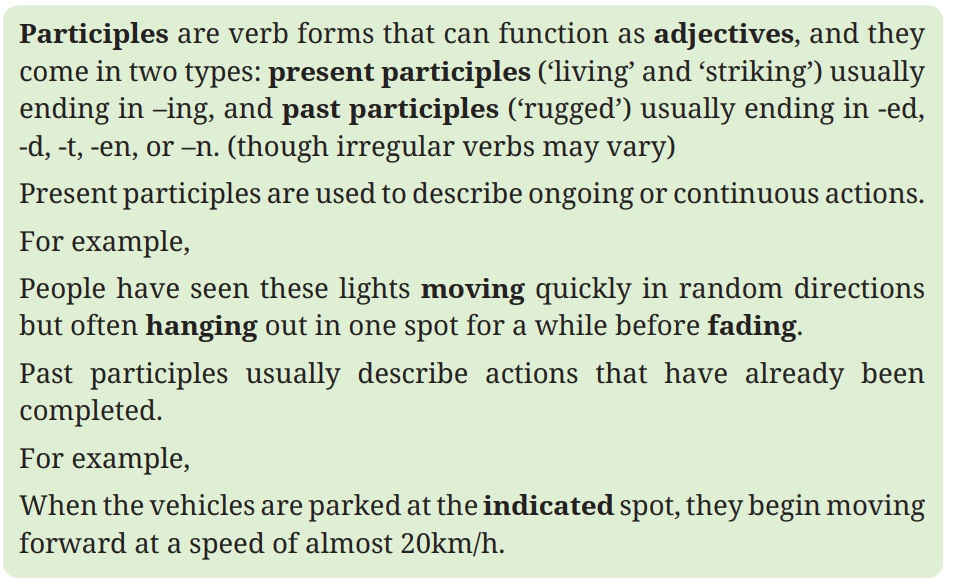
Now, fill in the blanks using present participle or past participle form of the verbs in the box given below.

1. The _______________ marble monument looks even more spectacular in the moonlight.
2. The _______________ view of the Himalayas from Darjeeling attracts visitors from all over the world.
3. The Sun Temple in Konark features intricately _______________ stone wheels and walls.
4. _______________ at a height of 182 m, the Statue of Unity is dedicated to Sardar Vallabhbhai Patel.
5. The _______________ islands of the Andaman and Nicobar offer some of the cleanest beaches in India.
Answer:
1. glowing
2. amazing
3. carved
4. Standing
5. scattered
V. Study the highlighted word in the following sentence from the text.
Crossing the many waterways without bridges was difficult for people in the past, during monsoons.
In the given sentence, the highlighted word ‘crossing’, is one example of a verb used as a noun. Such a verb is called gerund.
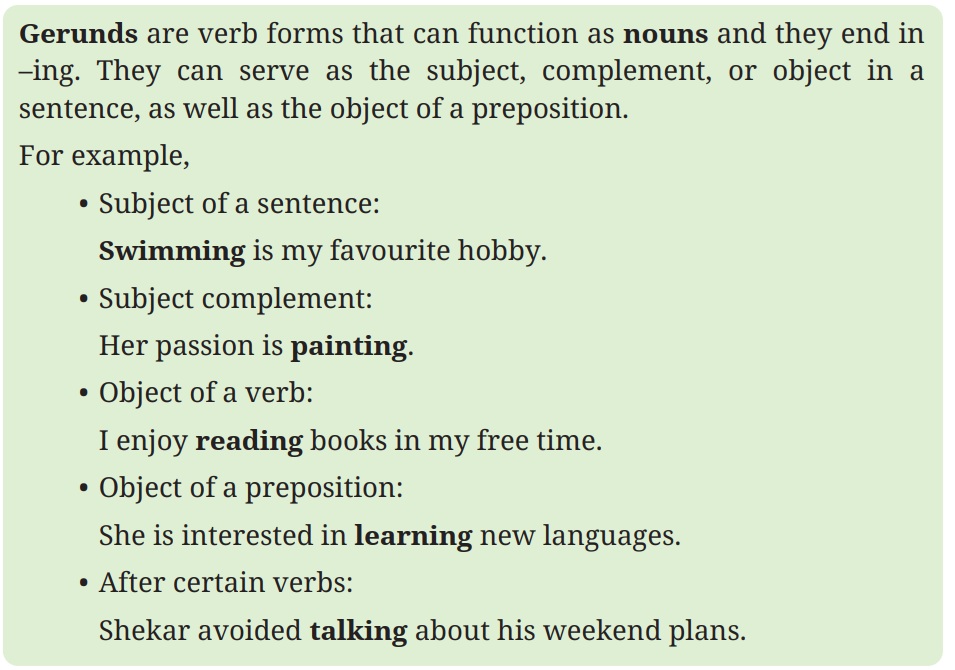
Underline the gerunds and participles in the following sentences. Write ‘G’ for gerunds and ‘P’ for participles in the space provided. One example has been done for you.
1. Dancing is a great way to express emotions. G
2. Travelling can broaden your perspective.
3. The falling leaves signalled the arrival of autumn.
4. She enjoys cooking new recipes for her family.
5. Reading helps improve your vocabulary.
6. He watched the shimmering stars in the night sky.
7. Forgetting the keys inside, Kanchan locked the door.
Answer:
1. Dancing is a great way to express emotions. → G
2. Travelling can broaden your perspective. → G
3. The falling leaves signalled the arrival of autumn. → P
4. She enjoys cooking new recipes for her family. → G
5. Reading helps improve your vocabulary. → G
6. He watched the shimmering stars in the night sky. → P
7. Forgetting the keys inside, Kanchan locked the door. → P
VI. Combine the following pairs of sentences using participles or gerunds. You may use the clues given in brackets. One example has been done for you.
1. Nitesh entered the room. He saw his friend sitting in the corner. (participle)
Answer: Entering the room, Nitesh saw his friend sitting in the corner.
2. Smitha walked carelessly. She slipped on the doormat. (participle)
3. Sleep for eight hours. It is good for health. (gerund)
4. Ranjith felt happy about the result. He called his parents. (participle)
5. Father encouraged Meena. Meena joined the course. (gerund)
Answer:
2. While walking carelessly, she slipped on the doormat. (Participle)
3. Sleeping for eight hours is good for health. (gerund)
4. Feeling happy about the result, he called his parents. (Participle)
5. Father encouraged Meena’s joining the course. (gerund)
Let us listen (Page no. 148)
I. You will listen to a brother and sister discuss a natural phenomenon. As you listen, mark the four true statements from 1–6 given below. (Transcript for teacher on page 153)
1. The brother was taken aback to see the posted pictures.
2. The brother admitted to not knowing about his sister’s favourite picture.
3. The sister stated that the rainbow mountain was like any other mountain.
4. The brother was aware of the reason for the formation of colours on the mountain.
5. The brother was surprised to learn about the mountain being covered with snow till recently.
6. The sister understood nature’s role in the beauty of the mountain.
Answer:
1. False
2. True
3. False
4. True
5. True
6. True
Let us write (Page no. 149)
I. You just read vivid descriptions of the natural wonders of our country. Write a descriptive essay for your school magazine describing anything from nature that attracted your attention. It may be an object, a place, or an event experienced by you. Remember to give a title to your essay.
Use proper format and content organisation—begin with a title, include introduction (one paragraph), body (two to three paragraphs), and conclusion (one paragraph).
Answer:
The Magical Beauty of the Valley of Flowers
Nature has always attracted me with its beauty, but the Valley of Flowers in Uttarakhand impressed me the most. This place is famous for its colourful flowers, peaceful surroundings, and breathtaking scenery.
The Valley of Flowers is covered with hundreds of rare and exotic flowers like orchids, poppies, and daisies. During the blooming season, the entire valley turns into a carpet of bright colours. Snow-covered mountains, flowing streams, and fresh air add to its charm, making it a paradise for nature lovers.
The valley is also home to rare animals and birds such as butterflies, birds, and even the snow leopard. The sight of flowers blooming naturally in such a harsh mountainous region shows the strength and beauty of nature. It also reminds us how important it is to protect such fragile ecosystems.
In conclusion, the Valley of Flowers is a true wonder of nature. It teaches us to respect and preserve the environment. Its beauty, calmness, and richness make it one of the most attractive natural places in India.
About the Chapter: Spectacular Wonders
The lesson Spectacular Wonders introduces unusual features and phenomena found in different parts of India. Its descriptions invite students to look closely at the natural world and consider the explanations behind sights that may initially seem mysterious.
Students also explore how descriptive language communicates wonder and helps readers imagine unfamiliar places. The chapter encourages observation, curiosity, and thoughtful questioning while building vocabulary and the ability to identify key information in an informative text.