

NCERT Solutions for Class 8 Science Chapter 2 The Invisible Living World: Beyond Our Naked Eye are provided here with simple and easy-to-understand explanations. Based on the NCERT textbook Curiosity, this chapter introduces cells, microorganisms, and the living world that cannot usually be seen without magnification. These solutions help students connect scientific ideas with familiar examples and complete textbook activities with confidence.
The Invisible Living World: Beyond Our Naked Eye Class 8 Questions and Answers
Probe and Ponder Questions (Page No. 8)
Question: Have you ever wondered what you might see if the invisible world around you became visible?
Answer: If the invisible world became visible, we would see millions of microorganisms such as bacteria, fungi, protozoa and viruses living all around us. Observing them would make us realise how active and diverse this hidden world is. It would also change how we perceive cleanliness, health, and the complexity of ecosystems around us.
Question: How do you think your observation of this hidden world might change the way you think about size, complexity, or even what counts as ‘living’?
Answer: Observing the hidden world would show that even the smallest organisms have complex structures and functions such as movement, reproduction, response to stimuli and forming colonies. This would broaden our understanding of what qualifies as a living being and show that size does not limit the complexity of life.
Question: Have you thought about how these tiny living beings interact with each other?
Answer: Yes, tiny living beings interact in many ways. Some compete for food, some live together in harmony and some even depend on each other for survival. Some are decomposers break down dead matter, while others act as food for larger organisms. Certain bacteria produce substances that kill other microbes. These interactions play a vital role in maintaining balance in ecosystems.
Keep the Curiosity Alive (Pages no. 25-26)
Question 1. Various parts of a cell are given below. Write them in the appropriate places in the following diagram.
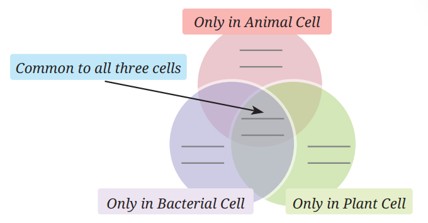
- Nucleus
- Cytoplasm
- Chloroplast
- Cell wall
- Cell membrane
- Nucleoid
Answer:
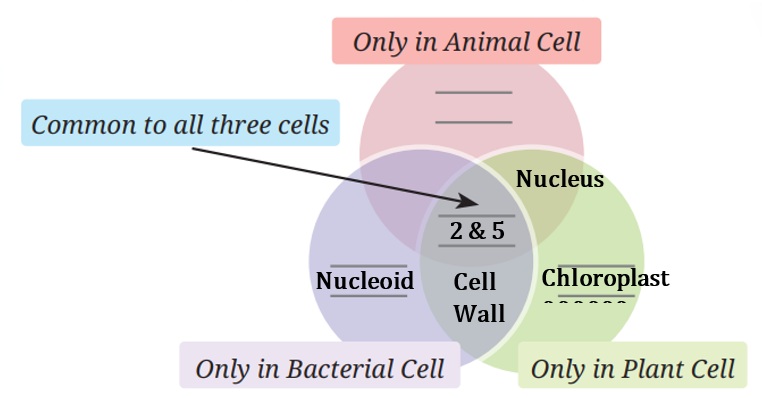
Nucleus: Present in plant and animal cells (not in bacterial cells), controls the cell’s activities.
Cytoplasm: Jelly-like substance that fills the cell and contains all organelles.
Chloroplast: Found only in plant cells, responsible for photosynthesis.
Cell wall: Found in plant and bacterial cells, forms the outermost layer.
Cell membrane: Found in all cells, located inside the cell wall in plant/bacterial cells or as the outer layer in animal cells.
Nucleoid: Found only in bacterial cells; the region where DNA is located since bacteria don’t have a true nucleus.
Question 2. Aanandi took two test tubes and marked them A and B. She put two spoonfuls of sugar solution in each of the test tubes. In test tube B, she added a spoonful of yeast. Then she attached two incompletely inflated balloons to the mouth of each test tube. She kept the setup in a warm place, away from sunlight.
(i) What do you predict will happen after 3-4 days? She observed that the balloon attached to test tube B was inflated. What can be a possible explanation for this?
(a) Water evaporated in test tube B and filled the balloon with the water vapour.
(b) The warm atmosphere expanded the air inside test tube B, which inflated the balloon.
(c) Yeast produced a gas inside test tube B, which inflated the balloon.
(d) Sugar reacted with warm air, which produced gas, eventually inflating the balloon.
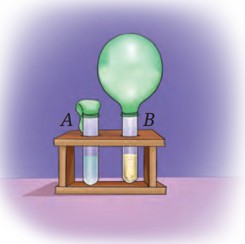
Answer: (c) Yeast produced a gas inside the test tube B, which inflated the balloon.
Explanation: The yeast fermented the sugar, releasing carbon dioxide gas (CO2), which inflated the balloon.
(ii) She took another test tube, 1/4 filled with lime water. She removed the balloon from test tube B in such a manner that the gas inside the balloon did not escape. She attached the balloon to the test tube with lime water and shook it well. What do you think she wants to find out?
Answer: She wants to test whether the gas produced in test tube B is carbon dioxide (CO2) or not. When the gas from the balloon is passed into lime water, if the lime water turns milky, it confirms the presence of carbon dioxide (CO₂). This is because CO2 reacts with lime water to form calcium carbonate.
Question 3. A farmer was planting wheat crops in his field. He added nitrogen-rich fertiliser to the soil to get a good yield of crops. In the neighbouring field, another farmer was growing bean crops, but she preferred not to add nitrogen fertiliser to get healthy crops. Can you think of the reasons?
Answer: Wheat cannot fix nitrogen on its own, so the farmer adds nitrogen-rich fertiliser to increase soil fertility and crop yield.
But beans are leguminous crops that form a symbiotic relationship with Rhizobium bacteria present in their root nodules. These bacteria trap nitrogen from the air and convert it into usable forms for the plant. Hence, the bean farmer does not need to add nitrogen fertiliser.
Question 4. Snehal dug two pits, A and B, in her garden. In pit A, she put fruit and vegetable peels and mixed them with dried leaves. In pit B, she dumped the same kind of waste without mixing it with dried leaves. She covered both the pits with soil and observed after 3 weeks. What is she trying to test?
Answer: Snehal is comparing decomposition of waste with and without dried leaves.
- In Pit A, fruit and vegetable peels are mixed with dried leaves. This creates the right balance of wet and dry waste. This allowed microorganisms to act and produce compost faster.
- In Pit B, only wet waste is present, which may decompose slowly, give a foul smell or not form good compost.
This experiment shows that decomposing agents like microorganisms work better when both carbon-rich and nitrogen-rich materials are present.
Question 5. Identify the following micro-organisms:
(i) I live in every kind of environment, and inside your gut.
(ii) I make bread and cakes soft and fluffy.
(iii) I live in the roots of pulse crops and provide nutrients for their growth.
Answer:
(i) Bacteria: They live in all environments, like water, soil, air, and inside our gut, helping with digestion.
(ii) Yeast: This fungus makes bread and cakes soft and fluffy by producing carbon dioxide gas during fermentation.
(iii) Rhizobium: This bacterium lives in root nodules of pulse crops (like beans) and traps nitrogen from the air to make nutrients for plants
Question 6. Devise an experiment to test that microorganisms need optimal temperature, air, and moisture for their growth.
Answer: Aim: Experiment to Test Microorganism Growth:
Materials: Bread slice, water, yeast powder, a warm place, a refrigerator, a sealed plastic bag.
Steps:
1. Take the bread slices (A, B, C)
2. In slice A, add a pinch of yeast and a few drops of water, then cover it and keep it in a warm place (like near a window).
3. In slice B, add a pinch of yeast and water, then put it in a refrigerator (cold, moist, with air).
4. In slice C, add a pinch of yeast, but don’t add water, and seal it in a plastic bag (warm, dry, no air).
5. Observe all bowls after 2–3 days.
Observation:
- Slice A (warm, moist, with air) will show the most growth, like mould or fluffy yeast, because microorganisms grow best in warm, moist conditions with air.
- Slice (cold) will show little or no growth, as cold slows microorganisms.
- Slice (dry, no air) will show no growth, as microorganisms need moisture and air.
Conclusion: Microorganisms grow best when temperature, moisture, and air are optimal.
Question 7. Take 2 slices of bread. Place one slice on a plate near the sink. Place the other slice in the refrigerator. Compare after three days. Note your observations. Give reasons for your observations.
Answer:
- Slice kept near the sink (warm and moist place) shows mould growth
- Slice kept in the refrigerator shows little or no mould growth even after three days.
Reason: Microorganisms like moulds grow best in warm and moist conditions (near the sink). The refrigerator has a cold environment that slows down the growth and activity of microorganisms.
Question 8. A student observes that when curd is left out for a day, it becomes more sour. What are two possible explanations for this observation?
Answer: Two possible explanations are:
- The Lactobacillus bacteria already present in curd continue to multiply when it is left out in warm conditions. They produce more lactic acid, making the curd taste more sour.
- If left exposed, other microorganisms from the air may also act on the curd, further increasing the sourness.
Question 9. Observe the set-up given in Figure and answer the following questions.
(i) What happens to the sugar solution in flask A?
(ii) What do you observe in test tube B after four hours? Why do you think this happened?
(in) What would happen if yeast were not added to flask A?
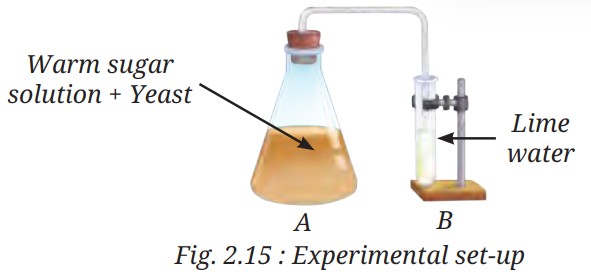
Answer: (i) The yeast ferments the sugar in the warm solution, producing alcohol and carbon dioxide (CO₂) gas.
(ii) The lime water in test tube B turns milky because the CO₂ gas released from flask A passes into it, confirming the presence of carbon dioxide.
(iii) Fermentation would not occur, so no carbon dioxide would be produced. As a result, lime water would remain clear in test tube B.
Class 8 Science Chapter 2 The Invisible Living World: Beyond Our Naked Eye Question Answer
These NCERT Solutions for Class 8 Science Curiosity Chapter 2 help students understand important concepts, complete textbook activities, and revise the chapter for school examinations.
The chapter The Invisible Living World: Beyond Our Naked Eye explores cells as the basic units of living organisms. Students learn about differences in cell shape and structure, the organisation of living bodies, and the use of microscopes to observe tiny forms of life.
Students also study microorganisms and their connections with food, decomposition, and the environment. Examples such as curd formation and the action of yeast help them understand the activities of microbes and recognise that microscopic organisms can have important effects on everyday life.