

NCERT Solutions for Class 8 Science Chapter 3 Health: The Ultimate Treasure are provided here with simple and easy-to-understand explanations. Based on the NCERT textbook Curiosity, this chapter introduces physical, mental, and social well-being, healthy habits, and the prevention of disease. These NCERT Solutions for Class 8 help students understand important concepts, complete textbook activities, and revise the chapter for school examinations.
Health: The Ultimate Treasure Class 8 Questions and Answers
Probe and Ponder Questions (Page no. 28)
Question 1: How does your body respond to an infection such as the common cold?
Answer: The body responds to a common cold (caused by viruses) through the immune system. Symptoms like runny nose, sore throat, sneezing, cough, mild fever and tiredness occur as the body fights the infection. The immune system produces antibodies to neutralize the virus, and white blood cells attack infected cells.
Question 2. We rarely see cases of smallpox or polio these days, but diseases like diabetes and heart problems are more common. Why?
Answer: Smallpox and polio are communicable diseases caused by viruses. They have been largely eliminated through effective vaccination programmes and public health campaigns. That’s why we rarely see them today.
On the other hand, non-communicable diseases (NCDs) such as diabetes and heart disease are increasing. This is due to changes in lifestyle, unhealthy eating, less exercise, and longer life spans. Most deaths in India now are caused by NCDs.
Question 3. Could climate change lead to new types of diseases?
Answer: Yes, climate change can lead to new or increased disease risks. Rising temperatures, changing rainfall, floods and warmer winters create conditions where disease-causing organisms (pathogens) and vectors like mosquitoes can spread more easily. For example, the arrival of monsoon leads to more malaria and dengue cases. With changing climate, new patterns of diseases and even new diseases may appear.
Question 4. How do emotions like stress or worry affect us and make us sick?
Answer: Health is not just physical fitness but also mental and social well-being. Excessive stress it may our immune system, reduces our ability to fight diseases, and can cause problems such as headaches, sleep disorders, anxiety, and even weight loss and make us fall sick.
Question 5. Why do some groups of people get affected more than others during disease outbreaks?
Answer: Not everyone’s body responds equally to disease-causing organisms. Our ability to fight infections depends on immunity. Some people, like children, the elderly, may have lower immunity. Such groups are more vulnerable and get affected more during outbreaks. On the other hand, healthier people with stronger immune systems can fight infections better and are less likely to get affected.
Keep the Curiosity Alive – Exercises Questions (Pages 42-45)
Question 1. Group the diseases shown in the images as communicable or non-communicable.
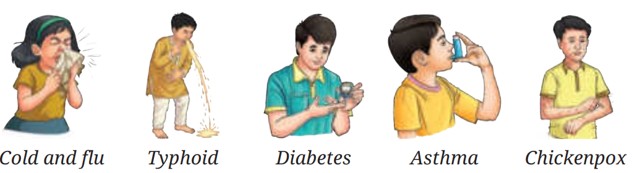
Answer: Communicable Diseases
- Cold and Flu
- Typhoid
- Chickenpox
Non-communicable Diseases
- Diabetes
- Asthma
Question 2. Diseases can be broadly grouped into communicable and non-communicable diseases. From the options given below, identify the non-communicable diseases.
(i) Typhoid
(ii) Asthma
(iii) Diabetes
(iv) Measles
(a) (i) and (ii)
(b) (ii) and (iii)
(c) (i) and (iv)
(d) (ii) and (iv)
Answer: (b) (ii) and (iii)
Question 3. There is a flu outbreak in your school. Several classmates are absent, while some are still coming to school coughing and sneezing.
(i) What immediate actions should the school take to prevent further spread?
(ii) If your classmate, who shares the bench with you, starts showing symptoms of the flu, how can you respond in a considerate way without being rude or hurtful?
(iii) How can you protect yourself and others from getting infected in this situation?
Answer:
(i) The school should advise sick students to rest at home, sanitise classrooms and encourage handwashing to stop the spread of flu.
(ii) I would politely suggest my classmate to inform the teacher or visit the school nurse and rest at home.
(ii) Frequent handwashing, not sharing items, wearing mask, and keeping safe distance from sick classmates can protect both myself and others from getting infected.
Question 4. Your family is planning to travel to another city where malaria is prevalent.
- What precautions should you take before, during, and after the trip?
- How can you explain the importance of mosquito nets or repellents to your sibling?
- What could happen if travellers ignore health advisories in such areas?
Answer:
(i) To protect our family from malaria during travel, focus on preventing mosquito bites and taking prescribed preventative medication.
- Before the trip: Consult a doctor, get necessary medicines, and pack mosquito repellent and protective clothing.
- During the trip: Wear full-sleeved clothes, use mosquito repellents, and sleep under nets. Avoid stagnant water nearby.
- After the trip: Watch for symptoms like fever or chills and consult a doctor immediately if they appear.
(ii) I will tell my sibling that mosquitoes spread malaria by biting us. Using mosquito nets and repellents keeps them away while we sleep or play.
(iii) If precautions are ignored, travellers may get malaria leading to high fever, weakness, and even serious complications.
Question 5. Your uncle has started smoking just to fit in with his friends, even though it is well known that smoking can seriously harm health and even cause death.
(i) What would you say to him to make him stop, without being rude?
(ii) What would you do if your friend offered you a cigarette at a party?
(iii) How can schools help prevent students from indulging in such harmful habits?
Answer:
(i) I would politely tell my uncle that smoking causes serious health issues including heart disease and lung cancer. I would remind him that his family cares for him and would be happier if he chose a healthier lifestyle instead of risking his life.
(ii) I would firmly but politely refuse and explain that smoking is harmful to the lungs, heart, and overall health. Instead, I would encourage my friend to enjoy the party in healthier ways, like playing games and dancing.
(iii) Schools can organize health awareness campaigns, invite doctors to explain the harmful effects of smoking, and add related lessons to the curriculum. They can also encourage sports and hobbies to build confidence and ensure strict rules to stop the sale or use of tobacco around schools.
Question 6. Saniya claims to her friend Vinita that “Antibiotics can cure any infection, so we don’t need to worry about diseases.” What question(s) can Vinita ask her to help Saniya understand that her statement is incorrect?
Answer: Antibiotics only work against bacterial infections, not viral ones like the flu or common cold. Overuse or misuse of antibiotics can lead to antibiotic resistance, making them less effective in the future. Some diseases are caused by fungi, protozoa, or viruses, which require different treatments.
So, Vinita can ask questions like:
- Do antibiotics cure viral infections like flu or chickenpox?
- If antibiotics worked for everything, why do we still need vaccines?
Question 7. The following table contains information about the number of dengue cases reported in a hospital over one year:
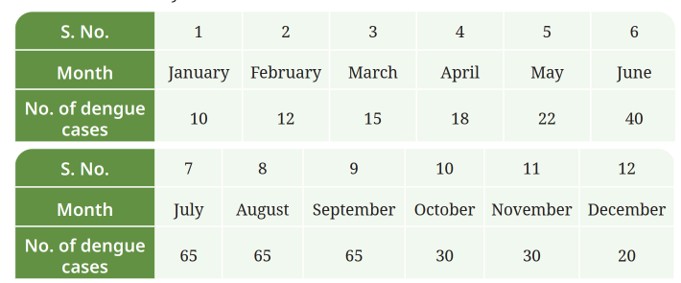
Make a bar graph of the number of cases on the Y-axis and the month on the X-axis. Critically analyse your findings and answer the following:
(i) In which three months were the dengue cases highest?
(ii) In which month(s) were the cases lowest?
(iii) What natural or environmental factors during the peak months might contribute to the increase in dengue cases?
(iv) Suggest a few preventive steps that the community or government can take before the peak season to reduce the spread of dengue.
Answer:
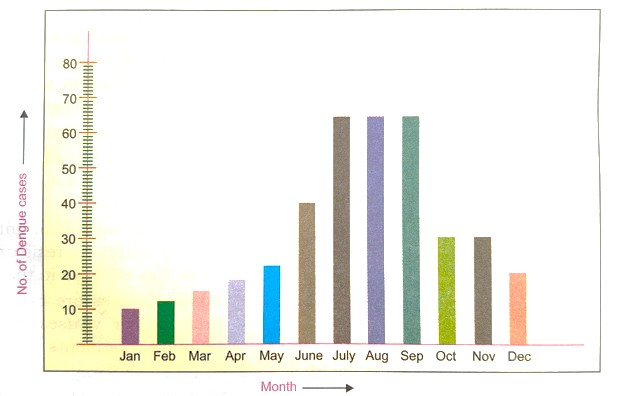
(i) The dengue cases were highest in July, August, and September.
(ii) The cases were lowest in January.
(iii) Natural or environmental factors during the peak months, such as the rainy season and standing water for mosquito breeding, might contribute to the increase in dengue cases.
(iv) The community or government can take preventive steps like removing stagnant water, using mosquito nets, and spraying insecticides during this period regularly to reduce the spread of dengue.
Question 8. Imagine you are in charge of a school health campaign. What key messages would you use to reduce communicable and non-communicable diseases?
Answer: In a school health campaign, I would promote handwashing, clean surroundings, vaccination, and safe food/water to prevent communicable diseases, and encourage healthy diet, exercise, no tobacco/alcohol, stress control, and enough sleep to prevent non-communicable diseases.
OR
In a school health campaign, the focus should be on preventing communicable diseases (caused by pathogens) and non-communicable diseases (caused by lifestyle factors).
Key messages could be:
For communicable diseases:
- Wash hands regularly with soap.
- Keep classrooms and surroundings clean.
- Cover mouth and nose while coughing/sneezing.
- Drink safe water and eat properly cooked food.
- Use mosquito nets/repellents to prevent malaria and dengue.
- Get vaccinated on time.
For non-communicable diseases:
- Eat a balanced diet and avoid junk food.
- Exercise or play outdoors daily.
- Avoid harmful substances like tobacco or alcohol.
- Manage stress through yoga, relaxation, or hobbies.
- Get enough sleep and reduce screen time.
Question 9. It is recommended that we not take an antibiotic for a viral infection like a cold, a cough, or the flu. Can you provide the possible reason for this recommendation?
Answer: Antibiotics work only against bacteria, not against viruses. Since cold, cough, and flu are caused by viruses, antibiotics have no effect on them. Taking antibiotics unnecessarily leads to antibiotic resistance, where bacteria become resistant to the antibiotic and medicines stop working.
Question 10. Which disease(s) among the following may spread if drinking water gets contaminated by the excreta from an infected person?
Hepatitis A, Tuberculosis, Poliomyelitis, Cholera, Chickenpox.
Answer: The diseases that may spread if drinking water gets contaminated by the excreta from an infected person are Hepatitis A, Poliomyelitis, and Cholera.
Question 11. When our body encounters a pathogen for the first time, the immune response is generally low, but on exposure to the same pathogen again, the immune response by the body is much more compared to the first exposure. Why is it so?
Answer: Our body has an immune system which develops acquired immunity after fighting a pathogen or receiving a vaccine. During the first exposure, the immune system takes time to recognise the germ and make antibodies, so the response is weaker. But after this, the body remembers the pathogen through memory cells.
On the second exposure, these memory cells quickly recognise the germ and produce a stronger and faster immune response, which prevents or reduces illness.
OR
When our body faces a pathogen (like a virus or bacteria) for the first time, our immune system needs time to:
- Recognise the pathogen.
- Produce suitable antibodies.
- Build memory cells for future defence.
This first reaction is called the primary immune response, and it’s usually slow and weak.
On second exposure to the same pathogen
- Memory cells quickly recognise it.
- Antibodies are produced faster and in larger amounts.
This is called the secondary immune response, and it’s faster, stronger, and more effective.
Class 8 Science Curiosity Chapter 3 Questions and Answers
The chapter Health: The Ultimate Treasure explains that good health involves more than the absence of illness. Students learn about the roles of balanced food, physical activity, rest, cleanliness, and supportive relationships in maintaining well-being.
Students also explore how diseases spread and how hygiene, safe water, sanitation, and vaccination help protect health. The chapter connects personal habits with community well-being and encourages informed choices that reduce the risk of illness.