

NCERT Solutions for Class 8 Science Chapter 4 Electricity: Magnetic and Heating Effects are provided here with simple and easy-to-understand explanations. Based on the NCERT textbook Curiosity, this chapter introduces the magnetic and heating effects of electric current and their applications in everyday devices. These NCERT Solutions for Class 8 Science Curiosity Chapter 4 help students understand important concepts, complete textbook activities, and revise the chapter for school examinations.
Electricity: Magnetic and Heating Effects Class 8 Science Questions and Answers
NCERT Probe and ponder Questions (Page no. 46)
Question 1. If we don’t have an electric lamp while making an electric circuit with an electric cell, is there any other way through which we can find out if current is flowing in the circuit?
Answer: Yes, there are other ways to check if current is flowing.
- If we place a magnetic compass near the wire and the needle deflects then current is flowing.
- If we connect the wire to a nichrome wire, it will become warm due to the heating effect of current.
Both the magnetic effect and heating effect of electric current help us detect its presence, even without a lamp.
Question 2: Is it possible to make temporary magnets? How can these be made?
Answer: Yes, temporary magnets can be made. They can be made by passing electric current through a coil of wire wound around an iron nail. The current produces a magnetic field, making the nail act like a magnet. When the current is switched on, the nail acts like magnet and when the current is switched off, the nail loses its magnetism.
Question 3: We can generate heat by burning fossil fuels and wood; but how is heat generated in various electrical appliances?
Answer: Heat in electrical appliances is generated due to the heating effect of electric current. When an electric current passes through a wire with high resistance, such as a nichrome coil, some electrical energy is converted into heat energy, making the wire hot. That’s why devices like heaters, irons, and toasters become warm when switched on.
Question 4: How do we know if a cell or a battery is dead? Can all cells and batteries be recharged?
Answer: A cell or battery is dead when it can no longer supply enough current to make an electrical appliance work. This happens because the chemicals inside the cell get used up and can no longer produce electricity.
Not all cells and batteries can be recharged. Dry cells, like those used in TV remotes, are single-use and cannot be recharged. Rechargeable batteries such as lead-acid and lithium-ion batteries those used in mobile phones and laptops can be recharged.
Intext Questions (Page no. 49)
Question: Can we use electric current to make a magnet?
Answer: Yes, electric current can be used to make a magnet. If an insulated copper wire is coiled around a soft iron core and connected to a battery, the iron core becomes an electromagnet. This magnetism remains only till the current flows, and disappears once the current is switched off.
Intext Questions (Page no. 50)
Question: Does an electromagnet also have two poles like a bar magnet?
Answer: Yes, an electromagnet also has two poles, just like a bar magnet. When current flows through the coil coiled around a soft iron core, one end of the core behaves as the north pole and the other end as the south pole. The direction of these poles depends on the direction of current in the coil.
Intext Questions (Page no. 52)
Question: Are electromagnets also used in real life, for lifting objects?
Answer: Yes, electromagnets are commonly used in real life to lift and move heavy metal objects. In junkyards and factories, large electromagnets are fitted to cranes. When current is passed, the electromagnet attracts and lifts heavy metal pieces of scrap. Once the current is switched off, the magnetism disappears, and the objects are released.
Question. While doing the activity for the electromagnet, did you also notice that the wire ends got warm? Why would that happen?
Answer: Yes, the wire ends get warm because when an electric current flows through the wire. Every wire offer some resistance to the flow of the current. Due to this resistance a small part of the electrical energy changes into heat energy, which warms the wire. This is called the heating effect of electric current.
Intext Questions (Page no. 56)
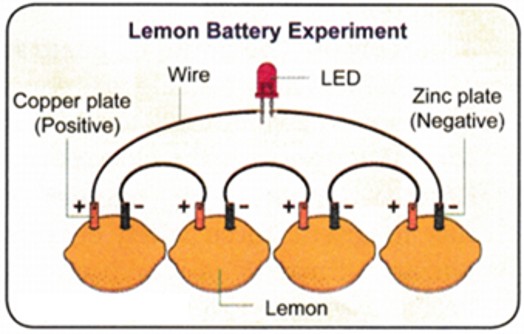
Question: Can we also make our Voltaic cell using easily available materials?
Answer: Yes, it is possible to make a simple Voltaic cell using materials that are easily available. If we insert two different metal strips, such as copper and zinc, into a lemon, potato, or vinegar solution, a chemical reaction occurs. This reaction produces a small amount of electric current that can be detected using a galvanometer or by lighting a very small LED. Though the current produced is weak, it clearly shows how chemical energy can be converted into electrical energy.
Keep the Curiosity Alive (Exercise) (Pages 58-61)
Question 1. Fill in the blanks.
(i) The solution used in a Voltaic cell is called ________.
(ii) A current carrying coil behaves like a _______ .
Answer: (i) The solution used in a Voltaic cell is called electrolyte.
(ii) A current carrying coil behaves like a magnet.
Question 2. Choose the correct option:
(i) Dry cells are less portable compared to Voltaic cells. (True/False)
(ii) A coil becomes an electromagnet only when electric current flows through it. (True/False)
(iii) An electromagnet, using a single cell, attracts more iron paper clips than the same electromagnet with a battery of 2 cells. (True/False)
Answer:
(i) False
Reason: Voltaic cells are less portable due to the liquid electrolyte.)
(ii) True
(iii) False
Reason: More cells provide stronger current, leading to a stronger magnetic field and more attraction.
Question 3. An electric current flows through a nichrome wire for a short time.
(i) The wire becomes warm.
(ii) A magnetic compass placed below the wire is deflected.
Choose the correct option:
(a) Only (i) is correct
(b) Only (ii) is correct
(c) Both (i) and (ii) are correct
(d) Both (i) and (ii) are not correct
Answer: (c) Both (i) and (ii) are correct
Question 4. Match the items in Column A with those in Column B.
| Column A | Column B |
| (i) Voltaic Cell | (a) Best suited for an electric heater |
| (ii) Electric iron | (b) Works on magnetic effect of electric current |
| (iii) Nichrome wire | (c) Works on the heating effect of electric current |
| (iv) Electromagnet | (d) Generates electricity by chemical reactions |
Answer:
| Column A | Column B |
| (i) Voltaic Cell | (d) Generates electricity by chemical reactions |
| (ii) Electric iron | (c) Works on the heating effect of electric current |
| (iii) Nichrome wire | (a) Best suited for an electric heater |
| (iv) Electromagnet | (b) Works on magnetic effect of electric current |
Question 5. Nichrome wire is commonly used in electrical heating devices because it
(i) is a good conductor of electricity.
(ii) generates more heat for a given current.
(iii) is cheaper than copper.
(iv) is an insulator of electricity.
Answer: (ii) Nichrome generates more heat for a given current
Reason: Nichrome offers high resistance, converting more electrical energy to heat.
Question 6. Electric heating devices (like an electric heater or a stove) are often considered more convenient than traditional heating methods (like burning firewood or charcoal). Give reasons to support this statement, considering societal impact.
Answer: Electric heating devices like an electric heater or a stove are often considered more convenient than traditional heating methods like burning firewood or charcoal because:
- Electric heaters and stoves give instant heat and are easy to operate.
- They do not produce harmful smoke or ash like firewood or charcoal.
- Using electric devices reduces the need for cutting trees for firewood, helping in forest conservation
Question 7. Look at the Figure. If the compass is placed near the coil deflects:
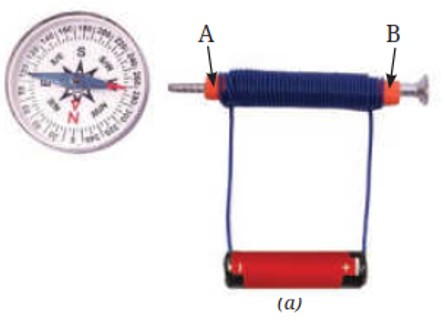
(i) Draw an arrow on the diagram to show the path of the electric current.
(ii) Explain why the compass needle moves when current flows.
(iii) Predict what would happen to the deflection if you reverse the battery terminals.
Answer:(i) The path of the electric current would flow from the positive terminal of the cell, through the coil from end A to end B, and back to the negative terminal.
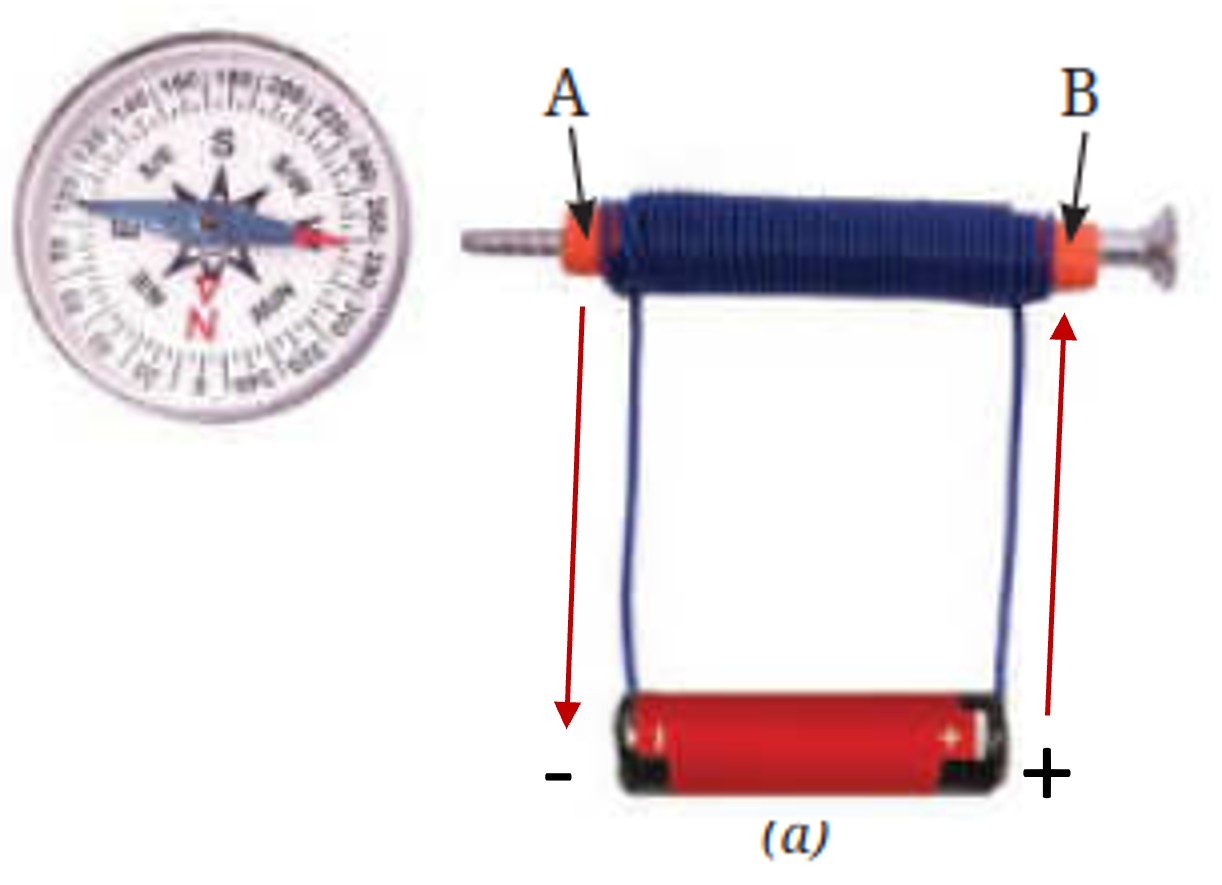
(ii) The compass needle moves because the current flowing through the coil creates a magnetic field, which interacts with the needle’s own magnetism, causing deflection.
(iii) When we reverse the battery terminals, the poles of the coil electromagnet change. Therefore, the deflection in the compass needle also changes accordingly. The pole of the compass needle that was earlier attracted to the coil will move away from it, and the other pole of the compass needle will get attracted towards the coil.
Question 8. Suppose Sumana forgets to move the switch of her lifting electromagnet model to the OFF position (in the introduction story). After some time, the iron nail no longer picks up the iron paper clips, but the wire wrapped around the iron nail is still warm. Why did the lifting electromagnet stop lifting the clips? Give possible reasons.
Answer: The iron nail no longer picks up the iron paper clips because of two possible reasons:
- Overheating of the iron core: Continuous current flow heated up the iron nail. When the iron becomes too hot, it loses its magnetism.
- Weakening of the current: The battery supplying the current may have become weak after being used for a long time. A weak current reduces the strength of the electromagnet, so it can no longer attract the clips.
The wire wrapped around the iron nail is still warm because it got heated earlier when current was flowing. When the current stops flowing the heating effect of the electric current stops, but the wire that has become warm takes some time before cooling to the normal temperature.
Question 9. In Figure (below), in which case, the LED will glow when the switch is closed?
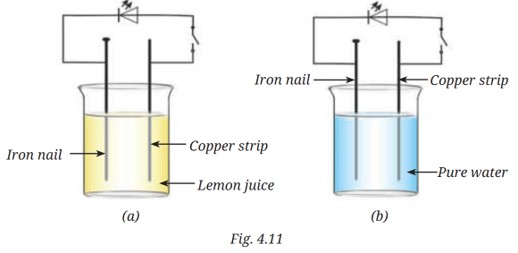
Answer: The LED will glow in (a) with lemon juice. Here, the electrolyte is the lemon juice enabling chemical reactions to generate current between the iron nail and copper strip.
In case of (b), the liquid used is pure water which is a poor conductor and does not facilitate the necessary reactions.
Question 10. Neha keeps the coil the same way as in Activity 4.4 but slides the iron nail out, leaving only the coiled wire. Will the coil still deflect the compass? If yes, will the deflection be more or less than before?
Answer: If iron nail is inserted inside the coil, the strength of the magnet increases. If Neha slid out the iron nail the coil will still deflect the compass because electric current through the wire produces a magnetic field. However, the deflection will be weaker than before, as without the nail the coil’s magnetic field will be weaker. So, the compass will show less movement.
Question 11. We have four coils, of similar shape and size, made up from iron, copper, aluminium, and nichrome as shown in the Figure:
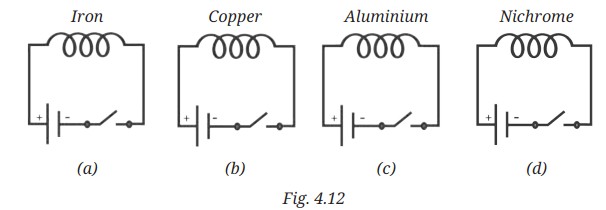
When current is passed through the coils, compass needles placed near the coils will show deflection.
(i) Only in circuit (a)
(ii) Only in circuits (a) and (b)
(iii) Only in circuits (a), (b), and (c)
(iv) In all four circuits
Answer: (iv) In all four circuits
Explanation: The compass needles placed near the coils will show deflection in all the four cases. The deflection however will not be equal in all the four cases. The magnetic strength of the electromagnet depends on the nature of the material used. Some magnetic substances like iron, nickel and cobalt make strong electromagnets, while aluminium and nichrome may be of the same shape and size may not make equally strong magnets.
Class 8 Science Curiosity Chapter 4 Questions and Answers
The chapter Electricity: Magnetic and Heating Effects explores what happens when electric current flows through a conductor. Students investigate the magnetic effect of current and learn how a coil of wire can be used to make an electromagnet.
Students also learn about the heating effect of current and its use in electrical appliances. Activities connect simple circuits with familiar devices and help students understand the importance of choosing suitable materials and using electricity safely.