

NCERT Solutions for Class 8 Science Chapter 6 Pressure, Winds, Storms, and Cyclones are provided here with simple and easy-to-understand explanations. Based on the NCERT textbook Curiosity, this chapter introduces pressure in solids, liquids, and gases, the movement of air, and the formation of storms and cyclones. These NCERT Solutions for Class 8 help students understand important concepts, complete textbook activities, and revise the chapter for school examinations.
Pressure, Winds, Storms, and Cyclones Class 8 Questions and Answers
Probe and ponder Questions Answers (Page No. 80)
Question: Why are winds stronger on some days than on others?
Answer: Winds are stronger on some days because of greater air pressure differences. Air always moves from a region of high pressure to a region of low pressure. On some days, this pressure difference is small, so the winds are gentle. On other days, uneven heating of land and water or storm conditions can increase pressure differences, leading to stronger winds.
Question: Why are water tanks usually placed at a height?
Answer: Water exerts pressure at the bottom of a container. Overhead tanks are placed at a height so that water flows out of the taps with sufficient pressure, ensuring a good stream even on lower floors of a building.
Question: Can air pressure really crush us?
Answer: Yes, atmospheric air exerts a very large pressure on us. But we are not crushed because the fluids and gases inside our body exert an equal pressure outward. This balance of internal and external pressures keeps us safe. If this balance did not exist, the huge atmospheric pressure would crush us.
Question: What causes storms and cyclones? If the Earth stopped rotating, would cyclones still form?
Answer: Storms when warm, moist air rises quickly. As it rises, the air cools, water vapour condenses into clouds, and releases latent heat, which further fuels the storm.
A cyclone develops over warm ocean waters when moist air rises and condenses, releasing heat that drives the air upward even further. Coriolis force due to Earth’s rotation makes winds spiral, creating the cyclone.
If the Earth did not rotate, the Coriolis effect would not exist. Winds could still rush into low-pressure areas and storms would occur, but they would not spiral into cyclones.
Question: Do liquids also exert pressure? (Page no. 83)
Answer: Yes, liquids exert pressure. Liquids exert pressure in all directions, and the deeper we go into the liquid the greater is the pressure.
Question: What will happen to the bulge of the balloon if we increase the height of the water column? (Page no. 84)
Answer: When the height of the water column increases, liquid pressure at the bottom rises. This extra pressure makes the balloon bulge more. Thus, the bulge of the balloon increases with the height of the water column, showing that pressure depends on liquid height.
Question: Does the difference in air pressure have anything to do with the formation of winds? (Page no. 88)
Answer: Yes, the difference in air pressure is the main cause of winds. Moving air is called wind. Air always moves from a high-pressure region to a low-pressure region.
Question: How do winds form? (Page no. 88)
Answer: Winds form because of differences in air pressure. When the Sun heats the Earth’s surface unevenly, some places become warmer than others. Warm air is lighter and rises, creating a low-pressure area. Cooler air is heavier and moves in to take its place. This movement of air from high-pressure areas to low-pressure areas is what we feel as wind.
Keep the Curiosity Alive Exercise Questions (Pages 94-96)
Question 1. Choose the correct statement:
(i) Look at the Figure carefully. Vessel R is filled with water. When pouring of water is stopped, the level of water will be _________
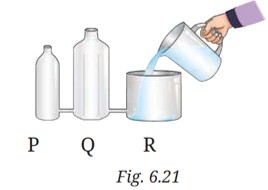
(a) the highest in vessel P
(b) the highest in vessel Q
(c) the highest in vessel R
(d) equal in all three vessels
Answer: (d) equal in all three vessels
Reason: The level of water in connected vessels (communicating vessels) will be the same regardless of shape, as liquid pressure depends on the height of the column, not the vessel’s shape or width
(ii) A rubber sucker (M) is pressed on a flat smooth surface, and an identical sucker (N) is pressed on a rough surface.
(a) Both M and N will stick to their surfaces
(b) Neither M nor N will stick to their surfaces
(c) M will stick, but N will not stick
(d) M will not stick, but N will stick
Answer: (c) M will stick, but N will not stick
Reason: A rubber sucker works when pressed against a smooth surface. The air inside is pushed out, and outside air pressure holds it tightly in place. But on a rough surface, tiny gaps let air slip in, so no suction forms. That’s why sucker M sticks, but N does not.
(iii) A water tank is placed on the roof of a building at a height ‘H’. To get water with more pressure on the ground floor, one has to
(a) Increase the height ‘H’ at which the tank is placed.
(b) Decrease the height ‘H’ at which the tank is placed.
(c) Replace the tank with another tank of the same height that can hold more water.
(d) Replace the tank with another tank of the same height that can hold less water.
Answer: (a) increase the height ‘H’ at which the tank is placed.
Reason: The pressure of water depends on the height of the water column, not on how wide the tank is or how much water it holds. Greater height means greater pressure at the taps. Hence, to increase pressure on the ground floor, we must increase the height H of the tank.
(iv) Two vessels, A and B, contain water up to the same level as shown in the Figure. PA and PB are the pressures at the bottom of the vessels. FA and FB are the forces exerted by the water at the bottom of the vessels A and B.
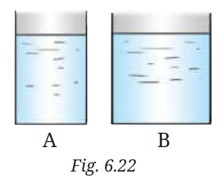
(a) PA = PB, FA = FB
(b) PA = PB, FA < FB
(c) PA < PB, FA = FB
(d) PA > PB, FA > FB
Answer: (b) PA = PB, FA < FB
Reason: Pressure at the bottom depends on the height of the water, which is the same in both vessels, so PA = PB. Force = Pressure × area. Since vessel A is narrower (smaller area), therefore FA < FB.
Question 2. State whether the following statements are True (T) or False (F).
(i) Air flows from a region of higher pressure to a region of lower pressure.
(ii) Liquids exert pressure only at the bottom of a container.
(iii) The weather is stormy at the eye of a cyclone.
(iv) During a thunderstorm, it is safer to be in a car.
Answer:
(i) True
(ii) False
Reason: Liquids exert pressure on the bottom, sides, and in all directions within a container.
(iii) False
Reason: The eye of a cyclone is calm, with no stormy weather.
(iv) True.
Question 3. Figure (a) shows a boy lying horizontally, and Figure (b) shows the boy standing vertically on a loose sand bed. In which figure does the boy sink more into the sand? Give reasons.
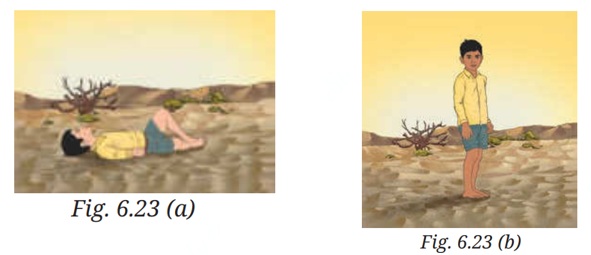
Answer: The boy in Figure (b) will sink more. The weight of the boy is the same, but in Fig. (a), the force (of the weight) is acting on a large area. The pressure in this case is less. In Fig. (b), the same force (of the weight) is acting on a small area. The pressure, therefore, is more. The boy will sink more into the sand in this case.
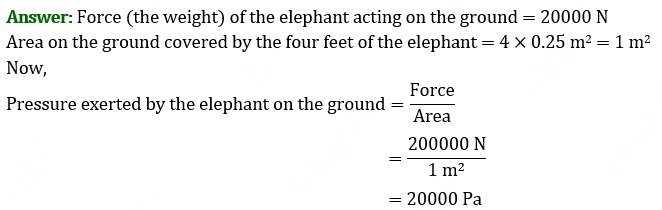
Question 4. An elephant stands on four feet. If the area covered by one foot is 0.25 m2, calculate the pressure exerted by the elephant on the ground if its weight is 20000 N.
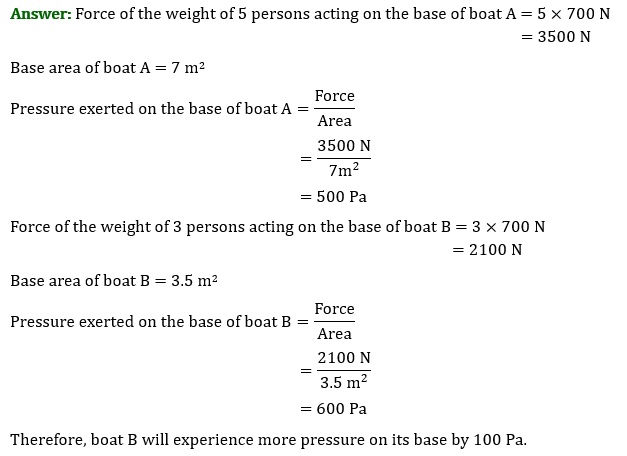
Question 5. There are two boats, A and B. Boat A has a base area of 7 m2, and 5 persons are seated in it. Boat B has a base area of 3.5 m2, and 3 persons are seating in it. If each person weighs 700 N, find out which boat will experience more pressure on its base and by how much?
Answer:
Question 6. Would lightning occur if air and clouds were good conductors of electricity? Give reasons for your answer.
Answer: Lightning occurs because air resists the flow of charges. It allows charges to build up until they discharge suddenly. If air and clouds were good conductors, charges would pass continuously and no build-up would occur. Hence, lightning would not occur.
In case the air and the clouds were good conductors of electricity, the charges could not accumulate in the clouds (because they would flow into the air), there would be no charge buildup, which is necessary for lightning to occur. Therefore, if air and clouds were good conductors of electricity, lightning would not occur.
Question 7. What will happen to the two identical balloons A and B as shown in Figure when water is filled into the bottle up to a certain height? Will both the balloons bulge? If yes, will they bulge equally? Explain your answer.
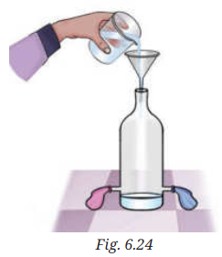
Answer: Since both the balloons are at the same height on the bottle, so they will bulge equally. It is because liquid pressure at a point depends on the height of the water column above it and it acts in all directions.
Question 8. Explain how a storm becomes a cyclone.
Answer: Cyclones are large storms that form over warm ocean waters. As the ocean water gets heated, the air above it becomes moist and warm. Since warm air is lighter, it rises rapidly, creating a low-pressure area. Cooler air from the surrounding regions rushes into the low-pressure area, where it also gets heated and starts rising. As the moist air rises higher, it cools and condenses into clouds and rain, releasing heat. This released heat makes the air rise even faster, lowering the pressure further and pulling in more air. The moving air starts to spin under the influence of the Earth’s rotation. When this spinning system of clouds, wind, and rain becomes large and organised, the storm grows into a cyclone.
Question 9. The figure shows trees along the sea coast on a summer afternoon. Identify which side is land – A or B. Explain your answer.
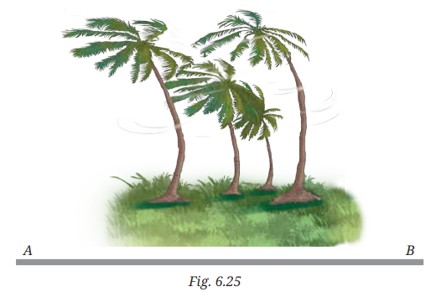
Answer: On a summer afternoon, the land heats up faster than the sea. So, the air above land rises resulting in low-pressure region over land. Cooler, denser air above the sea then moves toward the land to take its place. This movement is called a sea breeze. In the figure, the wind is blowing from B to A, which means B is the sea and A is the land.
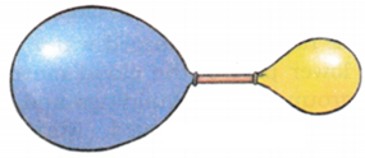
Question 10. Describe an activity to show that air flows from a region of high pressure to a region of low pressure.
Answer: Take two balloons and a drinking straw. Fix one balloon to each end of the straw, but keep only one balloon inflated while the other remains empty. We will see that after some time, air starts moving from the inflated balloon into the empty one. The inflated balloon has higher air pressure, while the empty balloon has lower air pressure. Air always flows from high pressure to low pressure, so both balloons eventually become almost the same size.
Question 11. What is a thunderstorm? Explain the process of its formation.
Answer: A thunderstorm is a storm with thunder, lightning, heavy rain, and strong winds. It forms when land heats up the warm and moist air being lighter rises, thus creating a low-pressure area. Cooler air from surrounding high-pressure areas flows to take its place. This air again gets heated and rises, thereby resulting in a continuous process of wind circulation. As the rising air expands, it cools and moisture in it condenses to form clouds and raindrops. This cloud may come down as rain, hail, or snow. The strong winds accompanied by rain are called a storm.
During a storm formation, under certain conditions, warm air rises to great heights, and the low temperature there changes water droplets into ice particles. Strong upward and downward winds cause rubbing between water droplets and ice particles, which produces static charges inside clouds. When these charges build up, they are suddenly released as a bright flash of lightning, followed by the sound of thunder.
Question 12. Explain the process that causes lightning.
Answer: Lightning happens because of the build-up and sudden discharge of electric charges inside clouds. During a storm, strong upward and downward winds make water droplets and ice particles rub against each other. This rubbing produces static charges. Ice particles are positively charged, and they move upwards in the upper part of the clouds. Water droplets are negatively charged and occupy the lower part of the clouds. The ground below becomes positively charged. Normally, air acts as an insulator, but when the charge build-up becomes very large, the insulating property of air breaks down. A sudden flow of charges occurs, producing a bright flash of lightning.
Question 13. Explain why holes are made in banners and hoardings.
Answer: Holes are made in banners and hoardings to reduce the pressure of wind on them. When strong winds blow against a solid surface, a large pressure difference forms between the front and the back. This pressure can tear the banner or blow it away. By making holes, some air can pass through, reducing the pressure difference. This keeps the banner or hoarding more stable and prevents damage during strong winds.
Class 8 Science Curiosity Chapter 6 Questions and Answers
The chapter Pressure, Winds, Storms, and Cyclones explores how force acting over an area produces pressure. Students investigate pressure in liquids and the atmosphere and learn how differences in air pressure are connected with wind.
Students also learn how uneven heating and rising warm air contribute to weather events. The chapter introduces storms and cyclones, explains their effects, and highlights precautions and preparedness measures that help communities stay safe.