

NCERT Solutions for Class 8 Social Science Part 1 Chapter 2 Reshaping India’s Political Map are provided here with simple and easy-to-understand explanations. Based on the NCERT textbook Exploring Society: India and Beyond Part 1, this chapter introduces changing kingdoms and empires, political relationships, and the transformation of the Indian subcontinent. These NCERT Solutions for Class 8 help students understand important concepts, complete textbook activities, and revise the chapter for school examinations.
Reshaping India’s Political Map Class 8 Questions and Answers
The Big Questions (Page no. 21)
1: How did foreign invasions and the rise of new dynasties reshape India’s political boundaries during this period?
Answer: From the 11th to the 17th century, India’s political map changed a lot because of foreign invasions and new dynasties. The Turkish and Afghan invaders, like Mahmud of Ghazni and Muhammad Ghori, attacked north India. After the Battle of Tarain (1192), Muhammad Ghori’s general Qutb-ud-din Aibak started the Delhi Sultanate, which brought many parts of north India under one rule. In 1526, Babur defeated the last Delhi Sultan and founded the Mughal Empire after the Battle of Panipat. The Mughals, especially Akbar, united most of India under one rule again.
At the same time, several Indian kingdoms rose in different regions and resisted these powers. Examples include the Vijayanagara Empire in the south, Rajput kingdoms like Mewar, and the Ahom kingdom in Assam. Due to wars and invasion India’s political borders kept changing throughout this period.
2: How did Indian society respond to invasions? How did India’s economy adapt during times of political instability?
Answer: Indian society showed both resistance and adaptation during invasions. Many rulers like Prithviraj Chauhan fought Muhammad Ghori, and the Rajputs continued to defend their kingdoms for centuries. The Vijayanagara kings, the Ahoms, and the Sikh Khalsa also fought and resisted the invasions. Even when new rulers came, the local traditions, customs, and religious practices continued. This led to a mix of Hindu and Muslim cultures in art, architecture, and language.
Despite wars, the economy remained strong. Agriculture stayed strong through good irrigation systems. Trade continued through ports like Calicut and Surat. Merchants used the hundi system to send money safely. Temples and artisans supported local business. So, though rulers changed often, the people kept the economy running.
3: What impact did this period have on the lives of the people?
Answer: This period brought both difficulties and growth for the people. Frequent wars and invasions destroyed cities, temples, and learning centres, causing fear and loss of life. Heavy taxes made life hard for farmers, and some even lost their land.
However, people adapted and continued farming, trade, and craft work. India remained wealthy because of agriculture, textiles, and overseas trade. Culturally, it was a time of mixing and growth. Hindu and Muslim traditions blended, that created new forms of art, music, and architecture. People learned to live under new rulers while keeping their religious and social customs alive.
Let’s Explore (Page No. 26)
1: Looking at Fig. 2.6, why do you think Ala-ud-din Khilji called himself ‘the second Alexander’?
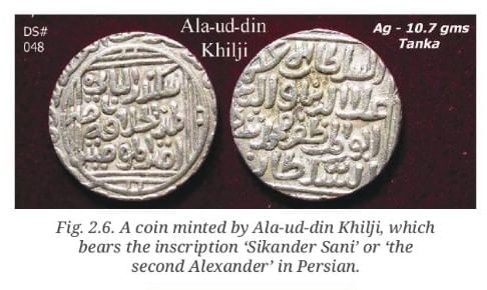
Answer: Ala-ud-din Khilji called himself ‘Sikander Sani’, which means ‘the Second Alexander’, because he wanted to show that he was as great and powerful as Alexander the Great. Alexander had conquered large parts of the world, and Ala-ud-din also wanted to be seen as a world conqueror.
2: What kind of resources do you think were needed to maintain an army and wage war in those days? Discuss in groups the various types of expenditure involved, from weapons or food for soldiers to animals used in warfare, road construction, etc.
Answer: Maintaining an army in ancient times required various essential resources:
- Weapons like swords, spears, bows, arrows, and later guns and cannons.
- Food, water, clothing, and shelter for soldiers during long campaigns.
- Horses, elephants, and camels for travel and fighting
- Construction and repair of roads so the army could move quickly.
- Carts and materials for transporting goods and equipment.
- Skilled people such as blacksmiths, carpenters, and doctors for weapon repair and treating the injured.
- Money to pay soldiers and buy necessary supplies.
Let’s Explore (Page No. 35)
Question: In Fig. 2.14, what elements do you observe? What do they tell you about life then? (Hint: observe the weapons, the animals, the activities.)
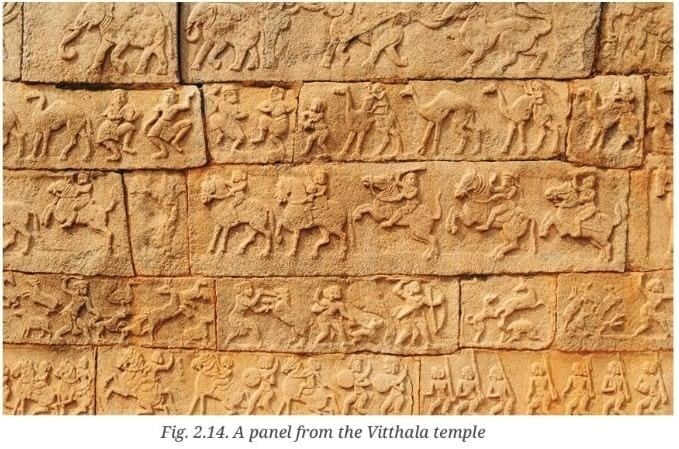
Answer: In above figure from the Vitthala temple depicts several significant elements:
- Weapons: Swords, spears, and shields suggest a society that prioritised warfare.
- Animals: Horses are prominently featured, indicating their vital role in transport and combat.
- Activities: Battle scenes illustrate a culture deeply engaged in conflict.
These elements reflect a vibrant, conflict-driven culture where warfare and the use of animals were integral to daily life.
Think About It (Page No. 37)
Question: What strikes you in Babur’s impressions of India? Discuss in groups.
Answer: Babur found India very different from his homeland in Central Asia. He said India had a warm climate and many strange customs. However, he was amazed by India’s wealth, especially its gold, precious stones, and rich markets. He noticed that India had many skilled workers and craftsmen. He also mentioned that Indians did not have good roads or proper cities like in Central Asia. Babur admired India’s beauty and resources, but he also found it strange and unfamiliar in culture and lifestyle.
Think About It (Page No. 40)
Question: Why do you think Akbar employed different strategies to expand his empire, while the earlier rulers of Delhi relied mostly on military might?
Answer: Earlier Delhi rulers attacked and captured places, but this often created anger and rebellion. Akbar understood that ruling a huge and diverse country was not possible only through war. Akbar wanted long-term peace, so he used smarter methods. Akbar used different strategies like diplomacy, marriage alliances to rule efficiently. He made friendly relations with local rulers, especially Rajputs, through marriage and by giving them high positions. He respected different religions, removed some unfair taxes, and tried to win people’s trust.
Think About It (Page No. 43)
Question: We saw above that Delhi sultans’ average reign lasted about nine years. This figure becomes 27 years in the case of Mughal emperors up to Aurangzeb; and 16 years if we consider all Mughal rulers, up to the end of the empire in the 19th century. What do you make of these numbers of years of reign?
Answer: The Delhi Sultans’ average reign lasted about nine years, which shows that there was political instability, frequent wars, revolts, and struggles for power. The Mughal emperors ruled about 27 years on average up to Aurangzeb, which means their rule was more stable and better organized. The Mughals had a strong system of administration and better ways to manage nobles and provinces.
Let’s Explore (Page No. 45)
Question: In his last letters to two of his sons, Aurangzeb wrote, “I came alone and am going away alone. I know not who I am and what I have been doing. … I have not done well for the country and the people, and of the future there is no hope. I was helpless [in life] and I am departing helpless.” What do these words tell us about Aurangzeb? How do you feel about them?
Answer: Aurangzeb’s letters show that he deeply regretted many actions he took during his rule. He had imprisoned his father, killed his brothers to gain the throne and killed several thousands of people during his brutal rule. In his last years, all his wrongdoings including the destruction of temples, schools, cities, and the looting of wealth must also have given him too much pain. That is why he admitted that he had not done well for the country and the people. His words also show that he felt lonely and helpless at the end of his life. These words make us feel sympathy for him. Even a powerful emperor can feel regret and sadness, which reminds us that everyone is human.
Let’s Explore (Page No. 48)
Question: Discuss in class how the paik system affected the daily lives of the people in the Ahom kingdom, both in terms of challenges and benefits, and helped the king manage both the army and the economy.
Answer: The paik system required every able-bodied man in the Ahom kingdom to give labour or military service for the state. This affected their daily lives in many ways. It was a benefit because it helped build roads, bridges, irrigation works, and public buildings, which improved life for everyone. It also allowed the king to maintain a strong army without keeping soldiers permanently, so the kingdom stayed safe. However, it was also challenging because people had to leave their homes and farms for long periods to serve the state.
Let’s Explore (Page No. 49)
Question: How did the Ahoms use the rivers, hills, and forests of Assam to their advantage? Can you think of ways in which the geography helped them build defences and fight wars?
Answer: The Ahoms used rivers like the Brahmaputra for transporting soldiers and supplies and for quick movement during wars. The hills and forests acted as natural defences, making it difficult for enemies to attack their kingdom. They built forts and stockades near riverbanks and hill passes to block invaders. The dense forests helped them in hiding and planning surprise attacks on enemies. The geography of Assam helped the Ahoms fight strong battles and protect their land from outside forces.
Think About It (Page No. 52)
Question: Why do you think Guru Tegh Bahadur endured torture rather than convert? Why did he think his sacrifice would make a difference? (Page No. 52)
Answer: Guru Tegh Bahadur refused to convert because he strongly believed in freedom of religion.He wanted to protect the beliefs of the Kashmiri Hindus, who were being forced to convert to Islam under Aurangzeb’s rule. He believed that his sacrifice would inspire others to stand up against injustice and protect their religion and values.
Question: What values did the Sikh Gurus and the Khalsa embody? (Page No. 52)
Answer: The Sikh Gurus and the Khalsa stood for truth, courage, and equality. They taught people to believe in one God and reject caste, discrimination, and superstitions. They valued honesty, hard work (kirat karo), and sharing with others (vand chhako). They believed in fighting injustice and protecting the weak, without fear.
Question: How are they relevant in today’s world? (Page No. 52)
Answer: The values taught by the Sikh Gurus and the Khalsa are still very important today. They encouraged equality, which reminds us that all people are the same, no matter their religion, caste, or background. They taught courage and standing up against injustice, which inspires us to fight unfair treatment in society. Their message of seva (selfless service) encourages people to help others in need. They also promoted honesty, discipline, and faith in God, which help people live good and responsible lives.
Questions and activities – Exercises (Page No. 59)
1: Compare the political strategies of the Delhi Sultanate and the Mughals. What similarities and differences existed between them?
Answer: Similarities between the Delhi Sultanate and the Mughal Empire political strategies are:
- Both tried to bring large parts of India under their control.
- Both used military force to conquer new territories.
- Both divided their empires into provinces for easier administration.
- Both collected taxes from the people to run the administration and the army.
- Both appointed officers to govern different regions.
Differences between the Delhi Sultanate and the Mughal Empire political strategies are:
- The Delhi Sultans mostly ruled by military force while the Mughals, especially Akbar, used diplomacy, alliances, and religious tolerance to win loyalty.
- The Mughals created a stronger central administration (e.g., mansabdari system), while the Sultanate used the iqta system.
- The Mughals promoted religious tolerance (under Akbar), but most Sultans followed strict Islamic laws.
- The Mughal Empire was larger and more stable, lasting longer than the Delhi Sultanate.
- The Mughals encouraged art, culture, and administration, while the Sultans focused mainly on military control.
2: Why did kingdoms like the Vijayanagara Empire and the Ahom Kingdom manage to resist conquest for a longer time compared to others? What geographical, military, and social factors contributed to their success?
Answer: Kingdoms like the Vijayanagara Empire and the Ahom Kingdom resisted conquest for a longer time because of a strong combination of geographical, military, and social advantages. Vijayanagara was protected by rocky hills and the Tungabhadra River, which made it difficult for enemies to attack. Similarly, the Ahom region in Assam had dense forests, hills, and the Brahmaputra River, which made it hard for invaders to enter.
Militarily, Vijayanagara had a large, well-trained army with horses and elephants, whereas the Ahoms used clever strategies such as guerrilla warfare and were skilled in river battles.
Socially, people in both regions supported their rulers. The Ahoms used the paik system, where every able man served the state, strengthening both the army and the economy. These factors helped them remain powerful and independent for a long time.
3: Imagine you are a scholar in the court of Akbar or Krishnadevaraya. Write a letter to a friend describing the politics, trade, culture, and society you are witnessing.
Answer: Dear Friend,
I hope you are well. I am writing to tell you about the amazing things I am seeing here in the royal court.
I am serving under Emperor Akbar / King Krishnadevaraya, and the kingdom is full of activity. The ruler is strong and wise. He brings different regions under his control, not only through war but also by forming friendships with local leaders. Because of this, the kingdom is peaceful and united.
Trade is very active. Merchants come from many lands to buy and sell goods. I see fine textiles, spices, precious stones, and even horses from foreign countries. Cities are busy with markets, and people from different places live and work together.
Art and culture are flourishing. Poets, musicians, dancers, and scholars visit the court. Temples and other buildings are beautifully designed, showing great skill in architecture. Society is diverse, but people mostly live in harmony. Farmers, craftsmen, and traders all contribute to the kingdom’s wealth.
I feel lucky to witness such a wonderful time. I hope you will visit soon.
Your friend,
Deepak
4: How come Akbar, a ruthless conqueror in his young days, grew tolerant and benevolent after some years? What could have led to such a change?
Answer: Akbar became emperor at the young age of 13. Initially he was a fierce and ruthless leader focused on conquest and military power. His early reign was marked by brutality, such as during the long siege of Chittor. But as he grew older, he realised that India was a land of many religions, languages, and cultures, and that ruling by fear could not unite such a diverse people.
Meeting people of different religions and ideas made him more thoughtful and tolerant. His discussions with scholars, saints, and advisors like Birbal and Abul Fazl taught him that kindness and justice were stronger than fear. He realised that to rule India successfully, he had to win people’s hearts, not just their lands.
Akbar abolished the jizya tax on non-Muslims, welcomed Rajput and Hindu nobles into his administration, and promoted sulh-i-kul (peace with all), a policy of religious tolerance.
5: What might have happened if the Vijayanagara Empire had won the Battle of Talikota? Imagine and describe how it could have changed the political and cultural history of south India.
Answer: If the Vijayanagara Empire had won the Battle of Talikota in 1565, the history of South India could have changed significantly. The empire might have remained strong and united instead of breaking into smaller kingdoms. It could have stopped invasions from the Deccan Sultanates and possibly even resisted the Mughal expansion.
Art, literature, and temple architecture would likely have continued to flourish, Great cities like Vijayanagara might have grown into major centres of trade and culture, attracting wealth and people from across the world. South India might have remained a powerful and influential region for centuries, shaping its identity and heritage strongly.
6: Many values promoted by early Sikhism, including equality, seva, and justice, remain relevant today. Select one of these values and discuss how it remains relevant in contemporary society.
Answer: The value of equality, taught by Guru Nanak, the founder of Sikhism. Later, it was strengthened by Guru Gobind Singh. They believed that all people are equal in the eyes of God, regardless of caste, religion, or gender.
This message of equality is very important even today. It reminds us to respect everyone, support equal rights for women and minorities, and build a society based on fairness and dignity.
7: Imagine you are a trader in a port city (Surat, Calicut, or Hooghly). Describe the scenes you see as regards goods, people you trade with, movement of ships, etc.
Answer: I am a trader living in the busy port city of Surat / Calicut / Hooghly. Every morning, I walk to the docks where I see large ships arriving from distant lands like Arabia, Persia, and Europe. Sailors unload goods such as horses, metals, and precious stones. In return, we send out fine Indian products like cotton cloth, silk, spices, sugar, and rice. The markets are crowded with buyers and sellers speaking many different languages. The air is filled with the smell of spices and the noise of bargaining.
Class 8 Social Science Exploring Society Chapter 2 Questions and Answers
The chapter Reshaping India’s Political Map explores the rise and fall of major powers, including the Delhi Sultanate, Vijayanagara, and the Mughal Empire. Students learn how expansion, resistance, and alliances influenced territorial control and administration.
Students also examine connections between political developments and people’s lives. The chapter encourages the use of maps and historical sources to understand changes over time and the roles played by different rulers and regional communities.