

NCERT Solutions for Class 8 Social Science Part 1 Chapter 4 The Colonial Era in India are provided here with simple and easy-to-understand explanations. Based on the NCERT textbook Exploring Society: India and Beyond Part 1, this chapter introduces the arrival of European powers, the expansion of British rule, and the effects of colonialism. These NCERT Solutions for Class 8 help students understand important concepts, complete textbook activities, and revise the chapter for school examinations.
The Colonial Era in India Class 8 Questions and Answers
The Big Questions (Page No. 83)
1: What is colonialism?
Answer: Colonialism is a system where a powerful country takes control over another country to use its land, people, and resources for its own benefit. The stronger country rules over the weaker one and imposes its own political, economic, and cultural systems there.
2: What drew European powers to India?
Answer: Europeans came to India mainly for trade and profit. India was famous for spices, silk, cotton, and indigo, which were in great demand in Europe. The Europeans wanted to control trade routes and earn large profits by trading Indian goods. Some came to spread Christianity among the Indian people especially Portuguese. Some also came to discover new lands and gain knowledge of geography and nature. Thus, the Europeans came to India for wealth, trade, power, religion, and exploration.
3: What was India’s economic and geopolitical standing before and during the colonial period?
Answer: Before the colonial period, India was one of the richest and most powerful countries in the world. It was a major centre of trade, culture, and manufacturing. Indian goods such as spices, cotton, silk, ivory, gems, and steel were highly valued across Asia and Europe. According to historians, India contributed about one-fourth of the world’s GDP, making it one of the two largest economies along with China.
During the colonial period, however, India’s economy declined sharply. The British and other European powers drained India’s wealth, destroyed local industries. They turned the country into a supplier of raw materials and a market for British goods. Heavy taxes, famines, and the loss of traditional industries like textiles made India poor. Politically, India lost its independence and became part of the British Empire.
4: How did the British colonial domination of India impact the country?
Answer: The British colonial domination had a deep impact on India in many ways:
- Indian industries, especially textiles, were destroyed.
- India was turned into a supplier of raw materials and a market for British goods.
- Heavy taxes and unfair trade caused poverty and famines.
- The British introduced their own laws and administration
- The British introduced English education to create Indians who would serve their rule.
- The British built railways, roads, and telegraphs, but mainly to serve their economic and military needs, not the people.
Let’s Explore (Page No. 87)
Question: What do you think the cartoon (Fig. 4.3) is trying to express? (Keep in mind that the telegraph, which permitted instant communications for the first time, was then a recent invention.) Analyse different elements of the drawing.
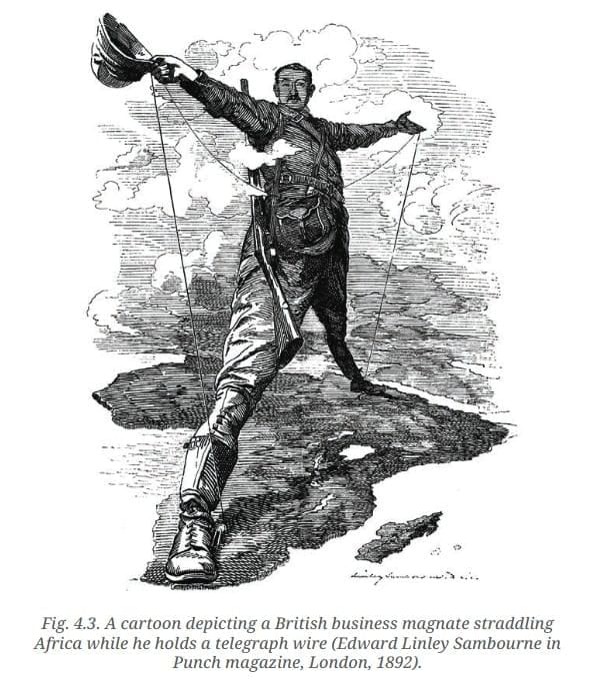
Answer: The cartoon shows a British businessman standing over the map of Africa while holding a telegraph wire. It expresses the idea of British control and domination over colonies through technology, trade, and communication.
The telegraph wire shows the new invention that let Britain send messages quickly across long distances. It symbolises how technology helped the British Empire expand and control its colonies effectively.
The cartoon also reflects the pride and arrogance of colonial powers. The map of Africa under his feet shows that the British saw their colonies as lands they could rule and use as they wished.
Let’s Explore (Page No. 98)
Question: Why do you think Dadabhai Naoroji means by ‘un-British rule in India’? (Hint: he was an MP in the House of Commons in 1892.)
Answer: By the term “un-British rule in India,” Dadabhai Naoroji meant that the British ruled India in a way that went against their own principles of justice, fairness, and liberty. The British claimed to bring progress and good governance, but in reality, they exploited India’s wealth and ignored the suffering of Indians. Naoroji used this phrase to show the hypocrisy of British rule, as they did not treat Indians with the same rights or respect given to people in Britain.
Think About It (Page No. 99)
Question: Let us return to this painting (Fig. 4.14), but now with some clues to its symbolism. Note how Britannia (a symbolic figure for Britain) sits higher than the colonies, pointing to her superior power; contrast with the lower position and bent posture of the colonies. Did they really ‘offer’ their wealth? Or did Britain seize it by force or ruse? Note also the Indians’ dark complexion (in contrast with that of Britannia), reflecting the belief in the superiority of white people over the dark-skinned ‘natives’.
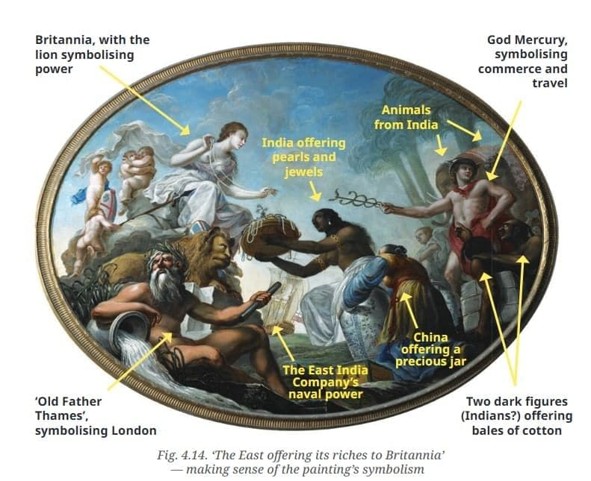
Answer: The painting shows Britannia sitting higher than the colonies, which symbolises Britain’s power and control over them. The colonies are shown in a lower and bent position, showing that they were treated as weaker and forced to serve Britain.
The painting makes it look like the colonies, including India, were offering their riches willingly, but in reality, Britain took them by force. The difference in skin colour with Britannia being fair and the Indians dark reflects the racist belief of the time that white people were superior to others.
Think About It (Page No. 102)
Question: What exactly did Macaulay mean when he wrote that “a single shelf of a good European library was worth the whole native literature of India and Arabia”? And why should he want to make Indians “English in taste, in opinions, in morals, and in intellect”? How does this relate to the ‘civilising mission’ mentioned at the start of the chapter? Ask your teacher to guide a class debate on these questions.
Answer: When Macaulay wrote that “a single shelf of a good European library was worth the whole native literature of India and Arabia,” he meant that he believed European knowledge were far superior to Indian or Arabic knowledge.
Macaulay wanted to make Indians “English in taste, in opinions, in morals, and in intellect” because the British wanted a class of Indians who would think and behave like the British and help them run the colonial administration.
This idea connects to the so-called “civilising mission,” where the British claimed they were bringing progress and civilisation to India. In reality, it was a way to justify their rule and make Indians accept British control and values.
Think About It (Page No. 104)
Question: What is meant by “the sun never sets on the British Empire”? Do you think this was a correct statement?
Answer: The phrase “the sun never sets on the British Empire” means that the British Empire was so vast and spread across so many parts of the world that, at any given time, the sun was shining on at least one of its colonies. Yes, I think this was a true statement for that time, because Britain ruled over many countries across Asia, Africa, Europe, and the Americas.
Let’s Explore (Page No. 105)
Q: Examine the map. What are the main differences with the map of today’s India, in terms both of borders and of names?
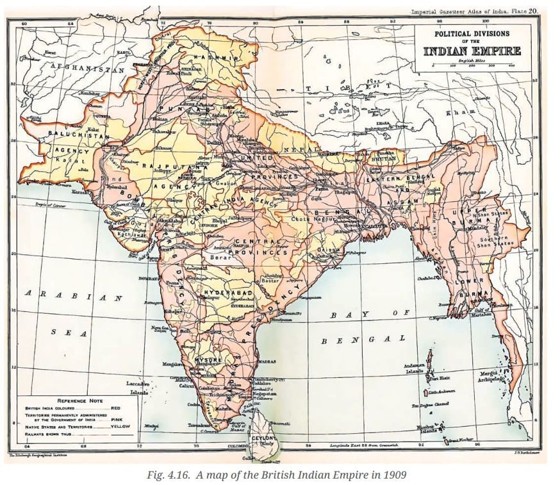
Answer: The 1909 map of the Indian Empire was very different from the map of India today. Pink areas showed regions directly under British control, while yellow areas were princely states ruled by Indian kings under British supervision.
During British rule, India included the areas of Pakistan, Bangladesh, and Myanmar (Burma), which are now separate countries. The northwestern border also included Baluchistan and the North-West Frontier Province, which are now in Pakistan.
Some place names were also different. For example, Calcutta is now Kolkata, Bombay is now Mumbai, Madras is now Chennai, and Burma is now Myanmar.
Let’s Explore (Page No. 107)
Q: Note how the Santhals are depicted in the 1856 sketch (Fig. 4.17) drawn from an artist’s imagination: observe their complexion, dress, weapons and draw your conclusions as regards the image this depiction would create in the popular mind in Britain.
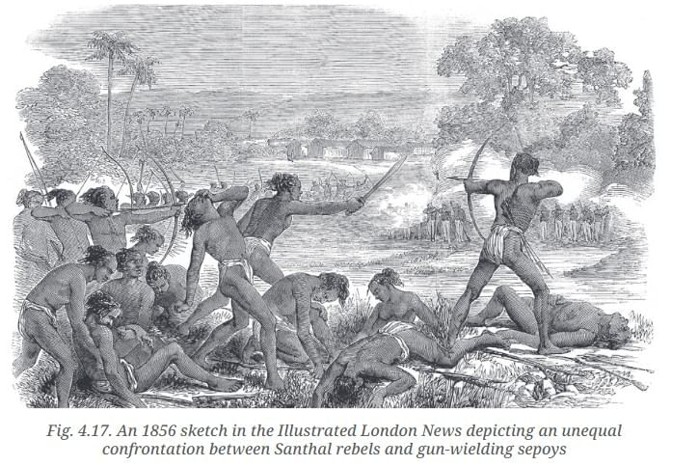
Answer: In the 1856 sketch, the Santhals are shown with dark skin, simple clothes, and basic weapons like bows and spears. This image makes them look primitive and weak compared to the well-armed British soldiers. Such a depiction was meant to create an image in the minds of British people that Indians, especially tribal communities, were uncivilised and needed British control and guidance. It supported the false idea that British rule was a “civilising mission.”
Let’s Explore (Page No. 108)
Q: Indigo is a natural deep blue pigment used in dyeing. Can you think of other natural substances that have been traditionally used in India to dye cloth?
Answer: Yes, many natural substances have been traditionally used in India to dye cloth. Some common examples are:
- Turmeric, which gives a bright yellow colour.
- Madder root and manjistha, which produce red shades.
- Henna leaves, used for orange or reddish-brown colours.
- Pomegranate rind and tea leaves, for brown or grey tones.
- Neem and bark of trees like babool, for greenish shades.
Q: Why do you think was the term ‘Sepoy Mutiny’ rejected after Indian Independence? Write one paragraph explaining your reasons.
Answer: The term “Sepoy Mutiny” was rejected after Indian Independence because it made the 1857 uprising sound like a small rebellion by a few Indian soldiers. In reality, it was a large and united struggle against British rule, involving not just soldiers but also peasants, kings, and common people. Calling it a mutiny ignored the national and patriotic spirit behind it. After Independence, Indians began to see it as the first major fight for freedom, so it was renamed the “First War of Independence” to honour its true importance.
Let’s Explore (Page No. 112)
Q: In the sentence “It opened (or re-opened) India to the world and the world to India”, why do you think we added ‘reopened’?
Answer: The word “re-opened” is added because India had already been in contact with the world long before the British arrived. For thousands of years, India traded with countries like Greece, Rome, China, and many others. It was known for its rich culture, science, and trade. When the British came, they did not open India to the world for the first time reconnected it to global systems through their colonial networks.
Q: Some argue that stolen cultural heritage has been better preserved abroad than it would have been in India. What is your view on its repatriation? Discuss in groups.
Answer: I believe that India’s stolen cultural heritage should be returned to the country. These artefacts are an important part of India’s history and identity. Even if they were preserved abroad, they were taken without permission during colonial rule. Today, India has the knowledge and facilities to protect and display them properly.
Questions and Activities – Exercises (Page No. 114)
1: What is colonialism? Give three different definitions based on the chapter or your knowledge.
Answer: Three definitions of colonialism are:
- Colonialism is a system where one powerful country takes control over another country or region and uses its land, people, and resources for its own benefit.
- Colonialism is the rule of one country over another, removing local rulers and freedom.
- Colonialism is when a strong nation exploits the economy and people of a weaker country and forces its own language, education, and culture on them.
2: Colonial rulers often claimed that their mission was to ‘civilise’ the people they ruled. Based on the evidence in this chapter, do you think this was true in the case of India? Why or why not?
Answer: No, the claim that the British came to India to “civilise” the people was not true. The evidence in the chapter clearly shows that their real aim was to gain wealth and power, not to help Indians. The British destroyed India’s industries, drained its wealth, and forced farmers to grow cash crops, which led to famines and poverty. They introduced English education only to create a class of Indians who would serve their interests. Their so-called “civilising mission” also spread the false idea that Indian culture was backward and that European culture was superior.
3: How was the British approach to colonising India different from earlier European powers like the Portuguese or the French?
Answer: The British approach to colonising India was more systematic and political than that of the Portuguese or the French. The Portuguese came first and were mainly interested in trade and spreading Christianity, often using force and religious persecution, especially in Goa. The French focused on commerce and tried to gain power through alliances with Indian rulers, but their control remained limited to places like Pondicherry. The British, on the other hand, came as traders but slowly took over political power using methods like divide and rule, subsidiary alliances, and the Doctrine of Lapse.
4: “Indians funded their subjugation.” What does this mean in the context of British infrastructure projects in India like the railway and telegraph networks?
Answer: The statement “Indians funded their subjugation” means that Indians paid for their own oppression under British rule. Projects like the railways and telegraph networks were built using Indian tax money. Although the British claimed these projects were meant to help India, they were actually designed to serve British interests.
The railways helped transport raw materials to ports, move British goods, and send troops quickly during revolts. The telegraph allowed fast communication between British officials and soldiers, that helped Britishers to suppress Indian uprisings easily.
5: What does the phrase ‘divide and rule’ mean? Give examples of how this was used by the British in India?
Answer: The phrase ‘divide and rule’ means breaking unity among people so that they cannot come together to fight against their oppressor. The British used this strategy very effectively in India to maintain their control. They encouraged rivalries between Indian kings and princes and supported one side against the other to gain power. For example, during the Battle of Plassey (1757), the British officer Robert Clive made a secret deal with Mir Jafar to betray the Nawab of Bengal, Siraj-ud-Daulah. The British also created divisions among Indians on the basis of religion, caste, and region, which weakened unity and made it easier for them to rule such a large country.
6: Choose one area of Indian life, such as agriculture, education, trade, or village life. How was it affected by colonial rule? Can you find any signs of those changes still with us today? Express your ideas through a short essay, a poem, a drawing, or a painting.
Answer: Before British rule, India had its own system of village schools, madrasas, and pathshalas, where students learned in their own languages about local traditions, science, and mathematics.
However, during British rule, this system was slowly replaced. In 1835, Thomas Macaulay’s Minute on Education introduced English-based education. The aim was to create a class of Indians who would be “Indian in blood and colour, but English in taste and intellect.”
This new system replaced India’s traditional learning and made English the language of power and jobs. Many Indians started to value English education more than their own languages. Even today, we can still see the influence of British education. English remains an important language in schools, offices, and exams.
7: Imagine you are a reporter in 1857. Write a brief news report on Rani Lakshmibai’s resistance at Jhansi. Include a timeline or storyboard showing how the rebellion began, spread, and ended, highlighting key events and leaders.
Answer:
Headline: Rani Lakshmibai Leads Fierce Resistance Against British at Jhansi!
Date: 20 June 1857
By: Special Correspondent
Jhansi, June 1857 — The brave Queen of Jhansi, Rani Lakshmibai, has become the face of India’s resistance against British rule. Following the outbreak of the Great Rebellion, the Rani refused to surrender her kingdom to the British after it was unjustly annexed under the Doctrine of Lapse.
When the British forces attacked Jhansi, the Rani organised her army with great courage. Men and women fought side by side under her leadership. Though heavily outnumbered, she defended the fort for several days with unmatched bravery. When Jhansi finally fell, the Rani escaped on horseback with her young son and joined Tantia Tope, the military adviser of Nana Saheb.
Together, they captured Gwalior fort and raised the flag of Indian freedom. However, on 18 June 1858, during a fierce battle against the British, Rani Lakshmibai was killed while fighting heroically. Her death has inspired thousands across India to continue the struggle for freedom. Even her enemies have praised her bravery — the British commander described her as “the best and bravest of the rebel leaders.”
Timeline of Key Events:
- 1853: The British annex Jhansi after the death of Rani Lakshmibai’s husband.
- May 1857: The Revolt of 1857 begins in Meerut and spreads to Central India.
- June 1857: Rani Lakshmibai takes control of Jhansi and leads her troops against the British.
- March 1858: British forces attack Jhansi. The Rani bravely defends the fort for two weeks.
- April 1858: She escapes to Gwalior and joins forces with Tantia Tope and Nana Saheb.
- June 18, 1858: The Rani is killed in battle while fighting heroically against the British army.
8: Imagine an alternate history where India was never colonised by European powers. Write a short story of about 300 words exploring how India might have developed on its path.
Answer: Title: India Uncolonised: A Nation’s Own Path
In an alternate history, the European powers never reached India. The country continued to grow under strong kingdoms like the Marathas, Rajputs, Mysore, and the Sikhs, who later formed a Bharatiya Sabha to promote peace, trade, and cooperation.
Without colonial rule, India’s industries and crafts continued to flourish. The fine muslin of Bengal, the steel of Mysore, and the spices of Kerala filled markets across Asia and Africa. Great universities like Takshashila and Nalanda were rebuilt, and science and technology grew alongside traditional knowledge.
By 1900, India had become a global centre for knowledge, science, and Ayurveda. The caste system began to fade as reformers promoted equality and education for all. Women played active roles as leaders, scientists, and teachers, helping shape a modern, progressive society.
In 1947, instead of fighting for independence, India proudly hosted the World Congress of Civilizations, representing peace and progress. Its tricolour flag symbolised not freedom from rule, but strength, diversity, and self-reliance.
Today, this India leads the world not through war or conquest, but through knowledge, culture, and harmony.
9: Role-play: Enact a historical discussion between a British official and an Indian personality like Dadabhai Naoroji on the British colonial rule in India.
Answer: Do it yourself.
10: Explore a local resistance movement (tribal, peasant, or princely) from your state or region during the colonial period. Prepare a report or poster describing:
- What was the specific trigger, if any?
- Who led the movement?
- What were their demands?
- How did the British respond?
- How is this event remembered today (e.g., local festivals, songs, monuments)?
Answer: Do it yourself.
Class 8 Social Science Exploring Society Chapter 4 Questions and Answers
The chapter The Colonial Era in India explores how European trading interests developed into political control. Students learn about the growth of British power and the economic and administrative changes introduced under colonial rule.
Students also examine how colonial policies affected farming, crafts, trade, and everyday life. The chapter helps them understand the relationship between political domination and economic change, using historical examples to explore the experiences of Indian communities.