

NCERT Solutions for Class 8 Social Science Part 1 Chapter 5 Universal Franchise and India’s Electoral System are provided here with simple and easy-to-understand explanations. Based on the NCERT textbook Exploring Society: India and Beyond Part 1, this chapter introduces the right to vote, the conduct of elections, and the role of citizens in choosing representatives. These NCERT Solutions for Class 8 help students understand important concepts, complete textbook activities, and revise the chapter for school examinations.
Universal Franchise and India’s Electoral System Class 8 Questions and Answers
The Big Questions (Page No. 117)
1: What is the universal adult franchise?
Answer: Universal adult franchise means that every adult citizen has the right to vote in elections, and each vote has equal value. In India, this right is given to all citizens aged 18 years and above, no matter what their caste, religion, gender, education, or wealth is.
2: What is an electoral system?
Answer: An electoral system is the method or process by which people choose their representatives through voting. It includes the rules, procedures, and institutions that ensure elections are held fairly and freely. In India, the electoral system is managed by the Election Commission of India (ECI). It organises elections at the national, state, and local levels so that every citizen can use their right to vote through universal adult franchise.
3: How does India’s electoral system work?
Answer: India’s electoral system works through free and fair elections based on universal adult franchise, where every citizen aged 18 and above has the right to vote. Elections are held regularly for the Lok Sabha, State Legislative Assemblies, and local bodies (panchayats and municipalities). India follows the First-Past-the-Post system, where the candidate who gets the most votes in a constituency wins, even if they don’t have more than half the votes. The ECI conducts and supervises all elections to ensure they are free and fair.
Let’s Explore (Page No. 118)
Q: India changed the minimum age for voting from 21 to 18 in 1988. Discuss whether this was a good move.
Answer: Yes, changing the voting age from 21 to 18 in 1988 was a good move. It allowed young people to take part in the democratic process and have a say in the country’s future. At 18, citizens are considered mature enough to understand national issues, form opinions, and choose their leaders. This change also helped increase voter participation and made India’s democracy more inclusive.
Let’s Explore (Page No. 120)
Q: In 1947, our literacy rate was about 14 per cent, only about 8 per cent among women. Some argued that the right to vote should be given only to literate people. Discuss in your group why the Constitution makers may have decided on universal franchise from the time of Independence itself.
Answer: The Constitution makers decided on universal adult franchise from the very beginning because they believed that every citizen is equal and has the right to vote, whether literate or not. Giving the vote only to educated people would have discriminated against the poor and uneducated, who also contribute to the nation.
They also knew that if voting was limited only to the educated, most Indians especially women and the poor would be excluded, which would make democracy unfair. By giving every adult the right to vote, they ensured equality, justice, and inclusion for all.
Let’s Explore (Page No. 123)
Q: About 34 per cent of eligible voters did not exercise their right to vote in the 2024 elections. Why do you think this is so?
Answer: The 34 per cent of eligible voters who did not vote in the 2024 elections may have stayed away for several reasons. Some people were not interested in politics or felt that their single vote would not bring any change. Others may not have been aware of the importance of voting. In many cases, practical problems like long distances to polling stations, poor weather, health issues, or missing voter IDs made it difficult for people to cast their votes.
Q. What are some challenges people face in exercising their rights?
Answer: Some challenges that people face in exercising their right to vote are:
- Health issues or physical disabilities
- Inaccessible or distant polling stations
- Lack of voter ID cards or problems with registration.
- Low awareness about voting procedures and the importance of voting.
- Poor transport facilities in remote regions.
- Work or family responsibilities on the voting day
Let’s Explore (Page No. 125)
Q: What are the most important aspects of the election process in this caselet?
Answer: The most important aspects of the election process in this caselet are:
- Fair and transparent election, conducted properly by the election officer.
- Voting took place through a secret ballot to protect voter privacy.
- All candidates got an equal chance to campaign
- A braille ballot paper was provided to ensure accessibility for all students.
- Votes were counted honestly in front of witnesses
Q: Why was it important to have a secret ballot?
Answer: It was important to have a secret ballot because it allows every voter to make their choice privately and without fear or pressure. This ensures that people vote honestly and freely, based on their own opinions.
Q: What considerations might the students have had while exercising their choice?
Answer: While voting, the students might have considered:
- The ideas and promises each candidate made during the campaign.
- Who would be the most responsible and fair leader for the class.
- The behaviour and attitude of each candidate towards classmates.
Q: Do you think the students have any responsibility after Gurmat was elected as the class rep? If yes, what are they?
Answer: Yes, the students do have the following responsibilities after Gurmat was elected as the class representative.
- Support Gurmat in carrying out her duties and class plans.
- Cooperate and share their ideas or problems honestly.
- Respect her decisions and help in maintaining discipline.
- Give feedback and remind her of her promises when needed.
Q: What was the role that Ms. Usha played? Why was it important?
Answer: Ms. Usha acted as the Election Officer in the class election. Her role was to
- Organise and supervise the election process.
- Explain the rules clearly to all students.
- Ensure the voting was fair, secret, and transparent.
- Arrange for a braille ballot paper so that every student could vote.
Q: Why was it important for Ms. Usha to organise braille ballot paper for Neha?
Answer: It was important for Ms. Usha to organise a braille ballot paper for Neha so that she could vote independently and secretly like everyone else. This ensured that Neha, who is visually impaired, could participate equally in the election process without needing help from others.
Q: What would happen if many students in the class chose not to mark a preference?
Answer: If many students in the class chose not to mark a preference, it would mean that their votes would be invalid and not counted. This would reduce the total number of valid votes and could affect the final result of the election. It would also show that many students were not interested or did not trust any of the candidates, which weakens the spirit of democracy.
Let’s Explore (Page No. 131)
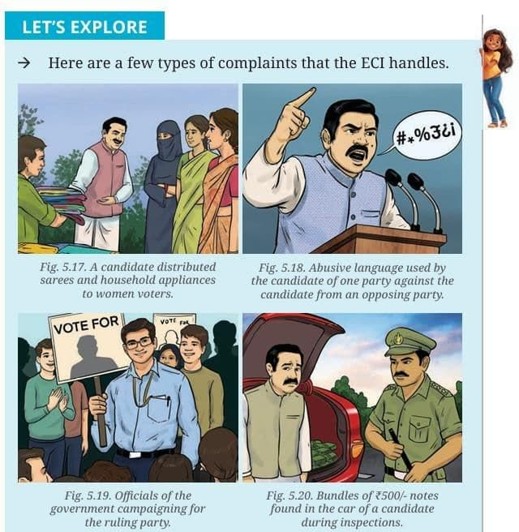
Q: Why do you think these might be violations of the code of conduct?
Answer: These are violations of the Model Code of Conduct because they go against the rules meant to ensure free and fair elections. When a candidate uses abusive language, offers gifts or money, or when government officials campaign for a ruling party, it unfairly influences voters and gives one side an unjust advantage.
Questions and Activities – Exercises (Page No. 138)
1: Why is the universal adult franchise important for a healthy democracy?
Answer: The universal adult franchise is important for a healthy democracy because it ensures that every adult citizen has an equal right to vote irrespective of their caste, religion, gender, education, or wealth. This allows all sections of society to participate in decision-making and choose leaders who represent their needs.
2: What is the meaning of ‘secret ballot’? Why is this important in a democracy?
Answer: A secret ballot means voting in private so that no one knows who a person has voted for. This is important in a democracy because it allows people to vote freely without fear, pressure, or influence from others. It protects their right to choose and ensures that elections are fair.
3: Give examples of direct and indirect elections.
Answer: Direct elections: In direct elections, people vote directly to choose their representatives.
Examples:
- Lok Sabha elections
- State Legislative Assembly elections
- Local body (panchayat and municipal) elections
Indirect elections: In indirect elections, representatives are chosen by elected members, not directly by the people.
Examples:
- Rajya Sabha elections (Members are elected by MLAs).
- President of India’s election (elected by MPs and MLAs).
- Vice President of India’s election (elected by MPs of both Houses).
4: How is the election of members to the Lok Sabha different from that to the Rajya Sabha?
Answer: The Lok Sabha and the Rajya Sabha elections are different in how their members are chosen.
Members of the Lok Sabha are elected directly by the people through universal adult franchise. Every citizen aged 18 and above votes for a candidate in their constituency. The candidate who gets the highest number of votes wins.
Members of the Rajya Sabha, on the other hand, are not directly elected by the people. They are chosen indirectly by the elected Members of the State Legislative Assemblies (MLAs) using a single transferable vote system.
5: What, in your view, are the advantages of the EVM over paper ballots?
Answer: The Electronic Voting Machine (EVM) has several advantages over the old paper ballot system. It makes the voting process faster, easier, and more accurate. Votes are recorded electronically, which helps in quick counting and result declaration.
EVMs also reduce the chances of errors, fake votes, and tampering. They save paper and printing costs, making elections more eco-friendly.
OR
Advantages of EVM (Electronic Voting Machine) over ballot papers are:
- Results can be declared quickly as votes are counted electronically.
- Saves money on printing and transporting ballot papers.
- It reduces mistakes that can happen during manual counting.
- Saves paper and helps protect trees.
- Reduces chances of invalid, duplicate, or tampered votes.
6: Voter turnout has been declining in some urban areas of India. What could be the reasons for this trend, and what steps can be taken to encourage more people to vote?
Answer: In many cities, voter turnout is falling due to busy lifestyles, lack of awareness, and the belief that one vote does not matter. Some people also lose interest because of disappointment with political candidates or long queues at polling booths.
To improve participation, awareness campaigns should be organised to highlight the importance of voting. Online voter registration, easy access to polling booths, and special drives to involve youth can also help. Greater transparency and trust in the election process will further motivate people to vote responsibly.
OR
Reasons for low voter turnout in urban areas:
- Busy lifestyles and lack of awareness.
- Belief that one vote does not make a difference.
- Disappointment with political candidates.
- Long queues and inconvenience at polling booths.
Steps to encourage more people to vote:
- Organise voter awareness campaigns.
- Provide easy online voter registration.
- Ensure better access and facilities at polling booths.
- Conduct special drives to involve youth.
- Build greater transparency and trust in the election process.
7: Why do you think a proportion of seats in the Lok Sabha is reserved for the Scheduled Castes and the Scheduled Tribes? Write a short note.
Answer: A proportion of seats in the Lok Sabha is reserved for Scheduled Castes and Scheduled Tribes to ensure their adequate representation in Parliament. These communities have faced historical discrimination and social disadvantage, which limited their participation in politics. Reservation helps give them a voice in the law-making process, promotes equality, and supports their inclusion in the democratic system.
8: Social media is changing the way we experience elections — from catchy campaign reels and live speeches to political debates on Instagram and Twitter. But is this strengthening democracy or confusing it? Discuss in pairs: What are the benefits, what are the challenges, and what might the future of elections be in a digital age?
Answer: Benefits of social media in elections:
- Social media helps people learn quickly about parties, candidates, and election issues.
- Leaders can directly connect with voters through live speeches and posts.
- Platforms like Instagram, YouTube, and Twitter attract young voters and make politics more engaging.
- News, results, and updates spread instantly, keeping citizens informed.
Challenges of social media in elections:
- False or biased information can mislead voters.
- Political debates can turn negative and spread hatred.
- Political ads may unfairly influence people’s opinions.
- Personal data of users may be misused for targeted campaigning.
Future of Elections in Digital Age:
- Elections might become more digital, with secure online voting to increase voter turnout.
- Campaigns may use data and technology to send personalised messages to voters.
- There will likely be stronger rules to control political ads, misinformation, and digital campaigning.
9: Visit the website https://www.indiavotes.com, and choose a parliamentary constituency election from any year and explore its results. Do the same for an assembly election in your state.
Answer: Do it yourself.
Class 8 Social Science Exploring Society Chapter 5 Questions and Answers
The chapter Universal Franchise and India’s Electoral System explains the principle that eligible adult citizens have an equal right to vote. Students learn how elections are organised and how voters choose representatives to participate in democratic government.
Students also explore the work of the Election Commission and the importance of free and fair elections. The chapter highlights informed voting, electoral procedures, and the responsibilities of citizens and candidates in sustaining democracy.