

NCERT Solutions for Class 9 English Kaveri Chapter 2 The Pot Maker are provided here with simple and easy-to-understand explanations. This story is included in Unit 2 of the NCERT textbook Kaveri. It explores a young girl’s passion for pottery and the effort needed to preserve a traditional skill. These NCERT Solutions for Class 9 help students understand the main ideas, complete textbook activities, improve their language skills, and prepare for school examinations.
The Pot Maker Class 9 English Questions and Answers
Reflect and Respond (NCERT Textbook Page No. 33)
I. Look at the pictures and identify the vocations. List at least five more vocations.
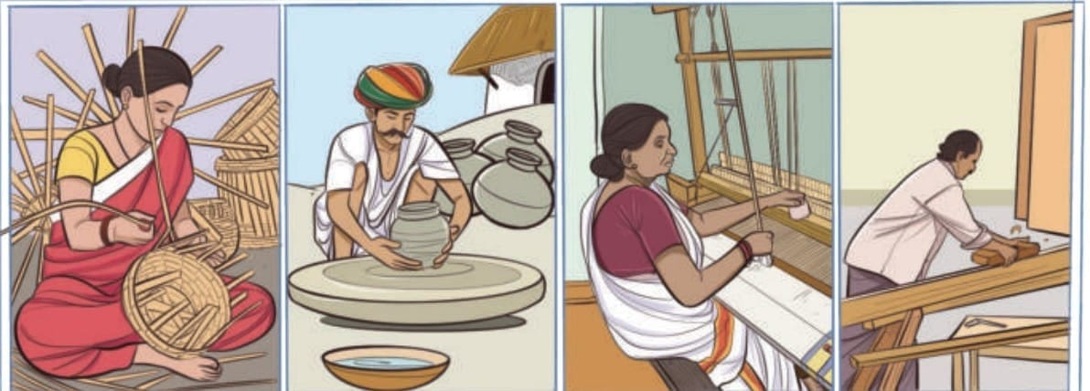
Answer: The pictures show: basket weaving, pottery (pot making), weaving/loom work, and carpentry/woodwork.
Five more vocations: blacksmithing, embroidery/needlework, stone carving, leather work (cobbling), and block printing.
II. Work in pairs. Discuss the following questions and share your answers with your classmates and teacher.
1. What is common among these pictures?
Answer: All pictures show people engaged in traditional, skill-based, handmade crafts requiring manual skill and expertise passed down from generation to generation. Workers create useful products using their hands and simple tools rather than machines.
2. We refer to such skill-based work as v__ __ a __ __ o __ s.
Answer: The word is vocations.
3. Mention a few differences between handmade and machine-made products.
Answer:
| Handmade products | Machine-made products |
| Made mainly by skilled people using their hands. | Made mainly using machines. |
| Each product may be unique and slightly different. | Products are usually uniform and identical. |
| They require more time and human skill. | They can be produced quickly in large quantities. |
| They often show the craftsmanship and creativity of the maker. | They are usually made for mass production. |
Check Your Understanding (NCERT Textbook Page No. 37)
I: Do you think pot making is easy? If yes, why? If no, why not? In the poem “The Pot Maker”.
Answer: No, pot making is not easy. It requires hard physical work and great skill. The clay has to be collected from the riverbank, carried uphill, soaked and pounded to soften it. The potter must then shape it carefully and dry and fire it properly. Even over-firing or under-firing can ruin the whole batch.
II: Would Sentila be able to fulfil her dream of becoming a pot maker? Explain.
Answer: Yes, Sentila is able to fulfil her dream of becoming a pot maker. From childhood, she shows a deep interest in the craft and patiently observes expert potters at work. Even though her mother, Arenla, is initially reluctant to teach her, Sentila continues practising and learning. With the guidance of Onula and by carefully watching her mother’s techniques, she gradually improves. Finally, she succeeds in making a row of beautiful pots that are as good as her mother’s. Thus, her passion, patience and determination helped her achieve her dream.
III: Do you think Mesoba and Arenla would support Sentila? Give a reason.
Answer: Yes, Mesoba and Arenla would support Sentila, though Arenla was initially reluctant. Mesoba defended Sentila before the village council and said that she would soon make the best pots in the village. Arenla also eventually taught Sentila how to collect and prepare clay and allowed her to practise. Later, she gave Sentila the chance to make the pots herself. Thus, both parents supported her dream in their own ways.
Check Your Understanding (NCERT Textbook Page No. 41-42)
I. Do you think Onula’s support helped Sentila? If yes, why? If no, why not?
Answer: Yes, Onula’s support helped Sentila greatly. She noticed that Sentila was too tense while trying to shape the clay. Instead of giving up on her, Onula patiently showed her how to make a perfect pot and encouraged her to try again. Sentila followed her instructions and successfully made a beautiful pot. Onula also advised her to carefully observe Arenla’s technique. Thus, her guidance and encouragement gave Sentila confidence.
II: Sentila observes her mother making pots. What does this tell us about her?
Answer: Sentila’s observation shows that she was keen, attentive, and determined to learn pot making. She carefully watched her mother’s movements and techniques, especially while shaping the mouth of the pots. This shows her strong interest in the craft and her willingness to learn through observation and practice.
III. Arrange the following events of the story in the correct sequence. Share your answer with your classmates and teachers.
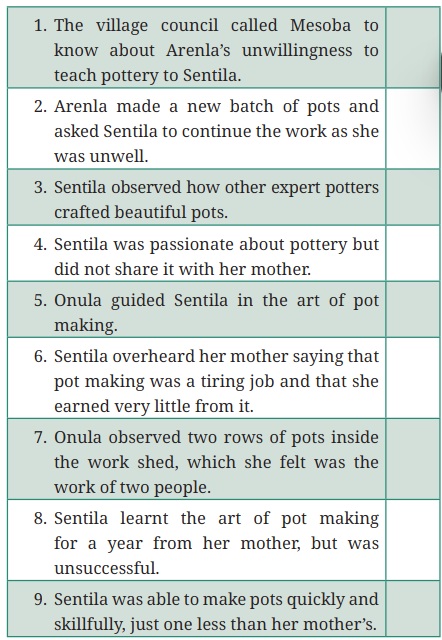
Answer: The correct order is 4 → 6 → 3 → 1 → 8 → 5 → 9 → 2 → 7
Critical Reflection (NCERT Textbook Page No. 42)
I. Read the extract given below and answer the questions that follow.
1. Pounding the stubborn clay inside bamboo cylinders to soften it, is also tedious. So many times I’ve dropped the mould out of sheer exhaustion and have had to start all over again. It takes months to bring out a batch of pots after so much labour. And the reward? A few rupees. But if Senile learns weaving, she can make much more money besides providing enough cloth for the family. Weaving is not messy like pot making and can be done indoors in all seasons. Also, the time spent on weaving one shawl is much less and the return is handsome.
(i) Choose the correct reason for the given assertion.
(A): The effort in making pots is far greater than the returns.
A. The process of pot making is quite tiresome and long, and one hardly earns much.
B. The process of pot making is exhausting takes a long time, yet gives a sense of satisfaction.
Answer: A. The process of pot making is quite tiresome and long, and one hardly earns much.
(ii) Why does Arenla want Sentila to learn weaving?
Answer: Arenla wants Sentila to learn weaving because it is easier and less messy than making pots. It can be done inside the house in any season and takes less time to finish one shawl. It also earns more money. She feels weaving will give Sentila a more comfortable and secure life.
(iii) State one advantage that weaving has over pot making, as per the extract.
Answer: One advantage of weaving over pot making is weaving can be done indoors in all seasons, whereas pot making requires going outdoors to collect clay and dry pots in the sun. The time spent on making one shawl is much less than a batch of pots.
(iv) Choose the sentence that uses the word ‘handsome’ in the same way as in the extract.
A. My father is a handsome man.
B. They will make a handsome profit selling this property.
Answer: B. They will make a handsome profit selling this property.
(v) ‘And the reward?’ What is the author’s purpose of using a question mark here?
Answer: The question mark in “And the reward?” shows Arenla’s disappointment and frustration. She has explained that pot making requires months of hard work, but it earns only a few rupees. The question makes the reader think about whether such great effort is worth such a small income. It highlights the poor financial returns of pottery compared with weaving.
2. Onula saw her taking out some clay and the implements from her basket quietly. She watched Sentila’s clumsy efforts to make a pot and noticed that Sentila was too tense. As a result, the clay seemed unable or unwilling to yield the right shape. When Sentila wearily let the misshapen lump fall flat on the ground, Onula went to her and said, “Don’t worry, little one, I shall teach you how to make a perfect pot.” Sentila watched in amazement as Onula fashioned a beautiful pot and asked her to try again.
(i) Complete the sentence with an appropriate reason.
Onula feels Sentila’s effort at making a pot is clumsy because ________.
Answer: Onula feels Sentila’s effort at making a pot is clumsy because Sentila was too tense and unable to shape the clay properly.
(ii) Choose the correct option to complete the following sentence.
‘Don’t worry, little one, I shall teach you how to make a perfect pot’
This shows Onula was __________.
A. sincere and generous
B. forgiving and thoughtful
C. thoughtful and generous
D. forgiving and sincere
Answer: A. sincere and generous
(iii) Which among the following is the effect of a cause?
A. As a result, the clay seemed unable or unwilling to yield the right shape.
B. Onula saw her taking out some clay and the implements from her basket quietly.
Answer: A. As a result, the clay seemed unable or unwilling to yield the right shape.
(iv) ‘Onula fashioned a beautiful pot’ Here, the word ‘fashioned’ means _________ (created/styled).
Answer: Onula fashioned a beautiful pot’ Here, the word ‘fashioned’ means created.
(v) How might Sentila have felt when she saw ‘the misshapen lump fall flat on the ground’?
Answer: Sentila might have felt disappointed, frustrated, and embarrassed when the misshapen lump fell flat. She had been trying hard to make a proper pot but had failed again. However, Onula’s encouraging words gave her confidence and motivated her to try once more.
II. Answer the following questions (Page 44)
1: Describe the process of pot making followed by expert pot makers, as observed by Sentila.
Answer: Expert pot makers first mix the clay with water and pound it to soften it. Then, they push their left hand into the softened clay and rotate it carefully, while shaping it with a spatula held in the right hand. After shaping, the pots are given a final touch-up and checked for consistency. They are then dried in the sun and finally fired in a kiln carefully.
2: What warning was given to Mesoba by the village council?
Answer: The village council warned Mesoba to remind Arenla that it was her duty to teach Sentila pot making. The elders said that this skill had been passed down from generation to generation. It did not belong to any individual, so experts were expected to pass it on to their children and others who wished to learn.
3: How did Sentila feel when she failed at pot making even after a year of training with her mother?
Answer: Sentila felt ashamed and frustrated when she failed to learn pot making even after a year of training with her mother. She repeatedly tried to shape the clay but could not even hold the lump properly. She hung her head in shame and frustration while watching Arenla turn the clay into a beautiful pot.
4: ‘Onula stood there for a long time as if trying to absorb a new phenomenon’. Explain.
Answer: Onula stood there for a long time because she was amazed by what she saw. She found two neat rows of newly made pots in the shed, and she could not tell which pots were made by Sentila and which were made by Arenla. She realised that Sentila had finally mastered the skill.
5: ‘The tradition and history of the people did not belong to any individual,’ what does this symbolise? In the chapter “The Pot Maker”.
Answer: The statement symbolises that traditional skills and cultural heritage belong to the whole community, not to one person. Pot making was passed down from one generation to another. Therefore, skilled pot makers had a responsibility to teach it to their children and others who wished to learn. It also shows the importance of preserving traditions and passing them on to future generations.
6: What is the significance of the concluding line of the story, ‘A new pot maker was born’?
Answer: The concluding line “A new pot maker was born” signifies that Sentila had finally fulfilled her dream of becoming a skilled pot maker. After years of interest, practice and failure, she successfully made pots with great speed and dexterity. Onula’s discovery of the two rows of pots confirmed her achievement. The line also suggests that the traditional skill of pot making would now be carried forward to the next generation through Sentila.
7: What is the role of perseverance in pursuing one’s dreams? Elaborate with reference to Sentila.
Answer: Perseverance plays an important role in achieving one’s dreams. Sentila never gave up on her dream of becoming a pot maker, even when she failed to learn from her mother for a year. She continued observing expert potters and later learned from Onula. She carefully watched Arenla’s techniques and kept practising. Finally, she made pots with great speed and dexterity. Her journey shows that determination and continuous effort can turn a dream into reality.
Vocabulary and Structures in Context (NCERT Textbook Page No. 45)
I. Read the highlighted words in the following sentences from the text.
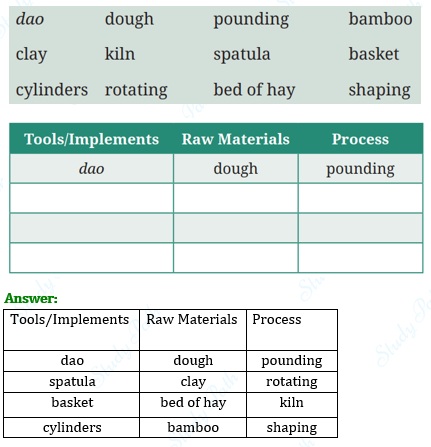
1. She taught Sentila how to dig the clay with dao, load it on to her carrying basket…
2. Sentila was a quick learner and turned the clay into malleable dough. Pounding the stubborn clay inside bamboo cylinders to soften it…
The highlighted words describe the tools and materials required in the process of pot making.
Now classify the words/phrases given in the box as shown in the table below. One example for each category has been done for you.
II. Notice the use of the following words in the text.

These words relate to livelihood and economic aspects that are crucial for any enterprise/ business/vocation.
Work in pairs and find the meanings of the following words related to economy. You may refer to a dictionary.
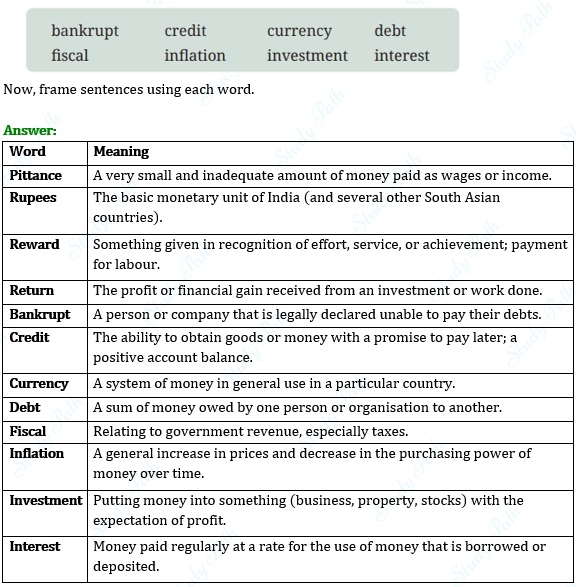
Simple sentences using each word:
- (a) bankrupt – The company went bankrupt after suffering huge losses.
- (b) credit – She used her credit card to buy a new phone.
- (c) currency – The currency of Japan is the yen.
- (d) debt – He is working hard to pay off his debt.
- (e) fiscal – The government announced a new fiscal policy this year.
- (f) inflation – Inflation has made basic goods more expensive.
- (g) investment – Buying property can be a good long-term investment.
- (h) interest – The bank charges high interest on loans.
III. Read the following sentences from the text. The main clauses has been underlined and the subordinate clause has been circled.
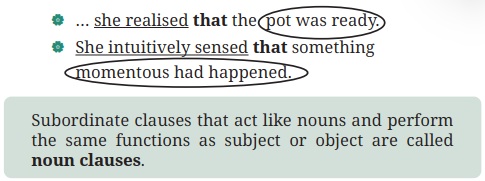
1. Complete the following sentences with suitable noun clauses.
(i) The elders emphasised that ____________.
(ii) Mesoba explained why ____________.
(iii) Onula’s promise was that ____________.
(iv) Sentila observed her mother carefully when she shaping the mouth of the pot, which ____________.
(v) The kiln, where ____________, required careful attention to prevent over-or-under firing.
Answer:
(i) The elders emphasised that it was their duty to pass on the skill of pot making to the next generation.
(ii) Mesoba explained why Arenla had not yet taught Sentila pot making.
(iii) Onula’s promise was that she would teach Sentila how to make a perfect pot.
(iv) Sentila observed her mother carefully when she was shaping the mouth of the pot, which helped Sentila understand the correct technique.
(v) The kiln, where the pots were fired, required careful attention to prevent over- or under-firing.
2. Read the following sentences from the text. Underline the main clause and circle the subordinate clause.
(i) Arenla took Sentile to the riverbank where the grey and red clay was found.
(ii) She started on the next one, and like a sprinter who had suddenly found momentum…
(iii) …skill such as pot making, which not only catered to the needs of the people…

Answer: (i) Main clause: Arenla took Sentila to the riverbank | Subordinate/Relative clause: (where the grey and red clay was found)
(ii) Main clause: She started on the next one | Subordinate/Relative clause: (like a sprinter who had suddenly found momentum)
(iii) Main clause: skills such as pot making | Relative clause: (which not only catered to the needs of the people…)
3. Complete the following sentences with suitable relative clauses.
(i) Sentile, whose _________, practiced the craft diligently.
(ii) The village council, where _________, sought an explanation for Arenla’s reluctance.
(iii) The potter’s hands, which _________, shaped the clay into beautiful creations.
(iv) Arenla, her mother, wanted to learn weaving, which _________.
(v) Mesoba went home and discussed the matter with Arenla, who _________.
Answer:
(i) Sentila, whose passion for pot making was strong, practised the craft diligently.
(ii) The village council, where Mesoba was summoned, sought an explanation for Arenla’s reluctance.
(iii) The potter’s hands, which worked with great skill, shaped the clay into beautiful creations.
(iv) Arenla, her mother, wanted to learn weaving, which could be done indoors in all seasons.
(v) Mesoba went home and discussed the matter with Arenla, who later taught Sentila the process of making pots.
4. Read the highlighted words in the following lines from the text.
- Onula saw her taking out some clay.
- … make as many pots as they could.
- … did not belong to any individual.
- Slowly she walked away from this place of wonder.
- … they would not have enough days of sunshine …
The highlighted words are determiners. Determiners are words that come before nouns and specify something about their quantity, definiteness, or ownership.
Here is a list of the most frequently used determiners-
- a, an, the (Articles)
- this, that, these, those (Demonstratives)
- my, our, your, his, her, its, their, one’s (Possessives)
- one, two, three, etc. (Definite numerals)
- some, any, no, all, both, much, many, few, less, several, little (Indefinite numerals)
- each, every, either, neither (Distributives).
(i) Find out some more determiners from the text.
Answer: Some more determiners from the text are: her, his, the little, one, no, my, a batch of, entire, all, any, everyone, some, another.
(ii) Fill in the blanks with suitable determiners.
The first two blanks have been done for you.
A. The florist arranged five bouquets for her clients, that were displayed in _________ elegant floral shop.
B. The carpenter crafted _________ unique tables, and _________ became the centrepiece in _________ furniture collection.
C. _________ of _________ apprentices in _________ culinary class demonstrated _________ knife skills during the intense cooking session.
D. _________ of _________ sculptures were displayed at _________ art exhibition, showcasing _________ diverse artistic skills.
Answer:
A. The florist arranged five bouquets for her clients, that were displayed in an elegant floral shop.
B. The carpenter crafted several unique tables, and one became the centrepiece in his furniture collection.
C. Each of the apprentices in the culinary class demonstrated their knife skills during the intense cooking session.
D. Many of the sculptures were displayed at the art exhibition, showcasing their diverse artistic skills.
Listen and Respond (NCERT Textbook Page No. 48-49)
I. You will listen to a man speak about stone statues.
As you listen, complete the given paragraph by filling in the blanks with the exact words you listen to.
(Transcript for teacher on page 261)
A statue is carved to create a shape that is 1. _________ .
Among the many things stone is used for making stone 2. _________ is one of them. India has some of the most 3. _________ stone sculptures, as is obvious from its many stone monuments across the country.
Answer: A statue is carved to create a shape that is 1. visually interesting three-dimensional shape. Among the many things stone is used for making stone 2. sculptures is one of them. India has some of the most 3. fascinating and mesmerising stone sculptures, as is obvious from its many stone monuments across the country.
II. You will now listen to the man speaking about some steps involved in making stone status. As you listen, select the six correct steps out of the nine given.
(Transcript for teacher on page 261)
1. carve to remove large unwanted portions of the stone
2. set up the different tools
3. measure the weight and dimensions of the statue
4. leave the statue in water to firm up overnight
5. refine the creation within the stone
6. choose the stone
7. begin carving from the centre
8. detach the creation from the stone as the final statue
9. work to bring out the imagined shape
Answer:
The six correct steps in making stone statues in chronological order are:
6. choose the stone
3. measure the weight and dimensions of the statue.
1. curve to remove large unwanted portions of the stone
9. work to bring out the imagined shape
5. refine the creation within the stone
8. detach the creation from the stone as the final statue
About the Chapter: The Pot Maker
The story The Pot Maker follows Sentila, who wishes to become a potter like the skilled women in her family. Her enthusiasm and persistent practice show how deep interest can guide a person towards mastering a craft.
Students also explore the dignity of labour, family expectations, and the transmission of knowledge across generations. The chapter encourages respect for artisans while developing understanding of character, motivation, and cultural heritage.