

NCERT Solutions for Class 9 English Kaveri Chapter 6 Twin Melodies are provided here with simple and easy-to-understand explanations. This play is included in Unit 6 of the NCERT textbook Kaveri. It explores musical traditions, creative experimentation, and understanding between generations. These NCERT Solutions for Class 9 help students understand the main ideas, complete textbook activities, improve their language skills, and prepare for school examinations.
Twin Melodies Class 9 English NCERT Questions and Answers
Reflect and Respond (NCERT Textbook Page No. 169-170)
I. Given below are some stringed musical instruments. Work in pairs and identify them by first letter of the spellings of their names.
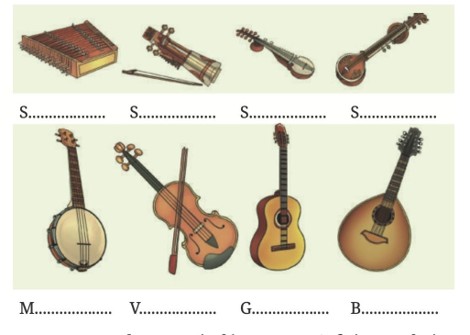
Answer:
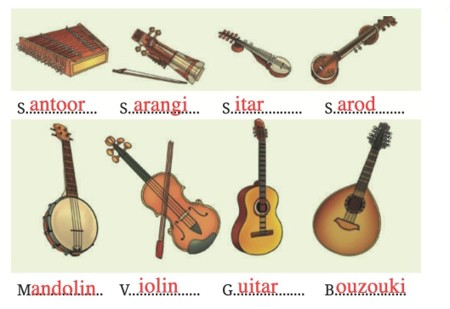
II. Do you play a musical instrument? If given a choice, which one would you choose and why?
Answer: I do not play a musical instrument, but if I were given a choice, I would choose the flute because its soft and melodious sound is pleasant to hear. It would also be interesting to learn how different tunes can be created with it.
III. Is there any difference in the choice of music between children and elders? If yes, why? If no, why not?
Answer: Yes, there can be a difference in the choice of music between children and elders. Children may prefer modern, lively, or fusion music, while elders may prefer traditional and classical music because they are more familiar with it. However, personal taste can vary from person to person.
IV. Work in pairs to complete the paragraph given on the next page by choosing the correct phrases given in the box. Discuss with your teacher whether the following phrases have a literal meaning or a figurative one.
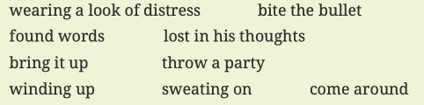
The theatre club was 1. ________ their practice. Anil saw Sunny was 2. ________ and not speaking to anyone. They had a disagreement in the morning and since then, Sunny was 3. ________ . Anil did not want to 4. ________ and disturb Sunny further but he finally decided to 5. ________ and speak to Sunny. He was sure if he apologised first, his friend would 6. ________ . With a lot of anxiety, he 7. ________ to apologise. And finally, Sunny smiled! Everyone clapped and asked them to 8. ________ to celebrate.
Answer:
- winding up
- lost in his thoughts
- wearing a look of distress
- come around
- bring it up
- bite the bullet
- found words
- throw a party
Check Your Understanding (NCERT Textbook Page No. 174)
I. Complete the table based on Act I of the play.
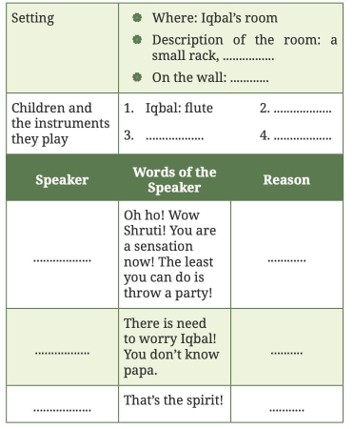
Answer:
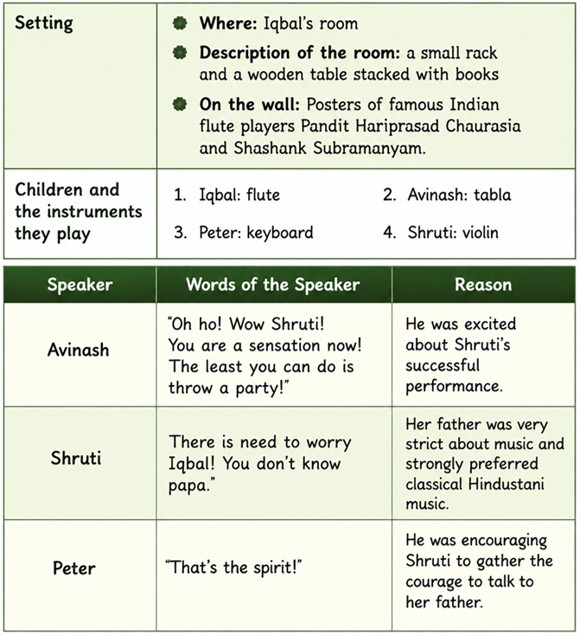
II. Do you think Shruti will gather the courage to speak to her father? Give a reason.
Answer: Yes, Shruti will gather the courage to speak to her father because Iqbal encourage her to face the situation instead of avoiding it. She finally decides that it is time to “bite the bullet” and promises to bring up the matter with her father at dinner. This shows that she is ready to overcome her fear and speak honestly about the fusion concert.
III. What might be Shruti’s father’s reaction? Why?
Answer: Shruti’s father’s Nabin is likely to react with disappointment and disapproval initially. He believes that playing the violin to Western tunes is a “desecration” of the instrument and strongly prefers Classical Hindustani music. He may also feel hurt that Shruti practised without telling him. However, since he is her father, he may eventually understand her point of view if she explains herself honestly and respectfully.
Check Your Understanding – Act II (NCERT Textbook Page No. 177-178)
I. Complete the summary of Act II by choosing the correct words from the box given below. There are two extra words that you do not need. Check your answers with the teacher.
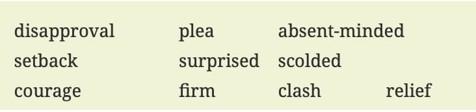
Shruti seemed 1. ________ during dinner. She finally gathered the 2 . ________ to inform her father, Nabin, about her wish to participate in an upcoming Indo-Western fusion concert. Nabin reacted negatively, expressing 3. ________ of fusion music and dismissed the idea. Despite Shruti’s 4. ________ to him to attend a practice before deciding, Nabin was 5. ________ in his decision. Shruti’s mother, Leela, 6. ________ her for not seeking permission earlier. The tension highlights the 7. ________ between traditional and contemporary musical preferences within the family. Despite the 8. ________ , Shruti promises not to hide again and is urged to go to bed by her mother.
Answer:
1. absent-minded
2. courage
3. disapproval
4. plea
5. firm
6. scolded
7. clash
8. setback
Extra words not used: surprised and relief.
II. Will Shruti’s father go for the rehearsal? Support your answer with a reason.
Answer: Yes, Shruti’s father is likely to go for the rehearsal because, although he strongly disapproves of fusion music at first, Shruti requests him to attend the practice once before making a final decision. This gives him a chance to judge the music for himself rather than reject it only because of his fixed beliefs.
III. Do you think Shruti and her parents would understand one another? If yes, why? If no, why not?
Answer: Yes, Shruti and her parents are likely to understand one another because there is love and concern on both sides. Shruti respects her father’s views and does not want to hurt him, while her parents also care about her future. Although they disagree over fusion music, honest conversation can help them understand each other’s feelings. This can gradually reduce the conflict between traditional beliefs and Shruti’s personal interest in modern musical expression.
Check Your Understanding – Act III (NCERT Textbook Page No. 181-182)
I. Work in pairs. Identify the true statements. Check the answers with your teacher.
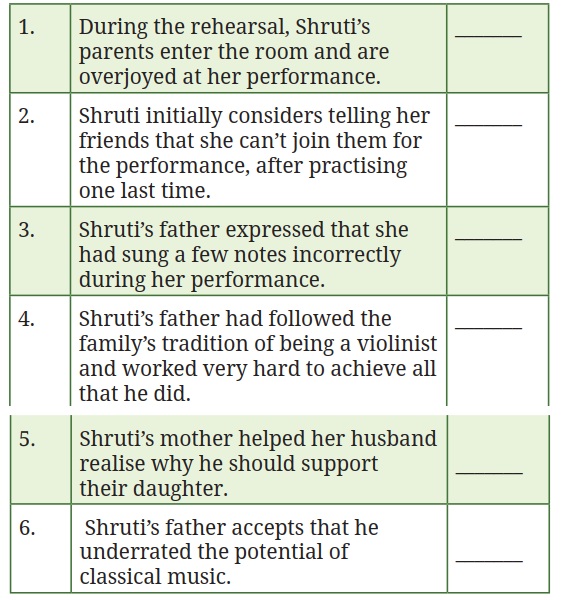
Answer:
- True
- True
- False
- False
- True
- False
Critical Reflection (NCERT Textbook Page No. 182-184)
I. Read the extracts given below and answer the questions that follow.
1: Shruti: There is need to worry Iqbal! You don’t know papa. He is very strict about these things. He will think it a desecration of the violin to be played to Western tunes. Papa firmly believes that Classical Hindustani music, with its ragas and aalaaps, is the only kind of music that an artist of any worth should play. I don’t want papa to feel that I don’t care about his opinions, because I do. It’s just that I want to give this a try too. I just don’t know how to tell him in the right way!
Iqbal: All ways are right ways, Shruti. He is your father, he will understand.
(i) Select the option that correctly identifies Shruti’s situation.
A. confident
B. indifferent
C. content
D. in a dilemma
Answer: D. in a dilemma.
(ii) What does Shruti mean by ‘the right way’, in the sentence, “I just don’t know how to tell him in the right way!”?
Answer: By “the right way,” Shruti means that she wants to tell her father about the fusion concert carefully, respectfully, and without hurting his feelings. She knows that he strongly believes in Classical Hindustani music, so she is worried about how to express her own wish while still showing respect for his opinions.
(iii) Complete the following with a suitable reason.
We can say that the extract reflects the generational gap in understanding art and tradition because _____________.
Answer: We can say that the extract reflects the generational gap in understanding art and tradition because Shruti wishes to explore Indo-Western fusion music, while her father believes that Classical Hindustani music is the only worthy form of music for the violin.
(iv) Explain how Iqbal’s words were meant as an assurance to Shruti.
Answer: Iqbal’s words – “All ways are right ways. He is your father, he will understand” reassure Shruti that her father would understand her if she spoke to him honestly. Iqbal encourages her not to be afraid of the conversation. His words give her confidence to face the situation and express her feelings openly.
(v) Fill in the blank with a phrase from the extract.
The critics argued that only films which provoke thoughtful discussion are _________.
Answer: The critics argued that only films which provoke thoughtful discussion are of any worth.
2: Nabin: I underestimated the power of our own music. I was afraid you would be lost to us. I realise that my fears were baseless. After all each bay, its own wind. I trust you Shruti and I will root for your group at the concert!
(Shruti hugs both of her parents)
(i) Select the suitable option to complete the sentence.
Nabin’s breakthrough in his understanding of artistic freedom, highlights a bridge between ______.
A. personal ambition and professional success
B. traditional values and modern expressions
C. strict discipline and casual learning
D. historical techniques and futuristic innovations
Answer: B. traditional values and modern expressions.
(ii) Fill in the blank with a suitable phrase. The extract uses the word ‘lost’ both in the sense of losing _________ and physical separation.
Answer: The extract uses the word ‘lost’ both in the sense of losing her cultural and musical identity and physical separation.
Nabin had feared that by choosing fusion music, Shruti might move away from the musical tradition and values of her family.
(iii) In the line, ‘Shruti hugs her parents’, which word from those given below does NOT show what it conveys?

Answer: The word that does NOT show what the hug conveys is: duty.
(iv) What can be inferred about Shruti’s future in music following her father’s expression of trust and support?
Answer: It can be inferred that Shruti’s future in music will be more confident, creative, and promising. Her father’s trust and support will give her the freedom to explore fusion music while still respecting her classical training. With his encouragement, she is likely to develop her own musical style and pursue her passion without fear or guilt.
(v) Identify the phrase that refers to the uniqueness of each artist’s journey and style.
Answer: The phrase is “each bay, its own wind.” It suggests that every artist has a unique journey, style, and way of expressing themselves.
II. Answer the following questions.
1. Justify the title ‘Twin Melodies’. How does the play explore the theme of tradition and modernity?
Answer: The title “Twin Melodies” is appropriate because the play brings together two different musical traditions—Classical Hindustani music and Indo-Western fusion music. Shruti represents the younger generation that wants to experiment with fusion music, while her father, Nabin Sharma, initially believes strongly in traditional classical music.
The play explores the conflict between tradition and modernity through their different views. Nabin first sees fusion music as a threat to classical values, but after hearing Shruti and her friends perform, he realises that new forms of music can still respect and preserve tradition. He finally supports Shruti and accepts that every artist may have a different path.
2. What are the different perspectives of Peter, Iqbal, and Avinash regarding confronting figures of authority? How do their attitudes towards Shruti’s dilemma provide insight into their own characters?
Answer: Peter, Iqbal, and Avinash all encourage Shruti to speak to her father, but their attitudes are slightly different.
Peter is practical and straightforward. He suggests that Shruti should simply tell her parents about the practice and the concert instead of hiding it. This shows that he believes problems should be faced directly.
Iqbal is reassuring and understanding. He tells Shruti that her father will understand because he is her father. His words show that he values trust and honest communication in relationships.
Avinash is bold and realistic. He tells Shruti that avoiding the issue is making things worse and that the worst her father might do is scold her before eventually accepting her choice. This shows that he is confident and believes in confronting difficult situations.
3. Analyse the character of Nabin Sharma. How does his attitude towards music evolve throughout the play?
Answer: Nabin Sharma is a disciplined, traditional, and devoted musician who takes music very seriously. At the beginning of the play, he strongly believes that Classical Hindustani music is the proper form of music and disapproves of Indo-Western fusion. He even feels that playing the violin to Western tunes is disrespectful to the instrument.
However, Nabin is not completely rigid. When he hears Shruti and her friends perform, he becomes impressed by their skill and realises that Shruti has not abandoned classical music. He praises her for maintaining the notes of the raga and even offers the group a better place to practise.
4. How does the play use Shruti’s internal conflict to explore the theme of duty towards family versus personal passion?
Answer: The play uses Shruti’s internal conflict to show the struggle between family duty and personal passion. She respects her father’s views on classical music and does not want to hurt or disappoint him, but at the same time, she wants to explore her love for Indo-Western fusion music.
Through Shruti’s dilemma, the play shows that personal passion does not always have to oppose family duty. By speaking honestly and proving that she can experiment with fusion music without abandoning her classical training, Shruti helps her father understand her choice. In the end, the conflict is resolved through communication, trust, and mutual understanding, suggesting that family values and individual dreams can exist together.
5. Evaluate the effectiveness of the play’s conclusion. Does it realistically address the conflicts presented?
Answer: The conclusion of the play is effective because it resolves the conflict between tradition and modernity in a positive and believable way. Nabin does not change his opinion suddenly without reason; he first listens to Shruti’s fusion performance, notices that she has still respected the classical raga, and then appreciates the quality of the group’s music.
The resolution also becomes more realistic when Nabin remembers that he too had once gone against his own family’s wishes to choose the violin. This helps him understand Shruti’s desire to follow a different musical path. In the end, his support is based on experience, reflection, and trust, not just emotion.
Therefore, the conclusion successfully shows that conflicts between parents and children can be resolved through communication, understanding, and mutual respect.
6. Assess how well the role of cultural diversity contributes to the storyline of the play.
Answer: Cultural diversity plays an important role in the storyline because it brings traditional Hindustani classical music and modern Indo-Western fusion music together. Shruti’s interest in fusion creates the main conflict with her father, Nabin, who strongly follows classical traditions. However, when Nabin sees Shruti’s performance, he realises that different musical traditions can exist together. Thus, cultural diversity helps the play promote acceptance, creativity, and harmony between tradition and modernity.
Vocabulary and Structures in Context (NCERT Textbook Page No. 184-188)
I. Read the highlighted word given in the brackets.
SHRUTI (Aside): Oh, how much I enjoy performing this piece. Perhaps I can practise one last time and soon after that I will tell them that I can’t join them for the performance.
1. What is ‘aside’ used for?
(i) enables characters to talk about the story
(ii) shows what a character thinks or feels
(iii) makes a direct link between the audience and the character
(iv) (i), (ii), and (iii)
Answer: (iv)
II. Read the following words from the text.
Ahem ahem, I… er…
Now, select the correct answer for the question given below.
Why are they used?
1. to fill gaps while speaking
2. to increase clarity
3. to provide confidence
Answer: 1. to fill gaps while speaking
Non-lexical fillers are words or sounds used in speech, like ‘uh’ or ‘um’ to fill pauses while a speaker gathers their thoughts or transitions between ideas.
Now, choose suitable non-lexical fillers given in the box to describe the emotions 1 to 4. There is an extra word you do not need.
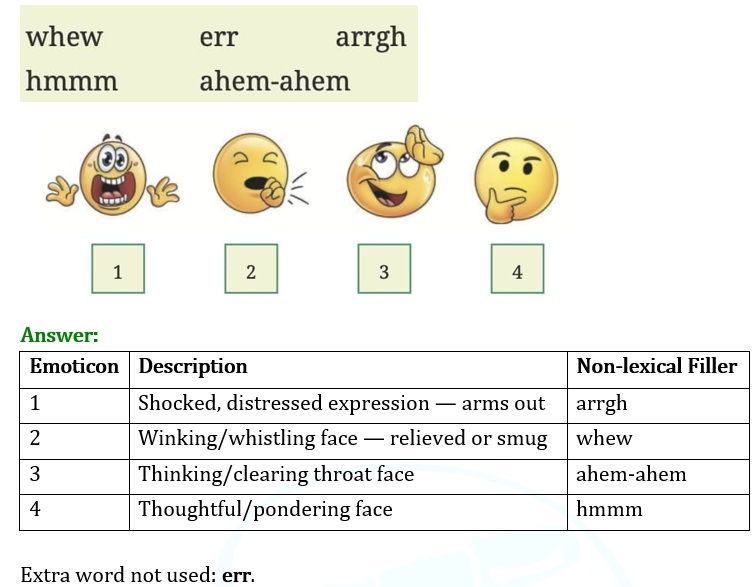
III. Match the music-related words in Column 1 with their meanings in Column 2.
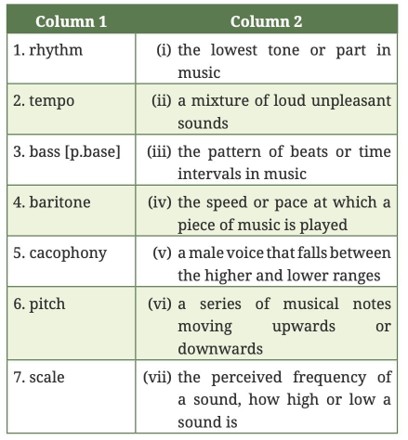
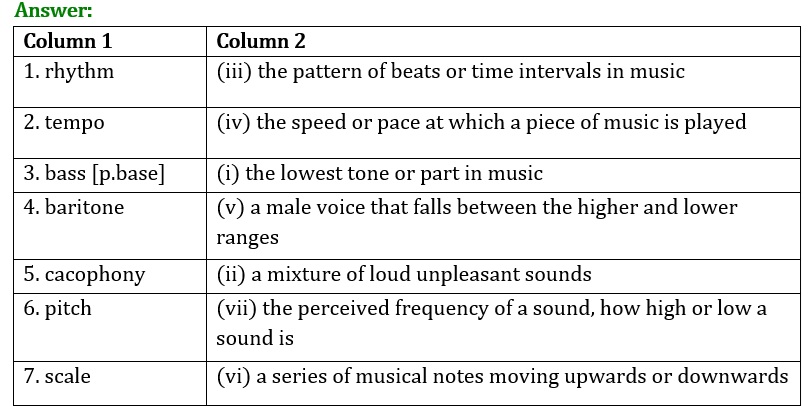
IV. Write the meanings of the underlined phrases based on your understanding.
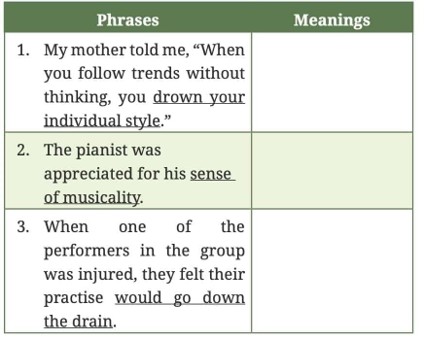
Answer:
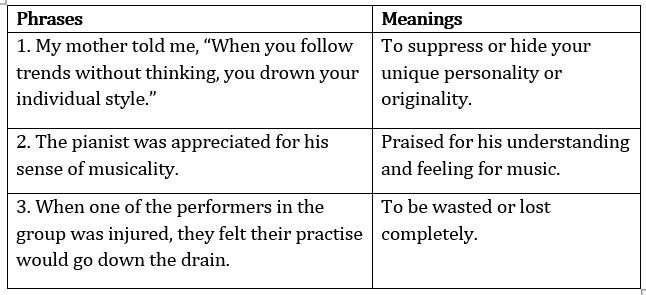
V. Read the dialogues given below.
1. Oh, how much I enjoy performing this piece!
2. Wah, how soulful! You all have done a wonderful job!
Sentences 1 and 2 are __________ sentences. (declarative/interrogative/exclamatory/imperative)
Now, convert the exclamatory sentences given above to declarative sentences.
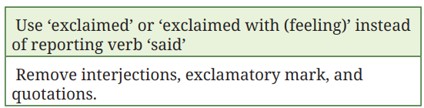
Answer: Sentences 1 and 2 are exclamatory sentences.
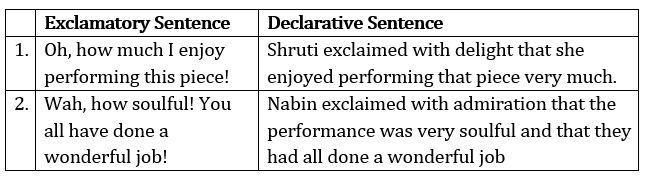
VI. Write the sentences given below in reported speech.
1. “Wow, Shruti! You’re a sensation!” suggested Avinash.
Answer: Avinash exclaimed with wonder that Shruti was a great sensation.
2. “What an incredible achievement! I can’t believe we pulled it off!” said Iqbal.
Iqbal exclaimed that it ________.
Answer: Iqbal exclaimed with excitement that it was an incredible achievement and that he could not believe they had pulled it off.
3. “Bravo! Each note was executed perfectly, and the performance was flawless!” said Shruti’s mother.
Shruti’s mother applauded that ________ .
Answer: Shruti’s mother applauded that each note had been executed perfectly and that the performance had been flawless.
4. Iqbal: I basically have a little bit of scolding for breakfast every day!
Answer: Iqbal said that he basically had a little bit of scolding for breakfast every day.
5. Shruti: Sorry mummy, won’t hide from you again. I promise!
Answer: Shruti apologised to her mother and promised that she would not hide anything from her again.
6. Avinash: You are a sensation now! The least you can do is throw a party!
Answer: Avinash exclaimed that she was a sensation then and added that the least she could do was throw a party.
VII. Report the following dialogue in the indirect form of speech.
Asma: Wow! What a unique experience I had at the art studio today!
Deepa: Tell me! I’m eager to hear!
Asma: I accidentally spilled paint all over my canvas.
Deepa: Oh, my goodness! What a pity!
Asma: No worries! The painting now looks better than my original plan!
Deepa: That’s incredible!
Answer: Asma exclaimed excitedly that she 1. had had a very unique experience at the art studio that day. Deepa urged her to tell her as she was eager to hear. Asma said that 2. she had accidentally spilled paint all over her canvas. Deepa pitied Asma. However, Asma replied to her not to worry as 3. the painting now looked better than her original plan. Deepa exclaimed that 4. it was incredible.
Listen and Respond (NCERT Textbook Page No. 188-189)
I. Look at the given stringed musical instruments and decide which one could be the yazh [yā]].
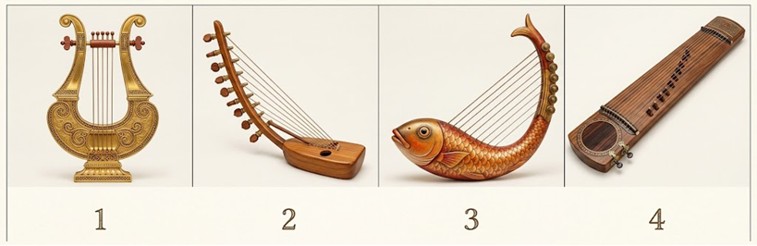
Answer: 3. Yazh
II. Now, listen to a musician describing the yazh and check if your choice was correct. (Transcript for teacher on page 270)
Answer: Yes, my answer is correct.
III. Listen to the musician’s description of the yazh once again. As you listen, complete the notes below with not more than three words.
The Yazh
1. Type of instrument – The Indian ________.
(i) Was used in: ________.
(ii) Earlier version of: ________
Answer: Type of instrument – The Indian harp
(i) Was used in: ancient Tamil Music
(ii) Earlier version of: Veena
2. Design
(i) stem tip-shaped like ________ of mythological animal
(ii) resonator
A. shape of a ________
B. material – ________
Answer: (i) stem tip – shaped like head of mythological animal
(ii) resonator
A. shape of a boat
B. material – skin
3. Design variety
(i) peacock, ________ , ________ , and bow string
Answer: (i) peacock, crocodile, fish, and bow string
About the Chapter: Twin Melodies
The play Twin Melodies explores the relationship between Shruti, a young violinist interested in fusion music, and her father, a committed classical musician. Their differing views create a conflict about tradition and creative freedom.
Students also explore communication, respect, and the possibility of appreciating different artistic approaches. The dialogue helps them understand character perspectives and consider how listening can build understanding within a family.